Mutual Assured Destruction -- Drone Warfare
"On the battlefield I did not see a single Ukrainian soldier. Only drones.""I saw them [Ukrainian soldiers] only when I surrendered. ""Only drones, and there are lots and lots of them.""Guys, don’t come. It’s a drone war."Surrendered Russian soldier"The rapid evolution in AI-enabled warfare has driven both sides into a struggle for control, with each country attempting to counter the other’s aerial assets.""Last year, Analytics Vidhya described Ukraine as a “goldmine” for AI warfare tech, and the stakes have only intensified as Ukraine pushes for AI mastery.""This push is impacting global security dialogues, as military strategists examine what it would mean to dominate the AI-powered “hive mind” of war machines. David Kirichenko, Lawfare
 |
| Photo: Anton Petrus/GETTY IMAGES |
In
the Ukraine conflict, drones now inflict an estimated 70 percent of all
Russian and Ukrainian casualties according to Roman Kostenko, chair of
the defense and intelligence committee in Ukraine's Parliament. They
cause even more casualties -- up to 80 percent of deaths and injuries in
some battles, according to commanders. No one might have envisioned
this three years earlier when Vladimir Putin ordered Russian troops to
storm into Ukraine.
Over
a million soldiers have been killed or wounded since Russia's 'special
military operation' launched the three-year-old war that has been
setting Europe on edge at the Russian Federation's obvious eye for its
revanchist territorial aggression. Drones now cause the death of more
soldiers, and destroy greater numbers of armored vehicles in Ukraine
than have all traditional weapons combined, according to Ukrainian
officials.
Frontline
trenches remain essential for defense, but in this war most soldiers
die or lose their limbs to explosives, many of which are modified hobby
models. From the security of bunkers or hidden behind tree lines drone
pilots attack the enemy with joysticks and video screens, safe
kilometers from the actual fighting. It has become too dangerous for
jeeps, armored personnel carriers or tanks to travel through
drone-infested territory, leaving soldiers to hike for kilometers
ducking for cover to reach their destinations.
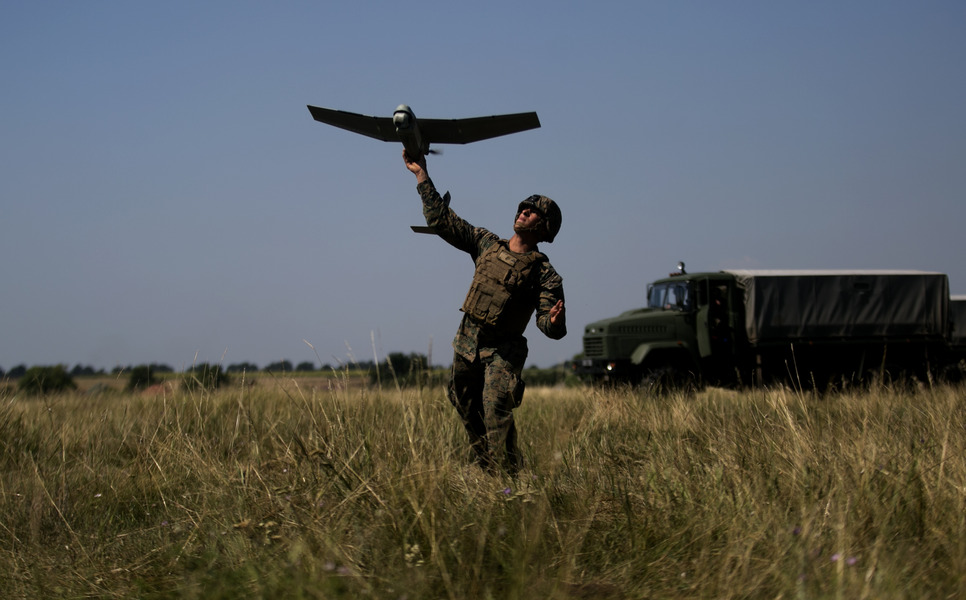 |
| A U.S. Marine with Black Sea Rotational Force 17.1 launches an unmanned aerial vehicle during exercise Sea Breeze 2017 in Mykolayivka. (Photo: CNE-CNA/Flickr, https://www.flickr.com/photos/cne-cna-c6f/35323529193/, Public Domain) |
Relations
that have evolved between Ukraine and the Trump administration are a
marked threat to future aid to the embattled country from its heretofore
main source of conventional weaponry. The billions sent by the United
States to Kyiv is history and the future holds little of promise to
Ukraine from Washington. 19 Abrams tanks remain of the 31 that the U.S.
gave Ukraine in 2023. The remainder were destroyed, disabled or
captured, some incapacitated by drones. All others taken away from the
front lines.
By
contrast drones are infinitely cheaper and easier to build. And Ukraine
is building them. Their numbers and efficacy helped compensate for the
dwindling supplies of Western-produced artillery and missiles sent to
Ukraine. Over a million first-person-view (FPV) drones were produced in
Ukraine last year. Both Ukraine and Russia now say they are scaling up
production; each planning to produce three to four million drones in
2025.
The
Ukrainian military reports huge increases in drone attacks by Russian
forces, while Ukraine follows suit, firing more drones in the last year
than the most common form of large-caliber artillery shells. Colonel
Vadym Sukharevsky, commander of Ukraine's drone force, reveals that
Ukraine is now pursuing a "robots first" military strategy.
Effective
as they may be, drones fail to meet all of Ukraine's war requirements.
Heavy artillery and other long-range weapons remain essential for many
reasons, including the protection of troops and the targeting of command
outposts or air-defense systems. Yet the very nature of warfare itself
sees the emerging dominance of drones.
 |
Ukraine Symposium – The Continuing Autonomous Arms Race Articles of War |
"The war is a mix of World War I and World War III -- what could be a future war",
stated Admiral Pierre Vandier of France, NATO's supreme allied
commander for transformation. A joint training center with Ukrainian
soldiers to develop new warfighting strategies with artificial
intelligence, advanced analytics and other machine-leaning systems, has
been opened by NATO in the face of the viability of weapons costing
millions on a battlefield, readily destroyed by drones that cost several
hundred dollars.
"Drones show that the one who is quicker to adapt wins the war",
said Lieutenant Volodymyr Dehtyaryov, brigade spokesperson, as soldiers
are kept at a distance, operating from a bunker behind the front line
while Russian forces attempt to destroy remote-controlled vehicles with
mortars and dropping explosives from their own drones following the 13th
Brigade of the National Guard of Ukraine carrying out the first fully
robotic combined arms assault in combat.
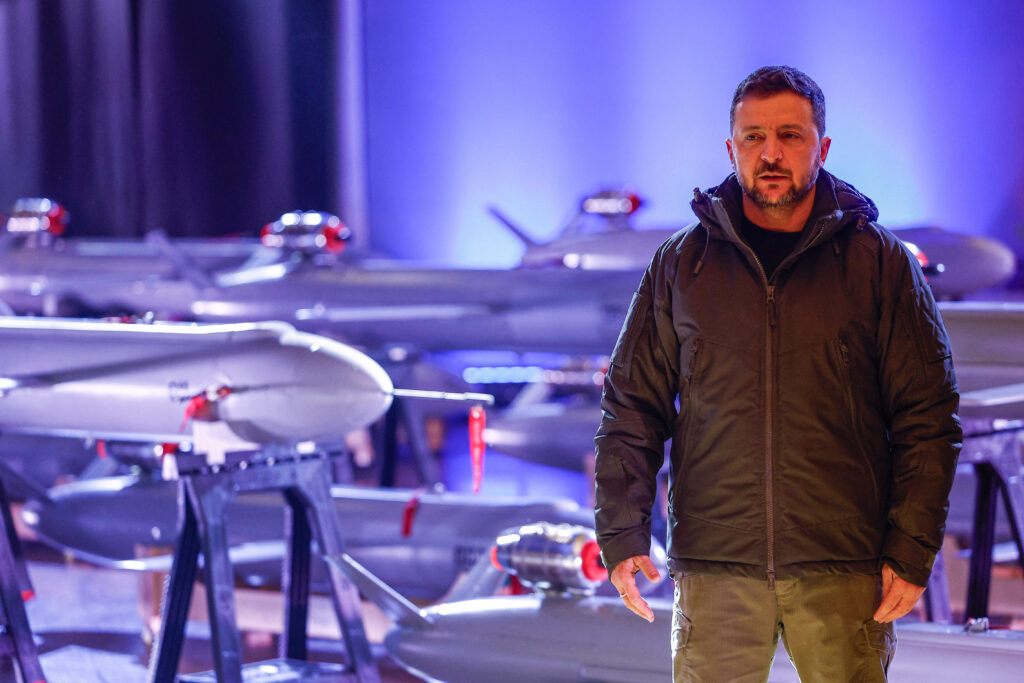 |
| Atlantic Council |
Labels: Conventional Weaponry, Drone Artificial Intelligence Warfare, Russian Invasion of Ukraine, Three years of Fighting
posted by Pieface @ Tuesday, April 08, 2025


<< Home