Oceanic 30,000-ft. -Deep Ecosystem
"It's a unique ecosystem. It's a totally new thing that has not been seen before.""This is the first time chemosynthesis-based communities have been directly observed at extreme depths.""Many hadal animals from these trenches are spectacular in their forms and colors [they survive by hosting microbes that metabolize methane, rather than through photosynthesis].""Long-standing theories suggest that chemosynthesis-based communities are widespread in hadal trenches, but few such communities have been discovered."Dominic Papineau, exobiologist, senior research scientist, Chinese Academy of Sciences"The depths probed here, coupled with the thriving communities discovered and distribution ranges observed, significantly expand the known habitat, depth and biogeographical distributions for a great many species.""These communities are sustained by hydrogen sulfide-rich and methane-rich fluids that are transported along faults traversing deep sediment layers in trenches."Research team study published in the journal Nature"There is some nervousness, of course, as you’re dangling above a 10-kilometer hole in the Earth.""You have a small window that is only 12 centimeters in diameter that you can look out of. You can’t stretch your legs while you’re sitting on a little bench in a small titanium sphere, which is only 1.8 meters wide [about 6 feet wide].""[The research team had discovered something] really rather unusual.""There were signs of really abundant, large life-forms and animals in these particularly deep areas.""Because it is such high pressure in these incredible depths, you wouldn’t necessarily expect them to live in these places."Kareen Schnabel, marine ecologist, Earth Sciences New Zealand
 |
| Tube-dwelling polychaetes are dominant at 22,500 meters at Aleutian Deepest, with spots of white microbial mats. (Institute of Deep-sea Science and Engineering, CAS) |
Plunging
within a three-seater submersible to descend over 30,000 feet into the
Pacific Ocean's deepest trenches, an international team of researchers
at the Kuril-Kamchatka and Aleutian trenches located between Russia and
Alaska witnessed a surprisingly dense cluster of tubeworms with scarlet
tentacles, iridescent snails on the worms, bristly white creatures
wriggling about, along with all manner of previously unknown creatures
capable of withstanding the immense pressures present at that depth, and
feeding themselves in a manner quite unlike sea creatures that inhabit
upper levels are reliant on.
The
discovery was made by this international team of the world's deepest
known ecosystem. Chemicals seeping from the sea floor sustains the
animal life that thrive there in the watery depths and utter darkness.
Their discovery was published in the study they produced on their
deepsea discovery in the journal Nature.
According to Lisa Levin, professor emeritus of biological oceanography
at Scripps Institution of Oceanography, the discovery of those bottom
dwellers "alter our understanding of trench ecosystems."
Previously,
scientists studied organisms thriving around hydrothermal vents --
fissures spewing superheated fluids, but the creatures living around
cold seeps -- where methane gases and hydrogen sulphide ooze from the
sea floor at freezing temperatures, located generally where tectonic
plates meet, have not been been thoroughly studied. The crewed
submersible Fendouzhe was used for the dive into this hadal zone
representing the ocean's deepest region, named after the Greek god of
the underworld, Hades.
The
wealth of minerals on the sea floor has captivated the interest of
China and the United States in particular, seeking to capitalize on
extraction opportunities. But the hadal zone is thought to be too deep
for mining the metals used in electric cars and other technologies --
aside from concerns over the potential of disrupting deep sea life
forms. Advanced technology, however, has enabled researchers to dive
deep into these immense trenches for scientific enquiry.
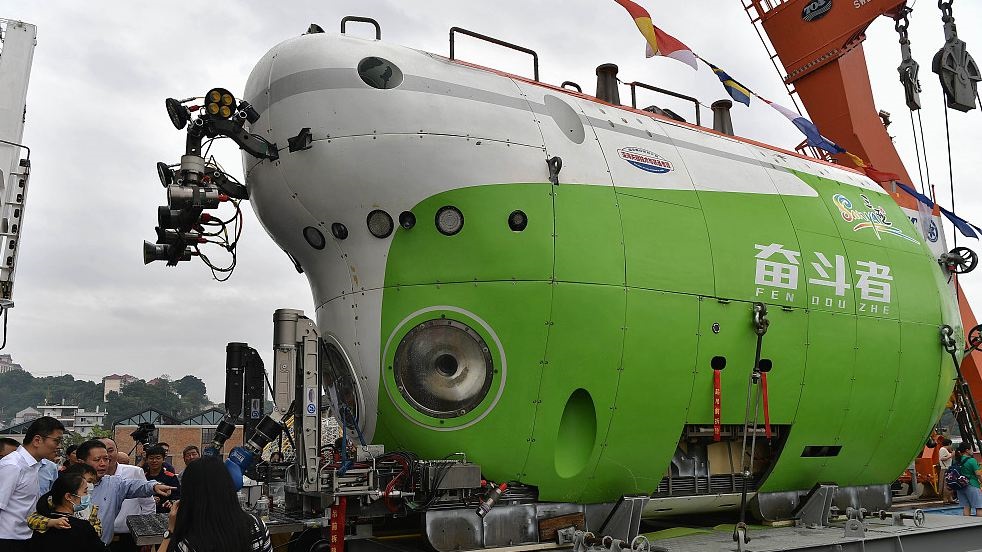 |
| China's crewed deep-sea submersible Fendouzhe. /CFP |
"People know very little about the bottom of the trench.""For decades, researchers lacked the] high technology to enable us to go there.""They [deepsea creatures] must have some trick, or they must have some unique metabolic pathway, to adapt to the high pressure."Mengran Du, geochemist, Institute of Deepsea Science and Engineering, China
Once
descended to the floor of the trench, the researchers discovered
communities of animals where marine tubeworms and mollusks dominated in
numbers, spanning over 1,500 miles of vast, total darkness. Sunlight
sustains life on Earth, where photosynthesis by plants or algae
represents the base of most food webs. It was previously assumed by
ocean scientists that trench creatures existed by consuming dead animals
and allied organic matter falling from the sunlit parts of the ocean
into the crevasses.
However,
analysis of gases seeping from the sea floor suggested to them that
microbes are consuming organic matter accumulating in the trenches and
belching methane following meals. Inside the tubeworms and mollusks,
symbiotic bacteria in turn absorb the methane and hydrogen sulphide from
the cold seeps, to produce organic matter to nourish their hosts:
chemosynthesis.
"Flourishing
chemosynthetic communities had long been postulated to exist in the
trenches, but this is the first paper that documents their existence
below nine kilometres and at multiple locations",
noted Lesley Blankenship-Williams, professor at Palomar College,
California. Life was found by the research team on 19 of 23 dives in a
40-day period, leaving the impression that hadal ecosystems may be
common in the ocean trenches of Earth.
This
intriguing realization of extreme adaptation of organisms in the
trenches leads to thoughts of similar possible adaptabilities in the
expectations of scientists searching for evidence of life within oceans
on other worlds.
"There is about 3,700 million years of Earth evolution between the oldest animal fossils to the oldest microbial fossils.""So, if deep extraterrestrial oceans existed for billions of years, then perhaps similar chemosynthetic-based ecosystems with animal-like creatures could also exist there [in oceans on other worlds]."Dominic Papineau
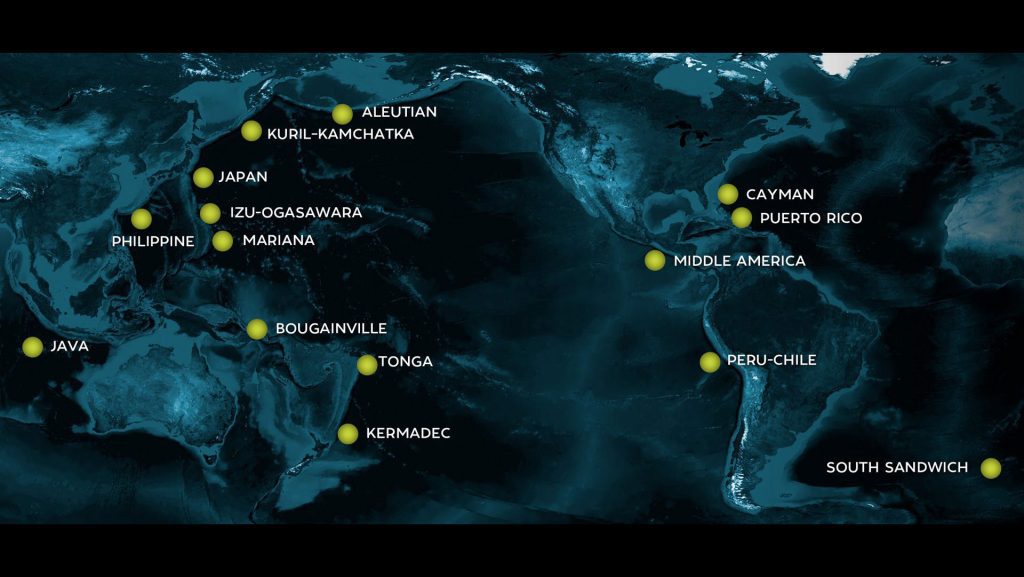 |
| Global map of deep-sea trenches |
Labels: Biogeographical Species, Oceanic Trenches, Sea Floor, Submersible, vast Sealife Communities
posted by Pieface @ Saturday, August 02, 2025


<< Home