Rio de Janeiro ... Echoes of the Philippines' Rodrigo Duterte's Anti-Drug Campaigns
 |
| Some of the bodies were displayed in their underwear in the Rio slums. AFP via Getty Images |
"The succession of lethal operations that do not result in greater safety for the population, but that in fact cause insecurity, reveals the failure of the policies of Rio de Janeiro.""[These deaths are a] tragedy.""The public prosecutor's office must open its own investigations and clarify the circumstances of each death."César Muñoz, director of Human Rights Watch in Brazil"We saw executed people: shot in the back, shots to the head, stab wounds, people tied up.""This level of brutality, the hatred spread—there’s no other way to describe it except as a massacre.""This cannot b e considered public safety."Raull Santiago, local activist"The terrible conditions in Candido Mendes prison, on Ilha Grande island in the state of Rio de Janeiro, pushed inmates to band together to survive within the system.""[Within the last two years, Red Command has been able to take back control of Rio, now] ruling more than half of the city."InSight Crime, think tank studying organized crime"We fully understand the challenges of having to deal with violent and well-organized groups such as Red Command.""[But Brazil is called on to] break this cycle of extreme brutality and ensure that law enforcement operations comply with international standards regarding the use of force."United Nations High Commissioner for Human Rights (OHCHR), Marta Hurtado"They [Rio police] slit my son’s throat, cut his neck, and hung the head from a tree like a trophy.""They executed my son without giving him a chance to defend himself. He was murdered.""Everyone deserves a second chance. During an operation, police should do their job, arrest suspects, but not execute them."Raquel Tomas, mother of 19-yr-old alleged gang member
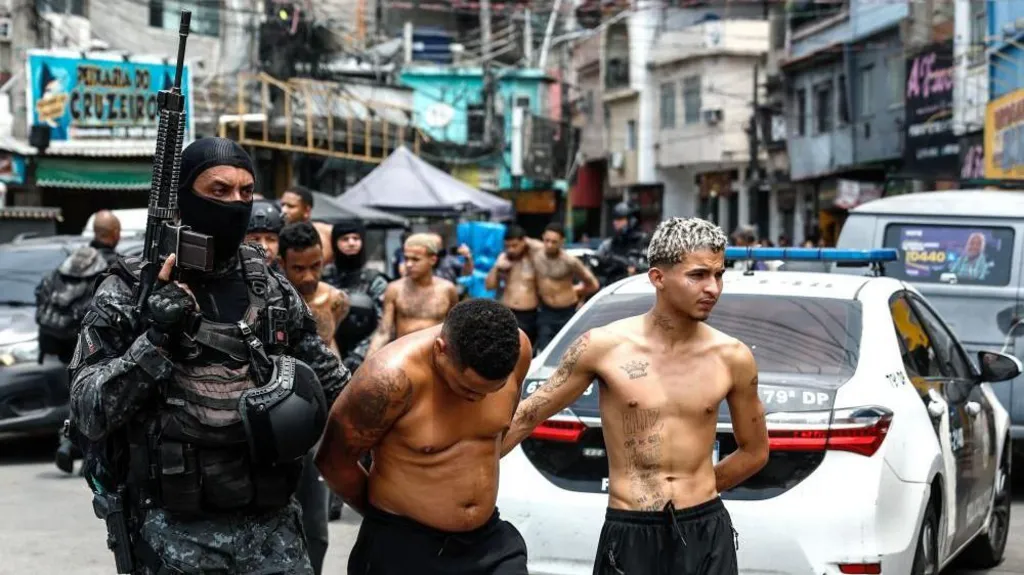 |
| Police said that among those detained were key members of the Red Command gang ANTONIO LACERDA/EPA/Shutterstock |
The
public defender's office in Rio de Janeiro, stated that 132 people had
died as a result of the Brazilian capital's bloodiest police raid on
record as drug gangs were targeted in a ferocious, warlike raid with no
holds barred. The bodies of dozens of victims were laid out in the
streets by grieving residents. The Rio state public defender's office
which provides legal assistance to the poor announced: "The most recent update is 132 dead".
Governor
Claudio Castro, Rio state governor, put the toll of dead from the
violence on Tuesday at around 60, cautioning that the real figure was
without doubt higher, as bodies were beginning to be taken to a morgue.
Among the dead were four police officers, killed during the
military-type operation. No fewer than 2,500 police officers were
assigned to the raids on the city's powerful criminal organization, the
Comando Vermelho (Red Command).
At
one of two densely populated working-class neighbourhoods that had been
targeted in northern Rio -- Penha Complex -- residents assembled a line
of corpses, at least fifty in number, early Wednesday, and wept over
the loss of life. One woman screamed, hunched over the body of a victim.
The bodies were covered in makeshift shrouds, stained with blood. A
sombre urban landscape of wasted lives.
"The state came to massacre, it wasn't a [police] operation. They came directly to kill, to take lives",
one woman shouted as she touched the face of one of the victims. Two
girls, faces tear-streaked, caressed the face of a dead man wrapped in a
sheet. They then turned helplessly to one another, and hugged tightly,
their bodies convulsed in grief.
 |
"Sixty criminals",
according to authorities, had been killed in fighting that resulted
during the drug raids in the Penha Complex and the Alemao Complex, both
located nearby Rio's international airport. They died, furious residents
responded, the victims of police summary killings.
Albino Pereira Neto, a lawyer representing three families with lost relatives, described "burn marks" on some of the bodies, and among those killed, some had been tied up. Some, he said, were "murdered in cold blood".
Armoured vehicles, helicopters and drones backed up the police officers
during the operation, as the streets of the favelas became scenes of
war.
The 'suspects' were accused by authorities of using buses as barricades and drones to attack police with explosives. "This is not ordinary crime, but narcoterrorism" wrote Rio state Governor Claudio Castro, on the social media platform X.
 |
| More than 100 gang members were allegedly killed in the crackdown ahead of next month’s COP30 climate summit. Anadolu via Getty Images |
Labels: Extrajudicial Killing, Favelas, Police Drug Raids, Red Command Gang, Rio de Janeiro, State Brutality, War Zone
posted by Pieface @ Friday, October 31, 2025


<< Home