Gaining Artificial Intelligence -- Risking Water Depletion
 |
Water, our No. 1 resource, is rapidly depleting and AI is accelerating this risk. Getty |
"I really, really enjoin you to think about what this [data centre] could mean for your political career [to Leonard Krog, mayor of Nanaimo, British Columbia].""Life on this planet is sustained by water. It is not sustained by data. We don't need data the way we need water.""And we in Canada have been pretty blithe about our natural resources.""It seems that wherever these data centres have been installed in the first place … those communities that have accepted them have come to regret it really, really deeply.""We have the opportunity here to stop it before it starts."Kathryn Barnwell, retired English professor, Nanaimo resident"There's barely any regulation in place.""If we're racing ahead and thinking only about the economic benefits, and not thinking about the downstream impacts to our environment, that's negligent.""I think Canadians ought to be concerned. Our water is highly sought after, and will be as the world gets hotter."Geoff White, executive director, Public Interest Advocacy Centre, Ottawa
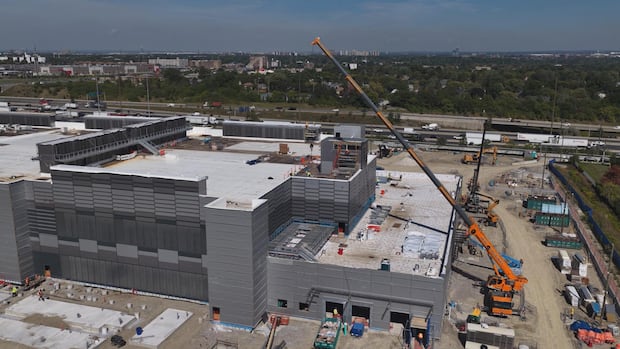 |
| YTO 40, a Microsoft data centre being built in the Toronto suburb of Etobicoke, was approved to use up to 39.75 litres of water per second for cooling purposes, according to planning documents submitted to the city. Still from video, CBC News |
Residents
in Queretaro, Mexico now understand that frequent power cuts they're
experiencing are a result of a data center Microsoft opened last year.
Now, as well, and perhaps more serious in the long run, water outages
stretch for weeks, leading to school cancellations and incidents of
stomach infections in the town of Las Cenizas. Local medical care has
been impacted, with doctors operating by flashlight to illuminate
surgeries. Locally in the town of Las Cenizas, when a farmer was in need
of oxygen due to his medical condition, he had to be rushed to a nearby
hospital, an hour's distance.
These
are becoming common occurrences , resulting from the boom in building
artificial intelligence installations -- all the more so when they are
located in geographic areas around the world with already fragile water
systems. Open AI, Amazon, Google, Microsoft and other high tech
corporations have invested vast sums in the hundreds of billions in
building gigantic computing sites to advance A.I.
While
the companies involved are led mostly by those in the industry out of
the United States, some 60 percent of the 1,244 largest data centres
across the globe are located outside the U.S., according to an analysis
conducted by Synergy Research Group. And this is just the start, as
greater numbers of these A.I. installations are in the planning stages
-- at least 575 from companies that include Tencent, Meta and Alibaba.
Requiring vast amounts of power for computing and water to cool the
computers, disruptions have burdened over a dozen countries.
 |
| Environmental activists Alejandra Salinas, right, and Tracey Duyvestein are pictured on Oct. 9, 2024, in front of land that was intended for the construction of a data centre for Google in Santiago, Chile. Drought, coupled with public pressure, is forcing technology giants such as Google, Amazon and Microsoft to reformulate data centre projects in the region in favour of low-water consumption ones. (Rodrigo Arangua/AFP via Getty Images) |
Data
centres consume over 20 percent of Ireland's electricity, while
precious aquifers in Chile have been placed in danger of depletion.
Blackouts have long been routine in South Africa, and now data centres
further tax their national grid. Brazil, Britain, India, Malaysia, the
Netherlands, Singapore and Spain are all now facing similar concerns.
Working through subsidiaries and service providers to build, Google,
Amazon, Microsoft and other tech companies are able to mask their
presence, revealing scant clues regarding resources their facilities
consume, in an atmosphere where governments, enthused for an A.I.
foothold, are eager to provide cheap land, tax breaks and resource
access.
"I blame the state governments for failing to negotiate support for the community.""Microsoft's project involved millions of dollars of investment, and none of it went to us, to the people."Dr. Barcenas, local clinic in the village of La Esperanza
Authorities
in Ireland for two decades welcomed Apple, Google, Microsoft and Tik
Tok which made Ireland their European base. Some 120 data centres are
now clustered around Dublin and beyond in the countryside. Within the
next few years a third of Ireland's electricity is expected to be
consumed by these data centres, up from 5 percent in 2014. New data
centres are now being limited in the Dublin area for "significant risk" to power supplies.
"There's a reason why the grid is under strain, and it's because of the disproportionate number of data centres."Sinead Sheehan, petition organizer, Ireland
Google
withdrew plans to build a centre that could have depleted water
reserves, following mass protests that took place in Chile. Construction
was halted in some data centres over environmental concerns in the
Netherlands. "You have this narrative that data centres are needed and will make us rich and thriving, but this is a real crisis",
stated Rosi Leonard of Friends of the Earth Ireland. A whopping $375
billion is projected to be spent by companies on data centres globally
in 2025, rising to $500 billion for 2026.
 |
| This aerial view from July 17, 2024, shows the IAD71 Amazon Web Services data centre in Ashburn, Va. (Nathan Howard/Getty Images) |
Labels: A.I. Data Centres, Activists Decrying Projects, Electricity Grids, Government Compliance, Massive Investments, Water Shortages
posted by Pieface @ Saturday, November 08, 2025


<< Home