Femicide in Canada
 |
| pathssk.org |
"It's just too easy to harm women, and there's no consequence of any meaningful significance."Megan Walker, former vice-chair, Police Services Board, London, Ontario"[The data on female killings gathered by the Investigative Journalism Bureau is] insane.""The difference between many killings of men and women is} Women are killed because they are mothers and they are spouses and they are sex trade workers and just for who they are."Heather Lachine, superintendent of criminal investigations, Ottawa Police Service"[Offenders with close ties to their victims are often treated with greater leniency than other violent criminals as a result of an] intimacy or domestic discount [in sentencing].""Persons accused of a homicide against someone with whom they share a close relationship may be perceived as lacking criminal intent [and viewed as the legal system to have acted on] provocation or strong emotion."Statistics Canada report"I represent her desire to find justice in a system that failed her when she needed it the most ... The restraining order did not do its job. It was a piece of paper with meaningless words.""[My] mission [is to have a law passed in Madisson's name that makes ankle monitors a mandatory condition of a restraining order.""How many innocent people need to die, like my young daughter Madisson, for legislation to change?""Her life was full of potential."Jackie Cobb, mother of murdered Madisson Cobb
 |
| Madisson Cobb was killed in a parkade near her office (Photo courtesy of the family). |
There
is an acknowledged Canadian epidemic of women being killed by their
intimate partners, a phenomenon now more familiarly known as 'femicide'
and which is defined internationally through the United Nations as 'the
intentional killing of women because of their gender'. In 2024 when full
data of the death toll of women was last tracked, a list of 221 deaths
was compiled representing an increase of 46 percent over 2019, when 151
deaths were numerated.
The
Investigative Journalism Bureau at the University of Toronto's Dalla
Lana School of Public Health undertook to research the issue, tracking
individual cases, and interacting with researchers, advocates and some
representatives of police forces. It is an issue that has finally caught
the attention of federal authorities. Canada's Justice Minister
recently introduced Bill C-15: the Protecting Victims Act which among
other issues looks prepared to recognize female murders involving "control, hate, sexual violence or exploitation" as 'femicide', making it a new category under Criminal Law.
Should
the bill pass, it would mean a first-degree murder designation, in such
instances, even without premeditation, to be added to the Criminal
Code. Some 1,329 women and girls have died in criminal or suspicious
circumstances over the past seven years in Canada; an average of one
female killed every-other day in the country. These killings have
steadily grown in number over the years.
The
term 'femicide' has not yet been fully accepted generally, although
some police forces in Canada label some deaths of girls and women as
clear 'femicide'. Other police fores have stated their position that if
the term were to be added to the Criminal Code, they would accept it as
well. The national police force of the RCMP defines women's deaths as
homicides while observing international and local law-enforcement
agencies using the word to denote the deliberate killing of a woman by
an intimate male.
Female
victims are killed almost 90 percent of the time by a man and that man
most frequently happens to be a current or former intimate partner.
Moreover police, child services, judicial or mental health systems were
83 percent aware before the killing of the offender, as a result of
previous interaction. At present, a conviction for such murder carries a
10-year sentence. Giving it a first-degree designation through naming
it a 'femicide' would result in a lifetime sentence of 25 years.
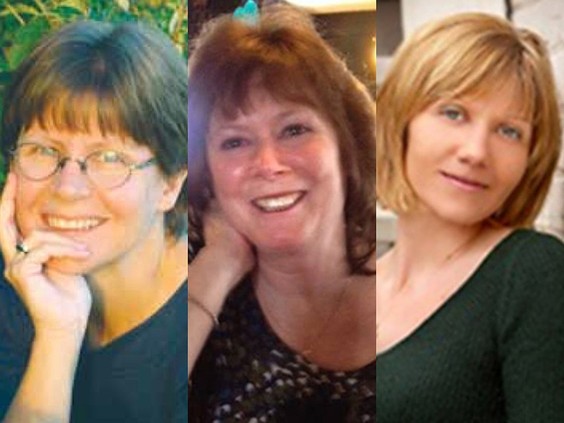 |
| Killed by the same man on the same day in Renfrew County, Ont., in 2015 were, left to right, Nathalie Warmerdam, Carol Culleton and Anastasia Kuzyk. Photo by Postmedia files |
In
their investigation, the Investigative Journalism Bureau researchers
took over a year to examine female deaths across the country, searching
public records, police reports, court documents and websites for missing
persons. The details and outcomes of 1,329 suspicious female deaths
taking place in Canada since 2019 represented their worksheet. The
database used was that of confirmed homicides and deaths deemed
criminally suspicious by police.
Of
687 individual cases the IJB reviewed where the accused was either a
current or former intimate partner or a family member, judicial outcomes
to date reached 337. Of that number, over one-third pleaded to lesser
offences, were found guilty of a lesser crime, or had their charges
stayed or dropped. In the past ten years inquiries to examine targeted
deaths of women including female victims saw hundreds of recommendations
made in prevention of root causes of gender-based violence, yet few
were enacted.
Most
of the intimate partner homicide cases reviewed by the Ontario chief
coroner's committee that reviews domestic violence fatalities included
red flags that under a better system would be seen as critical alerts,
according to psychologist Katreena Scott who sits on the committee:
"Systems often don't listen very well. Systems don't listen to
survivors -- to women, who are saying, 'Listen, this is a dangerous
situation' or are asking for help."
 |
| The Red Shoe Project is a global campaign inspired by Mexican artist Elina Chauvet to commemorate the women lost to gender-based violence and to advocate for change. iStock/GIANFRI958 |
Labels: 'Femicide', Federal Bill-19, Female Deaths Under Suspicious Circumstances, Intimate Partner Violence, Judicial Review, Restraining Orders
posted by Pieface @ Saturday, December 13, 2025


<< Home