Riding Roughshod Over Canada Releases a Hornet's Nest
"We can't back down. We need a full Team Canada approach.Everything is on the table, but Ontario can't do it alone. We need the support.""I'm tired of the bully trying to take our lunch money all the time. We always seem to be on our back heels. We need to be on the offence ... We need to stand up to the bully, and we need to hit him tariff to tariff -- all the way across the board.""And that's my message to the prime minister. We need a plan moving forward."Ontario Premier Doug Ford"There is not a chance in hell that U.S. alcohol is going back on a shelf in British Columbia. And I'm proud of that, and I know the British Columbians support that.""And the idea of the president that he can bully us into whatever he wishes is incorrect.""This attempt by the president to hurt Canadians to, for some reason, attack our country was entirely predictable. [He] will probably do it again. And there's no reason to believe that this is the bottom in terms of where he's willing to go.""The end of the trade agreement between the United States and Canada would be devastating for Americans and for Canadians alike. The extent of that self-inflicted injury on the United States would be profound. U.S. business will be very clear with the president about that."British Columbia Premier David Eby"It most certainly is time for us to intensify our negotiations, be very ambitious.""The ultimate goal isn't to counter-tariff and further weaken the North American economy. The ultimate goal is to get to a renewed agreement, a trade agreement that is going to build and ensure that our North American economy is more competitive moving forward."Saskatchewan Premier Scott Moe
 |
| U.S. President Donald Trump, left, watches as a Spanish soccer player shakes hands with Canadian Prime Minister Mark Carney at the World Cup final on Sunday. The next day, Trump hit Canada with threat of 50 per cent tariffs. (Frank Gunn/The Canadian Press) |
Fighting
another war in the Middle East that is beginning to wrack up American
casualties, making the Trump administration very unpopular in
significant sectors of the U.S. voting public, hasn't distracted Donald
Trump from his delusionary vendetta-pathology of making his trading
partners and neighbours suffer pangs of trade punishment for imagined
trade imbalances that Mr. Trump insists preys on the American economy.
Even nature herself has come in for some extraordinary treatment,
assigning her extreme weather tantrums to Canadian forest-management
malpractise.
As
for a generous move by the Government of Canada to improve truck
traffic flows between the U.S. and Canada in the busiest such trade
exchange benefiting the U.S. as much as it does Canada, by fully
committing to paying for the enormous cost of installing a new bridge
between Windsor and Detroit, riled President Trump who claimed the U.S.
was being cheated again, despite Canada paying the complete $6.4 billion
cost of building the Gordie Howe International Bridge. Toll revenues in
the initial years of operation were to have paid off this debt but
yielding to Trump pressure Canada is now deprived of that debt-revenue
in the interests of Trump's 'permission' to open the bridge to traffic
as intended.
Canada's
wildfires sending plumes of smoke over the border another wrathful
issue, and the punishment for Canada in not immediately shielding the
U.S. from the out-of-control wildfire smoke wafting over to the U.S.
necessitated another round of tariffs subject to the new Section 338
invoked by Mr. Trump's ire, where cement, dairy products, wood products,
alcoholic beverages, paper products, sporting equipment, jewelry, glass
products, salt, essential oils, clothing, swimming pools, gaming
consoles, smartphones, lamps and furniture products now come with hefty
50 percent tariffs attached.
 |
| Financial Times |
Yet
when the provinces respond to these devastating tariff impositions by
imposing tariffs of their own, the Canadian boycott of U.S. alcoholic
products by provincial liquor commissions enrages the Trump
administration. According to a White House fact sheet Canadian imports
of U.S. alcohol have decreased between March 2025 to February 2026 by 81
percent, an intolerable situation. Canadian provinces have made it
abundantly clear that as soon as Mr. Trump moves the needle downward on
his ever-increasing tariffs, they have no intention of lifting their
boycotts.
"I think this does provide a big reset to the negotiation agenda and will force Canada into difficult decisions in the coming 29 days.""What we're hearing from our clients right now is those that are hit, that are caught by this list, their export sales are going to go to zero, and this is actually quite catastrophic. Because the 50 percent tariff is very, very high, and no one else in the world has to pay that. Right? This is a new tariff unique to Canada."William Pellerin, international trade partner, McMillan LLP
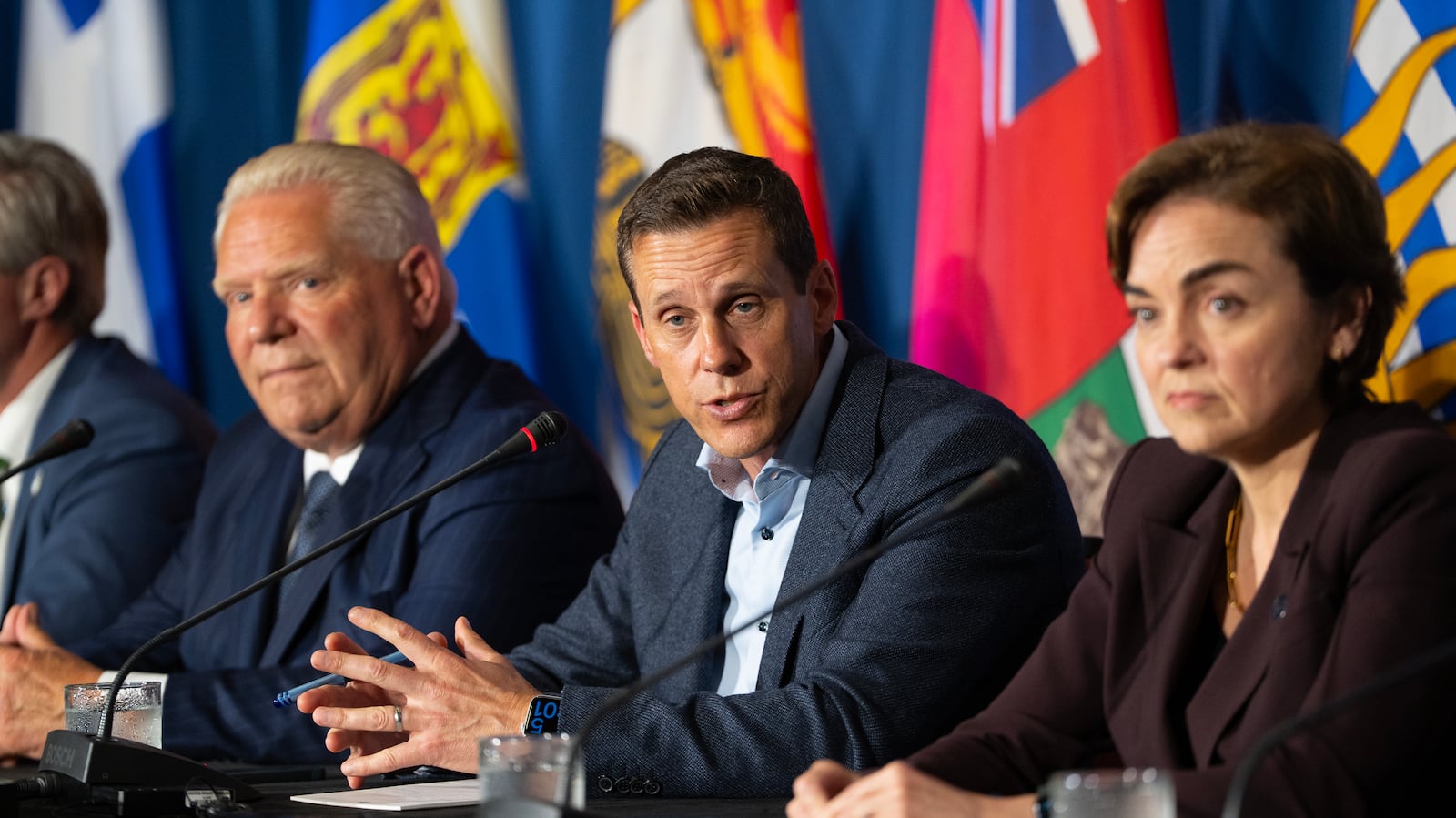 |
| Prince Edward Island premier Rob Lantz speaks to reporters with fellow premiers at a press conference closing the Council of the Federation meetings in Charlottetown on Wednesday July 22, 2026. THE CANADIAN PRESS/Darren Calabrese |
Economists
are aware of the documentation studies that reveal when governments
impose tariffs seeming to be paid by exporters, what is actually
occurring is that their own citizens are being taxed. The National
Bureau of Economic Research published a paper by a Harvard University
economist and a economist at University of Chicago which studied the
extent to which the 1918-19 [Trump's previous administration] as
well as 2025 tariffs ended up with the American public and not the
exporters. The tariff pass-through rate to U.S. importers, they
concluded is "pervasively high, during both the 2018-2019 and 2025 episodes". With 80 percent of the burden of the former and 94 percent of the latter tariffs paid by the U.S. public.
A
German think tank, the Kiel Institute for the World Economy, analyzed
$4 trillion of shipments between January 2024 and November 2025,
concluding that U.S. consumers and importers paid 96 percent of the cost
of Trump's tariffs; foreign exporters paid four percent. A National
Bureau of Economic Research paper and an analysis by New York Federal
Reserve researchers estimated approximately 90 percent of the U.S.
tariffs' economic burden fell on Americans.
Across
the border, Canadian studies document how protectionism harms Canadian
consumers. A Montreal Economic Institute study lat month estimated
supply management -- which involves quotas and high tariffs on dairy
eggs and poultry -- cost the average Canadian $224 annually in inflated
food prices. Statistics Canada's income survey and low-income cutoffs [a threshold for relative poverty]
suggested that inflated food prices effectively slid about 120,000
Canadians below the poverty line. So much for supply management.
"A lot of that [Canadian tourism to Vermont dropped 40 per cent] has to do with the rhetoric that the president has used, [referring to Trump’s threats to turn Canada into the 51st state and repeatedly calling the prime minister 'governor'.""We really value our relationship with Canada both emotionally and financially, and economically."Democratic Vermont Sen. Peter Welch"How are you [Jamieson Greer, U.S. trade negotiator] approaching the risk of retaliatory tariffs from Canada now that you’ve imposed 50 per cent duties on a wide range of products that were previously exempt?"Colorado Democratic Sen. Michael Bennet"Yes or no, when the new tariff on Canada takes effect, will Canada have higher tariffs than China on some products?""Let me work through that math. The 50 per cent tariff is higher than a number of tariffs on China."Oregon Sen. Ron Wyden
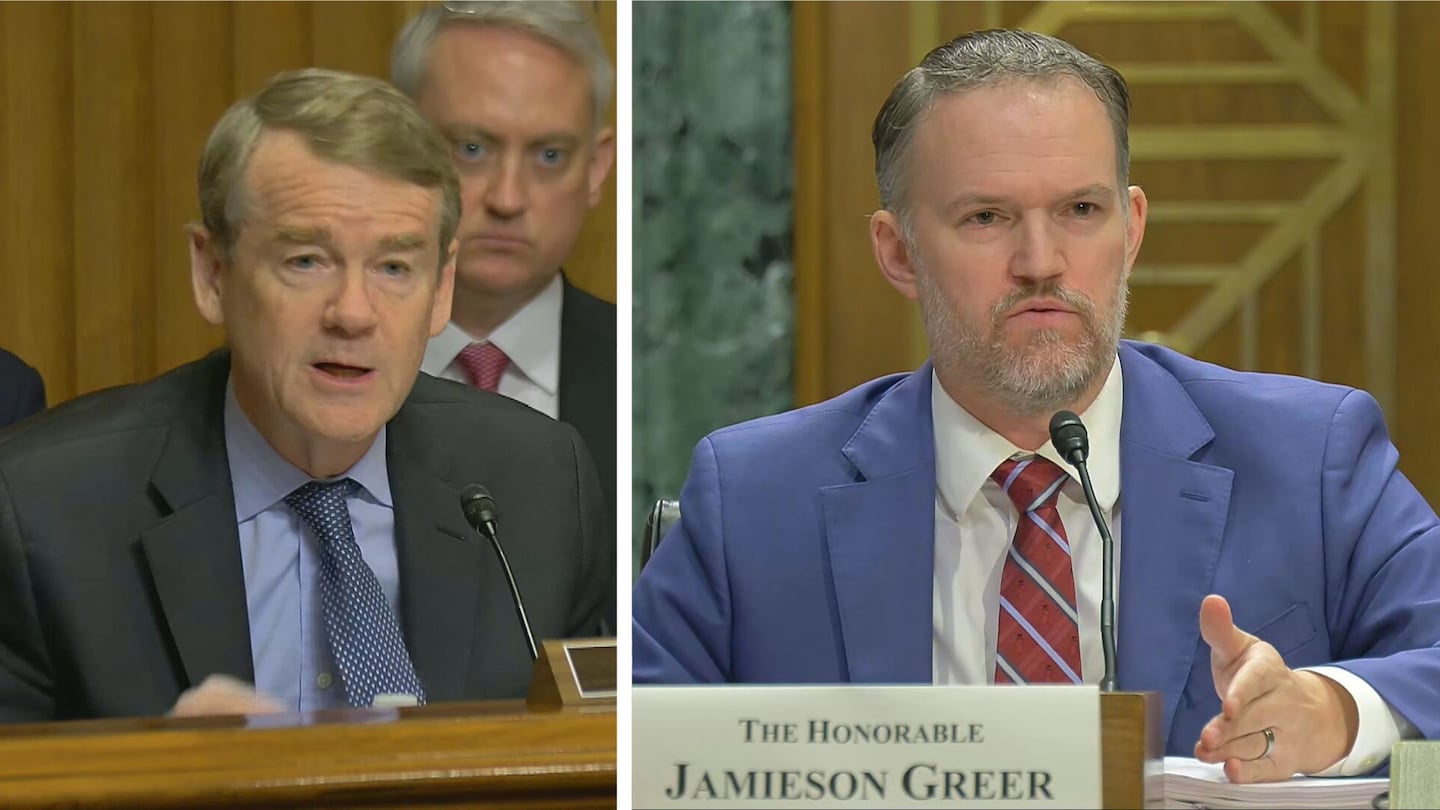 |
| Left: Colorado Democratic Sen. Michael Bennet. Right: U.S. Trade Representative Jamieson Greer. CTV News |
Labels: Canadian Boycotts, Feet to the Fire on Trade, Ontario Wildfires, Trump's Punitive Trade Tariffs, United States Trade Tariffs, Windsor/Detroit International Bridge
posted by Pieface @ Thursday, July 23, 2026


<< Home