Girding for Battle in Europe -- the U.K. on Alert
 |
| Credit AP |
"[The
United Kingdom is set to become] a battle-ready, armour-clad nation.
[Britain] cannot ignore the threat that Russia poses."
"The threat we face is more serious, more immediate and more unpredictable than at any time since the Cold War."
"[Britain is prepared to build] at least six new munitions factories [which the government says
will generate over 1,000 jobs and produce] thousands of new long-range
weapons [supporting around 800 additional positions]."
"[We will create] an Army which is ten times more lethal by 2035 [through the
integration of drones, destroyers, AI, and aircraft across all service
branches. We will] end the hollowing out of our armed forces [while delivering] the biggest armed forces pay rise in 20 years."
Prime Minister Keir Starmer
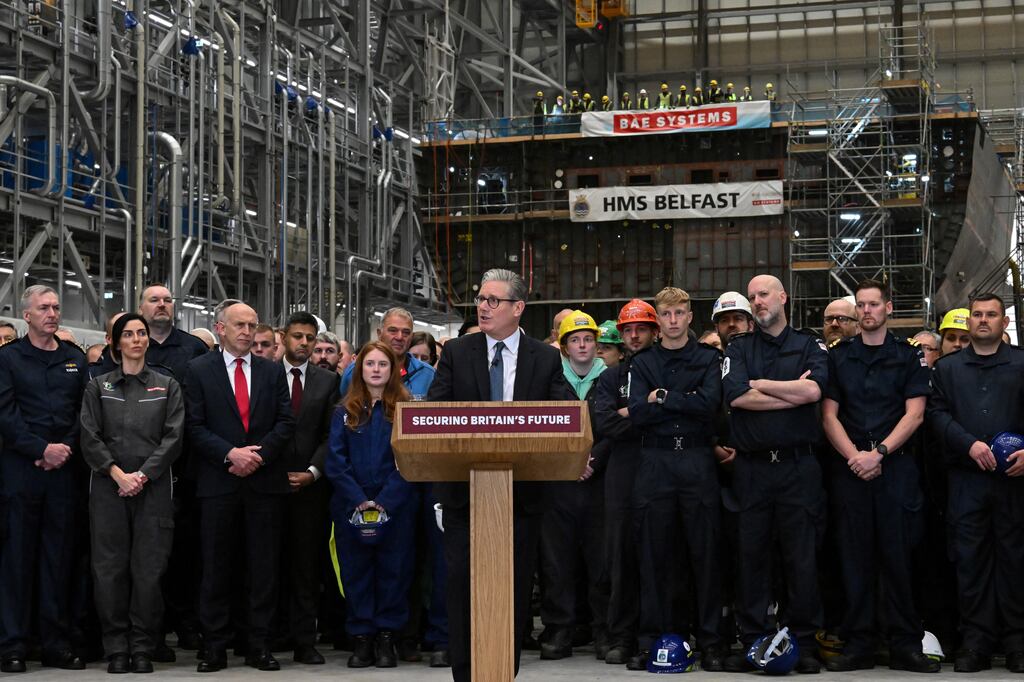 |
| Britain's Prime Minister Keir Starmer delivers a speech during a visit to BAE Systems' Govan facility on June 2, 2025, in Glasgow, Scotland. (Andy Buchanan - WPA Pool/Getty Images) |
A new "hybrid Navy" with Aukus submarines and autonomous vessels that can patrol the North Atlantic
Strategic Defence Review (SDR)
- £15bn to be spent on new nuclear warheads
- Commitment to £1.5bn to build six new factories to enable an "always on" munitions production capacity
- Building up to 7,000 long-range weapons including missiles or drones in the UK, to be used by British forces
- Pledge to set up a "cyber and electromagnetic command" to boost the military's defensive and offensive capabilities in cyberspace
- Extra £1.5bn to 2029 to fund repairs to military housing
- £1bn on technology to speed up delivery of targeting information to soldiers
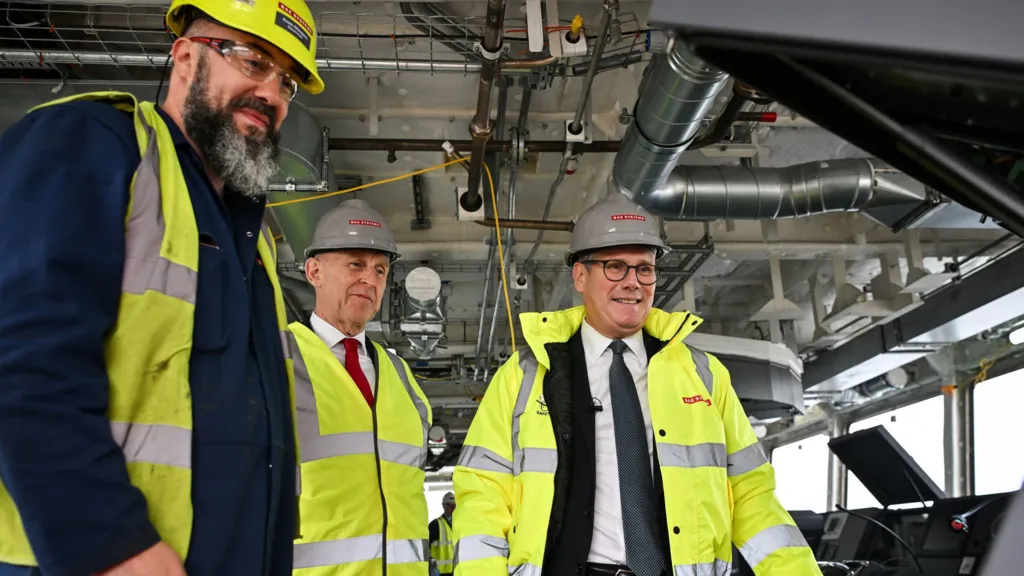 |
| The defence secretary visited defence company BAE Systems in Glasgow with the prime minister earlier PA Media |
The
plan calls for the United Kingdom to build new nuclear-powered attack
submarines, to prepare its army for combat, envisioning a war in Europe.
Britain's prime minister informed the public their country was in the
process of seriously increasing military spending, a move publicized
with the design to alert both Moscow and Washington. He pledged sweeping
changes to British defences far in excess of anything undertaken since
the collapse over 30 years ago of the Soviet Union.
Spurred
by the charges levelled by American President Donald Trump that the
U.S. would not defend any NATO member that failed to prioritize its
military spending, NATO member-countries have been reassessing defence
spending, taking into account the grim circumstances of Russia's
full-scale invasion of Ukraine. A strategic defence review undertaken
at the behest of Mr. Starmer, led by a former U.K. defence secretary and
NATO secretary-general, George Robertson, led to the U.K. government
announcing these plans for the military.
In
a Europe shaken and transformed by Russia's war in Ukraine and the
re-election of U.S. President Donald Trump last year, the review lays
out the vulnerability of Europe in the unsettling reality that a
resurgent Russia under President Vladimir Putin in his goal of
re-establishing Russia as a world power with the intention of returning
to the days of the USSR and the capture of Russia's near-abroad
neighbours in a new rendition of satellite dependents along with the
abandonment of its most powerful ally now extending sympathy to Moscow's
land claims in Ukraine, the prospect of a future of uncertainty and
potential occupation and conflict has fed European paranoia.
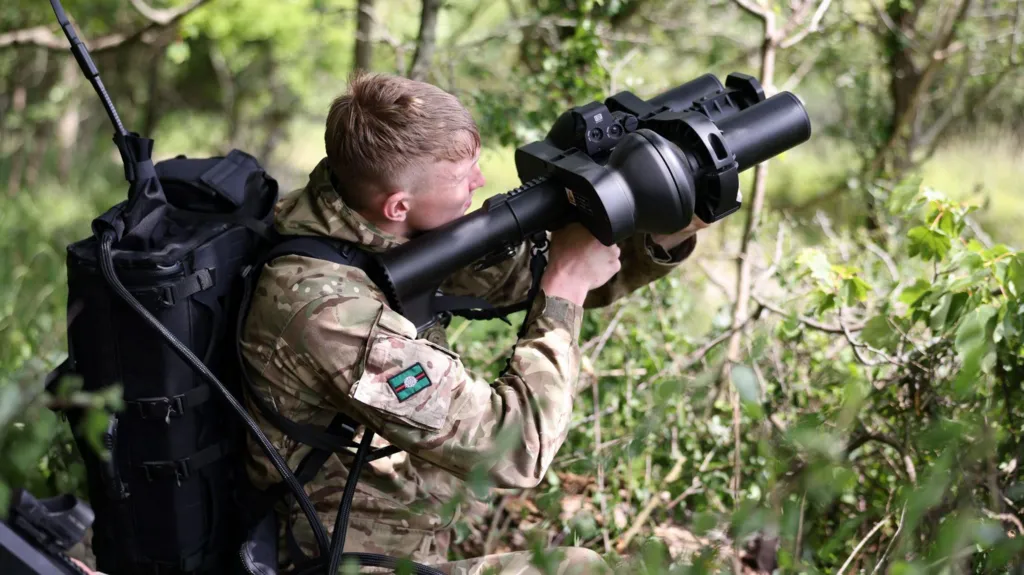 |
| UK Ministry of Defence |
At the time of the previous major defence review, then-prime minister Boris Johnson stated his confidence that the era of "fighting big tank battles on European land mass" are
over. His confidence was betrayed when three months later, Moscow sent
its tanks into Ukraine. In a rapidly changing world, where certainties
of territorial aggression have once again come to the fore, the current
British government is prepared to accept all 62 recommendations in the
current review. Its commitment to confront threats looming on land, air,
sea and cyberspace is total.
Now measures such as increased production of submarines and weapons and "learning the lessons of Ukraine" which
took the initiative in defending its sovereignty with a focus on
producing its own advanced drone technology to counter Russian forces,
to the extent of reaching out to strike targets deep within Russia has
inspired other European countries and deepened the commitment of
Britain, Germany, and Poland to back Ukraine even more strenuously in an
effort to prop up Kyiv, left high and dry by the Trump administration.
The
U.K. plans to establish a cyber command to counter daily Russia-linked
attacks. There is an intention to build up to a dozen nuclear-powered
conventionally armed submarines under the AUKUS partnership with
Australia and the United States. As well, the government plans to invest
15 billion pounds in Britain's nuclear arsenal; missiles carried on a
handful of submarines. Britain's conventional weapons stockpiles will
link with six new munitions factories and some 7,000 U.K.-built
long-range weapons.
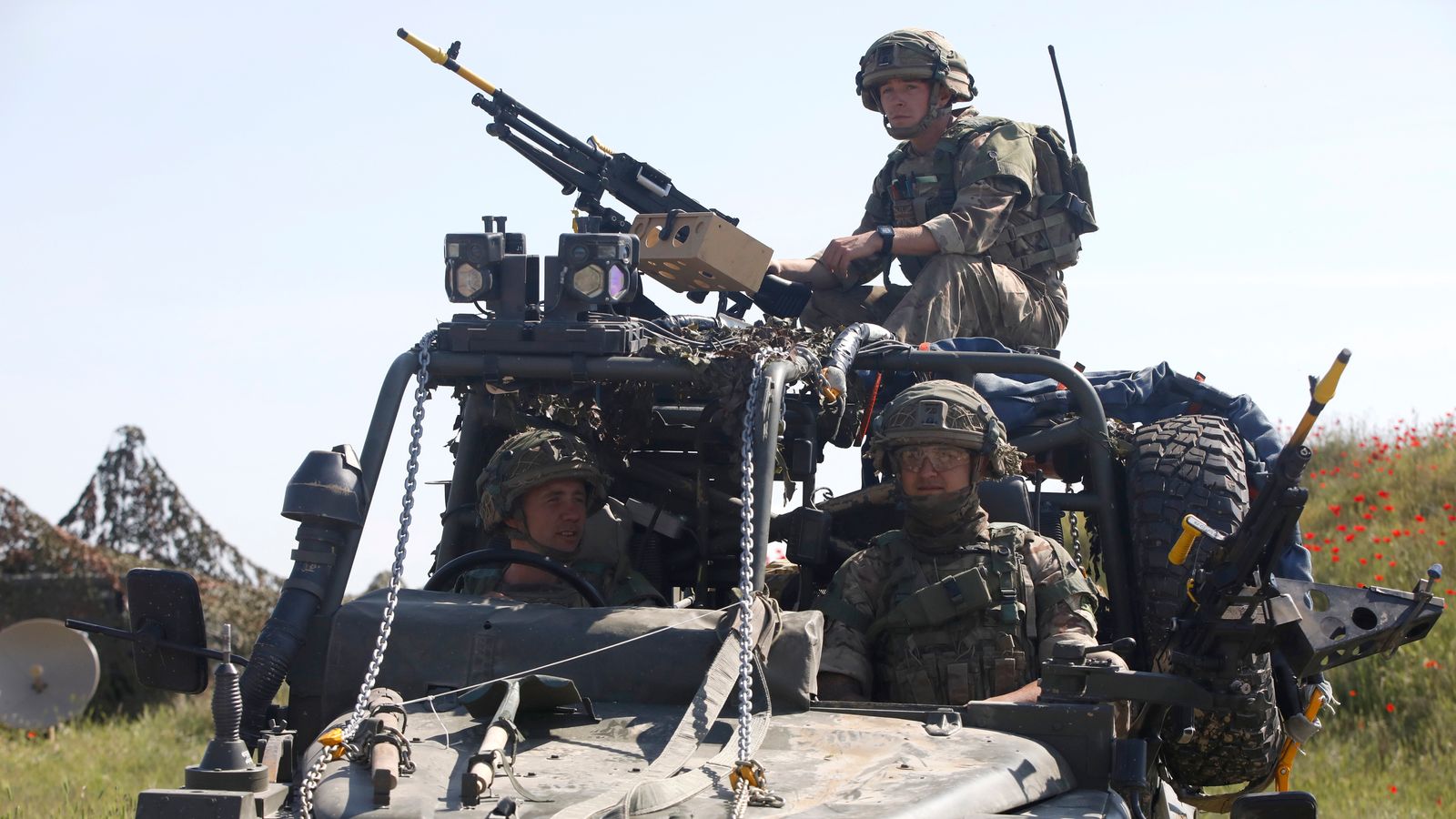 |
| British soldiers from the 16 Air Assault Brigade training in North Macedonia. Pic: AP |
Labels: Boosting Military Spending Keir Starmer Government, Munitions Factories, Nuclear-Powered Submarines, Russian Threat, United Kingdom
posted by Pieface @ Wednesday, June 04, 2025


<< Home