Russian Military Preparations -- Finland On Alert
"The Russian military has undergone a significant force expansion.""After the war, the ground force will probably end up larger than before 2022.""Looking at the planned restructuring of military districts, it seems clear that they're going to prioritize areas facing NATO."Michael Kofman, senior fellow, Carnegie Endowment for International Peace, Washington"They are changing structures and we are seeing moderate preparations when it comes to building infrastructure close to our borders, meaning that they will, once the war in Ukraine hopefully ends, start to bring back the forces that have been fighting in Ukraine, especially land forces.""They are doing it in phases. I would say it is still moderate numbers. It’s not big construction, but in certain places building new infrastructure and preparing, bringing new equipment in.""You also have to evaluate whether they are preparing to send more troops to Ukraine or preparing to build up their forces close to our border. But I guess they are doing both.""What happened right after the Ukrainian attack was we applied for NATO membership and then when we were accepted Russia announced they would start to change their military posture across the border."Maj.-Gen. Sami Nurmi, the head of strategy of the Finnish defense forces
 |
| Finnish troops with their Sisu XA-180 Armored Personnel Carrier. Photo: PFC LUIS A. DEYA/Wikimedia Commons |
Recent
satellite imagery has revealed that Russian forces have been put to
work fortifying bases and building military infrastructure adjacent the
border with Finland. These revelations are construed as moves that could
portend the Russian strategy for action meant to be taken when the
conflict with Ukraine comes to an end. Row after row of new tents; new
warehouses capable of storing military vehicles; fighter jet shelter
renovations; amongst steady construction activity has taken place on an
unused helicopter base, in imagery confirmed by NATO.
At
the present time these changes appear to represent early stages of a
more ambitious, longer-term expansion. However, NATO authorities state
the situation bears little resemblance as yet to the buildup of 2022
along the Ukraine border prior to Russia's full scale invasion. Russia
is for the present, preoccupied with its war in Ukraine and such being
the case, can spare very few troops along its frontier. Finland itself
feels that the situation does not -- as yet -- constitute a threat.
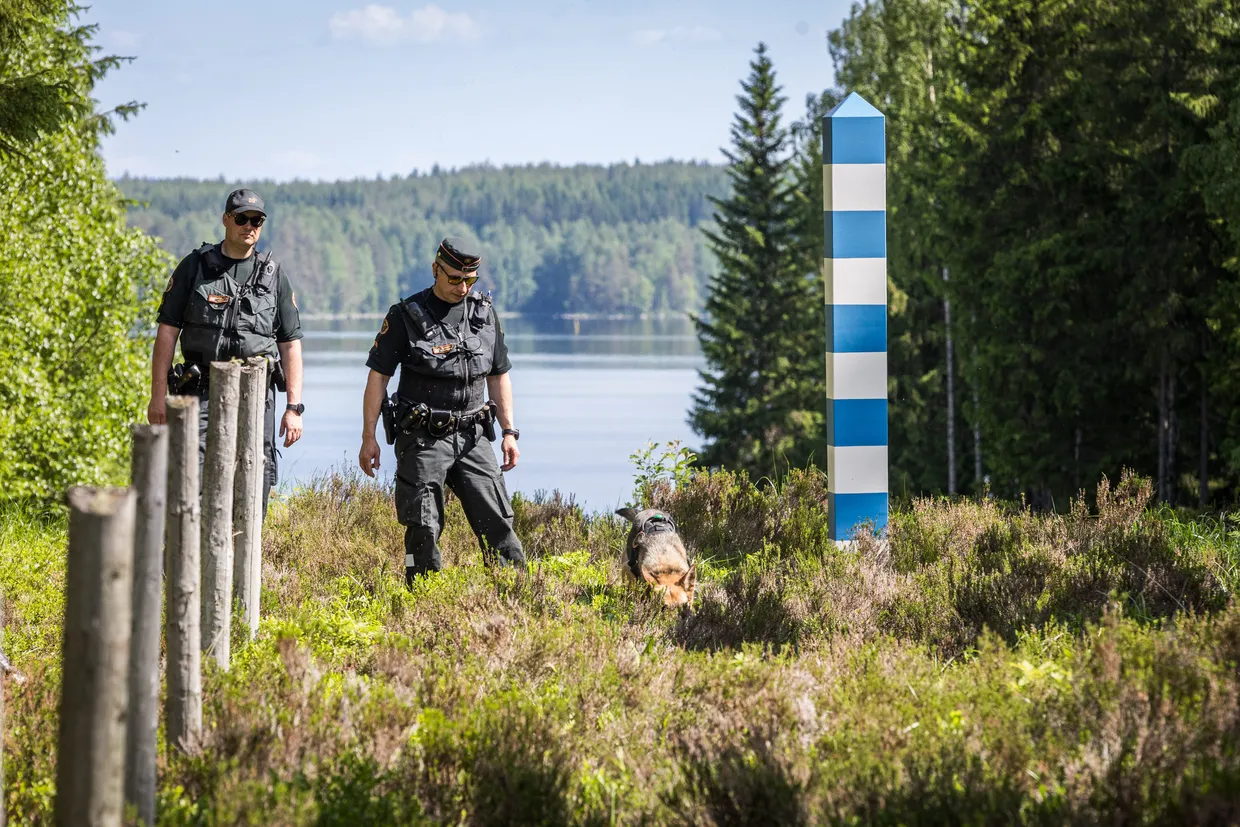 |
| Finnish Border guards in Joensuu at the border with Russia on June 5, 2024 (Jarno Artika / Lehtikuva / AFP via Getty Images) |
Russia
is in fact, responding to its well-known antipathy to its near
neighbours becoming part of NATO, a presence it views as a direct threat
to Moscow's interests. Finland, as of two years earlier is now one of
the newest members of NATO, impelled to join the defense group as a
result of Russia's invasion of Ukraine. In reacting to its neighbours'
willingness to become NATO members, the Kremlin's aggressive moves in
response have had the predictable result of spurring those neighbours to
find security within the NATO alliance.
The
1,300-kilometer frontier represents the Western alliance's longest line
of contact with Russia and as such, analysts predict it has the
potential to become a hot spot, much of it lying in the contested Arctic
Circle. Recent Arctic war games held by American and Finnish troops in
the region, had hundreds of troops rushing about the woods, with the
Finns on cross-country skis -- countering an obvious enemy, presumably
Russia.
The
prediction by Finnish defense officials, that whenever the
high-intensity phase of the war in Ukraine comes to an end, Russia will
then turn to deploying thousands of troops to the Finish frontier. They
feel they have an estimated five years roughly before Russia will be
able to rebuild its forces to threat level. This, according to their
reckoning, is a certainty, their expectations being that they will face
triple numbers of Russian troops. "We'll be talking about so much higher troop levels", stated Brigadier General Pekka Turunen, director of Finish defense intelligence.
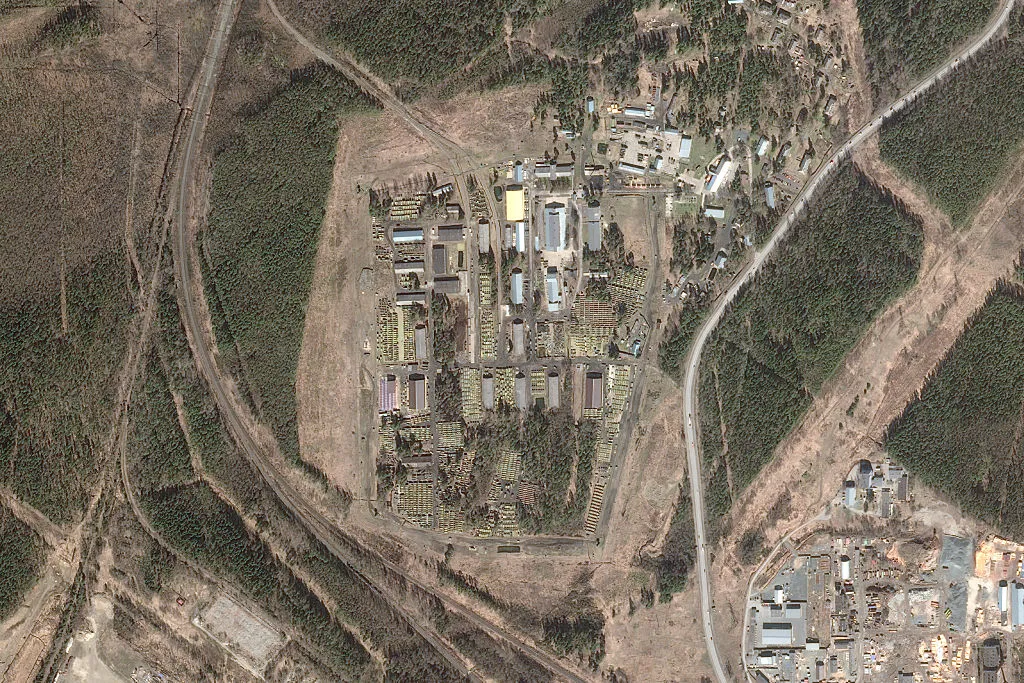 |
| Completed Russian warehouse construction is visible in Maxar satellite images in Petrozavodsk, Russia, May 4, 2025 (Satellite image 2025 Maxar Technologies) |
The
Baltic nations in Russia's near abroad were the first of the former
Soviet Union satellites to join NATO, in the process leading Moscow to
fear that large stretches of Russia's border became vulnerable to the
presence of NATO. When it appeared that Ukraine, a much larger former
Soviet republic, would rise to the option to join, Russia was spurred to
mount its 'special military operation'.
Satellite
imagery make it clear that Russian helicopters have been returned to a
base nearby Murmansk, a Russian port city located in the Arctic Circle,
after having stood unused for two decades. Recently, dozens of Russian
warplanes were seen at the Olenya air base also located in the Arctic,
less than 160 kilometers from the Finnish border, as identified by
satellite imagery.
Over a hundred new tents appeared a year earlier at Kemenka, a Russian base under 65 kilometers from Finland. "They
are expanding their brigades into divisions, which means that the units
near our borders will grow significantly -- by thousands",
Emil Kastehelmi, an analyst with the Black Bird Group, a Finnish
organization which analyzes military developments, revealed. This is a
situation which, if it reaches such a point, will involve a NATO
member-nation, compelling NATO itself to respond.
 |
| Sources: Black Bird Group, GFSIS, OpenStreetMap, Maptiler, NZZ research |
Labels: Finland on Alert, NATO, Post-War Preparations, Russian Invasion of Ukraine, Russian Troops
posted by Pieface @ Tuesday, June 03, 2025


<< Home