Thursday, August 06, 2026

The Expanding Use of Armed Robots and Unmanned Ground Vehicles in Ukraine

"It is already impossible to imagine defence without drones, and the same applies to UGVs [unmanned ground vehicles]."
"Logistics on the front line, evacuation of the wounded, combat missions -- the use of UGVs is now expanding at the fastest pace."
"The future is already on the front lines and Ukraine is creating it."
Ukrainian President Volodymyr Zelenskyy 
 
"At least 25 kilometres from the line of contact is effectively a 'kill zone', where the risks of casualties are extremely high due to the density of drones."
"So replacing human involvement with drones significantly reduces losses."
"[Some of these Unmanned Systems Forces are used in the delivery of mines or to conduct] kamikaze [attacks]." 
Robert Brovdi, commander, Ukraine's Unmanned Systems Forces
 
"Replacing the infantryman is totally impossible."
"We are talking about helping the infantryman."
Taras Ostapchuk, CEO, Ratel Robotics 
https://spectrum.ieee.org/media-library/an-ukrainian-soldier-adjusting-an-unmanned-ground-vehicle-u2019s-machine-gun.jpg?id=67114858&width=900&quality=100
The Droid TW 12.7, by DevDroid, is shown here outfitted with a 0.50-caliber M2 Browning machine gun that can be aimed and fired by a remote operator using a tablet and an encrypted communications link.  DevDroid
 
In the early years of the conflict imposed on Ukraine by the full invasion of the country by Russian forces it was tank formations and large-scale troop movements, the conventional mechanisms in the pursuit of offensive dominance and defensive responses that typified the war. Now approaching the second-half of its fourth year, not taking into account Russia's military annexation of the Crimean peninsula, the eastern and southern front line is at a stalemate, monitored by drones set to strike moving targets. 
 
Ukraine's surprise counteroffensive took Russia's Vladimir Putin off guard; despite its much smaller population, military, arms, and economy. Ukraine stopped the Russian military dead in its tracks, even recovering some of its territory. Ukraine steadily advanced from desperately attempting to down Russian missiles and drones to protect its civilian infrastructure targeted by Moscow, to striking back across the border into Russia, first hitting only border targets then moving on to strike as far as Moscow and beyond.
 
Now, Ukrainian infantry units are using robot vehicles on combat missions as Ukraine has out-innovated Russia. The asymmetric technological approach with the use of drones and robots is Ukraine's winning ticket to defeating the Russian military. Like Mykhailo Fedorov the Ukrainian Defence Minister recently removed, Ukraine's new Commander-in-Chief Mykhailo Drapatryi advocates leveraging drone and robotics know-how for advantage on the battlefield. 
 
Recently a battle robot armed with a flame thrower approached a group of Russian assault troops planning to challenge Ukrainian defences on a section of the eastern Donetsk front lines. The robot turned the area where the Russians were positioned near a tree line to into a flaming cauldron, followed up by a machine gun crew to clean up the surviving attackers. A new battlefield technique employed by Ukraine's 93rd Separate Mechanized Brigade.
 
https://imageio.forbes.com/specials-images/imageserve/6a70886d457ae098dd605309/Heavy-list-with-UGVd/0x0.jpg?width=960&dpr=1
 
That robot represents an expanding Ukrainian corps of unmanned ground vehicles equipped with such offensive devices as rifles, to rocket-propelled grenade launchers. At least 50,000 of these UGVs are set to be produced for the battlefield to reinforce human troops tasked to confront Russian servicemen. A remote-controlled combat robot was landed using an unmanned naval drone reaching the shore 11 kilometres away at the occupied Kinburn Spit in southern Ukraine. 
 
The  ground robot, a Wolly 7.62, carried an ammunition-loaded machine gun firing on Russian troop positions, who were forced to pull back, then self-destructed.
 
The $11,000 robot was made use of by the 123rd Separate Territorial Defence Brigade with four Ukrainian operators conducting the assault. "We are already fighting with drones in many areas, and we are very polite to our robots in advance", laughingly explained a solder with the call sign "House Goblin" archly referring to the Terminator movie series. According to Ukrainian officials, unmanned systems help manage the manpower gap with Russia, freeing up soldiers, saving lives on tasks with dangerous logistics in supporting front-line troops and evacuating the wounded. 
 
While Ukraine's wish to join the North Atlantic Treaty Organization remains endlessly deferred, NATO members are eager to learn from Ukraine's tactical innovations with the use of its advanced technology in the production of drones and robots. Some European states have signed defence production partnerships with Ukraine as Kyiv strives to become central to the security structures of the continent. 
 
https://s.yimg.com/lo/mysterio/api/0f3e4562ff6a4b8790b2f363f344c9fa5a38908e172d371f472512c171ac5bf2/lightyear_networkapi/resizefill_w780_h438%3Bquality_80%3Bformat_webp/https%3A%2F%2Fmedia.zenfs.com%2Fen%2Fbgr_ecomm_183%2F743896408fb3f4348637860fc46a2985
Zysko Sergii/Shutterstock
 
"Absolutely incredible,  [Ukraine] fully integrates every single drone every sensor, and every shooting platform into just one single network", the U.S. Senate Armed Services Committee was advised by U.S. army secretary Dan Driscoll. "Ours does not." Ukraine has signed drone deals with countries as disparate as Saudi Arabia and the Netherlands, with an increasing number of partnerships being floated, including with the United States.  
"They accomplished something never done in warfare."
"They pushed Russians off a position that was being defended by humans and they pushed them off the position with no humans in the fight."
Former U.S. army vice-chief of staff Jack Keane  
https://spectrum.ieee.org/media-library/an-unmanned-ground-vehicle-moving-through-a-sparse-forest-landscape.jpg?id=67114838&width=1200&height=750

RoverTech’s Zmiy uncrewed ground vehicle moved through a forest during a demonstration. RoverTech  


Labels: , , , , ,

Friday, April 03, 2026

Trump, Excoriating U.S. 'Allies'

"You'll have to start learning how to fight for yourself, the U.S.A. won't n e there to help you anymore, just like you weren't there for us."
"Iran has been, essentially, decimated. The hard part is done."
"Go get  your own oil!"
"[Paris has been] VERY UNHELPFUL]. The U.S.A. will REMEMBER!!!"
"We’ve been there automatically, including Ukraine. Ukraine wasn’t our problem. It was a test, and we were there for them, and we would always have been there for them. They weren’t there for us."
"All of those countries that can’t get jet fuel because of the Strait of Hormuz, like the United Kingdom, which refused to get involved in the decapitation of Iran, I have a suggestion for you: Number 1, buy from the U.S., we have plenty, and Number 2, build up some delayed courage, go to the Strait, and just TAKE IT”."
"I’ve long said that, you know, I wonder whether or not NATO would ever be there for us. So … this was a great test, because we don’t need them, but they should have been there."
U.S. President Donald J. Trump
https://www.thedailybeast.com/resizer/v2/K5KS2W5L45A4JNL6OR5LUAHCQI.JPG?auth=ffde8817218f541eef32308836e222c7fc2c8ac856e38fe3e2bfe1660fdf402e&width=1440&height=1004
Donald Trump has also called NATO countries that do not help with the war in Iran "cowards." Evelyn Hockstein/REUTERS
 
"I hope that amid the emotions surrounding the President of the United States today, a moment of calm will come."
"And why? Because there is no NATO without the United States, and it is in our interest that this calm comes."
"But there is also no American power without NATO."
Polish Defense Minister Wladyslaw Kosiniak-Kamysz 
https://www.reuters.com/resizer/v2/6VNZZMO6CRJJ3G7AGD7B7N6W3U.jpg?auth=ce471fba128412505d459bc8e38d5acbbc1afa1df3da776fc344ad4e822e9e53&width=960&quality=80
Cargo ships in the Gulf, near the Strait of Hormuz, as seen from northern Ras al-Khaimah, near the border with Oman?s Musandam governance, amid the U.S.-Israeli conflict with Iran, in United Arab Emirates, March 11, 2026. REUTERS/Stringer
 
Frustration with allies  unwilling to commit themselves through the NATO military alliance in support of the U.S. conflict in Iran, has hit boiling point with President Trump who is now telling his erstwhile allies to "go get  your own oil" in respect to the closure of the Strait of Hormuz by Iran, has sent energy prices soaring. 
 
Following U.S. strikes hitting Isfahan, the central Iranian city, leading to Tehran attacking a fully loaded Kuwaiti oil tanker in the Persian Gulf, Mr. Trump's precarious patience appears to have hit its limit. A month after the start of the aerial bombardment by the U.S. and Israel, the intensity of strikes on either side has not levelled off and major disruptions have erupted to the global supply of oil and natural gas, reflected by panicked global markets.
 
Earlier, Mr. Trump  shared footage of the massive attack on Isfahan, home to one of three nuclear enrichment sites that was attacked last June by U.S. strikes, where it is suspected that much of Iran's highly enriched uranium was stored. It seems evident that no agency foretold the extent of Iran's stranglehold on the Strait of Hormuz, with its catastrophic results to world shipping, much less the Iranian leadership's decision to attack its neighbours' energy infrastructure.
 
The roiling of world markets and the strait-closing effect on many basic goods such as fertilizer normally shipped across the world, has had its effect on the American president who directed responsibility at the United Kingdom and France for refusing to enter a war for which no clear endgame could be deduced, a war they were never consulted on, nor an alert given that it would be forthcoming. 
 
https://nationaltoday.com/wp-content/uploads/not-wordpress/2026/03/69cb37cf795ba.jpg
The U.S. attack on an Iranian ammunition depot in Isfahan raises tensions and the risk of further military escalation in the region. Los Angeles Today
 
France  permitted the U.S. Air Force use of the Isteres base in southern France once it received guarantees that planes landing there would not be carrying out strikes in Iran. Europe's loudest critic of the war, Spain stated it chose to close its airspace along with its joint U.S.-Spain airbases for any planes involved in the conflict. As for Italy, an official confirmed that U.S. military assets were refused use of the Sigonella airbase in Sicily for any operation with links to the offensive in Iran. 
 
American bombers were intending to land at the Italian base prior to continuing on toward the Middle East. However, affirmed Italy's Defence Minister Guido Crosetto, Italy would still allow the US. use of its bases; no cooling of relations between the two countries has resulted over the Iran conflict.
 
The world is now on notice that should a ceasefire not be "shortly" reached and the strait reopened, the U.S. was prepared to broaden its offensive, and that would include attacking the Iranian oil export hub on Kharg Island. 
 
https://www.reuters.com/resizer/v2/NB5JSYDZQZICZEQI6W3PU2YAOI.jpg?auth=b794af94d9519a0de03e8d8e92d9db35b8396c2e944f2107c80835dd27527ed9&width=960&quality=80
Luojiashan tanker sits anchored in Muscat, amid the U.S.-Israeli conflict with Iran, in Muscat, Oman, March 7, 2026. REUTERS/Benoit Tessier
"We don't want to have to do more militarily than we have to."
"But I didn't mean it flippantly when I said, in the meantime, we'll negotiate with bombs."
U.S. Defense Secretary Pete Hegseth 


Labels: , , , , , , ,

Monday, December 22, 2025

Peace? Of Course Peace!!!

"The United States is the creator of NATO, its main sponsor. All the main resources come from the U.S. -- money, military technology weapons, ammunition, everything."
"And in the new U.S. National Security Strategy, Russia is not named as an enemy or a target. Yet the NATO secretary general is preparing for war with us."
"What is that? Can't you read?" 
Russian President Vladimir Putin
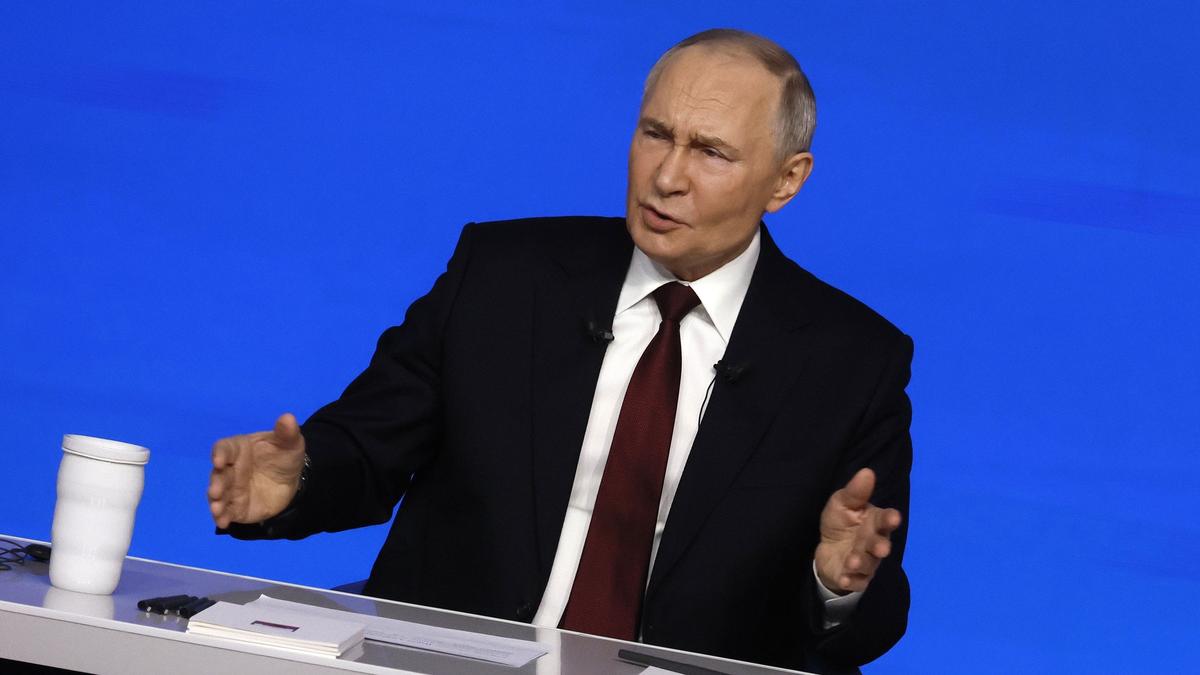
Ask your dictator anything
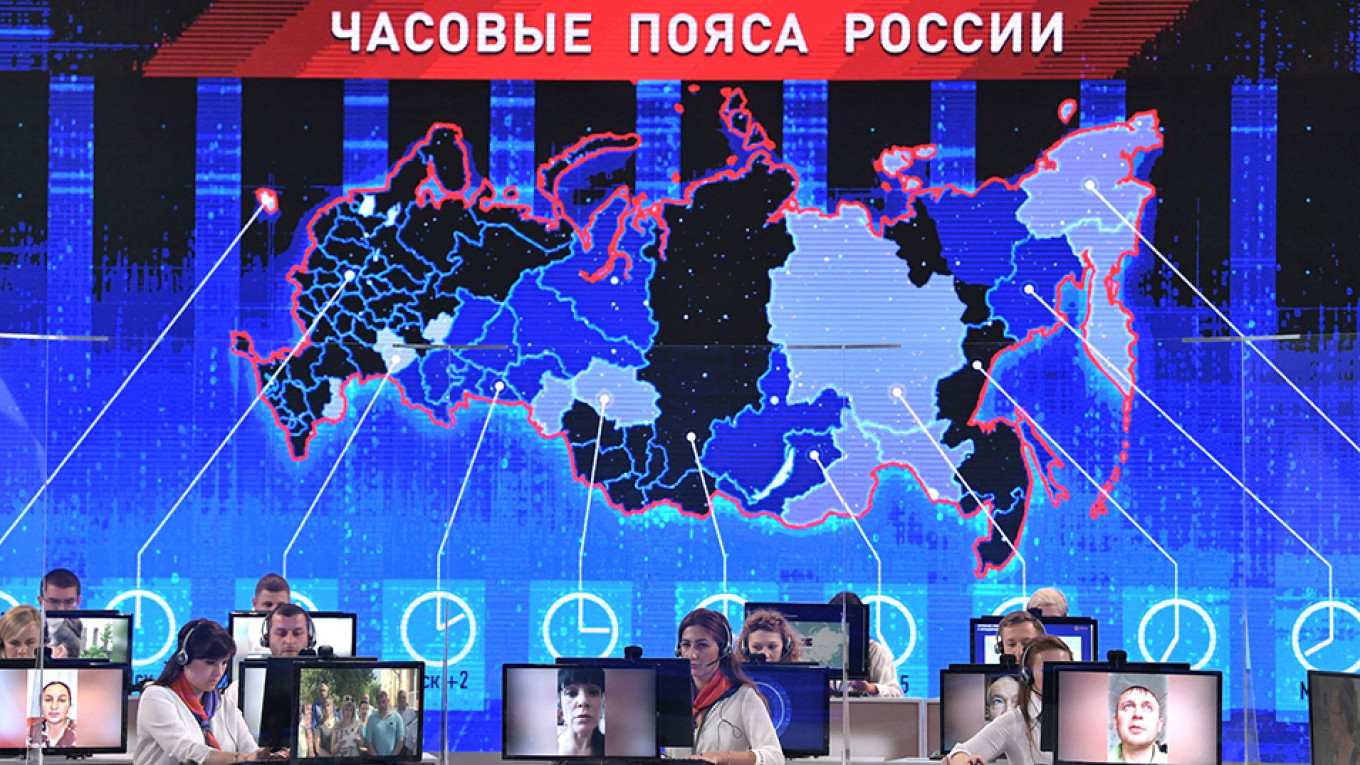
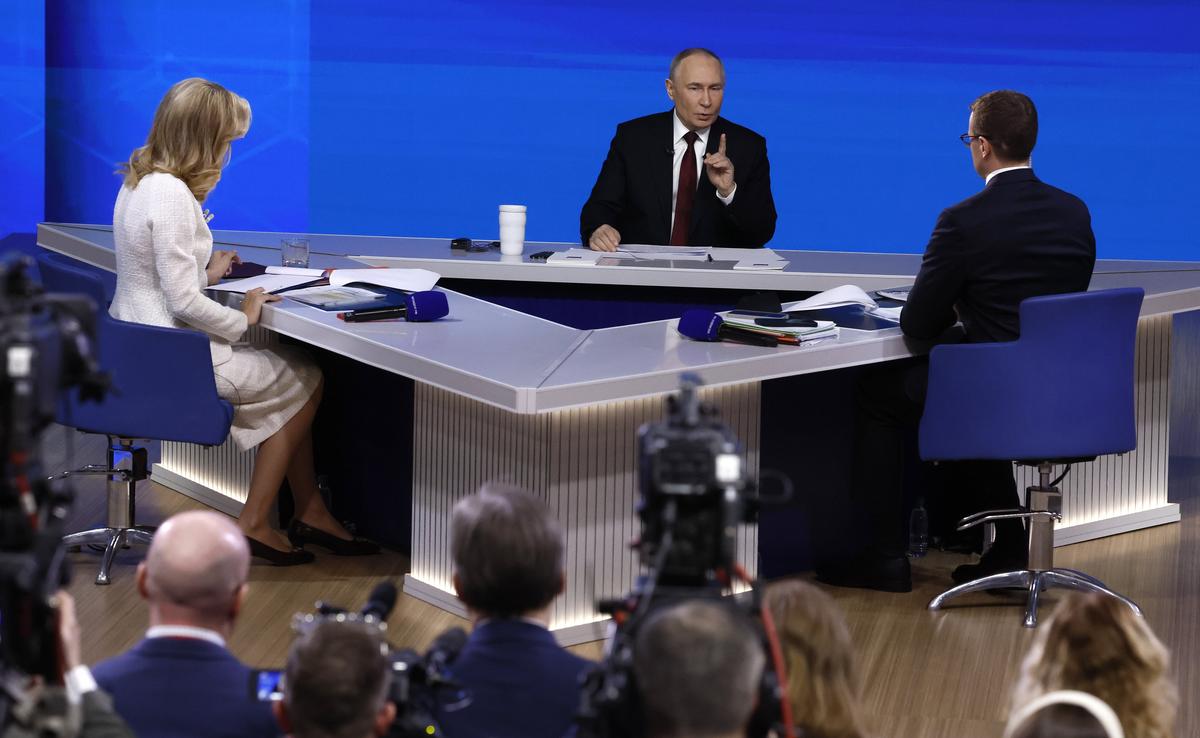
Vladimir Putin during his annual Direct Line call-in show at Moscow’s Gostiny Dvor, 19 December 2025. Photo: EPA / SERGEI ILNITSKY
 
"The financial package for Ukraine has been finalized. Ukraine is granted a zero-interest loan."
"These funds are sufficient to cover the military and budgetary needs of Ukraine for the two years to come."
"If Russia does not pay reparations we will -- in full accordance with international law -- make use of Russian immobilized assets for paying back the loan." 
German Chancellor Friedrich Merz 
 
"[The U.S. is trying to] figure out if we can nudge both sides to a common place."
"We understand that you're not going to have a deal unless both sides have to get."
"Both sides will have to make concessions if  you're going to have a deal. You may not have a deal. We may not have a deal. It's unfortunate."
U.S. Secretary of State Marco Rubio 
 
"The key question [relating to the U.S.-proposed plan to end the 4-year war] remains how the United States responds after consultation with the Russians. At this point, I honestly don't know, but I will know later today."
"This [agreement between Ukraine and Portugal for joint production of maritime drones] is one of the most promising areas of defence co-operation. What matters now is delivering results, and all parts of Europe must have sufficient capabilities to counter any threats."
Ukrainian President Volodymyr Zelenskyy 
The Key Quotes of Putin's Annual Question and Answer Session ...
Moscow Times
 
According to the Russian Defence Ministry it struck unspecified "transport and storage infrastructure used by the Ukrainian armed forces" as well as energy facilities supporting Kyiv's war effort. But then, Ukrainian drones have hit a Russian oil rig, the military patrol ship Okhotnik and other facilities as the ship patrolled the Caspian Sea near an oil and gas production platform at the Filanovsky oil and gas field, also hit, as well as a radar system in the Krasnosilske area of Crimea. 
 
Nothing, however, stops Mr. Putin from sneering at Ukraine's presumably feeble efforts at defence and offence, as, he claims, Russian forces are clearly winning the war that Ukraine is responsible for starting and he, Vladimir Putin, is anxious to put an end to. During the annual question-and-answer availability session staged by the Kremlin, Mr. Putin responded to many questions put to him. And in the process beamed over the fact that U.S. President Trump had shunted aside America's European allies in favour of Russia.
 
In responding to journalists and the general public in Russia the Russian president expressed his confidence on the trajectory of the Ukraine war while denying any responsibility for the war's consequences in massive human casualties, since it wasn't his fault at all, but rather that of the West. Sneering at NATO secretary-general's assertion that Russia might attack a NATO country within five years, pointing to the U.S. National Security Strategy linking Russia to "strategic stability". As for the security document; it is "largely consistent with Russia's intentions".  
 
Vladimir Zelensky and US President Donald Trump REUTERS/ Brian Snyder
"He can come back when he is ready for peace" 
Vladimir Zelensky and US President Donald Trump   REUTERS/ Brian Snyder
 
"When I arrived in Anchorage, I said these would not be easy decisions for us. But we agree to the compromises being 'proposed'. To say that we reject anything is absolutely incorrect and has no basis."
"The ball is entirely in the court of our opponents, so to speak, and, first and foremost, the leaders of the Kyiv regime and their, in this case, and above all, European sponsors." 
President Vladimir Putin  
It is, he reiterated, Kyiv that is refusing to end the war, while Moscow was prepared for peace with Ukraine and is willing to compromise to end the conflict, while Ukrainian forces were retreating "in all directions".  Terms suitable to Moscow are all that Russia is asking for to achieve peace. Terms eliminating "the root causes" of the conflict. Russia bears no responsibility for human war casualties "as we did not start that war".
 
While having assured President Trump that Russia stood willing to compromise in peace talks, Russia is also prepared to absorb more of Russia's "historical lands" from Ukraine through military force if negotiations to end the war on  Russian terms failed. Those Russian terms are, he contends, completely reasonable; the surrender of both Ukrainian territory in Russian hands, and portions still held by Ukraine. Oh and by the way, Ukraine taking steps to downsize its military and forego the weapons it holds to a limited number.
 
Right: no NATO presence in Ukraine as a guarantor of peace conditions upheld, nor any future attempt by Ukraine to join NATO. As for reconstruction costs associated with rehabilitating and rebuilding Ukraine, reparations are of no concern to Russia; Europe can foot the bill. Europe's decision to help fund Ukraine's continuation of its offensive saw EU Council President Antonio Costa declaring: "We have a deal. Decision to provide 90 billion euros of support to Ukraine for 2026-27 approved. We committed, we delivered."
 
Belgium continues to hold out on the EU's plan to use frozen Russian assets for Ukraine's war effort and reconstruction. The International Monetary Fund estimated 137 billion euros would be needed by Ukraine in 2026 and 2027. The 210 billion euros of Russian assets frozen mostly in Belgium would fit the bill nicely. While Putin's ally, Hungarian Prime Minister Viktor Orban who sees himself as a peacemaker declared: "I would not like a European Union in War. To give money means war"Putin answers questions as presenters Pavel Zarubin and Yekaterina Berezovskaya look on. Photo: EPA / SERGEI ILNITSKY Putin answers questions as presenters Pavel Zarubin and Yekaterina Berezovskaya look on. Photo: EPA / SERGEI ILNITSKY
"Western leaders created this situation themselves and continue fanning the flames by saying they are preparing for war with Russia. [It is] nonsense [that Russia wants a war with Europe]."
"I have no doubt that you and I will witness new successes of our armed forces, our troops on the contact line before the end of this year. That's the plan." 
President Vladimir Putin 
Putin answers questions as presenters Pavel Zarubin and Yekaterina Berezovskaya look on. Photo: EPA / SERGEI ILNITSKY

Putin answers questions as presenters Pavel Zarubin and Yekaterina Berezovskaya look on. Photo: EPA / SERGEI ILNITSKY

Labels: , , , , , ,

Monday, December 08, 2025

U.S. National Security Strategy (NSS)

"[European allies risk] civilizational erasure [as a result of their migration and free speech policies]."
"[Economic stagnation in Europe] is eclipsed by the real and more stark prospect of civilizational erasure."
"[Ending the war in Ukraine is a core U.S. interest to] reestablish strategic stability with Russia." 
"[Europe is enfeebled by its immigration policies, declining birthrates], censorship of free speech and suppression of political opposition [along with a] loss of national identities and self-confidence."
"Should present trends continue, the continent will be unrecognizable in 20 years or less. As such, it is far from obvious whether certain European countries will have economies and militaries strong enough to remain reliable allies. Many of these nations are currently doubling down on their present path. We want Europe to remain European, to regain its civilizational self-confidence." 
"[As for the Middle East], America's misguided experiment with hectoring [countries in the Middle East, especially monarchies in the Gulf, about their traditions and forms of government]."
"[The Arab nations are] emerging as a place of partnership, friendship, and investment. We should encourage and applaud reform when and where it emerges organically, without trying to impose it."
"[The U..S. strategy] is motivated above all by what works for America -- or, in two words, 'America First'."
U.S. National Security Strategy 
A person speaks into a microphone.
U.S. President Donald Trump speaks at an event in Washington, D.C., on Saturday. Trump's new national security strategy was welcomed by Moscow, according to a Kremlin spokesperson on Sunday. (Julia Demaree Nikhinson/The Associated Press)
 
"The adjustments that we see correspond in many ways to our vision."
"[The current U.S. administration is] fundamentally different from the previous ones." 
"President Trump is currently strong in terms of domestic political positions. And this gives him the opportunity to adjust the concept to suit his vision."  
Dmitry Peskov, Kremlin Spokesman  
A person seated leans back to speak with someone standing who bends over to listen.
Kremlin spokesperson Dmitry Peskov, left, speaks with Russian President Vladimir Putin in Moscow.(Sergei Ilnitsky/The Associated Press)
 
"This NSS is a real, painful, shocking wake-up call for Europe. It is a moment of cavernous divergence between Europe’s view of itself and Trump’s vision for Europe."
"If Europe had any doubt that the Trump administration is fully committed to a tough love strategy, it now knows for sure. The administration is asking—demanding, really—that Europe polices its own part of the world and, most importantly, pays for it itself."
"The most worrying parts of the strategy are the ones that chastise Europe for losing its European character. The sentiment behind the words seems to stoke fear of migrants and an adherence to an idealized, old-world Europe that is questionable at best. Modern Europe is vibrant, evolving, and—largely—pretty happy."
"The majority of Europe’s reaction to this NSS is likely to be the same aghast shock as met Vice President JD Vance’s Munich speech."
Center for Strategic & International Studies (CSIS) 
Released on Friday, the Trump administration's new national security strategy will give no comfort whatever to its heretofore allies in Europe, while Russia has already expressed its cautious pleasure, and China will be satisfied to an extent; Latin America has more to puzzle over, and the Middle East will feel somewhat gratified and no little relieved, for the most part. America's erstwhile partners in Europe stand to wallow in discomfort and uncertainty, not quite recognizing its place in this new America First reality imposed upon the world.
 
A disconcerting pivot from the role of controlling, stabilization empire of the globe to a new hands-off policy which allows other nations the pleasure of going it alone when it comes to stability and self-defense. With the second election/administration of Donald J. Trump to the presidency of the United States of America a new world order came into effect. On the other hand, Mr. Trump remains dedicated to 'peace' and peace-making, still counting on the Nobel Committee to come to its senses in 2026 -- which hasn't given it pause in striking 'terrorist' boats in the Caribbean Sea trafficking drugs to the U.S.
 
This is a document required by law that the administration must release; and it presents a break from former president Joe Biden's Democratic administration's course of intent which implemented a campaign to reverse Mr. Trump's first administration's trajectories. In brokering an end to the four-year-stagnant conflict in Ukraine, the first shock was the virtual abandonment of Ukraine's sovereign rights and a surprise embrace of Moscow's territorial imperative. An end to the war is not designed to liberate Ukraine but rather to consolidate a rapprochement with Russia.
 
As for America's European allies, their intransigence in supporting Ukraine and expecting the United States to continue the previous administration's commitment to that end, has left those expectations adrift and discombobulated. Trump's position in a drive to "reestablish strategic stability with Russia", when Europe's concerns are the Kremlin's yearning to restore the Soviet bloc to its former glory and NATO is stuck in a position of unease when its member-states are forced to cope with mysterious drones flying over their airports and military bases, flounders with its most powerful ally scorning its utility.
 
Jewish population of Greater New York reaches 1.4 million - JNS.org
Jewish population of greater New York reaches 1.4 million. JNS
 
The United States, of course, faces no issues of immigration/migrant/refugee instability where Congress is faced with elected Representatives from Somalia and 'Palestine' backgrounds along with other Muslim Arab-Americans whose loyalties to the United States are not always evident. The U.S. 'melting pot' has installed imams in mosques whose Friday sermons don't exactly praise democracy and love of their fellow-man. New York electing an avowed Socialist, Muslim extremist whose contempt for America's ally in the Middle East has him broadcasting his intention to 'arrest' Prime Minister Benjamin Netanyahu should he come to New York City, the major home of Jewish-Americans.
 
The world at large is extremely well aware of the presence of Donald J. Trump in the White House. It is still reeling from the economic blows of trading with the United States where former free-trade agreements have been swept into the dust heap of the past as economy-crippling tariffs have taken their place. The sovereignty of nations called into question when U.S. national security under Mr. Trump eyes Greenland and Canada as potential extensions of the United States. It's Mr. Trump's very own version of How to Win Friends and Influence People.  
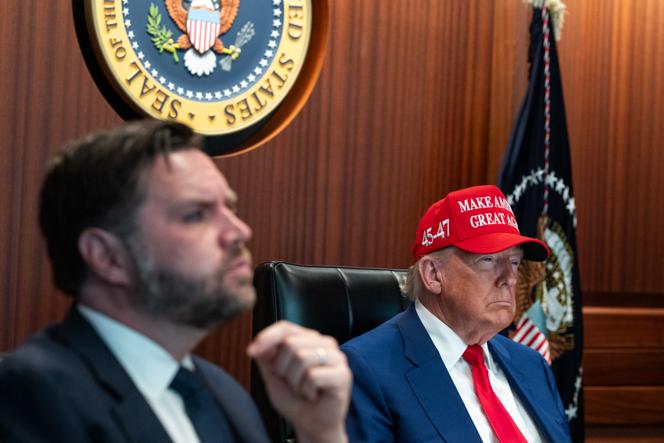
US Vice President JD Vance and Donald Trump at the White House, Washington, June 21, 2025.
J.D. Vance and Donald Trump   Getty Images
"That strategic clarity is entirely missing from the new NSS, which is more polemic than policy. The north star of great power competition with China and Russia—around which the first Trump administration built bipartisan consensus—is gone."
"Rather than describing the scope and scale of China’s systemic challenge to the United States and our allies and partners, the 2025 NSS makes clear that economics are “the ultimate stakes.” The new paramount objective of Washington’s China policy is a “mutually advantageous economic relationship with Beijing.” 
"The discussion of Russia is mealymouthed at best: The document declines to characterize the threat Moscow poses to U.S. interests. It instead opts for the bizarre formulation, “many Europeans regard Russia as an existential threat.” 
"And while the 2017 NSS highlighted Iran and North Korea as second-tier threats, the new NSS does not mention North Korea at all and downplays the danger posed by Iran after Operation Midnight Hammer."
"Vance’s speech in Munich could have been interpreted back in February as the ideological views of just the vice president and parts of the radical MAGA base. But now, these views have become the administration’s official policy, which will only accelerate Europe’s efforts to hedge against the United States and to build up its own autonomy."
Council on Foreign Relations  
https://time.com/redesign/_next/image/?url=https%3A%2F%2Fapi.time.com%2Fwp-content%2Fuploads%2F2025%2F10%2FGettyImages-2198761888.jpg%3Fquality%3D85%26w%3D1024&w=1920&q=75
  

Labels: , , , , , ,

Monday, September 29, 2025

Russian European Airspace Violations

"The repeated violations of our airspace are unacceptable. The message is clear: Russia is testing the European Union and NATO."
"And our response must be firm, united and immediate."
"At today's meeting, we agreed to move from concept  to concrete actions."
"[Ministers backed a broad plan to bolster the EU's eastern defences; the] immediate priority [should be a] drone wall, with advanced detection, tracking, and interception capabilities."
EU defence commissioner Andrius Kubilius 
 
"[Ukraine is] ready to participate [in the project]."
"The drone wall will create a fundamentally new defence ecosystem in Europe, of which Ukraine is ready to be a part."
Ukraine's defence minister Denys Shmyhal  
https://dims.apnews.com/dims4/default/59bd519/2147483647/strip/true/crop/5165x3408+0+0/resize/1440x950!/format/webp/quality/90/?url=https%3A%2F%2Fassets.apnews.com%2F6b%2Fc1%2Fd6ec0ff7d0ce5fb3f3e81522373b%2Fdf277eb34427443ebd5f5df4e7f96f10
A mobile radar installation is seen at the Danish military site on Amager, Pionegaarden, near the village of Dragoer and on the coast of Oresund, the sea between Denmark and Sweden, on Friday, Sept. 26, 2025. (Steven Knap/Ritzau Scanpix via AP)

The urgent need to create a "wall" of anti-drone defences following airspace violations by Russia, was unanimously agreed to by European Union countries on Friday. The threat that was made glaringly obvious this past week when  unidentified drones gave Denmark and Norway little option but to close down some of their airports gave sharp focus to the extent and breadth of the threat facing EU and NATO-member nations.
 
Online discussions were held by the EU defence commissioner with ministers from ten EU states located mostly along the bloc's eastern border. Ukraine, though not a member of the EU, was invited to take part in the discussions, given its proven capabilities to detect and disarm the missiles in their airspace by shooting down Russian drone swarms. 
 
The meeting participants agreed that focus would initially be on the development of a network of sensors to assist in better detection of such threatening incursions', feasibly on line within a year. Building full interception capabilities would take longer in the goal of intercepting the drones. Ursula von der Leyen, EU chief, in a keynote speech this month produced the first call for a "drone wall", mere hours following a NATO shoot-down of Russian drones in Poland. 
 
https://dims.apnews.com/dims4/default/61e6f88/2147483647/strip/true/crop/7971x5314+0+0/resize/1440x960!/format/webp/quality/90/?url=https%3A%2F%2Fassets.apnews.com%2F63%2F56%2F62e66e5caedbe3a893feb4f97a41%2Fdc30120af0a042678b2585ddaff7c64b

An engineer watches a Ukrainian-made quadcopter drone at an undisclosed location in Ukraine, June 12, 2025. (AP Photo/Efrem Lukatsky) 

NATO's initial response had little option given its unpreparedness, other than to use top-of-the-range fighter jets to fire expensive missiles with an aim of shooting down a handful of cheap Russian drones, emphasizing gaps in the alliance's arsenal for addressing such airborne threats. Since then, the alliance conveyed additional hardware to its eastern flank, yet the sort of low-cost capabilities of fending off Russian attack drones lack Ukraine's experience.
 
The proposal for the "drone wall" represents a portion of the broader impetus by Europe to  support an addition to its defences in recognition of the threats emanating from Russia. The program thus considered should be regarded as a new flagship defence project being worked on by the bloc in its response to Moscow's growing belligerence. 
 
https://dims.apnews.com/dims4/default/c95212f/2147483647/strip/true/crop/8192x5464+0+0/resize/1440x960!/format/webp/quality/90/?url=https%3A%2F%2Fassets.apnews.com%2Fbb%2F64%2F2c71ee4f59b3a1bbf7cd8d9da60c%2F8d1f2daeffb5466fbd865029fe331ebd
Ukrainian soldiers prepare to launch an Avenger UAV drone in Ukraine’s Kharkiv region, Wednesday, Sept. 24, 2025. ( AP Photo/Yevhen Titov)


Labels: , , , , , ,

Saturday, June 28, 2025

Europe: Preparing for War

"Russia emptied four brigades out of the Leningrad district to Ukraine, most of them actually killed."
"The reality is that when this war ends, Russia will start building up its soldiers on our border. But this is nothing new, it's not problematic."
"I'd ask people to stay cool, calm and collected. We know exactly what we're doing. We have full control over what's going on."
Finnish President Alexander Stubb
 
"The long term is just that Russia needs to take defence on the border with Finland more seriously now that Finland is a NATO member."
"If NATO and Russia go to war in the Baltics, the Finns aren't going to just sit there. They're likely going to counterattack and annex the Murmansk Peninsula – and the Russian nuclear forces and the Northern Fleet are all based in Murmansk."
"So the Finns can do quite a lot in terms of disrupting that by cutting the supply lines between St Petersburg and Murmansk."
Ed Arnold, senior research fellow for European security, International Security department, Royal United Services Institute defence think tank, United Kingdom
https://www.helsinkitimes.fi/images/2025/05/screeenshot.png
Before and after images from the Russian bases. Photo: Planet Labs PBC/Airbus /screenshot from SVT
 
Earlier this month Finland's public broadcaster, YLE reported the presence of a garrison being built for an artillery brigade by Russia, in a town close by the two countries' frontier. Half of the North Atlantic Treaty Organization's (NATO) land border is guarded by Finland against NATO's well-known adversary. A border that stretches out along over 1,300 kilometres.
 
There is a long history of conflict between Finland and Russia. As such, it is not surprising that Finland has been among the most dedicated European supporters and providers of military aide to Ukraine. In the face of Moscow's future intentions against Finland, its president states that his country remains "calm and collected", knowing through long experience what may be presenting for the not-too-distant future.
 
According to NATO Secretary-General Mark Rutte, such preparations are of no surprise to NATO as well. The Kremlin, suggested Mr. Rutte, may be counting on a five-year opportunity when Russia's war imposed on Ukraine has been concluded, to turn its attention elsewhere, and Finland appears the most likely initial target.
 
Nordic officials have their own version of a potential timeline before such an attack takes place, giving it a shorter window, hastening preparations in the knowledge that Russia will focus on rebuilding its capacity to carry out a conventional attack on yet another of its neighbours. 
"Before 2022 there was an unmanned aerial vehicle regiment somewhat operating in the field – so it wasn’t totally abandoned. But it wasn’t being used for larger equipment such as helicopters."
"But now, after 2022, they have been refurbishing it, renovating it, clearing the overgrown areas – so it seems that they are intending to also ramp up their activities in that area too."
"We are seeing military activity, and we are seeing the Russians developing their military infrastructure and most likely training new soldiers. But it's not anything too radical at the moment."
"It's really difficult to say yet, because the war in Ukraine is still heavily ongoing, and achieving a truce seems to be extremely difficult. The future will show just how heavily the Russians will invest in all of this – military bases, new units, soldiers and so on. But as far as we know now, it's going to be significant."
Finnish military historian Emil Kastehelmi 
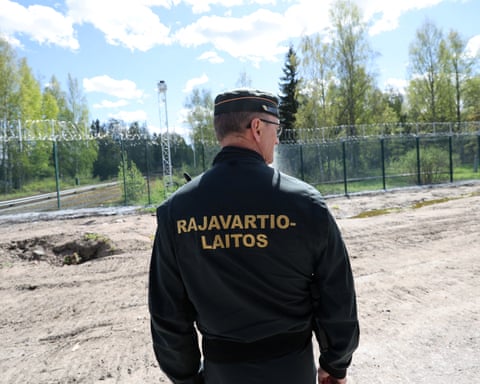
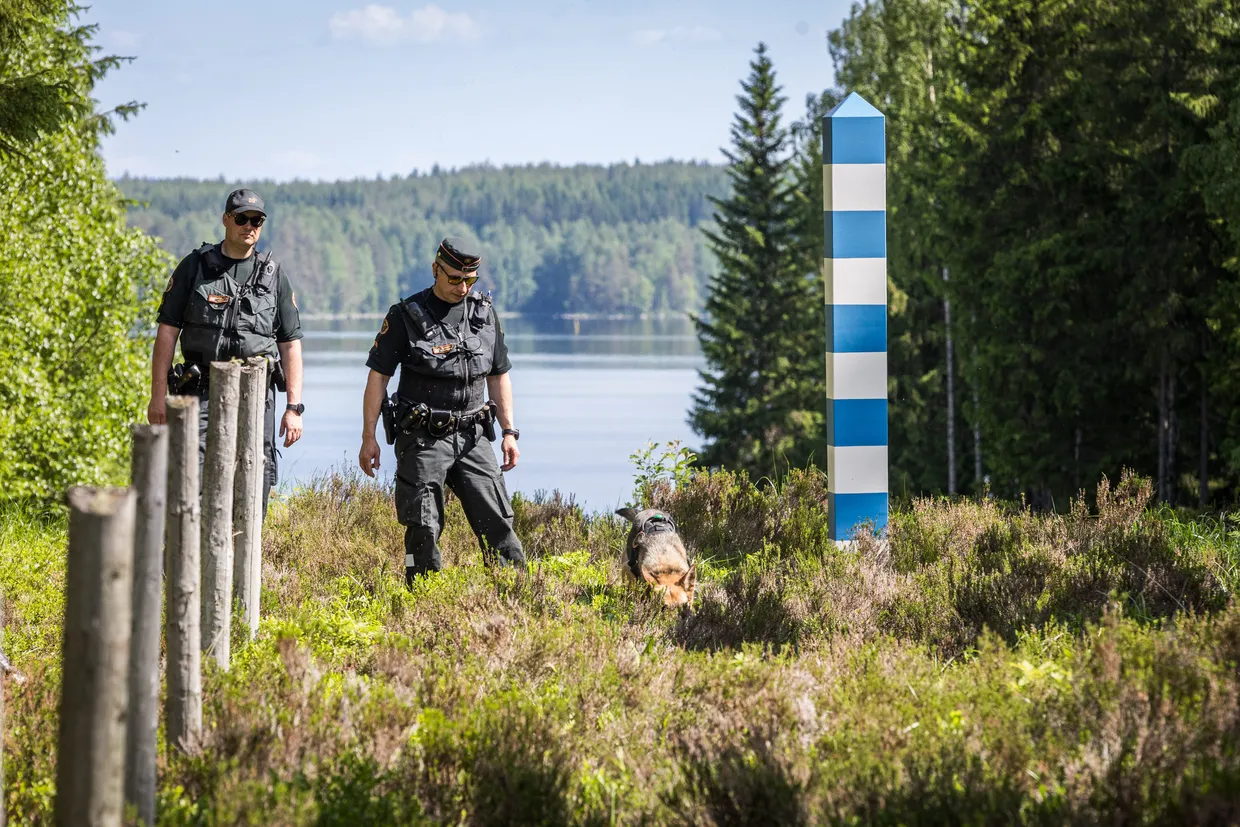
Rear of a border guard standing in front of the fence on the Finnish-Russian border
Finland’s border guard has completed the first 35km of a planned 200km fence on its eastern border with Russia. Photograph: Leonhard Föger/Reuters
 
Last week Finland's parliament approved a withdrawal from the Ottawa Convention, banning anti-personnel landmines. The vote was 157 to 18 in Helsinki, when lawmakers firmly committed to back the government's proposal. The release from the convention was a political decision taken in April while addressing risks from Russia.
 
NATO leaders had agreed on a massive increase in defence spending for its member-states, each to pledge honouring a five percent gross domestic product to boost the 32-member-organizational military capacity in mutual defence against a common enemy. At the same time the group reiterated its "Ironclad commitment" to respond as a unified military group in defense of any of its members coming under attack. 
 
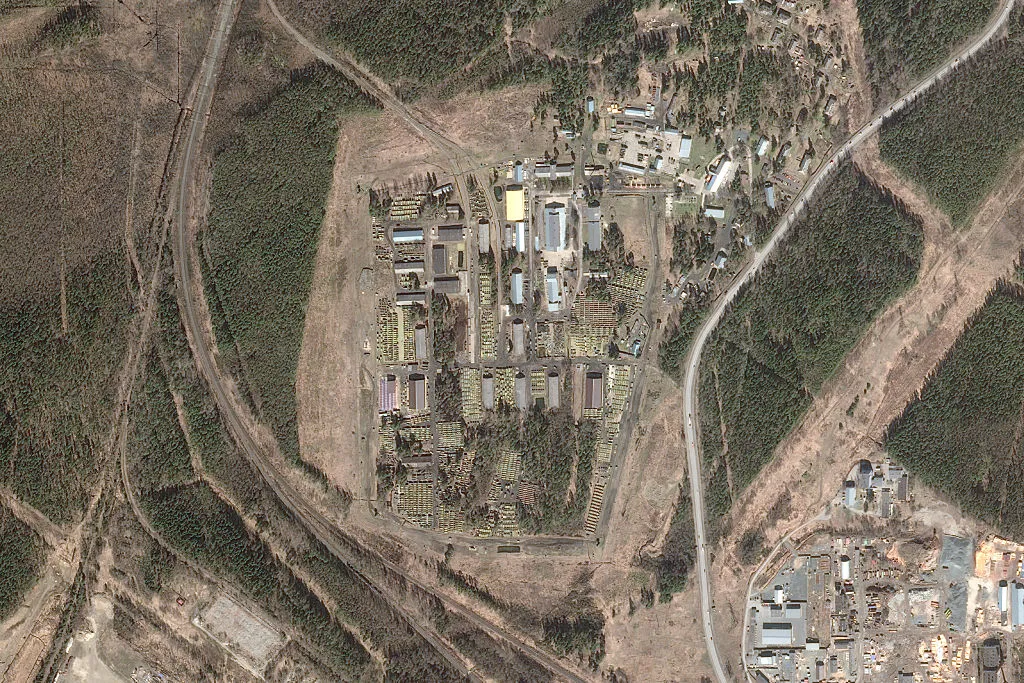
Some 175 kilometeres from the border, three large storage halls have been built in Petrozavodsk, each of which is judged to have the potential to  hold around fifty armed vehicles. As of April 2025, a fourth facility has been under construction. The new structures, according to analysts, may be intended to conceal an accurate number of the military vehicles to be stationed there.  
"[The developments appear to confirm earlier Russian statements about] military-technical measures [in response to NATO’s enlargement]."
"When we applied [Finland and Sweden] for NATO membership, Russia said it would take such steps. We are now seeing that happen."
Sweden’s Chief of Defence Michael Claesson 
 
"[The Russian government in April 2023 when Sweden and Finland jointed NATO, vowed to take] counter-measures."
"The enlargement of NATO is an encroachment on our security and on Russia’s national interests."
"We’re going to be following what happens in Finland closely … and how it threatens us."
Kremlin spokesperson Dmitri Peskov
"[The Finns’] whole position was … we need to be ready to be able to face the Russians on our own."
"So that's their mindset, and it's how their military is configured. They can get 284,000 troops on declaration of war. That's significant."
"That’s probably more than the UK can get together, probably more than Germany, more than France – probably more than anyone else bar Poland at the moment."
Ed Arnold, senior research fellow for European security


Labels: , , , , , ,

Friday, June 20, 2025

Europe's Russian Threat

"Russia is already a direct threat to the European Union."
"[Moscow is spending more on defence than the EU's 27 member states combined, and this year will invest more on defence than [on] its own health care, education and social policy combined."
"This is a long-term plan for a long-term aggression. You don't spend that much on [the] military, if you do not plan to use it."
"Europe is under attack and our continent sits in a world becoming more dangerous." 
"Today, against NATO and the EU, Russia doesn’t stand a chance. But we must stick together."
"When NATO leaders meet next week, keeping unity in the alliance is as much a priority as spending more on defence."
EU Foreign Policy chief Kaja Kallas 
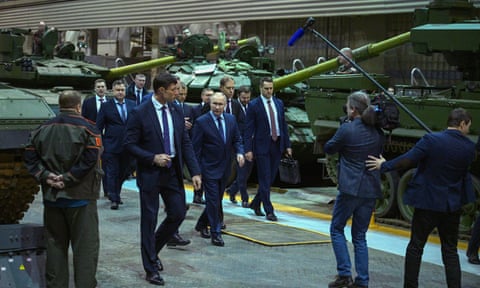
Vladimir Putin visits the Uralvagonzavod the largest in Russia producer of tanks, in Nizhny Tagil
Vladimir Putin during a visit to the Urakvagizavid factory, Russia's largest producer of tanks: Photo: Sputnik/Kremlin Pool/EPA
 
Acts of sabotage and cyberattacks by Russia toward members of the European Union have not endeared them to Moscow in their studied opinion of the Kremlin's plans post-Ukraine war. That Russian President Vladimir Putin has overseen a massive military spending spree leads to the conclusion that relations with Russia stand the potential of degrading even further than merely criticizing it for invading and annexing parts of  territorial Ukraine. That, if in the final analysis, Moscow achieves at least a part of its territorial aggression in Ukraine, it will continue to cast its malevolent eye on its squirming 'near abroad' seems inevitable.
 
There is a fairly general consensus among most EU members that Mr. Putin has plans for future use of his armed forces. Its ongoing airspace violations, provocative military exercises and energy grid attacks, on pipelines and undersea cables, represent in their opinion a testing of the waters, so to speak, as well as a deliberate move to deliver a message for the future. No one in Europe, they feel, can feel securely immune from Putin's roving eye and his territorial ambitions to make Greater Russia even greater at their expense.
 
According to NATO Secretary-General Mark Rutte, Russia is producing weapons and ammunition in three months in a quantity and of technical efficiency rivalling the entire output of the 32 allies combined can produce in a year. Russia, he believes, could be in a position to launch attacks on NATO allies come the end of the decade. Europe is becoming increasingly alarmed over the potential of Russia's capacity for mischief.
 
Vladimir Putin sits in a T-90AM tank at the Russian Expo Arms in the Urals city of Nizhniy Tagil in 2011.
Vladimir Putin sits in a T-90AM tank at the Russian Expo Arms in the Urals city of Nizhniy Tagil in 2011. Photograph: Alexei Druzhinin/AP
 
Even to the extent that Russia might wish to test the organization's Article 5 security guarantee, the assurance to its members that should any one of their members come under attack, NATO would act as one in response; the entire 32-member alliance would be committed to militarily defend any one of their members coming under a military attack by an outside source. This is a pact that is taken seriously, presumably acting as a clear deterrent to any member-state of the alliance coming under attack from malign forces.
 
NATO allies officially recognized that significant and cumulative cyberattacks could be viewed as representing a situation analogous to an armed attack, and as such could lead to an invocation of Article 5. Although that recognition of a prevailing situation was formally accepted in 2021, those same attacks have continued, with the alliance making no move to counteract them collectively. A malign actor perceiving sound and fury but no reaction could very well make their own conclusions based on probing the intent and analyzing the lack of response.
 
Europe finds itself somewhat rudderless of late, with new realities brought to the fore under the Trump administration in the United States, their foremost sponsor for decades. Reliance on the steady commitment of the United States to guide and direct the alliance has come under the sharp new lens of an altered political environment, leaving Europe adrift in indecision, a quandary propelling it to commit to greater responsibility for the outcomes of its relations with outlier nations.
 
Europe feels more vulnerable without the assured military canopy of the United States under the Trump administration that blows hot and cold with conflicting positions and alarming statements issuing from the American president. It is learning to fend for itself. Its support for Ukraine in its battle against predatory Russia remains firm, albeit weary; a general feeling of reduced assurance in the precarious position it now finds itself in, makes the alliance both nervous and defiant.       
                       
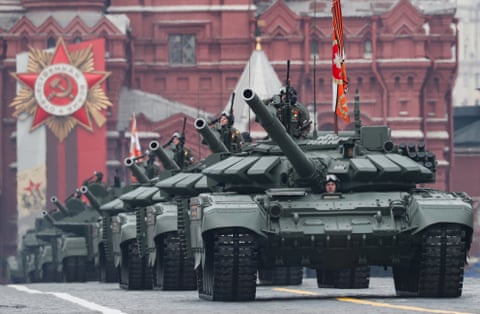
Military hardware in Red Square during Russia’s annual Victory Day military parade in May 2022.
Military hardware in Red Square during Russia’s annual Victory Day military parade in May 2022. Photograph: Yuri Kochetkov/EPA
 
"We are very certain, and we have intelligence evidence for this, that Ukraine is just a step on the path to the West."
"[Russia's goal is to expand its sphere of influence westward]. They want to catapult NATO back to the state it was in at the  end of the 1990s."
"They want to kick America out of Europe, and they'll use any means to achieve that."
Bruno Kahl, German's Foreign Intelligence Service chief 

Labels: , , , , ,

Tuesday, June 03, 2025

Russian Military Preparations -- Finland On Alert

"The Russian military has undergone a significant force expansion."
"After the war, the ground force will probably end up larger than before 2022." 
"Looking at the planned restructuring of military districts, it seems clear that they're going to prioritize areas facing NATO."
Michael Kofman, senior fellow, Carnegie Endowment for International Peace, Washington
 
"They are changing structures and we are seeing moderate preparations when it comes to building infrastructure close to our borders, meaning that they will, once the war in Ukraine hopefully ends, start to bring back the forces that have been fighting in Ukraine, especially land forces."
"They are doing it in phases. I would say it is still moderate numbers. It’s not big construction, but in certain places building new infrastructure and preparing, bringing new equipment in."
"You also have to evaluate whether they are preparing to send more troops to Ukraine or preparing to build up their forces close to our border. But I guess they are doing both."
"What happened right after the Ukrainian attack was we applied for NATO membership and then when we were accepted Russia announced they would start to change their military posture across the border."
Maj.-Gen. Sami Nurmi, the head of strategy of the Finnish defense forces 
https://thedefensepost.com/wp-content/uploads/2025/05/Sisu_XA-180-IFOR.jpg
Finnish troops with their Sisu XA-180 Armored Personnel Carrier. Photo: PFC LUIS A. DEYA/Wikimedia Commons
 
Recent satellite imagery has revealed that Russian forces have been put to work fortifying bases and building military infrastructure adjacent the border with Finland. These revelations are construed as moves that could portend the Russian strategy for action meant to be taken when the conflict with Ukraine comes to an end. Row after row of new tents; new warehouses capable of storing military vehicles; fighter jet shelter renovations; amongst steady construction activity has taken place on an unused helicopter base, in imagery confirmed by NATO.
 
At the present time these changes appear to represent early stages of a more ambitious, longer-term expansion. However, NATO authorities state the situation bears little resemblance as yet to the buildup of 2022 along the Ukraine border prior to Russia's full scale invasion. Russia is for the present, preoccupied with its war in Ukraine and such being the case, can spare very few troops along its frontier. Finland itself feels that the situation does not -- as yet -- constitute a threat.  
 
https://assets.kyivindependent.com/content/images/2025/05/GettyImages-2155551120.webp
Finnish Border guards in Joensuu at the border with Russia on June 5, 2024 (Jarno Artika / Lehtikuva / AFP via Getty Images) 
 
Russia is in fact, responding to its well-known antipathy to its near neighbours becoming part of NATO, a presence it views as a direct threat to Moscow's interests. Finland, as of two years earlier is now one of the newest members of NATO, impelled to join the defense group as a result of Russia's invasion of Ukraine. In reacting to its neighbours' willingness to become NATO members, the Kremlin's aggressive moves in response have had the predictable result of spurring those neighbours to find security within the NATO alliance.
 
The 1,300-kilometer frontier represents the Western alliance's longest line of contact with Russia and as such, analysts predict it has the potential to become a hot spot, much of it lying in the contested Arctic Circle. Recent Arctic war games held by American and Finnish troops in the region, had hundreds of troops rushing about the woods, with the Finns on cross-country skis -- countering an obvious enemy, presumably Russia. 
 
The prediction by Finnish defense officials, that whenever the high-intensity phase of the war in Ukraine comes to an end, Russia will then turn to deploying thousands of troops to the Finish frontier. They feel they have an estimated five years roughly before Russia will be able to rebuild its forces to threat level. This, according to their reckoning, is a certainty, their expectations being that they will face triple numbers of Russian troops. "We'll be talking about so much higher troop levels", stated Brigadier General Pekka Turunen, director of Finish defense intelligence. 
 
https://assets.kyivindependent.com/content/images/2025/05/GettyImages-2214222575--1-.webp
Completed Russian warehouse construction is visible in Maxar satellite images in Petrozavodsk, Russia, May 4, 2025 (Satellite image 2025 Maxar Technologies)
 
The Baltic nations in Russia's near abroad were the first of the former Soviet Union satellites to join NATO, in the process leading Moscow to fear that large stretches of Russia's border became vulnerable to the presence of NATO. When it appeared that Ukraine, a much larger former Soviet republic, would rise to the option to join, Russia was spurred to mount its 'special military operation'.
 
Satellite imagery make it clear that Russian helicopters have been returned to a base nearby Murmansk, a Russian port city located in the Arctic Circle, after having stood unused for two decades. Recently, dozens of Russian warplanes were seen at the Olenya air base also located in the Arctic, less than 160 kilometers from the Finnish border, as identified by satellite imagery. 
 
Over a hundred new tents appeared a year earlier at Kemenka, a Russian base under 65 kilometers from Finland. "They are expanding their brigades into divisions, which means that the units near our borders will grow significantly -- by thousands", Emil Kastehelmi, an analyst with the Black Bird Group, a Finnish organization which analyzes military developments, revealed. This is a situation which, if it reaches such a point, will involve a NATO member-nation, compelling NATO itself to respond.
 
https://q-images.nzz.ch/2025/05/28/russian-bases-map_fw@3x-80-1e51a043e0047f3858e5282744c0e660.jpeg?width=1120&format=pjpg&auto=webp
Sources: Black Bird Group, GFSIS, OpenStreetMap, Maptiler, NZZ research


Labels: , , , ,

Wednesday, April 02, 2025

All for One -- and One For All

"We stand in grief with the families and loved ones of these extraordinary 'Dogface Soldiers' during this unimaginable time."
"But the search isn't finished until everyone is home. Words cannot express our gratitude to those still working around the clock during these extensive search and recovery efforts and  your unwavering commitment not to rest until all are found."
"This past week has been devastating. Though we have received some closure, the world is darker without them."
“This loss is simply devastating. We are wrapping our arms around the families and loved ones of our Soldiers [during this difficult time]."
Commander Maj.-Gen. Christopher Norrie, 3rd Infantry Division  
 
"It has been truly amazing and very humbling to watch the incredible recovery team from different commands, countries and continents come together and give everything to recover our Soldiers."
"Thank you, Lithuania, Poland, Estonia, the U.S. Navy and the Army Corps of Engineers."
"We are forever grateful."
 Lt. Gen. Charles Costanza, commanding general, V Corps
https://media.cnn.com/api/v1/images/stellar/prod/c-gettyimages-2206632532.jpg?c=16x9&q=h_653,w_1160,c_fill/f_webp
 
"Lithuania mourns together with the American nation."
"Please accept my heartfelt condolences, as well as those of the Lithuanian people, to you, the loved ones of those who lost their lives, and all the people of the United States of America. "
"During this difficult time, our thoughts and prayers are with you."
Lithuanian President Gitanas Nausėda 
Under NATO, to give reassurance to Eastern Europe, member-countries of the military alliance were assigned to establish a Rapid Reaction Force as a deterrent and a defence against Russian designs on its neighbours. With a very real and demonstrated willingness to invade the borders of neighbouring nations, the Russian Federation's ambitions of territorial aggression and expansion gave birth to a renewed move by NATO to offer protection to its members under duress of potential invasion.
 
Among other member-nations the United States established a unit in Lithuania. On March 25, an American armoured vehicle with four U.S. soldiers aboard went astray in a marshy peat bog located at the huge General Silvestras Zukauskas training ground nearby the town of Pabrade. A search was undertaken and the location of the missing vehicle was found, though no vehicle was in sight. The almost-70-ton behemoth had sunk straight down, along with its personnel. 
 
https://i.abcnewsfe.com/a/7df6668b-2073-4d68-a5d3-9c3254fd1456/army-training-02-ht-jef-250327_1743084744908_hpEmbed_9x16.jpg?w=750
The U.S. Army search for four soldiers who went missing during a scheduled training exercise near Pabradė, Lithuania.  U.S. Army
 
It took six days in a massive effort by American, Polish and Lithuanian armed forces to locate and dig the M88 Hercules vehicle out of the peat bog. The search was widened when three of the missing men of the 1st Armoured Brigade Combat Team, 3rd Infantry Division were found dead, and a fourth body of the missing soldiers evaded the search teams. On a tactical training exercise, the soldiers were reported, along with their vehicle to be missing early on Tuesday. 

The thick forests and swampy terrain around Pabrade, some ten kilometres west of the border with Belarus saw hundreds of Lithuanian and American soldiers and other rescuers searching, engaged in a rescue mission. On Wednesday the armoured vehicle's whereabouts was finally discovered, submerged in 4-1/2 metres of swamp water. 

Military helicopters, fixed-wing aircraft, unmanned aerial systems and search and rescue personnel were provided by the Lithuanian armed forces. Excavators, sluice and slurry pumps were brought to the site, along with other heavy construction equipment along with technical experts and several hundred tons of gravel and earth, all to help with the recovery mission.
 
American navy divers manoeuvred through thick layers of mud, clay and sediment "with zero visibility" to finally reach the 63-ton vehicle on Sunday evening. There they established several points where steel cables could be attached to enable the work involved in lifting the vehicle. During the effort of dragging the vehicle out of its submerged position, they began to lose traction, requiring more heavy dozers to provide additional grip. Two hours later the vehicle was pulled free of its ghastly grave.
 
https://i.abcnewsfe.com/a/b01ed838-3d76-49b1-8ff6-ddbe841bee19/soldier-1-ht-er-250401_1743539523619_hpMain_4x3.jpg?w=750
Sgt. Edvin F. Franco, 25, of Glendale, California, Sgt. Jose Duenez, Jr., 25, of Joliet, Illinois and Pfc. Dante D. Taitano, 21, of Dededo, Guam.  U.S. Army

The navy dive team's work was not over. They then turned to searching the area with the use of radar for the presence of the still-missing fourth soldier. And his body was ultimately found, to join that of his other three comrades, to be returned to the United States and to their families, for burial. 
 
An undated photo of Staff Sgt. Troy S. Knutson-Collins, 28, of Battle Creek, Michigan, who died in a training mission in Lithuania.  U.S. Army

"I can’t say enough about the support our Lithuanian Allies have provided us. We have leaned on them, and they, alongside our Polish and Estonian Allies — and our own Sailors, Airmen and experts from the Corps of Engineers — have enabled us to find and bring home our Soldiers."
"This is a tragic event, but it reinforces what it means to have Allies and friends."
Gen. Christopher Donahue, commander of U.S. Army Europe and Africa

Labels: , , , , , ,

Follow @rheytah Tweet