Tradition of Honor Killings in Pakistan
"Many communities and families insist that their misplaced sense of 'honor' is located in a woman's body and actions.""That is also why control over a woman's actions and rights find so many colluders across the board in keeping heinous customs like this alive."Senator Sherry Rehman, Pakistan"In a country where conviction rates often fall to single digits, visibility — and the uproar it brings — has its advantages.""It jolts a complacent state that continues to tolerate jirgas [Loya Jirgas ... 'grand councils'] in areas beyond its writ."Constitutional lawyer Asad Rahim Khan
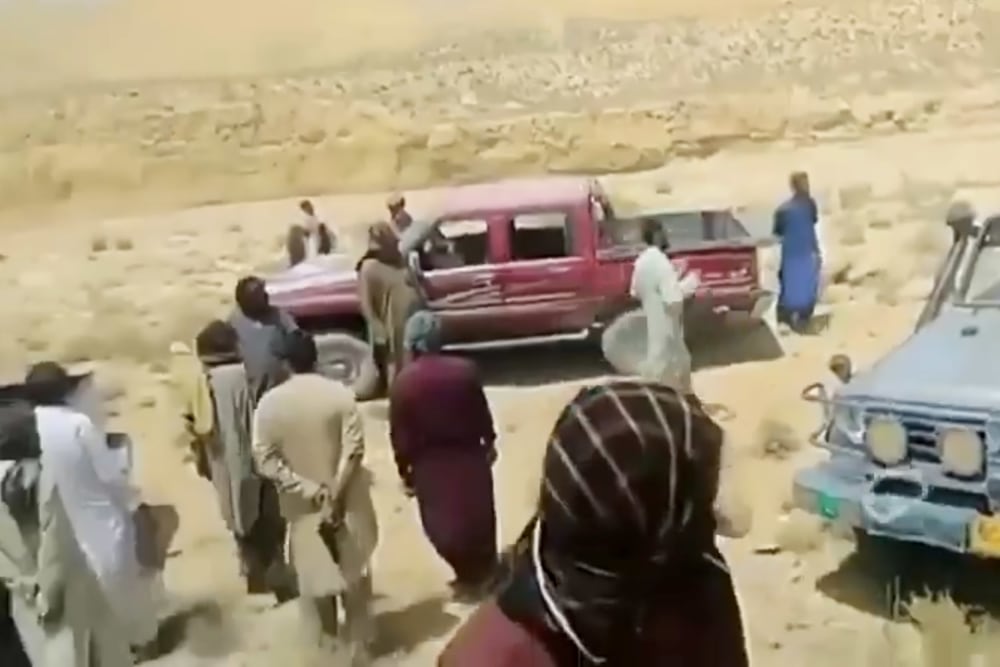 |
| The scene in Balochistan province, Pakistan, before the "honor killing" was carried out. NBC News |
The
two people involved, a man and a woman, accused of having an illicit
love affair -- in a country whose strict Islamic moral codes include
capital punishment for women who stray from their assigned roles as
subservient to men in all matters, for whom the human rights freedom of
women in other societies are severely restricted; they may not be in the
company of men other than husband, father, brother, uncle or risk the
ultimate punishment -- were lured to a neutral place in their village
where they were informed they were condemned to death.
Taken
to an open desert in southern Pakistan, a village crowd of both men and
women backgrounded them; for the women a warning lest they ever
surrender to the temptation to dishonour their family, their clan, their
village; for the men a validation that women who stray from their
assigned role as modest wife, daughter, sister, there will be due
punishment delivered to restore the honour their disgraceful actions
blemished.
Bano
Bibi was 35, a wife and mother of three. The man accused of being her
lover, Ehsanullah Samalani, 50, a father of four, was in this instance,
also punished to restore the honour he had besmirched intolerably. She
was shot first, three times, by her younger brother. Her mother, also
present, condemned her daughter and supported the punishment that took
her life -- for the killing "was necessary to cleanse our family's honor".
Particularly
in rural areas of Pakistan, honor killings are rampant; bringing shame
by irregular, disapproved conduct by a woman will guarantee lethal
punishment. And it is usually family members closest to the woman who
will carry out the death sentence. Even a child who refuses marriage to
an elderly man, thus bringing dishonor to her family can present as a
candidate for death, for centuries-old cultural practices do not bend to
the contours of modernity or human rights.
The
double execution took place in mid-July. Since then, public protests
have broken out, causing authorities to take notice, and with that
notice, action. That action was spurred by an investigation that
resulted in arrests, including that of Bano Bibi's mother for her role
in the death of her daughter. On average a woman dies every day for the
cultural crime of dishonoring family. A video of that double execution
went viral, fully six weeks after the event.
| Bano Bibi's mother, Gul Jan Bibi, said the killings were based on traditional Baloch traditions and were not sinful. (Reuters: Abdul Wali) |
Pakistan,
a nation of over 240 million where fundamental Islam is the law of the
land under Sharia, saw politicians and law enforcement officials
spurred to take action. After all, they have time and again vowed to
commit to the protection of women, and to take action against
perpetrators of honor killings. But traditions die hard, even while
women's lives are easily taken in punishment of carnal sins attributed
to both the innocent and the 'guilty'. Despite the government
assurances of imminent action, tradition carries on.
The
video shows male onlookers watching in silent intensity, some of them
filming the execution with their smart phones. Modernity is viewed
through the lens of technology, but cultural tradition is set in the
crystalline cast of a society whose moral piety is a death machine for
any who dare challenge tradition through the irresistible draw of human
emotions.
The
early June executions, thanks to the video and protests that
accompanied its viewing, saw an investigation begin in July, leading to
the arrest of over 15 people involved in the double killing. Last year
over four hundred women were victimized by these cultural executions,
according to the Human Rights Commission of Pakistan, independent of
government. Pakistan does have laws to protect against gender-based
violence; still such murders go unpunished; tribal code trumping civil
law in rural Pakistan.
Relatives
most often kill women for refusing forced marriage, for seeking
divorce, or for engaging in relationships that men categorize as
violations of their values. Criminal convictions resulted in 0.5 percent
of all reported honor killings last year. "Incidents every now and then get traction in the media, but it continues in a shameful way", stated Farah Zia, director of the Human Rights Commission of Pakistan.
| A video of an "honour killing" of a woman and her lover in Pakistan has sparked protests in Quetta city. (Reuters: Rizwan Saeed) |
Labels: Culture, Honour Killings, Pakistan, Tradition
posted by Pieface @ Saturday, August 23, 2025


<< Home