The Failed Canadian Justice System
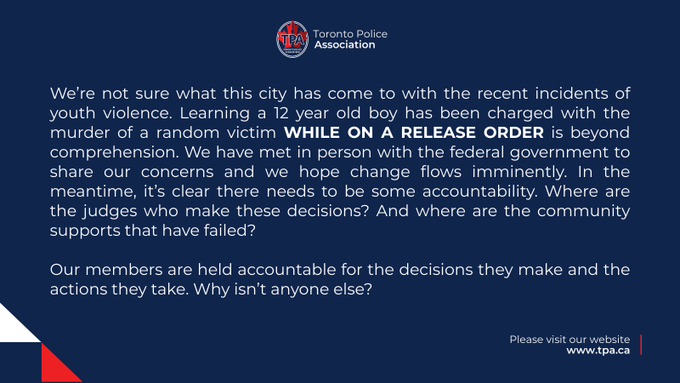
"Where are the judges who make these decisions?""Our members are held accountable for the decisions they make and the actions they take.""Why isn't anyone else?"Toronto Police Association"What we expect from the Crown -- what you and the public should expect -- is that the Crown is a zealous advocate for justice.""Unfortunately, so far, we have not seen that in this case."Megan Hankeich, executive director, legal services, Edmonton Police Service"This decision is not only profoundly disrespectful to Constable Scott's family and colleagues, it is a slap in the face to every police officer who puts their life on the line each and every shift to keep our communities safe."National Police Federation"...This incident comes just days after RCMP Members in Nanaimo apprehended a subject who was threatening residents with a machete while also out on bail, as well as a drive-by shooting in Coquitlam last week believed to involve suspects known to police."National Police Federation
 |
"Catch and release" justice
has infuriated Canadian police agencies for years, and the situation
has more latterly become a full-blown crisis of crime and criminals
being let off the hook of responsibility by a lenient system of justice.
Police do their jobs, trying to protect the public from sociopaths,
psychopaths and the criminal elements that invariably infect every
society, only to see soft-on-crime judges rule that those committing
serious crimes are still eligible for bail and release. While prison
parole boards opt for parole and early release for those committing
themselves to terrorizing whole communities.
Appeals
by police services to the federal government to harden bail for repeat
offenders have fallen on deaf ears. The previous Conservative government
had imposed hard bail conditions for criminal offenders, only to see
follow-up Liberal legislation reverse the decisions made by their
predecessors. Rising crime rates led to the Conservative move in an
effort to make sociopaths understand there are consequences to their
violent actions. Since the Liberal softening of consequences crime rates
have soared in Canada.
 |
| In the past decade, identity-based justice and a distaste for punishment has created a regime that allows chronic offenders to walk free Tristin Hopper, National Post |
The
Toronto Police Association was infuriated in a case where a 12-year-old
on a release order took part in the beating death of a homeless man in
Toronto. In Edmonton, police slammed Crown prosecutors for their failure
in pursuing murder charges for a woman who killed an eight-year-old
Indigenous girl. The child's whereabouts were unknown in 2023, missing
from her Alberta home until her body was discovered in the back of a
pickup truck stuffed into a hockey bag.
Crown
prosecutors agreed to a 'solution' where the accused killer of the girl
would plead guilty to manslaughter thus avoiding a murder prosecution.
Provincial officials were called by Edmonton police to annul the
agreement; while details of the case had been placed under a publication
ban shield, outraged police threatened to publicly disclose key details
of the case if the plea agreement proceeded.
Two
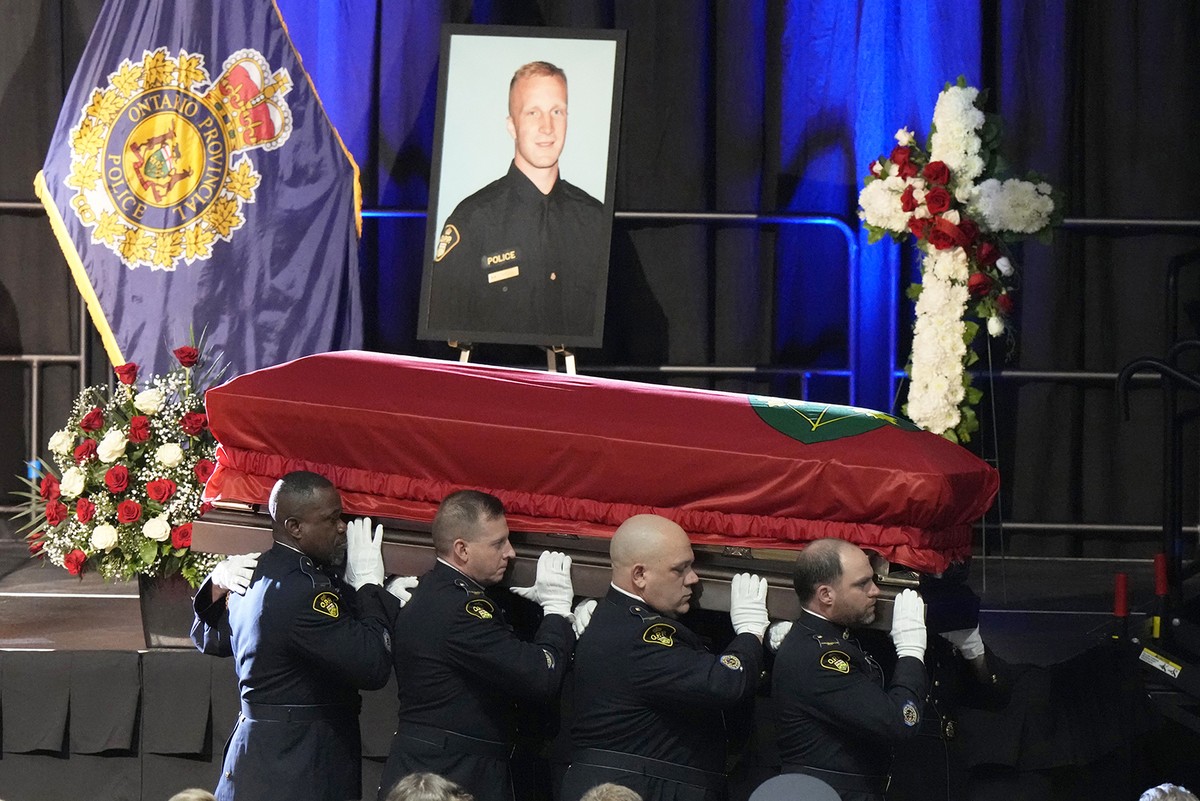
months ago the Parole Board of Canada released a convicted
police-killer 17 years into his 25-year capital sentence. Convicted of
first-degree murder for the 2007 shooting death of RCMP Constable
Douglas Scott in Kimmirut, Nunavut, Pingoatuk Kolola was given an early
release. Constable Scott was the sole police officer in Kimmirut. His
death resulted in eliminating single-member detachments in northern
communities. The parole board can approve unescorted prison releases or
day parole, despite first-degree mandatory 25-years incarceration.
In
the face of rising crime rates, Canadian police have all but abandoned
traditional agreement on Canadian justice policies; they are now more
vocal in calling for measures to tighten bail and release conditions for
chronic offenders; it is their job as professional defenders of the
public weal to view public safety and security as society's first order
of business. Their end of the justice system is rooting out crime,
apprehending offenders and turning them over to the justice system.
Closure cannot be found when the justice system simply releases chronic
offenders with no imposed penalty, leading to re-offence.
 |
| OPP Const. Grzegorz Pierzchala was killed in action two days after Christmas, around 2:30 p.m., while responding to a black truck in the ditch near Hagersville, Ont. (Submitted by Bill Dickson) |
The
2022 murder of Ontario Provincial Police constable Grzegorz Pierzchala
and its outcome was the initial spur to Canadian police calling for
justice reform in a loud, collective voice. Shot and killed during a
routine roadside check by a chronic offender with a lengthy history of
violent offences, Constable Pierzchala's murderer was given bail owing
to his Indigenous background. Justice Harrison Arrell who presided over
the case cited an "obligation" to consider that the accused was "a status Aboriginal".
The
response was police agencies calling out for tightened bail conditions;
a reversal of Liberal changes that saw judges such as Arrell required
to consider the "marginalized"
identity of criminal defendants in their final judgements. According to
OPP commissioner Thomas Carique, strict bail conditions would have
resulted in victims like Constable Pierzchala being spared their lives.
A year ago, the National Police Federation addressed the "catch and release"
format so regularly employed by the justice system, calling for its
cessation following horrific stranger attacks in downtown Vancouver when
a man with over 60 documented police interventions slashed two random
pedestrians, killing one, severing another's hand.
"Over
the last two years, we've seen serious incidents related to our bail
system that have put the lives of police service members and our
communities in danger", pointed out Mark Baxter,
president, Police Association of Ontario, his statement co-signed by the
Ontario Provincial Police Association. This, following a routine police
check in Toronto where an all-out gang shootout occurred. Leading three
Ontario police associations to call for "immediate action" on bail reform.
Police
unions in Toronto, Surrey, B.C., and Peel Region in Ontario accused the
Liberal government of ignoring a deadly gun crime situation, driven by
illegal firearms smuggled into Canada from the United States. "What difference does your handgun ban make when 85 percent of guns seized by our members can be sourced to the United States?" they
asked, responding to then-prime minister Justin Trudeau
self-congratulating the success of his government's gun bans, and a "freeze" on sale or transfer of legal handguns.
 |
Labels: "Catch and Release", Chronic Offenders, Liberal Soft-on-Crime, National Police Service, OPP, Parole Board of Canada, RCMP, Skewed Justice System
posted by Pieface @ Thursday, September 18, 2025


<< Home