Raising the New Generation of Islamic State Jihadists at Al-Hol
"All of the women here are radical.""But the bigger problem is that the mothers are educating their kids according to the Islamic State ideology."Hokmiya Ibrahim, administrator, Roj camp, Syria"Repatriation is the priority.""We are aiming to return people to their countries, not just in al-Hol, but for all the camps inside northeast Syria. Everyone should go back home.""This camp is a ticking time bomb. We’ve received intelligence from our allies in the international coalition, led by the United States, and from the Iraqi government, that ISIS [the Islamic State] is planning something. But we don’t know whether it will be an external attack or an uprising from within.""We’re trying to address this together with the National Security Agency and the [U.N. Refugee Agency].""[But on the part of the new government], no steps have been taken to relocate these populations.""Humanitarian cases in al-Hawl need urgent referral to Damascus or elsewhere and, for the past month and a half, we’ve seen no positive moves."Jihan Hanan, co-head, al-Hol camp, Kurdish-led Syrian Democratic Forces"Many international organizations have programs for al-Hol, but when it comes to actually moving and supporting families, there is no one there in practice.""Given the scale of needs and funding constraints, no returnee receives a full package of support immediately upon return. Resources simply do not allow for that."Mounzer al-Salal, director, Syrian NGO Stabilization Support Unit (SSU)

 |
| Families prepare to return to their hometowns from northeast Syria’s al-Hol camp, 27 April 2025. Reuters |
"A massive fence confines 39,000 people, 11,000 of whom are foreign nationals. Of these, 95% are women and children — mostly relatives of Islamic State fighters — along with a number of other civilians displaced by war. The camp is divided into six sections. Sections 1 through 5 house about 33,000 Syrians and Iraqis. Section 6, which the camp’s director described as “the most dangerous,” holds the families of foreign fighters from over 42 countries.""There are 24,000 minors in al-Hawl. Many were born behind barbed wire and have never seen the world beyond the camp. Seven thousand of these children are under 12 years old. As we drive in, children hurl stones at the armored vehicles driven by our escorts from the Syrian Democratic Forces (SDF), a Kurdish-led militia coalition that has battled the Islamic State for years. Others hide. One boy raises his right index finger — a gesture often associated with the Islamic State.""Since 2019, over 150 killings have been documented inside al-Hawl; an average of more than two murders per month. A few weeks ago, authorities discovered the mutilated remains of a woman in Section 6, partly mummified and discarded in a ditch between tents belonging to extremists."New Lines Magazine
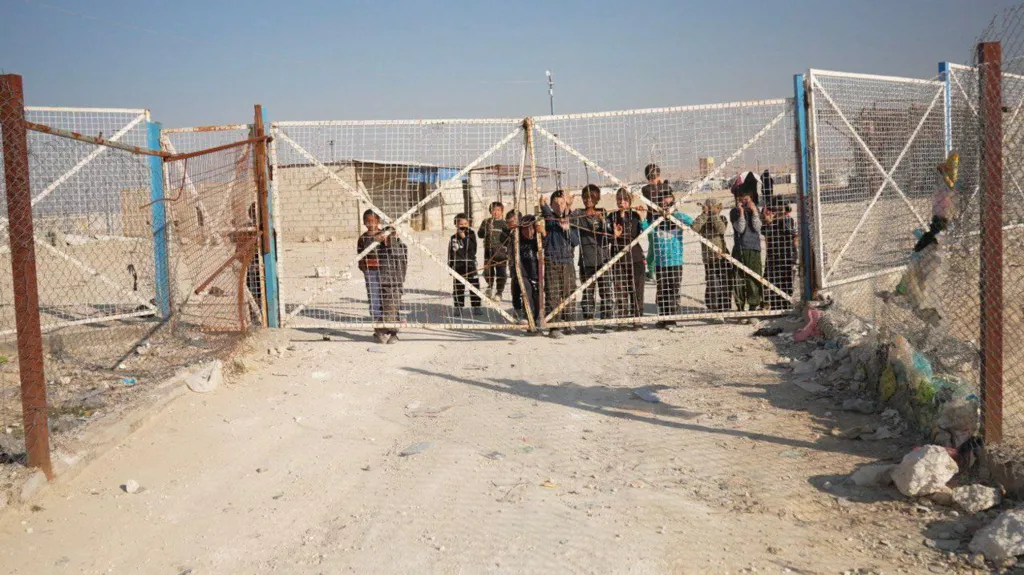 |
| Mostly women and children live in the al-Hol camp BBC |
Most
of the detainees in the Al Hol Camp located in northeastern Syria where
a fence with barbed wire surrounds the immense compound, are family
members -- the wives, sisters and children -- of the Islamic State
fighters imprisoned nearby. Prisons close by the women's prison house
over 8,000 of the ISIS fighters. Kurdish-led Syrian forces supported by
the United States fought to reclaim land in Syria that ISIS had ruled
for years as well as in Iraq, when it established its 'Islamic
Caliphate', planning to conquer ever greater tracts of land until it was
finally brought to heel.
The
Kurdish-led forces that had protected the minority groups such as
Yazidis, Christians and their own from the brutal Islamists detained
thousands of ISIS fighters and tens of thousands of their relatives,
many women who had entered Syria from abroad responding to an appeal
from ISIS for 'brides' for their terrorist fighting men. Ever since that
wind-down of ISIS and the capture and imprisonment of their cohorts,
the Kurds have been left to the task of guarding them. Despite
years-long appeals to the international community by the Kurds to
repatriate their citizens, few have complied.
The
United States, allied with the Kurds, is now preparing to completely
withdraw their presence and expects the new government of Syria to take
responsibility for the thousands of residents in the detention camps,
part of its plans to have the Syrian Democratic Forces led by the
Kurds merge with the reconstituted military of the Syrian government
under one-time ISIS affiliate, President Ahmed Al Sharaa, once known as Abu Mohammad al-Julani, in his earlier role as a bona fide jihadist.
Although
the Trump Administration has given the new Syrian administration a
clean bill of health, that hasn't stopped the Al Sharaa military from
aiding and abetting parts of its Sunni alliance jihadist militias in
deadly reprisal attacks against the Syrian Alawites as well as Syrian
Druze and Christians. Understandably, given the Kurdish experience with
Sunni Jihadist militias and its battles over the years to free the
geography from the hold of the Islamic State, the Kurds have little
trust in the new government and its stated commitment to fight ISIS.
 |
| The al-Hol camp holds families of alleged Islamic State fighters [Getty] |
Kurds
view the likelihood that the former al-Qaeda-linked new government may
turn the ISIS prisoners free, despite their public stance of battling
ISIS. By no means is the Islamic State dead and gone as a violent
ideological threat to global stability and security. It continues to
target northeast Syria's Kurdish-led forces, expanding reach and
frequency and lethality, reflecting the assessments by the UN and U.S.
Two American soldiers were killed in one such attack in mid-December.
According
to camp officials, ISIS operatives remain inside the camps, their focus
that of radicalizing the children. Over 27,000 family members of ISIS
fighters are held in Al Hol and nearby Roj camps. And while none of the
women have been charged with any crimes, the officials are under no
illusion that many of these women are dangerous as ongoing proponents of
the ISIS agenda, intent on teaching their children to become future
acting members of the terrorist group.
The
most extreme of the detainees are those from countries outside the
Middle East; Tajikistan, France and Russia; among them, about 6,000
women and children living separately in the camp, off limits to
visitors. Violence and ill-health are the lot of the residents of the
camp, where weapons are smuggled in and women and older adolescent boys
attempt frequent escapes. Among the hundreds of vehicles entering daily
with supplies, some carry human contraband out of the camp.
"Every day people are fleeing, and it seems it is an organized operation", observed Al Hol administrator Jihan Hanan.
 |
All
the residents at the camp are under indefinite detention, even though
many have no links to the Islamic State and fled to the camp to escape
the punishing U.S.-led bombing campaign. Photograph by Ivor Prickett |
Labels: Al--Hol ISIL Camp, Islamic State, Kurdish Autonomous Region, Responsibility for Foreign Fighters/Relatives from Abroad, Syrian Democratic Forces
posted by Pieface @ Thursday, December 25, 2025


<< Home