When Arrogance Supersedes the Neutrality of Judgement
 |
| Supporters cheer on drivers in the protest convoy headed for Ottawa from an overpass in Kingston, Ont., on Friday, Jan. 28. (Lars Hagberg/The Canadian Press) |
"I think it's important for the chief justice to review the circumstances and make his own determination about whether it would be appropriate or whether it could give rise to a reasonable apprehension of bias by any of the litigants."Alexander Boissonnea-Lehner, lawyer for Canadian Frontline Nurses litigants"Chief Justice [Richard] Wagner has advised that he did not, at any time, either directly or indirectly, comment on the Emergencies Act ... or matters at issue in the proceedings.""Chief Justice Wagner has considered the certificates and letter, and has concluded that there is no actual or reasonable apprehension of bias that would require his recusal under the applicable legal test."Chantal Carbonneau, registrar, Supreme Court of Canada
 |
| The chief justice of the Supreme Court of Canada Richard Wagner Photo by Via Supreme Court of Canada |
What would an informed person, viewing the matter realistically and practically -- and having thought the matter through -- conclude.""Would he think that it is more likely than not that [the decision-maker], whether consciously or unconsciously, would not decide fairly."Test of apprehended bias
When
a convoy of truckers arrived and assembled near the Parliament Hill
Precinct to showcase their dissatisfaction with many of the government's
COVID 19 edicts, including a provision that would revoke the licenses
of long-range truckers who refused COVID vaccinations, their purpose was
to demonstrate citizens' right to free speech, assembly and to protest
government actions that they construed as impeding their rights under
constitutional rights and freedoms.
The-then
Liberal government of Justin Trudeau was dead-set against sending out
an emissary to meet with the truckers, to discuss the situation to calm
the troubled waters before matters got out-of-hand. Which it did,
according to nearby residents whose peace was shattered by the
deliberate constant honking of big rigs' horns, and the
often-celebratory atmosphere that prevailed as the congregant truckers
socialized among themselves, their trailers stationary for weeks.
Locals
complained about the noisy crowded conditions, truck fumes and
interruptions in their daily routines given the presence of so many
out-of-towners. In exercising their right to freedom of assembly and
free speech, what became known as the Freedom Convoy was hugely
unpopular locally, despite a good level of support by other locals. The
federal government panicked at the presence of so many Canadians
scornful of their political leaders' autocratic rules, and invoked the
Emergencies Act.
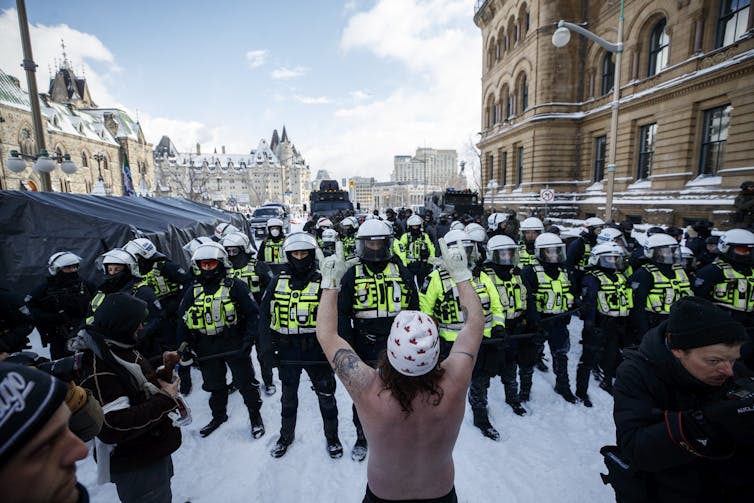 |
| Police move in to clear downtown Ottawa near Parliament Hill of protesters after weeks of demonstrations. THE CANADIAN PRESS/Cole Burston |
That
forced other truckers to haul away the offending trucks, forced police
to take action they had already taken to address the situation, forced
the dispersal of all those citizen-truckers and their supporters from
across Canada who assembled to express their frustration with the
government. In the process, banks were authorized to freeze people's
bank accounts who were involved in the convoy, and the government
brought legal action against those they considered to be convoy leaders;
a turn of event that amounted to unjust and undue persecution.
The
invocation of the Emergencies Act, which was never, ever meant to be
used for such a purpose, became the subject of other lawsuits that
balked at government overriding the limits of state power. That response
to rights of citizens to exercise free expression was not the action of
a liberal democracy. Around that time, in 2022, the Chief Justice of
the Supreme Court of Canada described the participants in the convoy as
'anarchists'. He failed to heed the warning that "Judges should be cautious in their communications on social media relating to matters that could come before the court", a caution that he himself helped write in Ethical Principles of Judges.
Now,
because two courts ruled that the federal government was unreasonable
in invoking the Emergencies Act, the current Liberal government under
prime minister Mark Carney has appealed to the Supreme Court, now
considering whether to hear the case. According to lower courts, the
protesters' Charter right to free expression had been breached. The
Federal Court of Appeal cited a case that held that the meaning of
freedom of expression "is
to ensure that everyone can manifest their thoughts, opinions ...
however unpopular, distasteful or contrary to the mainstream".
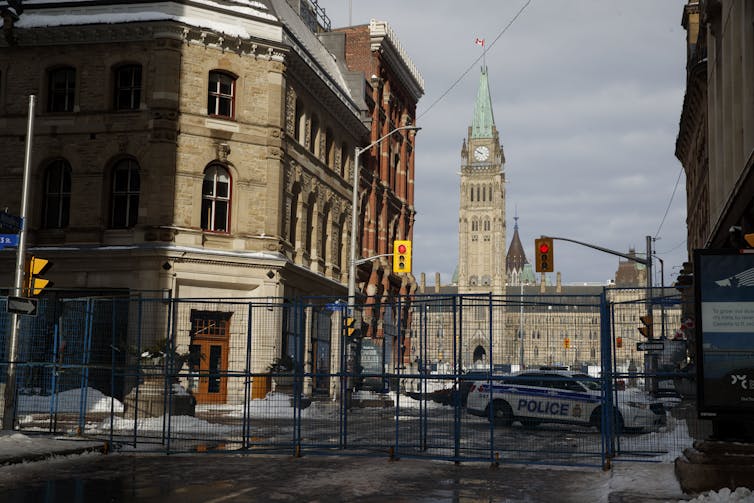 |
| A fence cordons off Parliament Hill in Ottawa on Feb. 21, 2022, after police cleared truckers from the area following the invocation of the Emergencies Act. THE CANADIAN PRESS/Cole Burston |
Yet,
in 2022, the Chief Justice of Canada's Supreme Court relieved himself
publicly of his personal opinion that some of those in the Freedom
Convoy protests were 'remote-controlled' people attempting to
short-circuit the government's politics, which "does not fill me with good feelings. What
we saw recently on Wellington Street, here, is the budding start of
anarchy where some people decided to take other citizens hostage, to
take the law into their own hands, to disregard the system … I find that
worrying", he said in an interview.
Having
said which, to be perfectly logical, ethical and principled, he should
be more than willing to recuse himself from the Supreme Court's hearing
of the case, should it decide to do so. Yet he adamantly claims he has
no reason to do such a thing. Claiming neutrality, non-bias as his
defence, a defence more than neutralized by his obvious bias expressed
in a public forum. An expression totally unbecoming his position as a
jurist, infinitely more so as the Chief Justice.
He
had gone on to utter additionally 'non-biased' statements respecting
the convoy, such as stating that the downtown Ottawa 'occupation' was
partially fuelled by a "certain ignorance", a "bad understanding" of Canadian law. The impact of the Freedom Convoy's blockades on Ottawa business and individuals -- particularly "the most vulnerable" was "deplorable".
But of course no one should expect that in full compliance and respect
for justice, that this man is prepared to recuse himself honourably.
"Judicial independence is not the private right of judges. It is the foundation of judicial impartiality and a constitutional right of all.""[Judges should] be mindful of the ways in which their conduct would be perceived by reasonable and informed members of the community and whether that perception is likely to lessen respect for the judge or the judiciary as a whole.""[Judges should] avoid conduct which could reasonably cause others to question their impartiality."Ethical Principles for Judges
Labels: Charter Rights and Freedoms, COVID Protests, Emergencies Act, Ethical Principles for Judges, Ottawa, Truckers Convoy
posted by Pieface @ Wednesday, May 06, 2026


<< Home