Ukraine, Putting Up a Strong Defence
"[Ukraine has significantly] slowed the enemy's advance and is gradually regaining the initiative.""[About 35,203 Russian soldiers were killed or severely wounded in April and the goal is] to inflict at least 200 enemy losses for every square kilometre of advance.""Together with the president and the diplomatic team, we explain to our partners that Ukraine is doing its homework.""What matters now is for our partners to do their part and help scale up what is already proving effective today."Ukraine Defence Minister Mykhailo Fedorov"Ukraine is putting up a strong defence.""If you look at the front line at the moment, it is stabilizing.""[Ukraine is even regaining territory] on net terms."NATO Secretary General Mark Rutte
 |
| Ukrainian servicemen of Khartia brigade launch a drone towards Russian positions at the front line in the Kharkiv region, Ukraine, Wednesday, May 20, 2026. (AP Photo/Andrii Marienko) |
There
is a feeling among Ukraine and its allies that Vladimir Putin's
'special military operation' is on the cusp of failing, with Kyiv's
position now of stabilizing the front line, stalling a Russian spring
offensive. Ukraine is matching its growing effectiveness at drone
deployment, inflicting heavy Russian troop losses, by also striking
behind the front lines as well as deep drone and rocket incursions
inside Russia, a situation that has succeeded in increased domestic
criticism of Russia's president by a war-weary and increasingly
vulnerable home population.
Many
among Russia's elite are becoming edgy about the situation, taking into
account the worsening economic situation alongside the demoralizing
effects that Ukraine's counteroffensive success has wrought. When some
senior Kremlin officials reach the state of considering the conflict has
reached a dead end, with no way appearing open to a resolution to the
situation, Vladimir Putin must be feeling the heat. He plans to conclude
the war by year's end, but as long as he counts on his demands being
met, that plan cannot succeed.
He
needs a face-saving victory; nothing less than full control over the
eastern Ukrainian Donbas region, despite that his greater forces have to
date in four years of combat, failed to capture. He insists as well on a
broader security agreement with Europe that would have the effect of
acknowledging Moscow's new gains in territory. Eastern Europe, in fear
of Putin's next moves to continue his grasping territorial ambitions
with their own sovereignty next in line, is unlikely to give their stamp
of approval to his military annexation of eastern Ukraine.
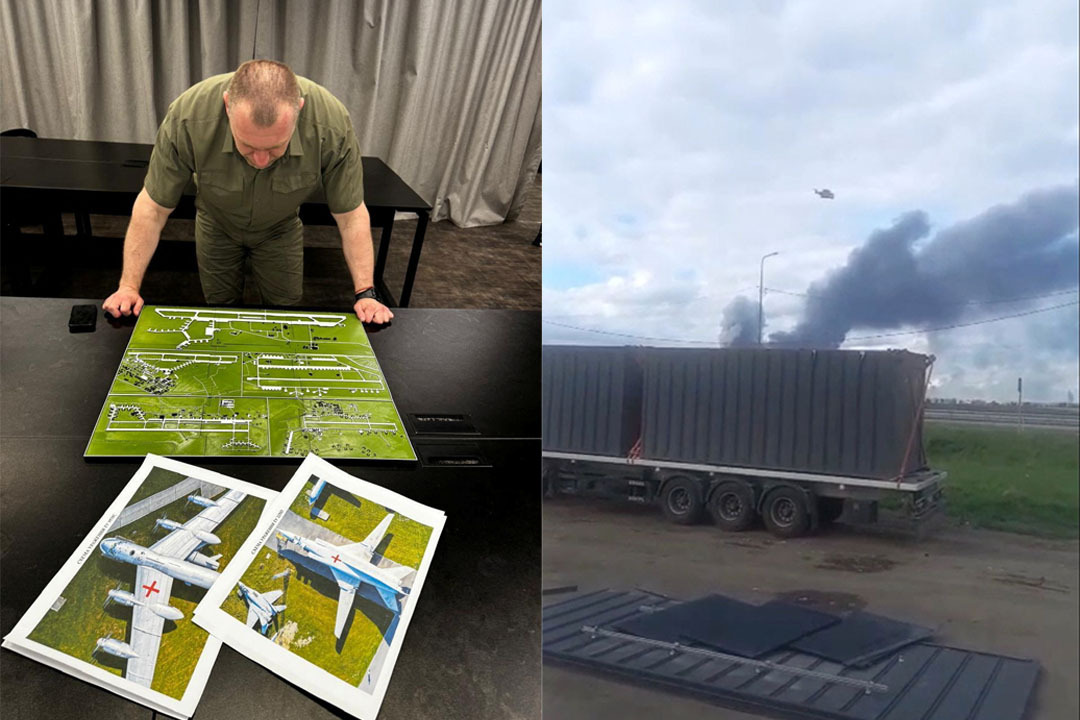 |
| Left: Head of Ukraine’s Security Service Vasyl Maliuk looks at a map of an airfield in a handout picture released June 1. | Right: A drone lifts off from wooden sheds loaded onto a truck at the perimeter of a Russian airbase in a social video on June 1. Left: Security Service of Ukraine/Reuters | Right: Social Media/Reuters |
A
major security advance in the north of the country was announced on
Thursday following President Volodymyr Zelenskyy's warning of the risk
of a potential Russian offensive from the Bryansk region and from
Belarus, in a repeat initiative that failed at the start of Russia's
invasion in 2022. Anticipating the Kremlin's resorting to another
conscription campaign, however unpopular it is with Russians, to enable
greater troop support for another push this summer, Ukrainian forces
have succeeded in holding the line after a winter lull.
According
to data from DeepState, a conflict mapping service in cooperation with
Ukraine's Defence Ministry, much of the front was stabilized by mid-May.
Ukraine's casualty ratio has significantly improved to approximately
one Ukrainian soldier for every five Russian troops. In an assessment by
U.S. Secretary of State Marco Rubio, Ukraine possesses now Europe's "most powerful armed forces". The game changer has been Ukraine's deploying in greater numbers, drones which has helped to offset a manpower disadvantage.
 |
UKRAINIAN drones have struck a key Russian oil station 800 miles behind the frontline in the latest blow to Vladimir Putin’s bloody war. Astonishing footage showed towering plumes of smoke billowing in the skies following Kyiv‘s precise attack. Huge plumes of smoke were seen after the blitz Credit: @ZelenskyyUa / X |
Kyiv
launched one of its heaviest attacks on Moscow over the weekend, as
well as on the surrounding region, leading many Russians to directly
fault their president for bringing the conflict into Russia. In
response, Russia has conducted massive drones and missile strikes
recently, in an effort to destroy the public morale in Ukraine. The
death toll among civilians rose last month, according to the United
Nations, to the highest number tallied since July 2025.
All
is not quite celebratory in Ukraine which itself has failed to achieve
its strategic goals to reclaim most of the territory Russia occupies,
nor moving any closer to an acceptable peace agreement in negotiations
that lead frustratingly nowhere. Ukraine's population, understandably
weary of the war, is increasingly unwilling to join the army, with
broader conscription remaining deeply unpopular. Ukraine's Defence
Minister Fedorov is preparing reforms to increase pay for service
members in hopes of attracting fresh recruits.
Adept
at intercepting drones, the struggle by Ukraine's air defences
continues against ballistic missiles that during the brutally cold
winter decimated its energy infrastructure. Growing difficulties in
securing ammunition for U.S.-made Patriot missile systems that
experience proved to be the only really effective weapon against
ballistic missiles, remain a sore point for Kyiv.
 |
| Russia continues to launch attacks on Ukrainian towns and cities Credit: AFP |
"Russia is facing setbacks on the battlefield.""In order to sustain its war efforts in Ukraine, the Kremlin will almost certainly have to impose a second partial mobilization [within the next 12 months]."Nigel Gould-Davies, senior fellow for Russia and Eurasia, International Institute for Strategic Studies, London
Labels: Drone Technology Russian Invasion of Ukraine, Russian/Ukrainian Public Demoralized, Ukraine Hitting Deep Within Russia, Ukrainian Counteroffensive
posted by Pieface @ Wednesday, June 03, 2026


<< Home