Canada-U.S. Trade Insecurity
"Taken together, size does not change the direction of travel, but it does influence the pace.""Larger, more globally integrated firms are responding earlier and at greater scale, while smaller firms remain earlier in the cycle.""This highlights both the potential scale of the shift and the likelihood that similar patterns may emerge across other sectors."KPMG Canada"While most manufacturers are staying, many are reassessing where future investment, growth and production will occur. The decisions made today will shape Canada's manufacturing sector for years to come.""Businesses can only operate in endurance mode for so long.""At some point, uncertainty begins to shape long-term decisions about where investment, production and growth will occur.""[While Canadian manufacturing still has a part to play in North America], the question is how strong that position will be."Anamika Gadia, KPMG Canada partner/national leader, industrial markets
 |
| Trade uncertainty is prompting more Canadian manufacturers to shift production to the U.S. and delay investments in Canada, a new survey finds. Photo by Peter Power |
Ongoing
and worsening trade uncertainty with Canada's largest trading partner
across the long 'undefended' border with the United States is creating
an atmosphere of economic destabilization in Canada the likes of which
have never in anyone's living memory ever before been seen. The
situation has led a growing number of Canadian manufacturers to move
their enterprises or to plan to move a portion of their production to
the U.S. A majority, responding to a recent survey, plan to restrain
themselves in their Canadian investments.
This
is a scenario seen before in a much more prolonged manner when China in
the process of becoming the manufacturing behemoth it now is, began
flooding the international market with consumer goods to be sold at
prices that appealed hugely to the purchasing public throughout Europe
and North America. Cheaper goods, widely available, because of cheap
Chinese labour and government support (subsidies) eventually
convinced manufacturers throughout the Western world that since they
were unable to match the pricing and wide range of Chinese-produced
goods, it was best to fold their manufacturing and submit to the
inevitable.
Under
this volatile administration with a president who believes himself an
expert on deal-making, and who has been accusing all countries globally
that have or were doing business with the United States of taking
'advantage' of the most powerful economic force on the planet, and he
wasn't going to take it any longer, so here's tariffs for you, and you,
and you, the world is reeling. Try that on for size. And as much as
global manufacturing had been altered by the world's premier production
manufacturing in China, the world economy was far more immediately and
deeply beleaguered and beggared by the new Trump-led upending of world
trade alliances.
According to the 2026 KPMG Canada manufacturing poll, four in ten (42 percent) of
Canadian companies have latterly adjusted their horizons by shifting or
planning to shift production to the United States, 29 percent of whom
had already taken the plunge in banking on the move to further their
bottom line. Another 13 percent plan to do likewise, while 77 percent of
that group anticipate committing within two years under the operating
environment as it is at present.
 |
| Mandel Ngan/AFP via Getty Images |
"I love Canada [but I'm] not going to bend.""The United States can't subsidize a country for $200 billion a year, We don't need their cars. We don't need their energy. We don't need their lumber. We don't need anything that they give.""We do it because we want to be helpful. But it comes a point when you just can't do that.""[Canada, a longtime ally, would be much better off without tariffs -- as part of the U.S.]""[Not to use military force against Canada, only] economic force.""That would really be something [taking control of Canada].""You get rid of that artificially drawn line, and you take a look at what that looks like. And it would also be much better for national security. They’re great, but we’re spending hundreds of billions here to protect it [subsidies include substantial military support while the United States loses out through trade deficits]."U.S. President Donald Trump
The majority (49 percent) represent businesses with over $300 million in gross revenue, mostly having made the move in full or in part. A third (34 percent) of companies generating less than $300 million have or are planning to move, leaving a mere fifth (20 percent) which have as yet chosen to take no action. "Higher margins when producing and selling within the U.S. than when exporting from Canada", reported a third (32 percent) of respondents, attesting to "stronger margins on international sales from the U.S."
Lower
operating costs in some states, more favourable tax environment and
easier supply chains when customers are already in the U.S. are cited by
some firms choosing to migrate south -- outside of the tariffs issue.
When queried what circumstances could alleviate the situation to the
point where owners would prefer to remain in Canada, corporate
executives and decision-makers representing 275 companies polled
responded that certainty around free trade, continued tariff relief,
lower corporate taxes, cheaper energy, better access to skilled workers
and lower housing costs for workers.
The survey revealed capital investment projects have been "paused, reduced or cancelled"
by 57 percent of firms, with 42 percent operating similarly with
respect to their research and development. Roughly half of
those polled stated they were focused on weathering the economic
tempests driven largely by U.S. President Donald Trump and his trade
policies. The poll revealed as well that 61 percent felt they would be
unable to remain in business lacking access to the U.S. market. Almost
all (96 percent) stated their products qualified for tariff-free
treatment under the Canada-U.S.-Mexico Agreement. An Agreement that is
now lacking stability given the U.S. refusal to renegotiate.
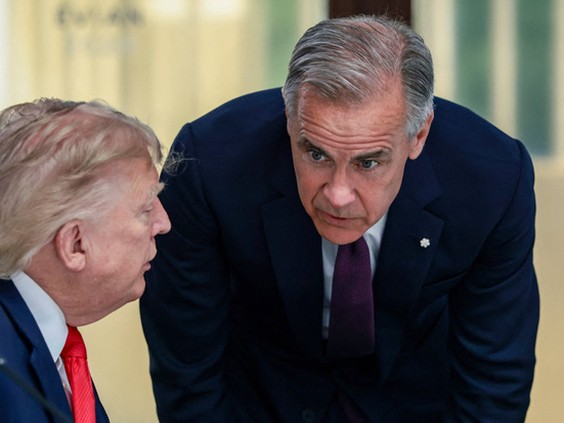 |
| U.S. President Donald Trump (left) and Prime Minister Mark Carney (right) attend a work lunch as part of the G7 summit, in Evian, France, June 16, 2026. Photo by Evelyn Hockstein / POOL / AFP /Getty Images |
"While tariffs are an obvious factor, Canadian manufacturers are making long-term decisions about where to locate based on a broader assessment of where they are most likely to have a competitive advantage.""Otherwise, Canadian exporters may have to depend on U.S. customers to act as importer of record, potentially straining key commercial relationships."Joy Nott, KPMG Canada partner, trade and customs
Labels: Canada-U.S. Trade, Coercion, Inflated Claims, Manufacturing Relocations, Tariffs, Trade Insecurity, Trump Administration
posted by Pieface @ Sunday, July 12, 2026


<< Home