The Canadian Museum for Human Rights, Winnipeg
 |
| The Canadian Museum for Human Rights has unveiled a controversial exhibit on the Nakba, the displacement of hundreds of thousands of Palestinians. Still from video, CBC |
"My dad [Izzie Asper] always said the most important asset you have is your reputation.""I think that this exhibit [Palestine Uprooted: Nakba Past and Present] is going to have a lot of people lose faith in the museum's trustworthiness for being an honest purveyor of accurate historical and current-day information.""[The museum piece] deliberately omits key, relevant facts about the conflict [that are crucial to understanding its full context].""It's inaccurate, and in my opinion shows bias on the part of the curators of the museum, and is not at the level of scholarship befitting a federal institution."Gail Asper founder, Canadian Human Rights Museum in Winnipeg
 |
| Photo: CMHR, Aaron Cohen |
"The story of the Nakba is a complex one. It's not reduced to a quick little sound bite. There's a lot of nuance with it, there's a lot of history that preceded it and a lot of history that developed over the years of the Nakba.""Hamas terrorists launched the greatest large-scale massacre against Jewish civilians since World War II, where over 1,150 or so Jewish babies and children and mothers and young people were brutally murdered in the most horrific fashion.""The failure to describe that horror, and then simply say, Oh, ya, these people were displaced', is an error in judgment."Mark Berlin, former CMHR board member"The frame, or the scope, of the exhibit is to centre Palestinian experiences of forced displacement. So it's told through their stories, through their lens, and that's an approach the museum takes in a variety of other places.""Every word in the exhibit is backed up by credible research. We had our research sources academically reviewed internally, and then we took an additional step to have them reviewed externally."CMHR chief Executive Isha Khan
 |
| A multimedia gallery on the museum's second floor that introduces visitors to a timeline of human rights acknowledges 'hundreds of thousands of people became refugees' in the 1948 Arab-Israeli war, including Palestinian Arabs and Jews from surrounding Arab countries. (Tyson Koschik/CBC) |
The
Canadian Human Rights Museum, established in Winnipeg, was the
brainchild of Israel (Izzie) Asper, former Canadian media magnate. The
initial $24 million required to move the idea of the museum to its
actual presence was donated by the Asper Foundation. There was also a
public subscription, and later financial support from the federal
government. From conception in 2003 to opening in 2014, the museum set
out to inform the public of human rights and the world's most egregious
assaults against human rights. There were ten permanent exhibits when
the museum opened, the Holocaust among them.
Most
recently the seven-story museum has mounted a Nakba exhibit that
includes a collection of photos, video testimonies family heirlooms and
artworks to portray the experience of Palestinian Arabs who fled
conflict in the area. Keys to Palestinian homes that had been left are
among the exhibits. Beginning at the Arab-Israeli war in 1948 when
Egypt, Lebanon, Iraq, Jordan and Syria attacked the fledgling Jewish
state to destroy it in response to the Partition Plan offered by the
United Nations empowering Jews to return to their ancestral home,
750,000 Palestinian Arabs fled.
Most
left on the promise by the invading Arab armies that when Israel was
destroyed they could return to claim the entire territory; others fled
to escape the incipient war situation while others still were forced to
leave as enemies of the new state. Over a million Palestinians chose to
remain, where there are now 2 million Palestinian Arab citizens of
Israel. Concurrently with the re-establishment of the Jewish state,
surrounding Arab countries forcefully expelled their Jewish residents
who had lived there since antiquity, confiscating their properties.
850,000 Jews found themselves homeless, more than balancing the number
of Palestinian Arabs who became refugees through an event they named
their Nakba (catastrophe).
The
exhibit makes no mention of the expulsion of 850,000 Jews from the very
Arab countries that went to war on Israel, amidst others. In this mass
displacement, the Jews found homes for themselves in Israel or elsewhere
in the greater diaspora. The Palestinians who settled in refugee camps
in Jordan, Syria and Lebanon were there ostensibly on a temporary basis;
none of the neighbouring Arab/Muslim countries offered them permanent
status, much less citizenship.
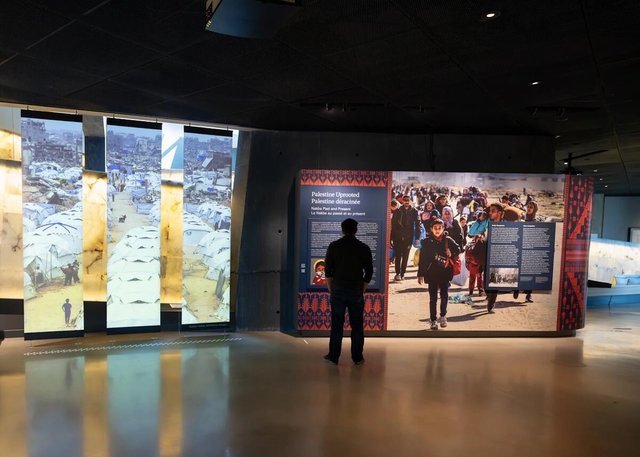 |
| Palestine Uprooted at the Canadian Museum for Human Rights Photo: Annie Kierans. Courtesy the Canadian Museum for Human Rights |
And
while there is mention of the infamous October 7, 2023 massacre in
southern Israel led by the Palestinian terrorist group Hamas, joined by
the Palestinian Islamic Jihad and Fatah alongside the Popular Front for
the Liberation of Palestine, along with ordinary Palestinian/Gaza
citizens, it fails to identify the victims of that mass atrocity as
Jews, only as 'people'. That 'people', the Jews and their country,
Israel, responded to that horrific event as any other country would do
to protect its own, by invading the area responsible -- Gaza -- in
search of the murderous terrorists.
That
time and place in more recent history was included as illustrative of
ongoing Palestinian suffering at the hands of Israel's military
'occupation'. It is disingenuous for the chief executive of the museum
to declare that there was academic scholarship involved in the setting
up of this one-sided, dreadfully canted exhibition in its obvious
obfuscation of cause-and-effect, showcasing Palestinian victimhood by a
heartless, 'genocidal' neighbour.
"I think that the board clearly didn't understand the risks of doing inaccurate exhibits on volatile subjects.""They didn't understand the impact it could have on their reputation, or they were indifferent, or they were too deferential to management."Gail Asper
 |
| Protesters gathered outside the Canadian Museum for Human Rights on June 26 to protest the Nakba exhibit. (Rudi Pawlychyn/CBC) |
Labels: Canadian Museum for Human Rights, Museum Curators Bias, Nakba Exhibit, Perversion of Reality, Winnipeg
posted by Pieface @ Tuesday, August 04, 2026


<< Home