'Bug Sweeps' In the Canadian House of Commons
'[The sweep will look for any] technical intrusions [which can be anything from listening devices to signal interceptors] and a summary of the investigation will be provided to members.""It is recommended by the Sergeant-at-Arms that you participate in this program for your Parliamentary office."Sergeant-of-Arms Patrick McDonald"The members of that particular committee are likely speaking to foreign delegations and missions more often.""It's entirely possible that there was a threat detected, there was a situation that caused concern.""[The bug sweeps are] prudent practice, one that we underutilize."Jody Thomas, former national security adviser"In my head, the House of Commons is secure, my office is secure, so I'm not sure how it could be bugged.""But it's good to know that they're taking this seriously.""I have immense respect for the sergeant-of-arms, so if he's offering the service, I know it's serious.""In my phone, I have tons of contacts of opponents to various regimes. I'm not the one in danger as much as the people I speak to, who may not be known publicly."Commons Foreign Affairs and International Development committee vice-chair MP Alexis Brunelle-Duceppe
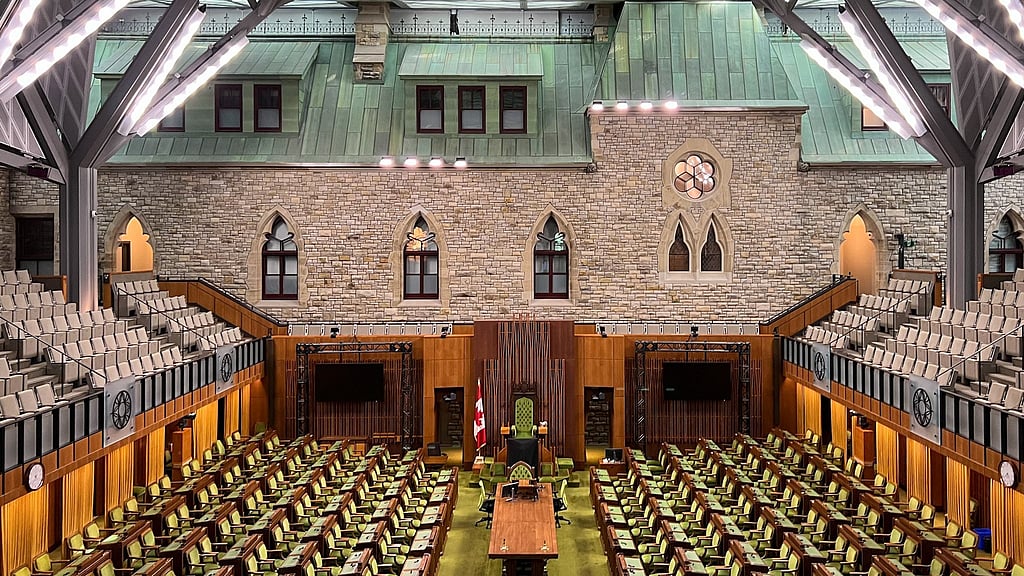 |
| House of Commons Chamber West Block. Image credit: Wikipedia |
It seems odd, on the evidence given the government of Canada by its Intelligence agencies that Canada has a real problem with cyber-security, possible insider-eavesdropping and foreign governments' intense interest in acquiring state secrets and military data, that a regular protocol of bug-sweeping is not already in place in the House of Commons. Now, however, it has been announced that House of Commons security is prepared to offer sweeps of specific parliamentary offices for Members of Parliament to ensure that spying devices are not in place. Such sweeps to take place twice each year.
Members of the Parliament on the Commons Foreign Affairs and International Development Committee in particular received a memorandum signed by Sergeant-of-Arms Patrick McDonell back in September. Since the FAAE committee studies Canada's foreign affairs it has been deemed appropriate that they are offered, and can choose to participate in a scheduled biannual technical surveillance counter measures check ('bug sweep') of their parliamentary offices.
The offer of such a surveillance counter measure given that parliamentary offices are inaccessible to the public and physically secured by the office of the Sergeant-at-Arms and agents of the Parliamentary Protective Service is suggestive of a previously discovered breach arousing a level of alarm of possible insider espionage threats. Unsurprising, given the furtive intrusion of unrecognized members of the Muslim Brotherhood comfortably making their way through the corridors of power in Canada.
A Canada that is aware of the presence of malign Islamist groups present in social circles, government branches, news media, academia, union leadership, but is unconcerned at the stealth presence of these actors. Just as Intelligence points out that members of the Iranian IRGC are openly present in Canada, as well as the surreptitious infiltration of representatives of Islamist terrorist groups on Canada's proscribed terror list, such as Hamas and Hezbollah, along with Palestinian students who make no secret of their propaganda that belittles Canada and calls for a global Intifada.
National security practitioners along with members of Parliament are well aware of the growing threat of hostile actors spying on MPs. MP Alexis Brunelle-Duceppe's parliamentary contacts are involved with his advocacy for oppressed minorities globally, with a particular focus on China's Xinjiang province's oppressed Uyghur population, subjected to 're-education' and slave labour.
The problem of insider espionage is not Canada's alone. These threats cut a wide swath globally where governments recognize the problem that impacts politicians, businesses and powerful individuals with the insidious presence of agents hostile to the West and to democracy. A Saudi national was arrested last month by American authorities. He worked for OpenAI and was charged with bugging a conference room used by top company executives. Abdulrahman Alfozan had installed a device behind a television screen in one of OpenAI's executive conference rooms.
 |
| Photo courtesy of Mark Carney |
That Open AI conference space was used for "discussions of highly confidential technical, commercial, and strategic information ... as well as nonpublic information about Open AI's technical progress and strategic decisions, capabilities, priorities, government engagements, and commercial relationships." And which country would be the likeliest candidate for being the most likely to have been involved in this spying enterprise other than China.
Historically, it is China that has consistently reaped state secrets through espionage, where their nationals achieve positions of trust throughout the West to enable them to infiltrate corporations, governments, media and academia and come away with purloined data, secrets, formulae, and any information that is of value to Beijing and the CPC, along with the Peoples' Liberation Army, to short-cut their own research and take advantage of the advances of other nations, to elaborate and build upon them.
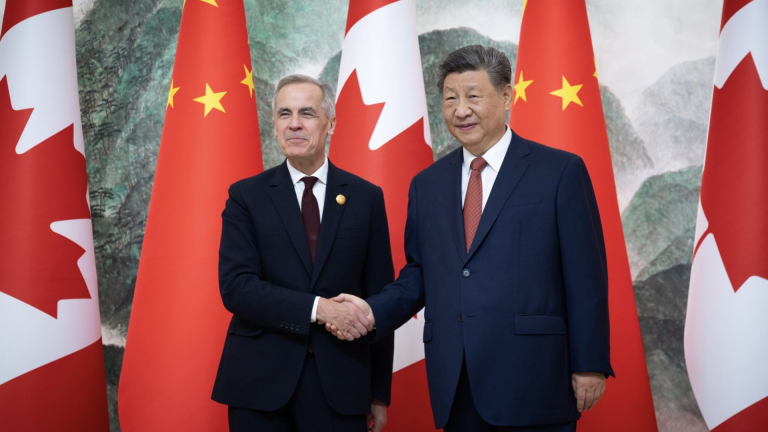
And this is the country and the government that Canada's Prime Minister Carney has most latterly conferred with at an APEC conference in the Philippines, to build upon a new, 'enriched' agreement with Beijing in trade, science exchanges, and cooperation in security in a 'mutual' exchange of goodwill and trust.
 |
| Delegations led by Chinese President Xi Jinping and Canada’s Prime Minister Mark Carney attend a bilateral meeting on the sidelines of the Asia-Pacific Economic Cooperation (APEC) Economic Leaders' Meeting in Shenzhen, Guangdong province, China November 17, 2026. REUTERS/Maxim Shemetov/Pool |
"[I don't know why security officials made the offer to FAAE members, but I will] probably [be taking up the sergeant-at-arm's offer] down the road.""The way I looked at it was, maybe this represents a new threat environment.""If the sergeant-at-arms and the House security people feel that this is something that they're recommending we should do, I think we should listen to them."Foreign Affairs and International Development Committee chair, MP Ahmed Hussen

Labels: Chinese Premier Xi Jinping, Cyber Theft, Hostile Infiltration, House of Commons, Ottawa/Canada, PM Mark Carney, Security, Trade Agreement
posted by Pieface @ Thursday, November 19, 2026


<< Home