"That's
super-concerning. It means that there's a disconnect between the
partner agencies engaged in the processing of foreign nationals seeking
entry into Canada. It's really alarming."
"This
is yet another example of why we need to have [a] serious review of how
policing, security and intelligence are undertaken in this country and
how to coordinate it and make it more efficient and effective."
"When it happens 46 per cent of the time, why the hell even bother
having CBSA then? Why did you ask them in the first place if you’re
basically flipping a coin? This is yet another example of why we need to
have serious oversight and constant audit of CBSA and its relationship
with other agencies."
"That’s not how migration and border security should work."
"To me it's unacceptable. As a Canadian I expect more, and I think other
Canadians expect that our federal law enforcement, intelligence and
border security agencies can work seamlessly, share information
seamlessly. And if there are administrative or legal hurdles, then
that's something Parliament needs to look at."
Kelly
Sundberg, criminologist, former border services officer, associate
professor, department of economics, justice and policy studies, Mount
Royal University, Calgary
"[The Canadian Security Intelligence Service (CSIS) goal is to] prevent
inadmissible foreign nationals or permanent residents from entering or
remaining in Canada."
"It should be noted that not all risk is captured through enforcement
actions, nor can it be fully monitored through surveillance."
"Having these individuals in Canada could have negative consequences
for the country’s reputation or result in actions that are more
difficult to intercept and act on [e.g. business espionage or
threatening Canadian residents], particularly as most of these
individuals are short-term visitors."
"One individual with an inconclusive screening result was authorized
entry to Canada but was later alleged to be a member of a terrorist
organization and ended up in the Removal inventory [for deportation]; as
such, the risk to public safety of this individual being in Canada was
potentially very high."
Internal audit of the Immigration National Security Screening Program
According
to an internal audit of the Immigration National Security Screening
Program, close to half of all foreign nationals who were flagged by
Canadian security agencies to the Immigration Department for their ties
to serious offences, including war crimes, espionage and terrorism were
nonetheless permitted to take up residency in Canada between the years
2014 and 2019, the years the audit covered. Immigration officials,
despite warning, ultimately took it upon themselves to approve temporary
or permanent residency or refugee applications for a whopping 46
percent of the over 7,000 cases for which the Canadian Border Security
Agency recommended against applicants being allowed into the country.
Quietly
published earlier this year by the CBSA, the data emerged through a
study meant to assess the effectiveness and efficiency of the country's
Immigration National Security Screening Program operated by Canada
Border Security Agency's national security screening division. A program
in tandem collaboration with the Canadian Security Intelligence Service
(CSIS) with a goal to "prevent inadmissible foreign nationals or permanent residents from entering or remaining in Canada". They both get a failing grade in spades.
A young person waits with their families' belongings after getting off a
bus and waiting for a taxi to cross into Canada at Roxham Road, an
unofficial crossing point from New York State to Quebec, in Plattsburgh,
New York, U.S. March 25, 2023. (Carlos Osorio/REUTERS)
Security
screeners are tasked with reviewing temporary or permanent residence
applications or refugee claims that Immigration Refugees and Citizenship
Canada (IRCC) flags, as posing a potential security risk. Screeners
must assess the potential inadmissibility of applicants under sections
of the Immigration and Refugee Protection Act, dealing with serious
crimes such as espionage, terrorism, crimes against humanity, or
organized criminality - and then must submit a recommendation to IRCC
officers.
Although
the greater majority of applications are positively screened, then
allowed into the country, of the 7,141 instances where security
screeners forwarded a "non favourable" recommendation to IRCC during the
years covered by the audit, 3,314 were permitted into Canada, according
to the report. Most of the individuals (numbering 1,887) were allowed into Canada as a result of another government department asserting their applications be approved "in the national interest for high-profile foreign nations who are inadmissible", through a "public-policy exemption", noted the audit.
Some of the people who got off buses from New York City to Plattsburgh,
N.Y. in the hours after the deadline before strict new border rules in
Canada decided to try their luck at Roxham Road anyway. (Carlos Osorio/REUTERS)
IRCC
spokesperson Nancy Caron stated that if an officer determines an
applicant is inadmissible to Canada on serious grounds such as violating
human rights or organized crime, an exemption can be granted if "it is deemed that the entry of this person is in Canada's interest.""Public policy exemptions are issued on a case-b-case and exceptional basis", further remarked IRCC in a statement. 177 such applicants were approved when IRCC disagreed with CBSA's assessment.
The
current audit, pointed out Professor Sundbergm, is another in a series
of 'wake-up' calls. If CBSA or another security screening agency feels a
foreign national should not be granted permission to enter Canada, that
then should be the definitive response, he pointed out reasonably. Two
major, unexpected influxes of applications during the five years covered
by the audit were highlighted; the first, Operation Syrian Refugee when
the Trudeau government resettled over 26,000 Syrians within three
months to Canada beginning in 2015.
The second represented the sudden influx of 55,000 irregular migrants (illegal entries to Canada)
entering at the U.S. border, mostly through the infamous Roxham Road
crossing in Quebec between 2017 and 2022 -- and still crossing to the
present time, to claim refugee status. In addition, whenever a
"inconclusive" finding came back to IRCC from CBSA, the applicant for
refugee status was permitted into Canada by IRCC.
Of
the more than 420,000 applications receiving favourable recommendation
from CBSA between 2014 and 2019, 295 were later investigated and set to
be deported. Approximately half of the applicants in that group were
found to be members of a terrorist organization. Not mentioned is the
very real fact that there are thousands of entrants to Canada deemed to
be inadmissible and for whom extradition notices have been sent out, but
the individuals involved are nowhere to be found although they're
somewhere in Canada...
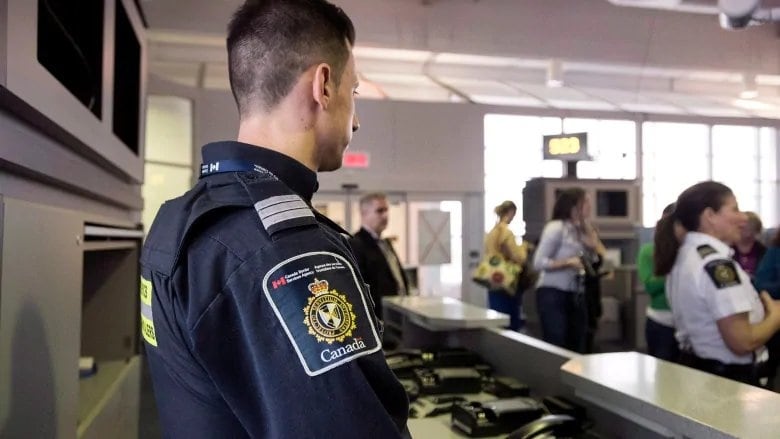
The Canada Border Services Agency said its internal review policies and
procedures have been 'refined' in light of the granting of permanent
residency to a person of 'national security concern.' (CBC)
"Seventy-Five
years ago, on the fifth day of Iyar on the Hebrew lunar calendar, which
falls on April 26 this year, on the eve of Great Britain pulling out of
Palestine, the region's Jewish community declared 'the establishment of
a Jewish state in Eretz-Israel, to be known as the State of Israel'."
"The
Zionist movement was formed to re-establish the ancient Jewish homeland
in Judaea, as a refuge for a people who faced centuries of persecution.
At the end of the 19th century, the World Zionist Organization began
building the institutions that would form the basis of an eventual
state."
"Following
the Holocaust, Zionism came to be seen not just as a dream, but as an
existential imperative for a people who had barely escaped total
annihilation."
From ubiquitous carbonated water to drip
irrigation for growing crops in the desert, the USB key and anti-missile
systems, Israel has a talent for creating things the world wants.
Modern-day
Israel has distinguished itself as a innovative hub of human
creativity, a vast beehive of technological advances as well as an
agricultural focus on the art of the possible. In an arid landscape
where water is always in short supply, its lack through normal means and
natural resources has been rectified by coercing nature to cooperate
with enterprising methods in resupply to huge advantage not only to
Israel but in sharing its remedies to the rest of the water-scarce
world.
Ranking
highest in the world for per-capita startups, Israel's rate of tech
investment has registered as much as 28 times greater than the United
States. In the 1980s, the USB stick was invented in Israel. Israeli
agricultural scientists popularized the cherry tomato. Smartphones with
Waze operate with Israeli code. The brilliant inventive power of Israeli
scientists has led to all manner of inventions uniquely Israeli which
become technologies with global spread.
Translation
machines represent a particular Israeli tech inspiration possibly
reflective of the many langues aside from the country's national Hebrew,
being spoken. Babylon, one of the first software programs offering
instantaneous translation of documents and web pages was the work of an
Israeli company in 1997. In the 1990s Wizcom Technologies debuted pens
able to scan words and translate them to an LCD screen. OrCam Read, a
hand-held device, can scan printed pages and read them aloud.
One
of the country's first major technical challenges to face Israeli
scientists was how to maximize scarce water resources. Israeli geography
is largely desert; almost all sources of surface water arrive through
neighbouring territories hostile to Israel. Israel now produces 20
percent more water than required internally, with three major
initiatives.
Huge
desalination plants to repurpose sea water into potable water; a
centralized water management system repurposing wastewater, replenishes
aquifers and moves awater through a complex system of canals, pipes and
reservoirs. Irrigation, the third, a method of agriculture developed in
the 1950s where water crops use targeted drips instead of sprinklers.
The Pillcam ESO is used to photograph a patient’s esophagus.
Rewalk,
a robotic exoskeleton enabling paraplegics to walk, grabbed world
attention to gawk at Israeli medical technology. Israeli researchers
invented tiny cameras and sensors to be introduced into the human body;
disposable 'cameras'-in-a-pill, the PillCam that can be swallowed to
allow doctors to view the state of a body's internal organs. An off
shoot of Israel's security tech sector. Surveillance cameras, drones and
spy cameras, part of Israeli defence technology.
ENvizion
Medical based in Tel Aviv created a "smart" feeding tube to help chart
its path down the esophagus, meant to prevent health-care providers from
accidentally sending the tube into the lungs. Another, a flexible and
high-resolution Aer-O-Scope colonoscope sends a tube to scope around the
human colon.
Israel's
never-ending concern over hostile neighbours scheming to destroy it by
incremental attacks and lethal violence required technology capable of
destroying incoming missiles. The country's military poses an advanced
catalogue of technologies designed to shoot down missiles; Iron Dome the
most famous among them. About 90 percent of incoming rockets and
artillery shells are blocked from landing through the latticework of
sensors and interceptor missiles along Israel's border.
Israel has an advanced catalogue of technologies designed to shoot down missiles from hostile neighbours.
A qick reaction missile -- Arrow 3 -- "designed to intercept and destroy the newest, longer-range threats, especially those carrying weapons of mass destruction"
has been developed. A tiny anti-missile system to be attached to tanks
and armoured vehicles is the Trophy countermeasure system, designed to
detect an incoming anti-tank missile and disarm it at the last second
with a burst of small projectiles.
In
2013, Israeli labourers were put to work repairing the security fence
that separates Gaza from Israel. A sniper killed one of the workmen and
Israel retaliated by bombing Gaza at a number of Hamas sites and where
the sniper shot the fence repairman from. Hamas issued a statement
condemning Israeli 'aggression'. This is the security fence necessitated
by countless suicide bombing incursions from the West Bank and Gaza
into Israel that left 900 Israelis dead in the last several decades,
young and old, wounding many more.
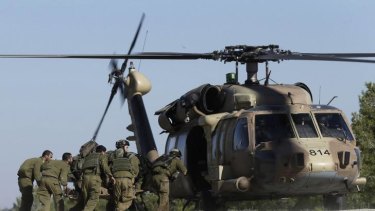
Israeli army soldiers carry a labourer shot near the Israel and Gaza border to a helicopter.
The
Israeli workman who was shot dead that day was a civilian contractor
who worked for the Israeli Defense Ministry. The day previous, an
Israeli police officer had been stabbed and wounded at a West Bank
junction. And a few days on, a bomb exploded on a bus in Bat Yam, near
Tel Aviv. Minutes before, passengers were warned to exit the bus, a
quick appraisal that worked to prevent casualties.
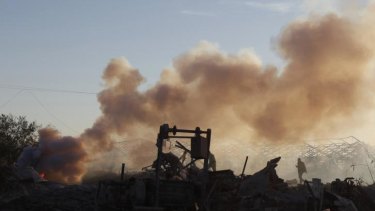
Israel responds ... A Palestinian inspects a Hamas
training camp after it was hit by an Israeli air strike in Khan Younis
in the southern Gaza Strip.
There
was a wholesale reduction of Palestinian terrorist incursions from the
West Bank and Gaza Strip into Israel after the controversial security
fence was built. In a sense, the fence, while protecting Israelis and
saving countless lives, gave impetus to the slander of Israel as an
'Apartheid State'. The usual Palestinian contortion of reality, where no
Jews are permitted to live in the West Bank governed by the Palestinian
Authority, while 20 percent of the Israeli population is comprised of
Israeli-Palestinians with full citizenship.
The
fence has, since its building, fallen into disrepair with gaps and
breakages occurring here and there. Upkeep to the fence is ongoing.
Recent deadly incursions into Israel by Palestinian terrorists resulted
within a two-week span of attacks, in 14 Israelis being killed, knifed
or shot to death, as well as vehicular homicide. This led to damaged
areas of the fence having to be repaired once again to restore its
integrity as a deterrent to deadly violence.
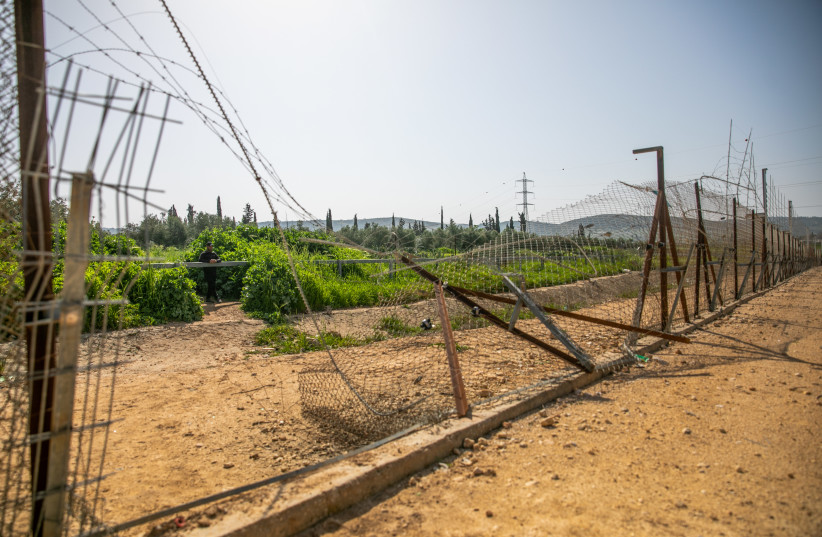
View of a hole in the the security fence, near Mevo Horon, March 30, 2022.
(photo credit: YOSSI ALONI/FLASH90)
Where,
on the occasion of the murder of five Israelis by a 29-year-old
Palestinian from Jenin, Palestinian Authority President Mahmoud Abbas
was heard to condemn the violence, calling for a "permanent, comprehensive and just peace",
he and his Fatah party have never stopped inciting Palestinians to
violence against Jews. From primary school curricula up to high school
and through social media the PA, Fatah and Hamas glorify martyrdom,
teaching Palestinian children to view Jews as the enemy.
The only
'permanent, comprehensive and just peace' that the PA's Abbas will
countenance in reality is to see Israel defeated in conflict, and the
country and its Jewish inhabitants disappear, to enable Palestinians to
claim the entire geography as their own, 'from the river to the sea'.
More recently, during the confluence of Passover, Easter and Ramadan,
violence has once again flared up at the Temple Mount over which the
Noble Sanctuary of Islam was built, with the Dome of the Rock and the Al
Aqsa mosque.
The Temple Mount, the most sacred place in Judaism
where the two Temples of Solomon sat, the second ruined by the Romans
during their occupation of Judea, has been ruled off limits to Jewish
worshippers to satisfy the monopoly claimed by the Jordanian Islamic
Waqf authority to whom Israel signed over authority with the peace
agreement it signed with Jordan. Mahmoud Abbas has railed against
'filthy Jewish feet' soiling the Noble Sanctuary when Jews have appeared
on the Temple Mount.
During this Passover week, Israelis were
given permission by the Israeli government to approach the Temple Mount,
while Israeli Palestinians who call it the Noble Sanctuary prayed at
the Al Aqsa mosque. Palestinians assaulted Orthodox Jews and they rained
rocks down on Jews gathered at the Wailing Wall to pray. The
Palestinians gathered rocks, placing them within the mosque, and lobbed
them along with incendiary devices at Israeli security.
Attempts
to restore peace and security saw hundreds of rioting Palestinians
injured. Smoke bombs and tear gas was used, as well as truncheons
wielded by the Israeli Security. Hundreds of rioters were arrested. The
Arab Muslim world reacted, insisting on cautious moderation in response
to the riots where, if they were themselves faced with the savagery of
violent riots, would have used more forceful means to disperse and
arrest the rioters.
Avishai Yehezkel, one of the victims, was buried in Bnei Brak Reuters
The
recent murders of Israelis by Palestinians, outwardly condemned by the
PA's president, rings hollow on many fronts, not the least of which is
that the Bnei Brak attack that killed five Israelis was carried out by a
Fatah militant, earning praise from senior Fatah members who are part
of the West Bank governing party. Hamas and Islamic Jihad in Gaza as
well as Fatah, celebrated the murders, handing out sweets and adding
incendiary threats for further deadly attacks.
These are the
neighbours that the international community, the United Nations, the
European Union, the United States, the UN Security Council, the Arab
League -- whose member states never allowed Palestinians to settle in
their own countries as citizens -- all insist that Israel must negotiate
for a peace accord with. A neighbour against whose malevolence and
thirst for the murder of Jews necessitated a security fence.
In Israel's case, good fences did not make for good neighbours.
"Governments continue to spy on each other, but spying now has a much further reach, including into our universities and businesses."
"It is not inherently improper for countries to try to influence each other, but we can never allow national security to be compromised."
"The activities of those hidden relationships where public figures are encouraged to push another country's interests, hack-and-leak operations, covert surveillance and organized online trolling..."
"We in the U.K. will no longer tolerate the brazen way we have seen our national security subject to such activities. Our upcoming legislation will represent the biggest counter state threats legislation in decades."
Priti Patel British Home Secretary
UK Home Secretary Patel Accuses 'brazen' China For Spying On Universities: Report AP
Taking a page out of Australia's book in defence of national security and the values of their political system in enacting a law that would prohibit 'corrupt, coercive or covert interference' in Australian politics, the U.K. knows full well what a rough track it has in future relations with a trade colossus that expresses its displeasure at criticism aimed at it from any quarter for any reason in vicious trade exchange interruptions and diplomatic hostage-taking, ahead. Beijing has failed to 'notice' that other nations do take notice at its constant interference in their national affairs.
China's installation of the Chinese Communist Party's major foreign interference arm, the United Front Work Department, has fomented and encouraged underhanded, covert and aggressive push-back by Chinese Mainland residents of other countries who have taken citizenship with their countries of adoption. It is past time that Britain publicly acknowledged that China spies on British businesses and universities; they've done so for decades, purloining any intelligence of value to Chinese interests.
To counter these espionage threats through an ever-bolder Chinese strategy of taking advantage of other nations' advances in academia, science, technology and business, the U.K.'s official secrets laws are to be modernized in view of new spying threats and online trolling in efforts to destabilize and steal secrets. In a speech to the Heritage Foundation in Washington, she warned her audience, "espionage is evolving" and she held no compunction in naming Russia, China and Iran.
Chinese state-linked hackers were behind a computer hack involving 250,000 Microsoft Exchange servers accessing email accounts, acquiring data, and deploying malware. The U.K. plans to hold China to account through a bilateral agreement setting out acceptable behaviour in cyberspace with China. "In December 2018, the U.K. and 14 other countries called out China's Ministry of State Security for breaching the agreement", she stated.
She spoke of 31 terror plots having been foiled since 2017 and social media firms' plans to extend end-to-end encryption where neither the platform operator nor law enforcement could see the content of messages "jeopardizes the good work that has gone before". Freedom of speech, she warned, did not include the right to incite terrorism and "reasonable" people should be able to rely on police to track and tackle terrorist or child abuse content.
"The agencies will form a view, and for the partnerships that are deemed high risk, they will not be funded."
"The
bottom line is that [research projects] that are found to be high-risk
will not be funded and those which come with a low-to-medium risk
assessment will be required to have risk-mitigation measures put in
place."
Innovation Minister Francois-Philippe Champagne
"Money
is no object in Chinese R&D, and the Chinese partner in most cases
would be happy to step in to fund what would otherwise have been the
NSERC [Natural Sciences and Engineering Research Council] portion."
"This would still have Canadian researchers contributing to projects that hold a national security risk for Canada."
"The
guidelines seem to be limited to areas where there is federal funding.
National security threats are hardly limited to areas receiving federal
funding and these guidelines should cover all university research in a
way that reflects federal responsibility for all aspect of national
security."
Richard Fadden, former CSIS (Canadian Security Intelligence Service) director
A view by drone of the National Microbiology Laboratory in Winnipeg on Wednesday, June 9, 2021. (Trevor Lyons/Radio-Canada)
The
Liberal government was recently on the embarrassing political hot seat
with opposition parties insisting on assessing information in Parliament
relating to the situation that took place at Canada's high-security
microbiology laboratory when two Chinese scientific investigators, a
husband and wife, were summarily escorted out of the laboratory in 2019
and a year later when their high security credentials were revoked,
fired from the lab. Escorted out of the lab at the time was a number of
Chinese biology students working alongside them at the National
Microbiology Laboratory.
An
unauthorized shipment of Ebola and Henipah viruses left the laboratory,
sent to the Wuhan Institute of Microbiology with which the two
scientists collaborated. It was also revealed that a microbiology
specialist who worked for the People's Liberation Army biology
laboratory was employed for a while at the Winnipeg laboratory. China
has long had a habit of exploiting secret data, the intellectual
property of other countries, lifting it and treating it as their own,
providing useful short-cuts to refine their own scientific
investigations.
Xiangguo Qiu, her biologist husband and her students were escorted out
of the National Microbiology Laboratory in Winnipeg in July 2019. The
RCMP have been investigating a possible 'policy breach' reported by the
Public Health Agency of Canada. (CBC)
The
government of Prime Minister Justin Trudeau fought to deny the
opposition Conservatives in the House of Commons access to revelatory
documents and it has now seen fit to resort to protecting future federal
government-funded research projects from the sticky hands of foreign
governments. Without naming China specifically, the federal innovation
minister announced new guidelines for scientific research granting to
avoid as much as possible in future the kleptocratic inroads that
Beijing has made into Canadian research property.
The head of the
Public Health Agency of Canada defied a Parliamentary order to present
the documents requested that would reveal the explanatory background of
the two fired Chinese biologists who worked at the Winnipeg laboratory.
The situation surrounding the two and the mystery of specific details
aroused attention and gave rise to the urgent matter of security related
to scientific research, with Canadian intelligence property falling
into the wrong hands. Henceforth, researchers applying for grants
through NSERC must complete a comprehensive security risk assessment.
Qiu and her husband, Keding Cheng, were escorted from the
National Microbiology Laboratory in Winnipeg on July 5, 2019. After
that, the University of Manitoba ended their appointments and reassigned
her graduate students. (Governor General's Innovation Awards)
A
national-security review conducted by Canadian security agencies and a
team of scientists will be called for any project assessed as "higher
risk". Any project judged to fall into the category of high risk will
not be eligible for government funding. Roughly $1.3-billion is granted
each year by the National Sciences and Engineering Research Council to
fund research and training. It is not the only funding source, however
since the U15 Group of Canadian Research Universities including most of
Canada's research-intensive universities lays claim to funding
$8.5-billion of annual research.
Last year the Canadian Security
Intelligence Service repeatedly gave warning of Canada targeted by
sophisticated state-sponsored infiltrators whose function it is in
service to their countries of origin to purloin information and
intelligence from Canadian companies and researchers. NSERC grants for
the present involving researchers and private-sector partner
organizations will require inspection and clearance to qualify for
federal financial support for their projects. In time the process is
meant to be expanded to cover all federal granting councils along with
the Canadian Foundation for Innovation.
Grants are to be
scrutinized to determine research that could be of potential benefit to
other countries' military, police or intelligence agencies, or that
would focus on critical minerals, nuclear power, critical infrastructure
or technology and software subject to restrictions under the Export and
Import Permits Act. All those categories neatly sum up the interests of
the People's Republic of China in securing data and rights of all
kinds, as well as its focus on monopolizing critical minerals and
software and other areas of technological advances.
Criticism has
come the way of the federal government for its obvious willingness to
trust cooperative ventures with China-based corporations which then have
the opportunity to cyber-access highly secret information. Such as the
federal government partnering with Huawei Technologies in the funding of
computer and electrical engineering research at Canadian universities.
NSERC announced in February its collaboration with the Canadian arm of
Huawei to fund studies, in contrast to top universities in the U.S. and
Britain which have halted further research funding from Huawei over
intellectual property and national security concerns.
A 2018
investigation revealed Huawei to have established a vast network of
relationships with leading research-focused universities in Canada in
the creation of a steady pipeline of intellectual property (theft) the
company uses to underpin its own mobile technology market position.
Western countries have assumed growing concerns over efforts by China to
scour the world for technology with both civilian and military value --
characterized by Richard Fisher, senior fellow on Asian military
affairs at the International Assessment and Strategy Center as a global "intelligence vacuum cleaner".
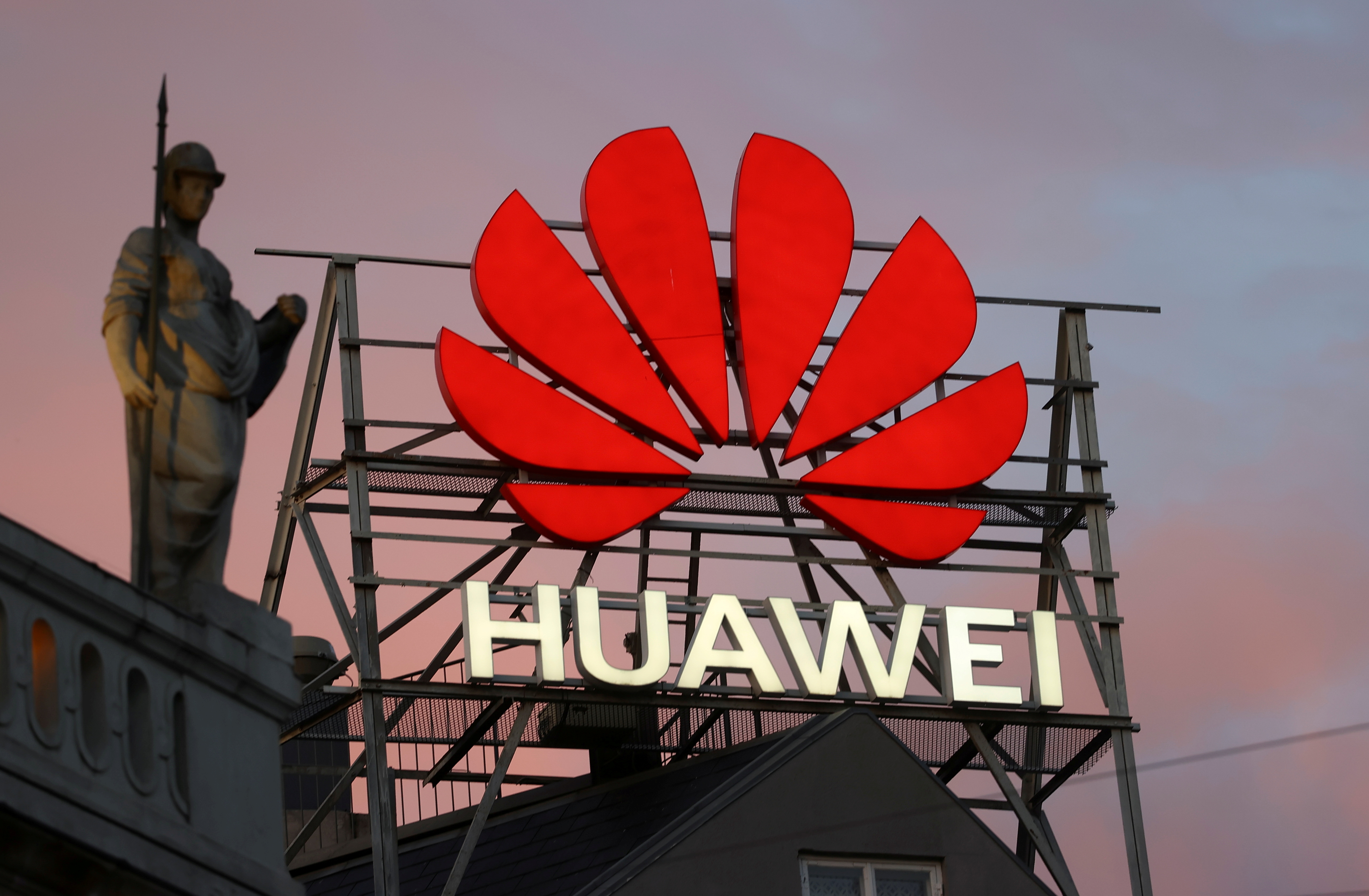
The logo of the Chinese telecommunications giant Huawei Technologies is
pictured next to a statue on top of a building in Copenhagen, Denmark,
June 23, 2021. REUTERS/Wolfgang Rattay/File Photo
The Moral of the Story: Beware, Take Care, Be Wise
"The
Government of Canada [should] demonstrate stronger leadership on the
issue of procurement and national security, including at the highest
echelons -- the Prime Minister, ministers and senior officials."
"[Government
should] prohibit Chinese state-owned enterprises, partial state-owned
enterprises, including companies receiving undisclosed government
subsidies, and technology companies from obtaining federal contracts
related to information technology or security equipment or services."
"[The
Privy Council Office should look] to develop, implement and oversee a
policy to direct all government departments and agencies to review
current contracts with China related to information technology or
security equipment or services."
"The
Committee heard that the federal government should not always choose a
supplier based mostly on the lowest price when evaluating bids for
security equipment."
"Where circumstances warrant, it should put greater emphasis on national security risks."
"Throughout
its study, the Committee became concerned that federal departments and
agencies did not collaborate to assess potential threats to Canada's
national security when the government was procuring a replacement of
security screening equipment in Canadian embassies."
"The Committee recognizes that closer collaboration among federal departments and agencies is required."
House of Commons Government Operations Committee
Government
procurement infamously selected a Chinese company's X-ray machines to
be installed at all Canadian missions abroad until the absurdity of
awarding such a contract to a Chinese company was highlighted by an
investigative journalist, in the wake of Beijing arresting and charging
two Canadians with espionage and imprisoning them on those trumped-up
charges in an effort to apply pressure to have Canada release Huawei's
CFO who had been detained by the RCMP at a stopover in Vancouver
honouring an extradition request by the U.S.Department of Justice.
Relations
with China have since descended to their lowest pitch, with Beijing
threatening repercussions should Canada decide not to permit Huawei to
take part in Canada's 5Gupgrade as the rest of the members of the Five Eyes group (an integrated, collaborative intelligence-sharing between members, U.S., Britain, Australia, New Zealand and Canada) have
done. Even under those strained relations, the Liberal government still
decided to proceed in partnering with CanSino, a Chinese
pharmacological company to joint-produce a vaccine for SARS-CoV-2, which
Beijing chose to cancel unilaterally.
The
Liberal government under Prime Minister Justin Trudeau, tutored and
mentored by former Prime Minister Jean Chretien, hungered for a free
trade deal between Canada and China. Canadian corporations headquartered
in Quebec see such a free trade agreement with China as a profitable
venture, sitting on the Canada-China Business Council continuing to
promote business with China despite Beijing's hostility and threats.
Canada's
government under the Liberals refuses to take China's cybertheft
proclivities, political and academic infiltration and influence-peddling
seriously. It is only very recently that in public fora, Justin Trudeau
has stated Canada's opposition to China as a growing threat to the
world order in its focus on control, power, monopolistic trade,
influence and its soft power working hand-in-glove with its hard power.
Investing in vital infrastructure loans to developing countries while
threatening Taiwan, Hong Kong, and abusing the human rights of Tibetans,
Christians and Uyghurs.
Now,
a parliamentary committee has released a report calling on the federal
government to place greater consideration on issues such as national
security in tendering contracts and favouring bids by Chinese companies,
all of which must, by Chinese law, answer to Beijing's call. Apart from
the fact that many are state-owned corporations. The concerns expressed
go across party lines since the committee is comprised of Liberal,
Conservative, Bloc Quebecois and NDP members.
Government
officials testified before the committee, along with experts on China
and national security. The committee reviewed a threat assessment from
the Department of Foreign Affairs, describing the Chinese company
selected to install and service its security equipment on contract to
the Canadian government with the company in question characterized as "a Chinese state-owned enterprise with direct connections to the People's Liberation Army and the Chinese Communist Party".
The
X-ray machines were not considered a security risk since their use was
in a publicly accessible area, unconnected to embassy computer networks.
The committee was informed however, by an official with the
government's Centre for Cyber Security, that this view of X-ray machines
was outdated; they now typically come equipped with hard drives and USB
ports potentially useful to hostile actors "with malicious intent". And that certainly describes Beijing's attitude toward Canada.
The
report released by the committee found no effective government strategy
in place to manage security risks revolving around China and federal
procurement. Stronger security measures were recommended, to focus on
screening companies and employees who install and maintain equipment in
sensitive federal facilities such as embassies. There is room for
improvement at flagging potential security threats.
"We are being introduced in a very rough way to a new world where the
rules of the road are decided by the strongest."
"We've always said in Canada that we
needed a foreign policy that built on the international rules and
regulations… but China is starting to play rogue."
Paul Heinbecker, former Canadian ambassador to Germany, representative to the United Nations
"Relations between the two countries
can't be reset until the two Michaels [Spavor/.Kovrig] are set free. Once that happens,
relations should be reset in a different way."
"China is capable of acting
aggressively against Canada. China is not our friend and we should stop
treating it as though it is. We should form a relationship with China
based on mutual needs."
"We should treat China with respect but always
protect our own interests and push back when necessary. We also need to
find allies who will help us retain our sovereignty in a world where
China is trying to encroach on it."
Former Canadian ambassador to China David Mulroney (2009 to 2012)
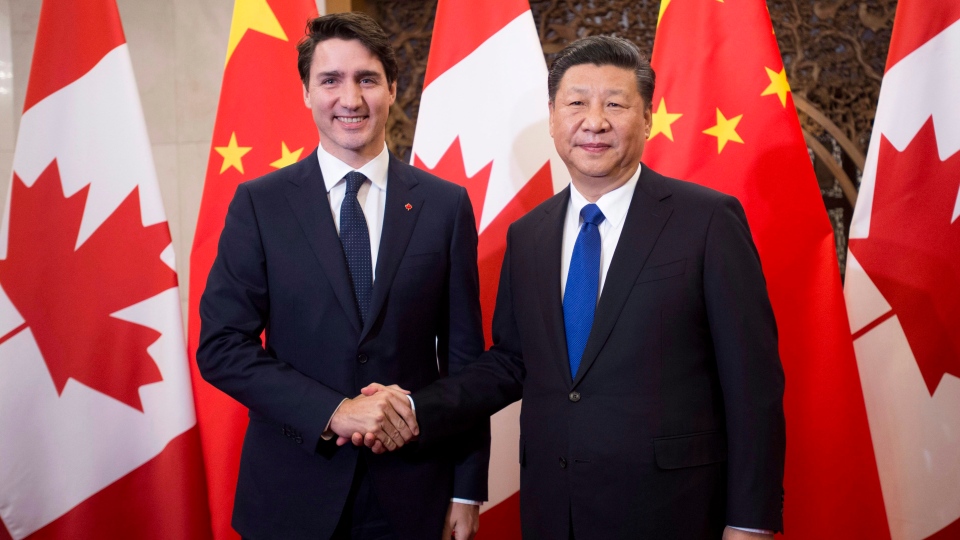
China's
President Xi Jinping and Canada's Prime Minister Justin Trudeau are
shown at the Group of 20 summit in Osaka, Japan on June 29, 2019 (KAZUHIRO NOGI/AFP via Getty Images)
"I am deeply concerned about the potential theft of Canadian intellectual property and further concerned that research partnerships with the People's Republic of China may be used by Chinese military and intelligence agencies."
"More needs to be done to curb foreign state infiltration into our research and innovation centres, including our post-secondary institutions."
"My priority is to work with our post-secondary institutions to protect Canadian intellectual property and to ensure that Alberta institutions do not enter into agreements with entities that would undermine our country's core national interests."
Alberta Advanced Education Minister Demetrios Nicolaides
"A consistent national response on security matters and international engagement is necessary and we are fully committed to working with all levels of government to ensure that Canada's core security interests are protected and advanced."
"To be a leading research-intensive university means being an active participant in the globalized community."
Walter Dixon, interim president of research and innovation, University of Alberta
The University of Alberta Campus Saint-Jean Photo by David Bloom /Postmedia
Agreements are in place by the University of Alberta with partners from over 80 different countries. International partnerships, inclusive of research, teaching agreements and international learning opportunities represent the universally acknowledged academic community freedom to provide students, post-doctoral researchers and faculty with the stimulation and experiences required to ensure that knowledge flows freely around the world, to be shared by all. A noble tradition.
One that has its newly-revealed flaws, when one partner above all others seeks to purloin, not share in research for their own very specific advantage. In the process probing deeply into political and military areas that have nothing to link them to shared scientific endeavours unless they fall into the category of protected state secrets. And those limited areas have been, from time to time, the subject of unlawful cyber security breaches on the part of state actors.
It all seems to come down to the rogue acts of the People's Republic of China's agenda to acquire as much of other nations' critical data, protected secret files and scientific and technological research breakthroughs as it can manage to capture by any means necessary to fulfill the Chinese Communist Party's increasingly understood agenda of becoming the most influential and powerful nation on the globe whose infrastructure and political tentacles reach everywhere.
Alberta has now taken steps to inform four of its universities to put a halt to searching out research projects with any link to the Chinese government. Because everything in China is linked to the Chinese government. The province's Advanced Education Minister Demetrios Nicolaides asks the University of Alberta, the University of Calgary, the University of Lethbridge and Athabasca University to pause pursuing any new or renewed partnerships linked to the Chinese government or ruling Chinese Communist Party.
A thorough review is to be undertaken of their institutions' relationships with any entities with potential links to Beijing, ensuring that ongoing partnerships recognize stringent risk assessments and enhanced diligence. The statement from the minister cites ongoing concerns with respect to national security and intelligence, most notably the federal government's domain. This provincial initiative echoes what has been occurring in other democratic countries such as Australia and the United States.
Concerns relating to foreign involvement in university research and intellectual property protection are the subjects of great debate, particularly of late. Ottawa had initiated the concern when it signalled its focus on "espionage and foreign interference activities" when the federal government encouraged researchers to become cautious in protection of the security of their research and intellectual property.
Canadian Security Intelligence Service building is shown
in Ottawa. (THE CANADIAN PRESS/Sean
Kilpatrick)
"Real sympathy with the Palestinian people means searching for
solutions for an actual and practical peace that guarantees their
safety, security, and development. The
solutions should also stop those [Hamas] who are ready to burn Palestine
and its people."
"[The Hamas terrorist group] was well prepared for this war by building trenches in which its
members can take shelter, while innocent Palestinians were being killed.
Hamas likes to play the role of victim and kill Palestinians to win
Arab, Islamic and international sympathy."
"Some ask, is this the right time to present the crimes of Hamas.? This is precisely the best time to do so. The reader can
conduct a quick search on the Internet to learn about the crimes that
Hamas has committed against the Palestinians. Hamas has the right to
destroy its homes with its own hands, but it has no right to destroy the
homes of Palestinians and underestimate their blood and the blood of
their children."
"Hamas
and its Muslim Brotherhood patrons do not care about the suffering or
interests of the Palestinians. They only care about demonizing those who
stand against them. Hamas is
saying: Let the Palestinians die for the sake of a Muslim Brotherhood
victory."
Saudi writer/researcher Abdulah Bin Binjad Al Otaibi
"Abbas wants to cover up for this decision to postpone the
Palestinian elections so that he can continue to sit on the presidential
chair at the expense of Palestinian blood. Hamas aspires to increase its popularity and drain the pockets of
those who see it as a resistance movement by launching futile missiles
that harm it more than doing any good."
"A few months ago, we were very happy with the signing of the Abraham
Peace Accords [with Israel], which the people rely on to create peace
that benefits everyone politically, economically and socially,"
"But the extremists are working to kill this dream. It is sad that some
are working hard for peace, while others are working hard for the sake
of war and the continuation of the conflict."
Emirati writer Al-Sheikh Wuldalsalek
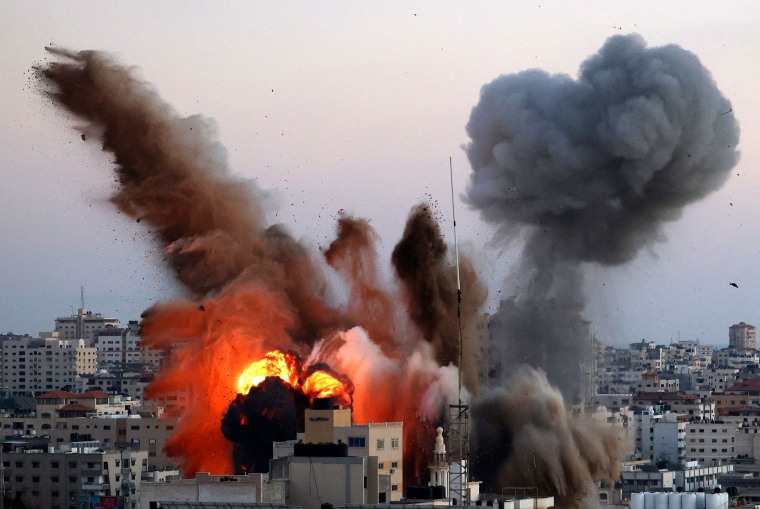
Air Strikes in Gaza EPA
Geographically,
Israel is a tiny sliver of a country. As such it wasn't too much to ask
for, for the remnants of world Jewry following World War II when the
total number of diaspora Jews was reduced by six million men, women and
children. And the singular event of the Holocaust convinced Jews that
there was no country where Jews had residence, whether for a thousand
years or a hundred, that would bother itself to give security to its
Jewish civilian population (with rare exceptions).
Throughout
history in the millennia of the diaspora, Jews became accustomed to
keeping a low profile, hoping not to bring attention to themselves. They
lived in Europe and throughout most of the world where happenstance
took them, sometimes tolerated, sometimes not, but always vulnerable to a
fallback scapegoat position of a tiny ethnic, cultural and religious
minority among majority population of different heritage, culture and
religions and often visceral hatred of Jews.
That tiny sliver of a
country has produced miracles. As a nation dedicated to the
preservation and safe security of Jews it has also absorbed, as a
democratic state, people of other ethnic, cultural, social and religious
groups as citizens of a Jewish state. In that state pioneering
breakthroughs of another kind regularly take place in various areas of
science and technology. Discoveries that render service to the world at
large, from medical advances to agrarian and technological discoveries.
This
country of great accomplishment whose science, medical research and
allied breakthroughs give it recognition, has also in its over 70 years
of existence, never started a war, though it has fought many, for its
survival. It has some admirers and many critics. Who never tire of
challenging the reality that is Israel's existence. From the horror of
the immediate Holocaust years when the world witnessed the liberation of
death camps and became knowledgeable of the hideous strategy to
exterminate the Jewish identity and people, empathy has returned to the
viral pathology of anti-Semitism.
In 1948 Israel was given
permission by the great United Nations to form a sovereign nation out of
that sliver of land representing a mere fragment of its ancestral
heritage geography. Arabs, identifying themselves as 'Palestinians' (when the original Palestinians were in fact Jewish inhabitants of the land),
refused the land they were offered under the UN's Partition Plan of
equal opportunity. When combined Arab armies marched on the nascent
Israel to destroy it, half of the Palestinians, some 700,000 people,
left with plans to return once victory was assured.
At the very
same time, a like number of Jews, Sephardic and Mizrahi who had lived
for thousands of years in Arab lands were summarily exiled, becoming
stateless refugees, and were welcomed to Israel where they found haven.
Neither the Arab/Muslim nations in the Middle East nor the Palestinian
Arabs themselves would give recognition to a Jewish state in the
geography; ongoing hostilities led to a number of wars until the final
one that saw Israel take the Sinai Peninsula, the Golan Heights, east
Jerusalem and in fact the Palestinian Territories in its defence from
its enemies.
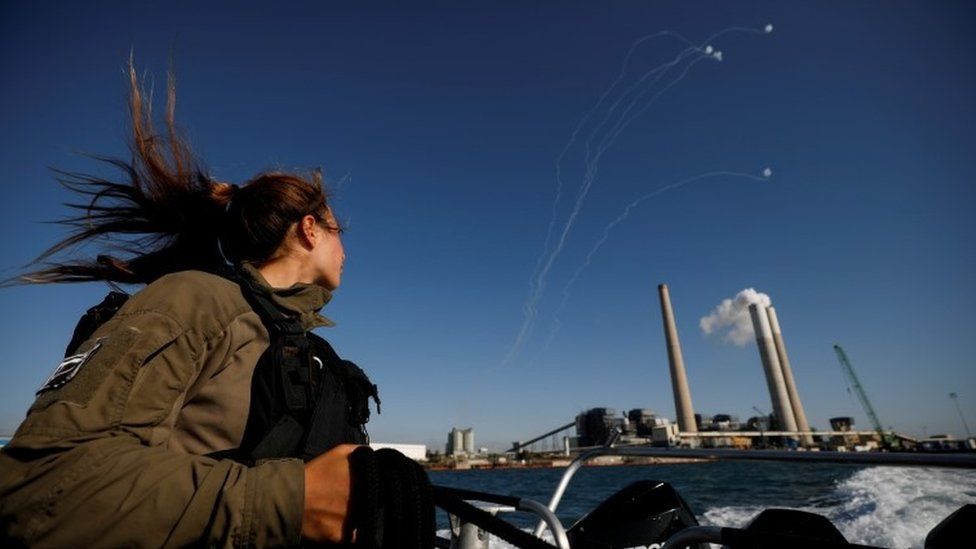
An Israeli soldier looks on as Israel's Iron Dome anti-missile system intercept rockets launched from the Gaza Strip Reuters
Returning
the West Bank and the Gaza Strip to the Palestinians did nothing to
convince the Palestinian leadership that it would be in their best
interests to live in peace, side by side, and to attain their own
sovereignty through a mutual agreement with a fellow-nation it would
give recognition to. The Palestinian Authority speaks of 'occupation',
but it is one forced upon Israel by constant violence afflicting its
people from incited Palestinians who are taught that 'resistance' (violence) against the 'enemy' (Israel), results in martyrdom for which they can anticipate financial rewards and/or Paradise.
During
the First Intifada in 1987, the Palestinian uprising, conflict saw
1,200 Palestinians and 150 Israelis die. And when the Palestinian
leadership identified Palestinian collaborators with Israel they
executed over 800 of their own people who preferred to live in peace
with Israel rather than kill Jews and die as martyrs to the Palestinian
'cause', thus setting an example that other Palestinians with such
dangerous ideas would be certain to avoid.
Of those Palestinians
who remained in Israel, a number equal to those who fled, this 700,000
has swelled to 1,900,000, representing 21 percent of the total
9.2-million Israeli population. Not the 'apartheid' government that
Israel-haters are so fond of declaring, but one that accepts its
Palestinian population as citizen-Israelis. A month ago, before this
current round of attacks between Gaza/Hamas and Israel, the Jewish
People Policy Institute released an annual study on Israeli identity.
The overwhelming majority of the 1.9 million the world knows as Palestinians, refer to themselves as Israeli-Arab (51 percent), or just Israeli (23 percent), with those who identify as Palestinians amounting to roughly 7 percent.
Yet in the West Bank and Gaza the Palestinian Authority (Fatah/PLO) and Hamas, celebrate the 'Naqba' (Catastrophe) which
identifies the establishment of Israel in 1948. They could be
celebrating 'Palestine' from that same date forward, had they not
refused categorically to even consider accepting half the disputed
territory as their own. In fact, the land originally envisaged as being
offered to Israel was much greater in size, but was handed over to the
Hashemite Kingdom of Jordan which had been ensconced there as
compensation when the British Mandate helped the Saudis to claim Arabia
as their own, displacing the Hashemites contesting Arabia as theirs.
There's
a certain hypocritical similarity in the two situations which no one
ever seems to linger on, all the more so when Jordan illegally occupied
part of Jerusalem, the Judean city of antiquity, the Old City called
Eastern Jerusalem where Judaism's most sacred symbol sits, under an
Islamic shrine and mosque built on the twice-ruined Temple of Solomon.
Under Jordan's rule, the Jews who had lived in East Jerusalem since time
began were forcibly displaced and no Jews were permitted to enter the
area,much less to pray at the Wailing Wall, the remnants of the Eastern
Wall of the Temple.
Even before that Jews were massacred in
Hebron, Sefad and a dozen other ancient Jewish communities in the 1920s
by rampaging Arab/Muslim mobs in what is now Israel. And the Jews exiled
in 1948 from Morocco, Iraq, Syria, Algeria, Yemen and Libya among other
Arab states where Jews lived for thousands of years, might consider
those events their own 'naqbas'. The designs of the Muslim Brotherhood
in their alignment with the Nazis helped entrench anti-Semitism
throughout the Arab world in the 1940s.
And what brings the
situation to the present, is the break-away group from the Muslim
Brotherhood that became Hamas with its charter outlining its intention
to exterminate Israel, with their links to the Islamic Republic of Iran,
and the al Quds Islamic Revolutionary Guard Corps, the great patrons of
Hezbollah, Hamas and Yemeni Houthis, all happily conspiring toward the
destruction of Israel, with the complacent disinterest of the West other
than its instant recoil of disapprobation when Israel has the
unmitigated gall to defend itself.
Palestinians inspect damage to buildings in Gaza City on May 20, 2021. Fatima Shbair/Getty Images
"What’s different about this round is the fact
that Hamas has managed – not just to fire missiles in the direction of
my house or to bash Ashkelon with lots of rockets – but they have made
Jerusalem, and Arab and Muslim claims and complaints about Jerusalem,
into a focal point."
?They have
incited Arab citizens of Israel to attack Jews, who attacked Arabs in
return. They have helped start a conflict inside Israel, while inciting a
mini-intifada in the West Bank and also sympathy rockets fired from Lebanon."
"We will continue as long as it takes in order to restore calm for all of Israel's citizens."
"One
other thing: I"m sure that all of our enemies around us see the price
we are exacting for the aggression against us and I am certain that they
will have absorbed that lesson."
Israeli Prime Minister Benjamin Netanyahu
"Tensions
Rise in Middle East As One Side Wants To Kill Jews And The Other Side
Are Jews Who Don't Want To Die And Neither Will Compromise."
The Babylon Bee
Rockets are launched from the Gaza Strip toward Israel on Wednesday. (Hatem Moussa/The Associated Press)
This
is a determination and an attitude born of no longer wanting to accept a
ticking time bomb perched on Israel's border prepared to explode at any
time. This is a nation of a people that has been tried and tested far
too often by malevolent forces believing it has no human right to exist,
bolstered by the silent support of countless others whose visceral
hatred of Jews leads them to criticize Israel when it responds to
violent provocations threatening the lives of its citizens. Those
critics who deny bias against Jewish survival cannot really expect a
state constantly attacked by missiles, rockets, suicide bombers, car
rammings, knife attacks and violent riots along with incendiary events
to do nothing to defend itself.
None
of the countries that see fit to urge Israel to curb its response to
ongoing rocket barrages that have only one purpose, to kill as many
Israelis -- preferably Jews, since a hefty minority of the population is
non-Jewish, belying the apartheid label -- as possible, would
themselves sit calmly by not bothering to react when missiles fly by and
hit random targets like schools and synagogues and apartment buildings
in their own countries. Israel has up to the present after over a week
of attacks from Gaza, sustained a relatively low rate of deaths and
injuries, in comparison to the numbers of deaths and injuries sustained
in Gaza. The low-death rate of Jews appears to mystify and bother
onlookers from abroad.
And
that owes largely to the fact that bomb shelters have been built
everywhere in Israel to protect the population from the never-ending
grip of Palestinian terrorist attacks. These are terrorists who enjoy
their games of delivering death to Jews. All costs related to the
weapons used, the rockets and other military equipment, courtesy of the
Islamic Republic of Iran. Hamas, Palestinian Islamic Jihad and Hezbollah
in Lebanon, all fostered by, trained and equipped by the Iranian
theocracy. If Israel were to wait until "the Arabs love their children more than they hate us", to paraphrase former Israeli Prime Minister Golda Meir, it would be an endless wait.
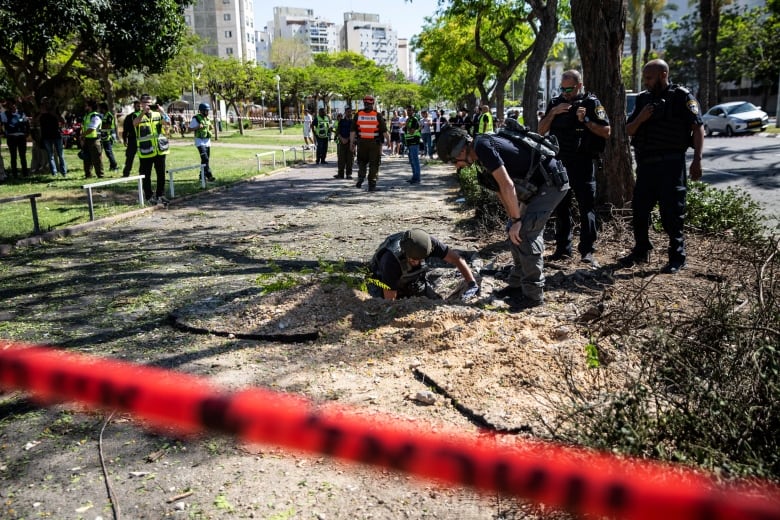
An Israeli bomb squad unit inspects the site where a rocket
fired from the Gaza Strip hit a sidewalk, in Ashdod, Israel, on
Wednesday. (Heidi Levine/The Associated Press)
For
Palestinians who hate Jews and the presence of Israel, are accustomed
to teaching their impressionable children from a young age through
school curricula, television, songs and family tradition, that Jews are
their enemy, and there is nothing finer than to aspire to become a
martyr in defence of Palestinian intentions to annihilate Israel so
Palestine can be free 'from the river to the sea'. Mothers praise their
children who die as 'martyrs' while attempting to or succeeding in
killing Jews. They don't speak for the countless others who would prefer
to live in peace with their neighbours but fear speaking out and
revealing themselves.
Western
media appear to exult in framing their reportage around Israeli
responses to Hamas and Palestinian Islamic Jihad efforts to destroy
Jewish lives, as though it is Israel that is the aggressor and
Palestinians in Gaza the helpless victims. Gaza Palestinians are indeed
victims, but of the ruling Hamas in Gaza who deliberately inflict danger
on the population for the greater goal of luring the Israel Defence
Forces to bomb civilian enclaves which Hamas uses as shields and props
for their missile and rocket launches.
The
Palestinians have no bomb shelters to head to. There are only
underground tunnels laced below the towns and cities in Gaza, affording
protection for Hamas terrorists, their commanders and their foot
'soldiers', where undisturbed, they can produce new rockets and maintain
a sizeable inventory of munitions. Civilians can look to their own
devices; they are there as fodder for the Hamas public relations
machinery that can point out to the international community and the
media hungry for sensational 'news', the number of Palestinian women and
children that Israel 'targets'.
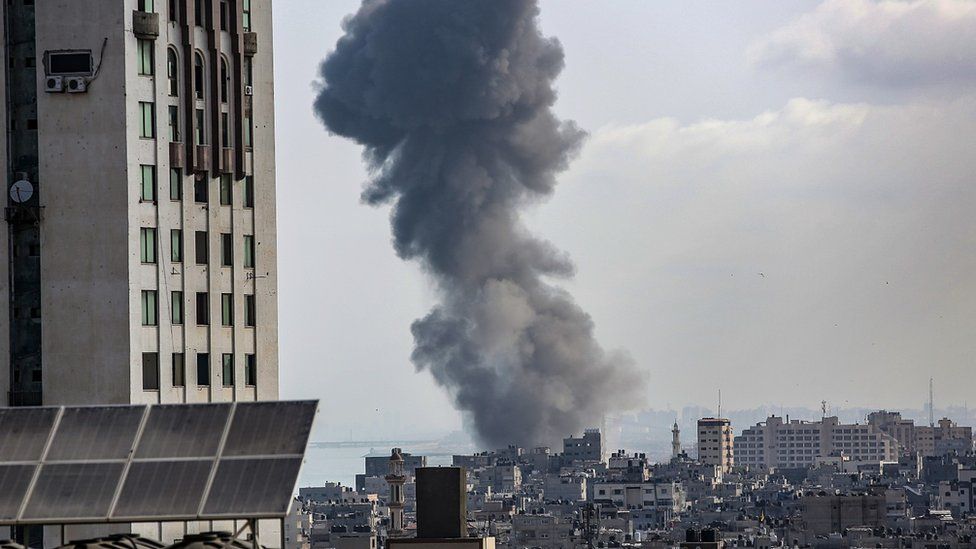
Smoke billows after an Israeli airstrike on Gaza City targeted the Ansar compound, linked to Hamas, in the Gaza Strip on Friday.Mahmud Hams / AFP - Getty Images
While
Hamas denies bomb shelters for the people they govern even as they use
them as human shields, drawing fire toward crowded urban settings like
hospitals, schools and mosques, the IDF makes every effort to alert
people living in areas where Hamas-linked buildings are located, to
advise them to leave before a bomb is dropped. Hamas deliberately
targets crowded civilian venues like border towns, as a war crime. Its
goal is to terrorize and to kill; that it succeeds in the first instance
and less so in the second seems to give Israel an 'unfair advantage' in
the minds of its critics; the Israeli death toll is too low to satisfy
those who point to the greater number of Palestinian deaths in the
carnage that Hamas has brought to Gaza.
When
the IDF portrayed itself earlier last week as being on the cusp of an
invasion into Gaza, Hamas quickly ordered its commanders and 'fighters'
to assemble in the underground tunnel system popularly referred to as
"the Metro" by the IDF, where weapons manufacturing, storage, launch
sites are installed in a voluminous underground network. From there,
they were prepared to launch an attack on IDF troops supposedly entering
Gaza. IDF intelligence is such that it was able to determine these
anticipated responses where key tunnel entrances and exits are located,
then bombed them to trap those inside, along with their weapons.
Zealously
and endlessly digging miles and miles of underground tunnels beneath
urban centers and elsewhere in the Gaza Strip may seem at first glance
to be a tactical winner, but what it does is destabilize the integrity
of large buildings built above ground with an unstable foundation
supporting them as a result of the wide-ranging, deep and extensive
excavations. The buildings 'destroy' themselves as the ground they're on
and the streets nearby collapse when bombed.
Thanks
to a naive and gullible international population reading spurious
headlines reporting on Israel's 'uneven' response to Gaza rockets,
people ask: "Why is Israel attacking Gaza again?"
Journalists work near the destroyed Al-Jala'a building, which housed
international press offices, and Hamas security offices, following an Israeli airstrike in Gaza on
Saturday, May 15 CNN
This represents a general opinion site for its author. It also offers a space for the author to record her experiences and perceptions,both personal and public. This is rendered obvious by the content contained in the blog, but the space is here inviting me to write. And so I do.