An Agreement Turned Sour
"This is a very serious issue [claims that the U.S. has a disabling "kill switch" for the $19-billion aircraft fleet that Canada has ordered from Lockheed Martin].""Certainly the situation makes it difficult to sustain operations without continued support.""Until [Donald] Trump was elected nobody gave a thought to the idea that the U.S. president would be cutting off Europe or trying to annex Canada or take over Greenland.""It was a completely crazy Idea."Bill Sweetman, author: Trillion Dollar Trainwreck: How the F-35 Hollowed out the U.S. Air Force"Lockheed Martin is committed to helping our customers strengthen their airpower and security with the F-35.""As part of our government contracts, we deliver all system infrastructure and data required for all F-35 customers to sustain the aircraft.""Foreign military sales are government-to-government transactions, so anything further will be est addressed by the U.S. or respective customer governments."Rebecca Miller, Lockheed Martin media relations director
 |
Surprise,
surprise, there are times when the unexpected has a habit of popping by
and delivering a blow to amicable relations between nations,
particularly those historically united in language, values, democratic
ideals and intertwined trade. It has recently been revealed by defence
analysts that the United States -- now under the guardianship of
newly-installed President Donald Trump who has lost no time in bringing
to that long-term continental friendship between Canada and the United
States hostile actions and presumption of force sufficient to 'persuade'
Canada that it would be in its best interests to fold up its
sovereignty and apply for the honoured position as America's 51st state
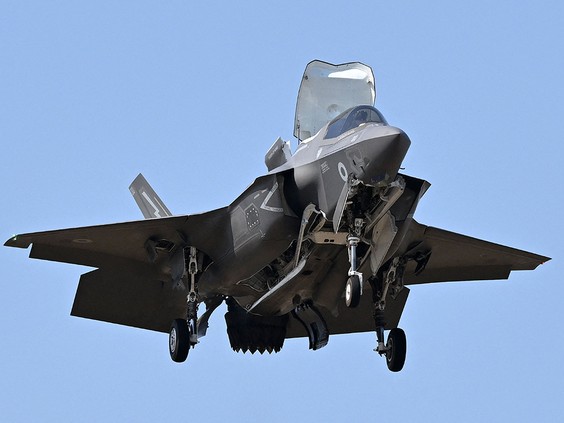
-- will have the upper hand in control of Canada's airfleet of F-35
military jets.
The
issue, one of defence-sharing and creating interoperability between
NATO members making use of the same aircraft needless to say, creates a
situation where one country -- the world's most powerful -- has complete
control of operational systems of a widely-shared aircraft. Trust in
the United States' power and reliability among member NATO countries was
gained over the years since the Second World War and had just latterly
been creeping downward in a confusion of mixed messages by a newly
nationalist-isolationist U.S., resentful of its own self-imposed role as
protector of Europe and other allied nations from the potential of
attack by other nations' malign military forces.
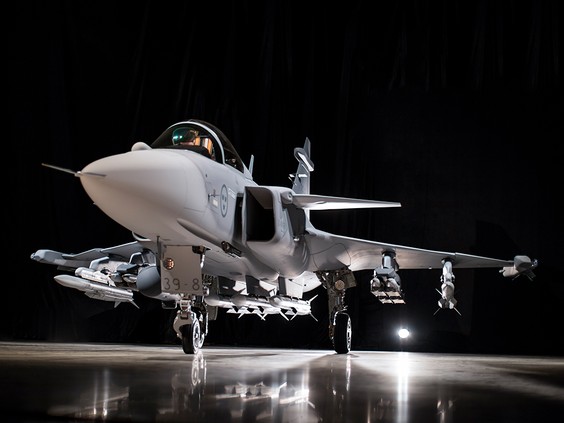 |
| Swedish-built Gripen E fighter jets would be the likely replacement should Canada’s F-35 contract be cancelled. |
Even
while dismissing any problem in the situation, Canada's Department of
National Defence did acknowledge that control of the planes' software
and hardware upgrades required for ongoing aircraft operations were
invested in the Pentagon, leaving Canada with a significant strategic
vulnerability. Britain had evidently on negotiating with the U.S. for
the F-35, requested that control over specific F-35 data systems be left
with them, but it appears the Americans outright rejected the request.
In
early 2023, Canada's Liberal government announced its intention to sign
an agreement for 88 F-35 aircraft at an initial cost of $17 billion
that would total $70 billion over time incorporating the life-cycle cost
for the project. It is only recently that some defence analysts have
spoken of concerns over a specialized kill switch installed by the
United States. No such switch existed, advised DND spokesperson Kened
Sadiku. However, admitting that the U.S. remained in charge of both
software and hardware plane upgrades. "Upgrades are available to all nations that participated in their [the planes'] development."
When
the company was approached directly for reassurances from President
Trump that he would not take steps to cut Canada off from future F-35
software upgrades and initiatives, a Lockheed Martin spokesperson would
only commit to stating his employer's commitment to providing affordable
and reliable services to its customers; for a response to the question
where assurances were given by the Trump administration over the issue,
the statement went on to say that question was one settled
government-to-government.
Former
defence executive Bill Sweetman, on the other hand, pointed out
guarantees were absent that the U.S. would supply Canada with the
upgrades, highlighting that any American decision to "unplug" Canada
from the F-35 technical updates could potentially render the planes
inoperable.
Former
head of DND procurement, Alan Williams, confirmed the U.S. maintained
full control over aircraft software. Mr. Williams, who had signed the
original agreement to have Canada contribute to funding F-35
development, said the decision to buy the F-35 had made Canada
vulnerable. "Now
we find ourselves having to be careful and under the threat of
potential chaos. Trump can undermine everything we want to do."
Originally,
it was pointed out by supporters of Canada's F-35 orders how beneficial
the purchase would be to Canada, referring to the hundreds of millions
in contract value Canadian companies would earn through Producing supply
parts for the aircraft. That was then. More recently President Trump
had advised Lockheed Martin his expectation that aircraft supply parts
would have to be reestablished back in the United States, effectively
diminishing Canada's expectation of benefiting through employing
Canadians to produce parts for the F-35.
 |
Labels: C-35 Aircraft, Canada, Department of National Defence, Lockheed Martin, Pentagon, Software/Hardware Control, U.S. President Donald Trump
posted by Pieface @ Monday, March 10, 2025


<< Home