Traditional U.S. Alliances: Now You See Them ... Soon You Won't
"Based
on my very good relationship with Kim Jong Un, of North Korea, I am not
happy with the fact that the United States has, long ago, agreed to
participate in Joint Military Exercises with South Korea."
"These
exercises are not only costly, with much of these costs paid for by the
United States of America [as usual], but send a signal that is totally
inappropriate and hostile, to a Country that, as long as Donald J. Trump
has been President, has been unthreatening and respectful."
U.S. President Donald J. Trump
 |
| Chinese
President Xi Jinping made a rare visit to North Korea to meet with Kim
Jong Un, where the two moved closer to improving economic ties despite
North Korea strengthening its relationship with Russia. Still from video, CBC News |
Mr.
Trump's great good friend saw to it that Pyongyang test-fired a
ballistic missile recently over the Sea of Japan, warning it was
prepared to respond to the annual joint military exercises shared by the
United States and South Korea as practise runs in preparation for a
potentially possible attack by North Korea on the South. All of the
region has been made nervously expectant by the obvious militancy of Kim
Jong Un, leading North Korea on a military and nuclear arms trajectory
that traditional U.S. allies like South Korea, the Philippines, Japan
and others view as threatening, along with that of Beijing, North
Korea's 'big brother'.
There
is also no secret about an alliance between Russia, North Korea, China
and Iran. Much less the fact that Russia's war on Ukraine has been aided
by the presence of North Korean troops. All four of those countries are
anything but friends of the Democratic West. And while the U.S.
military views Russia, North Korea and China as volatile military
enemies, and is at war, directed by their president, with Iran, this
tangled version of friends and allies versus military belligerents and
adversaries of all that the West values is as puzzling as it is
nonsensical.
 |
| A museum in North Korea honors soldiers who have fought for Russia |
The U.S. president wrote on his Truth Social site that he had ordered the Pentagon to scale back "inappropriate and hostile"
military drills with South Korea, mere hours prior to the drills taking
place. The exercises, according to South Korean officials, proceeded as
planned. South Korea officials, in fact, expressed the hope that the
personal relationship Mr. Trump speaks of with the South's political
nemesis could yield a resumption of talks, and with that, some forward
movement in reconciliation between the two Koreas.
While
U.S. allies in East Asia cringe over displays of weapons' technical
capabilities forever moving forward and displayed with militant pride by
Pyongyang, along with the hermit nation's growing alignment with
Vladimir Putin's territorially aggressive agenda, not to mention North
Korea's historical mentorship by China, the annual drills offered a
notional reassurance of having the support of the United States should
the situation of military threats continue to accelerate.
"I
recently asked the President of South Korea if they would like to join
us in the Denuclearization of the Islamic Republic of Iran, and they
said, 'No thanks!'." That disinclination to become
embroiled in a conflict outside their own internal interest zone appears
to have sealed and delivered a verdict that Mr. Trump has applied
elsewhere, when allies have failed to join America's spontaneous
military decisions with no outreach before conflict has been launched
with the heads of governments later expected to lend themselves to the
American enterprise of war.
 |
| U.S. army soldiers are seen during joint military exercises with South Korea in Yeoncheon, South Korea, in March 2025. (Ahn Young-joon/The Associated Press) |
The
normal 11-day Ulchi Freedom Shield exercises, designed to prepare the
region for a potential war with North Korea, proceeded, though to "substantially reduced" impetus.
That, reflecting the fact that when Mr. Trump decided he no longer
wished the United States under his rule to continue with the drills, it
was too late to cancel them, but Defence Secretary Pete Hegseth was
ordered to reduce them.
Seoul's presidential office assured the press that it remained in "close coordination" over the exercises with Washington, expressing the
"hopes that the friendly relationship between the leaders of the United
States and North Korea will lead to meaningful dialogue".
That's called diplomacy. Or looking on the bright side of things as
expressed by Monty Python, in a skit somewhat resembling his
tongue-in-cheek, sardonic episodes of portraying human lunacy.
There
are some 28,500 American troops stationed in South Korea as a show of
support for the country's defences since the 1950-53 armistice that
ended the Korean War. Tellingly, American commitments to security in
East Asia now appear fairly wobbly given U.S. President Trump's repeated
criticism of what was once universally thought of as rock-solid
alliances.
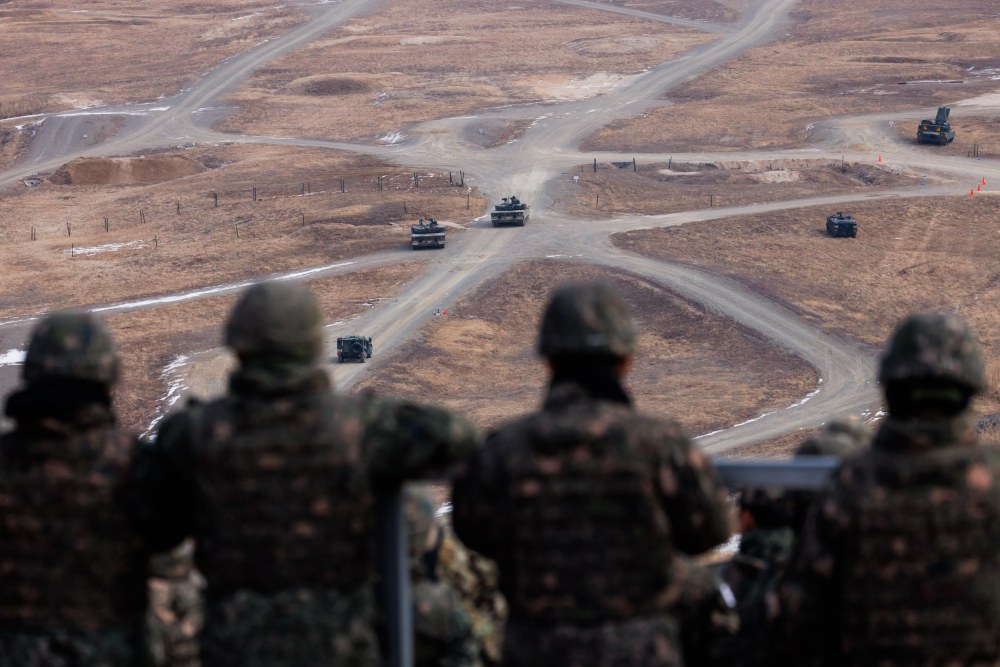 |
| South Korean soldiers watching a joint live-fire exercise with the U.S. Army in Pocheon, South Korea, last year. SeongJoon Cho / Bloomberg via Getty Images file |
Labels: Jim Jong Un, North Korea, Pyongyang, Seoul, South Korea, Strange Alliances, Twinned War Games, U.S. President Donald Trump
Smile, You're on Candid Camera, Canada!
"Among
the several commitments Canada has made to Qatar in the hopes of
convincing the Gulf autocracy's ruling Al Thani family to double down on
its energy investments in Canada is a June 25 memorandum of
understanding between Canada's Public Safety ministry and Qatar's
Internal Security Force. It's also under wraps, like the RCMP agreement
with Beijing's Public Security ministry."
"The
deal is supposed to extend Canada's co-operation on a variety of law
enforcement portfolios, including money laundering, financial crime and
terrorism."
"This
will be unavoidably awkward, owing to the Al Thani family's conviction
that the terrorist front Hamas, the Palestinian offshoot of the Muslim
Brotherhood, is merely a national liberation movement."
"Qatar
is already notorious in Canada's national security circles for the
hundreds of millions of dollars it lavishes on the Muslim Brotherhood
and its Canadian fronts and affiliates."
Terry Glavin, journalist, National Post
 |
| Carney is greeted by Emir of Qatar Tamim bin Hamad al-Thani as he arrives to Amiri Diwan in Doha, Qatar. (Sean Kilpatrick/The Canadian Press) |
Canada
is at an impasse in attempting to deal with mercurial U.S. President
Donald Trump, wedded to the big stick he wields with wild abandon,
striking friend and foe alike with threatening tariffs geared to make
them tremble in trepidation over the suddenly-wobbly state of their
economy. The entire world economy is shaken to its foundations when
America suddenly becomes unreliable, both in its trade and commerce
cooperation with allies and competitors alike, ditching diplomacy for
belligerence in expressions of bad faith and contempt toward other
nations.
 |
| "I like this guy!" CBC |
Trade
dependency on a geographic neighbour may make common sense when one
country is viewed as the junior, valued for its abundance of natural
resources, prepared to continue its trade relationship with the other
whose appetite for energy and mineral extraction is boundless. The
exchange of raw resources with finished products has always been
reflected in the trade relationship. Advanced to the junior partner in
later decades through the sharing of production to the benefit of both.
Canada's
standard of living reliant on the good graces of its neighbour,
received a shock when that neighbour suddenly began growling and
grumbling about being taken for granted, insufficiently adored for its
generosity, and become fed up with being milked in unfair trade
practises. And the trade deficit!!!Then the junior reeled back in dismay
at the very pronouncements of a trade-enforced
geographic-sovereign-lost-merger, genially imposed by its powerful
neighbour.
Trade-diversion
and -diversity imposed becoming the order of the day, the month, the
year, stretching into infinity. Pierre Elliott Trudeau back in the
distant past embarked on a similar adventure, but it somehow never
progressed to the point of being. Canada's new foreign-policy trade
agreements under current prime minister Mark Carney, a self-professed
economic genius, now has his turn. Jean Chretien in his day made
frequent exploratory-trade visits to China with a full regalia of
government ministers and corporate elites in tow.
 |
| Prime Minister Mark Carney and Diana Fox Carney disembark a government
plane in Ankara, Turkey, Tuesday, July 7, 2026. THE CANADIAN
PRESS/Adrian Wyld |
In
a year-and-a-half, Mr. Carney and his ministers have gone to 29 foreign
capitals to drum up trade agreements with countries Canada has much in
common with; Liberal democracies, and unsavoury others as well. He
launched a "new world order"
partnership with China, opening Canadian manufacturing and vehicle
production in particular, to the trade-predatory Chinese Communist Party
in Beijing. Taking no notice at the same time of China's human rights
record on Tibet and Xinjiang.
China's
predation is right out there in plain sight; countries that have
imported cheaply-produced Chinese products valued by global consumers
for their low prices have seen their own industries eviscerated, unable
to complete with the low wages and CCP subsidies to make Chinese goods
preferable to their own. Europe's vast trade deficit with China was
exemplified by the president of the EU Chamber of Commerce in China
commenting on the situation comparing it to a "400-metre-long giant container ship loaded with 24,000 containers going to Europe, and coming back almost empty".
 |
| Mark Carney — pictured with Chinese President Xi Jinping — reached a
'landmark' trade deal with China. (Sean
Kilpatrick/Reuters) |
Volkswagen's
plans to rescue its Osnabruck plant along with 2,300 jobs y converting
to production of components for Israel's Iron Dome defence system met a
roadblock when Qatar objected, since the Qatari sovereign wealth fund
purchased 10.4 percent of Volkswagen shares and 17 percent of its voting
rights. Recep Tayyip Erdogan's Turkey is another potential trade
partner for Canada under Mr. Carney's wide-ranging plans of rescue from
the American trade orbit.
Turkey's
Erdogan is committed to the reestablishment of a Global Caliphate.
Achieved perhaps, in a trifle more sophisticated way -- without the
beheadings and crucifixions seen exercised by the Islamic State in Syria
and Iraq, but equally devoted to its inevitability, with the
considerable assistance of the Muslim Brotherhood globally, and
regionally the MB offshoot, Hamas in Gaza. Only two weeks earlier Mr.
Carney announced Ottawa's negotiations with Ankara toward a free trade
agreement.
"Last
year, the Institute for the Study of Global Antisemitism and Policy
[ISGAP] published an in-depth study of the reach of Qatar and the Muslim
Brotherhood in Canada, recommending that Canada's intelligence agencies
keep much closer tabs on Qatar's promotion of extremist ideology and
support for extremist organizations in Canada:
"'It
is imperative to assess their level of penetration, areas of influence,
and long-term goals in order to effectively manage the risks posed to
Canada' [ISGAP]."
Terry Glavin
Another
opportunity for Canada's Liberal Carney government arose with
discussions on a free trade agreement with the 11-member Association of
Southeast Asian Nations (ASEAN) bloc of which Myanmar is a member,
albeit a police state. Myanmar is listed among three other countries --
Iran and North Korea -- on the Paris-based Financial Action Task Force.
Details, inconvenient details, so inconsequential, no need to bother
with them.
 |
| Turkish President Recep Tayyip Erdoğan gifted Prime Minister Mark Carney and
other NATO leaders a custom revolver with each recipient's name engraved
on the barrel during the alliance's summit in Ankara, Turkey. (Adrian Wyld/The Canadian Press) |
"So
it's all well and good for Canada to be looking for deep-pocketed
police state investors and maybe even some customers beyond the United
States, at least for now."
"But
the lasting damage to Canada's national security, diplomatic
sovereignty, moral conscience, democratic alliances and international
reputation might also be taken into account from time to time."
Terry Glavin, journalist extraordinaire, National Post
Labels: Canada-U.S. Trade, Canadian PM Mark Carney, Free Trade Imperatives, New World Order, Trade Diversion, U.S. President Donald Trump, World Dictators
Windsor/Detroit Gordie Howe International Bridge
"[Prime Minister Mark Carney has] negotiated a terrible deal for Canada."
"We took the risk and the cost. We deserve to recover our money."
"What
precisely will be divided? Gross toll revenues, operating profit, net
profit after expenses after Canada has fully recovered its investment?"
Conservative Canada-U.S trade critic Shuvaloy Majundar
"I'm happy the bridge is going to be open. We need it. We need it because we're expanding."
"The
word 'net' does a lot of work in this. We are sharing after Canada is
paid back. We get the revenues. Then the servicing of the costs of the
bridge and paying the debt of the bridge, and then what's left over,
there's a split of that for 15 years."
"We
are sharing after Canada is paid back. It's manning the toll booths,
it's maintenance, it's snow removal, a series of other operational
costs. So we get the revenues, then the servicing of the cost of the
bridge and paying the debt of the bridge."
"And then what's left over, there's a split of that for 15 years."
"There's not going to be a lot of net to split. It's a good deal for Canada."
Prime Minister Mark Carney
"I
will not allow this bridge to open until the United States is fully
compensated for everything we have given them, and also, importantly,
Canada treats the United States with the Fairness and Respect that we
deserve." (February)
"The new deal is great, and fair. Thank you and congratulations to the Canadian Government."
"May we both have many years of success with this wonderful new development." (July)
"I
was able to cut a MUCH BETTER DEAL for America, and by so doing, will
be allowing the new and spectacular Gordie Howe International Bridge,
spanning Detroit and Windsor, Ontario, to open on July 27th, as
scheduled. The original deal made was unacceptable to me! The new deal
is great and fair."
U.S. President Donald J. Trump
 |
| Gordie Howe International Bridge |
Under
the original agreement between Canada and Michigan which was signed as a
contract in 2012, Canada, which paid for the construction of the $6.4
billion bridge, offered half ownership to Michigan. The contract
stipulated that Canada would collect bridge tolls until such time as the
capital costs expended by Canada were recouped. Following that, bridge
toll revenues would be evenly split between Canada and Michigan. Because
President Trump vetoed that understanding, a new, opaque agreement was
reached to satisfy U.S. demands.
"Mark Carney's capitulation to Trump on the Gordie Howe Bridge is awful for Canada", commented opposition MP Andrew Lawton. While MP for Calgary Heritage Shuv Majumdar named it as "a terrible deal for Canada".
He had written to Trade Minister Dominic LeBlanc that the full
agreement be released before the official bridge opening on July 27, so
that the those who paid for the bridge -- Canadian taxpayers -- would be
in possession of "a complete account of what was given away, what was received, and the true cost of this deal".
An American official, reported Bloomberg News,
contradicted Mr. Carney's statements; interest costs are not to be
included in the calculation. In 2018 a bridge connecting Windsor and
Detroit went under construction, although the owners of the long
standing Ambassador Bridge made every attempt beforehand to stall and
stop the initiative that would compete with the revenues they had long
received as the sole bridge handling over a quarter of all trucked
Canada-U.S. trade.
 |
| Gordie Howe International Bridge from Detroit, Detroit Free Press |
And
while Mr. Carney stated no split of toll revenue would occur until the
debt is fully repaid, U.S. President Trump in February announced the
terms of the deal did not pass muster with him as final arbiter,
eventually blocking a June opening ceremony following completion of
construction. U.S. Commerce Secretary Howard Lutnick is credited with
bringing the president around to that opinion. The Moroun family, owners
of the Ambassador Bridge had the ear of the Trump administration. All
the more so as significant $1-million contributors to Trump's MAGA
campaign.
"I'm proud to have fought for its opening and congratulate my partners who have worked on this issue alongside me for years."
"This
bridge is a testament to the enduring partnership between Michigan and
Canada and what we can et done when we think big and bet on our shared
future together."
"Thank you to our allies in Canada and to the Michiganders who advocated for years to get this done."
Michigan Governor Gretchen Whitmer
Trump's
tariffs have disrupted trade flows between the U.S. and Canada, but not
entirely. There was an exchange of some $880 billion in goods and
services in 2025, slightly diminished by about five percent less than
the year before. While many Canadians have taken to boycotting
recreational travel to the United States in protest of the tariffs as
well as the U.S. president's anti-Canadian rhetoric, not to mention his
constant musings and urges over the '51st State', these conditions may
presage a lighter traffic flow than originally envisioned.
President
Trump on Tuesday reposted an image with himself in the Oval Office
surrounded by other world leaders, obviously produced by AI. A map of
North America appears in the image, with the U.S. Stars and Stripes
imposed over Canada and Greenland.
"Perhaps
Canada's willingness to pay a bribe was the correct thing to do in the
short term, but signing long-term deals with the U.S. on anything has
suffered an additional blow."
"[The
opening was a] plus for commerce, but] it's bad for credibility, faith
in contracts and a system of law and order, the viability of making
long-term deals with the U.S., and democracy. It's blatantly unfair and
commingles donor politics with commerce once again."
"Canadians
have a right to know the full details, like was the Moroun family paid
off somehow in the murky language of shared proceeds?"
Derek Holt, vice-president, head of capital markets economics, Scotiabank, Toronto
Labels: Ambassador Bridge, Canada-Michigan Contract, Canadian Prime Minister Mark Carney, Gordie Howe International Bridge, Moroun Family, U.S. President Donald Trump, Windsor/Detroit Truck Traffic
In Defiance of Trump's Deal -- Israel's Survival
"[Iranian
officials pushed to include a clause in the interim agreement finalized
earlier this week requiring Israel to leave] the security zone in
Lebanon."
"The
prime minister said to the U.S. President: 'We understand the concerns,
but this is a critical issue for our national security and we won't
pull out'."
Zev Elkin, security cabinet member, Prime Minister Benjamin Netanyahu ally
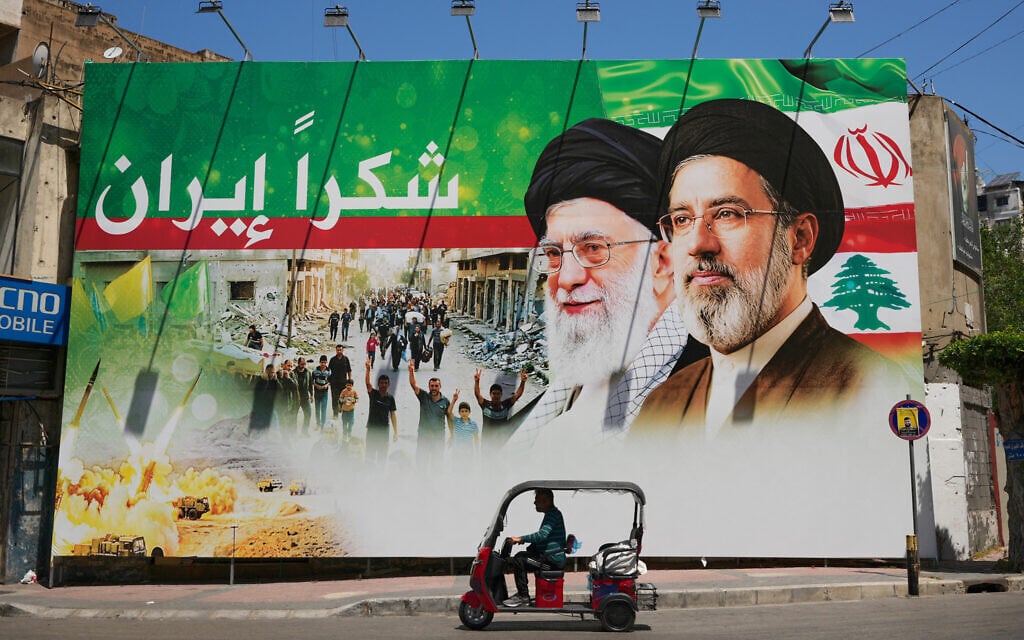 |
June 18: Khamenei okays MOU in written statement, says talks with US do ‘not mean accepting its views’ |
The
agreement reached between the United States and Iran had no input from
Israel. This, despite that the aerial attacks launched on February 28 on
the Islamic Republic was a joint enterprise shared by both Israel and
the United States in a unified stance against the Iranian regime ever
breaking the barrier toward achieving nuclear weaponry through its
stealth uranium enrichment enterprise. That partnership broke down when
Israel was excluded from negotiations carried on between Pakistan and
Qatar as intermediaries between the U.S. and Iran, to achieve a
ceasefire deal and end to the conflict.
And
because Israel was not a member of the negotiations -- even though any
such arrangement as was negotiated based on Iran's 'word of honour' that
it had no intention of achieving nuclear arms, even while it threatened
to destroy Israel, and its terrorist militias, Hamas, Hezbollah,
Islamic Jihad and the Yemeni Houthis were all delegated by Iran to take
part in a pincer-movement of destroying Israel -- there was no
expectation incumbent upon Israel to heed any of the conditions it felt
to be inimical to its own survival.
President
Trump made no secret of his disapproval of Israel's ongoing incursion
into southern Lebanon, the stronghold of the Hezbollah-Lebanese
terrorist group whose rockets continued to rain down on Israel at the
behest of Iran whose proxies tend to respond to commands from the Shiite
Islamist fundamentalist state that have been formed, trained and armed
by the al Quds arm of the Islamic Revolutionary Guards Corps, the power
behind the Ayatollahs' throne of command.
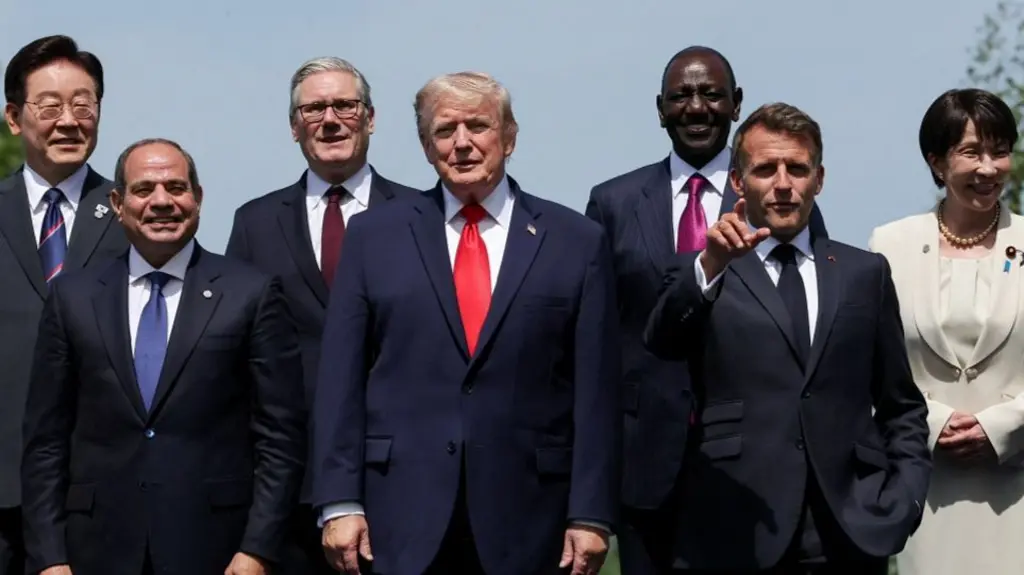 |
Trump insists Iran deal will open Strait of Hormuz 'toll-free' as he meets world leaders BBC News |
That
being so, Israel did not appear to hesitate when rejecting the U.S.
request to withdraw its troops from Lebanon, not as long as Hezbollah
controlled Lebanon, despite the complications that ensued between the
'partnership' of Israel/U.S. defense coalition. The U.S./Iran
agreed-upon interim deal stipulates hostilities must ease on all fronts,
including -- at Iran's insistence -- in Lebanon, where Israel has been
fighting a parallel war ever since Hezbollah attacked Israel in response
to the joint attack on Iran.
President
Trump's dissatisfaction with Prime Minister Netanyahu's ongoing
commitment in the face of Israeli security challenged by Iran's proxies
and Iran itself, to continue its defensive offences has been publicly
stated much to Israel's chagrin; re-stated more emphatically by
Vice-President JD Vance in fairly offensive terms verging as close to
rabid antisemitism as conceivable, helping to shake Israeli confidence
in steadfast American support for Israel's survival.
On
the other hand, a senior U.S. official stated that Israel's withdrawal
from Lebanon did not represent a condition of the deal; that Israel, in
the opinion of the U.S. administration has the right to respond to any
attacks by Hezbollah. Scathing condemnation from JD Vance, aside, which
assurances is Israel to pin its decision-making upon? Grin and bear Mr.
Trump's truculent insults, and turn aside from his vice's commentary, or
put stock in what other Trump officials interpret...?
Israel
has committed to destroying Hezbollah's capacity to continue lobbing
rockets and drones into Israeli territory. So it continues to forge
deeper into southern Lebanon, to oust Hezbollah from its perch there. In
discussions with the Lebanese President Joseph Aoun, Israel has assured
him that any territory it clears of Hezbollah's threatening presence,
while degrading its weaponry stockpiles and eliminating its leaders,
will be turned over to the Lebanese National Army, in 'pilot' zones.
Lebanon's
President Aoun has accused Tehran of using Lebanon as a bargaining
chip. The Hezbollah drone incursions led Israel to bomb Beirut on June
14, enraging President Trump. As insurance, Israel now focuses on new
means whereby it can neutralize the threat the drones pose, hoping to be
able to sidetrack responses that would once again raise tensions with
Washington. According to PM Netanyahu, Hezbollah's pre-war arsenal of
150,000 rockets have been reduced to 12,000; still capable of more than
ample damage.
Smoke rises from Israeli bombardment near the village of Kfar Tibnit in southern Lebanon on June 14, 2026.
AFP via Getty Images
Labels: Hezbollah, Islamic Republic of Iran, Israeli Prime Minister Benjamin Netanyahu, Lebanon, U.S. President Donald Trump, U.S./Iran Deal
DeLiberation Day in the United States of America
"Their decision is incorrect. But it doesn't matter because we have very powerful alternatives."
"Today, I will sign an order to impose a 10 percent global tariff under Section 122, over and above our normal tariffs already being charged."
"And we're also initiating several section 301, and other investigations to protect our country from unfair trading practices of other countries and companies."
"I am absolutely ashamed [of some judges who ruled against me]; disloyal to our Constitution. Lapdogs."
U.S. President Donald J. Trump
"The Government reads IEEPA [International Emergency Economic Powers Act] to give the President power to unilaterally impose unbounded tariffs. On this reading, moreover, the President is unconstrained by the significant procedural limitations in other tariff statutes and free to issue a dizzying array of modifications at will."
"All it takes to unlock that extraordinary power is a Presidential declaration of emergency which the Government asserts is unreviewable."
"IEEPA's grant of authority to 'regulate ... importation' falls short. IEEPA contains no reference to tariffs or duties. The Government points to no statute in which Congress used the word 'regulate' to authorize taxation .. we hold that IEEPA does not authorize the President to impose tariffs."
United States Chief Justice John Roberts
"The Trump tariffs amount to an average tax increase per U.S. household of $1,000 in 2025 and $1,300 in 2025."
"The Trump tariffs are the largest U.S. tax increase as a percent of GDP [0.54 [percent for 2026] since 1993."
Tax Foundation
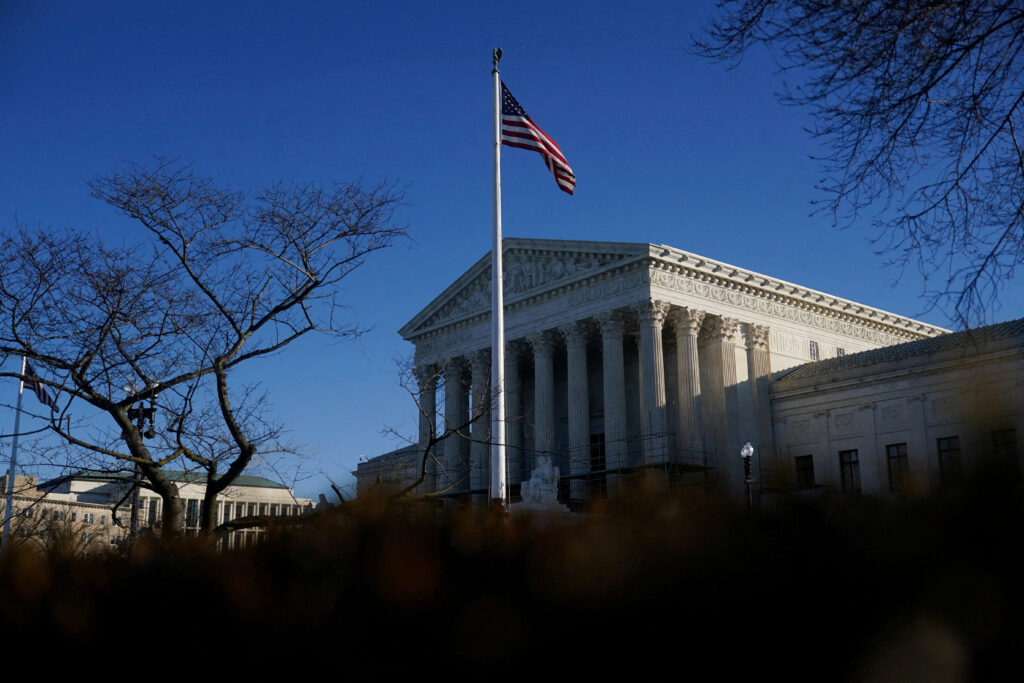 |
| Supreme Court of the United States of America Call it DeLiberation Day. On Friday, the US Supreme Court ruled in a 6-3 decision that
the US president does not have the power to unilaterally impose tariffs
under the International Emergency Economic Powers Act (IEEPA) Atlantic Council |
When Donald Trump took office in his first term at the 2017 White House he made it clear as a business real estate tycoon that the 'art of the deal' was his forte. His America First agenda and antagonism to world bodies, including those that regulate economics, international cooperation, Western alliances in defence sent a cautionary message abroad. However, it wasn't until his second term at the helm of the most powerful nation on Earth that the quakes of his decision-making rumbled through the international community.
Declaring that the United States of America had too long propped up foreign nations, in a leadership role that had for too long been taken for granted by other nations who favoured riding on America's coattails, while failing to fairly contributing their share, the world was put on notice that the trust and reliance they had placed for the past 80 years on the leadership of the United States was at a troubling crossroad. Then came the hammerblow of Mr. Trump's rejection of global trade and investment that he felt favoured other countries over the well-being of the United States.
To correct that monumental assault on American economic sensibilities in trade imbalances, the surprising issue of sudden steep tariff announcements roiled the global financial world as friend and foe alike were placed on notice that the U.S. was no longer content to be the international community's rescuer in shoring up the economies of other countries that preyed on that of the United States. And to 'legalize' that impulsive decision to make enemies of friends and friends of enemies, Mr. Trump called upon the authority of a putative national emergency law.
Free trade suddenly became a dirty word in the United States along with free markets. The very drivers of enormous poverty reduction that rescued 2.3 billion people globally living below the poverty line in 1990, reducing that figure in 2025 to 831 million, even taking into account population increase."The proponents of quotas say 'Free trade is fine in theory but it must be reciprocal. We cannot open our markets to foreign products if foreigners close their markets to us"; a concept that the indomitable Milton Friedman responded to with: "The arguments sound reasonable. It is, in fact, utter nonsense. Exports are the cost of trade, imports the return from trade, not the other way around".
 |
| Containers are stacked at the Port of Long Beach in California on
Friday, the day the U.S. Supreme Court struck down President Donald
Trump's tariffs. The refunds that do get issued as a result of the
decision will take 12 to 18 months to roll out, experts estimate. (Damian Dovarganes/The Associated Press) |
"The court's decision is welcome news for American importers, the United States economy, and the rule of law, but there's much more work to be done."
"Most immediately, the federal government must refund the tens of billions of dollars in customs duties that it illegally collected from American companies pursuant to an 'IEEPA tariff authority' it never actually had."
Scott Lincicome, Cato Institute
Labels: Global Financial Impact, IEEPA, Runaway Tariffs, Supreme Court of the United States of America, U.S. President Donald Trump
The Gaza Board of Peace
"[The Board of Peace would] work with many others, including the United Nations."
"Once
this board is completely formed, we can do pretty much whatever in
conjunction with the United Nations. You know, I've always said the
United Nations has got tremendous potential."
"Every
one of them [those signing on the 'Board of Peace'] is a friend of
mine. A couple, let's see, a couple I like, a couple I don't like."
"No,
I like, actually, this group. I like every single one of them, can you
believe it? Usually I have about two or three that I can't stand."
"[I wish that] we didn't need a Board of Peace [but the UN had failed to help solve the world's conflicts]."
U.S. President Donald J. Trump
 |
| U.S. President Donald Trump, centre, sits with leaders of other
countries during a signing ceremony for his 'Board of Peace' initiative
aimed at resolving global conflicts, at the World Economic Forum in
Davos, Switzerland, on Thursday. (Jonathan Ernst/Reuters) |
"I think what you're seeing is a board that has been cobbled together
for Gaza with much bigger aspirations. But with a set of skills and a set of people
that is really very Middle East centric, and I think has quite little
relevance to crises outside of that region."
"Yes, the UN has very serious problems. But I think that doesn't mean
that Europeans [and] many others — in South America, for example — want
to see a world in which the White House, in which Trump, in which
Americans acquire disproportionate power over these sorts of decisions."
"This is not just a contest that the U.S. can shape by itself and say,
'I'm done with the UN, it's over.' The Chinese will keep playing this
game. Very powerful rising countries like Brazil and India will have a
stake in the UN, and they will seek to influence its agencies and bodies
more and more as the U.S. draws back."
Shashank Joshi, defence
editor, The Economist
President
Donald Trump in Davos officially launched his Board of Peace
initiative, claiming his very personal project so dear to his heart
which may yet gain him 2026's nomination for the Nobel Peace Prize,
joined on stage by his board's founding members comprised of political
allies such as President Javier Milei of Argentina, Hungarian Prime
Minister Viktor Orban and representatives from Bahrain, Morocco,
Azerbaijan, Bulgaria, Pakistan, Saudi Arabia, Turkey, the United Arab
Emirates and Uzbekistan.
All
of whom were pleased to join Mr. Trump at the document signing table
where the board's charter was declared to be 'in full force', as an "official international organization".
Phase two of the Peace Plan is set to proceed, despite the fact that
Phase one has not been fully implemented. And considering the critical
nature of fully implementing the first portion of the plan focusing on
dismantling and disarming the Hamas terrorist group governing Gaza, to
follow on seems a trifle premature. It represents, in fact, a failure.
Not
according to Mr. Trump who considers the initial peace plan phase
successful, emphasizing his intention and that of the United States to
have Gaza 'properly rebuilt'. There are some heads of state who, given
the uncertainties that lie ahead and their concerns regarding the makeup
of the board's membership who prefer to hang back before finalizing
their decisions to join, and others who are certain there is no good
reason for them to be part of the notional planned success.
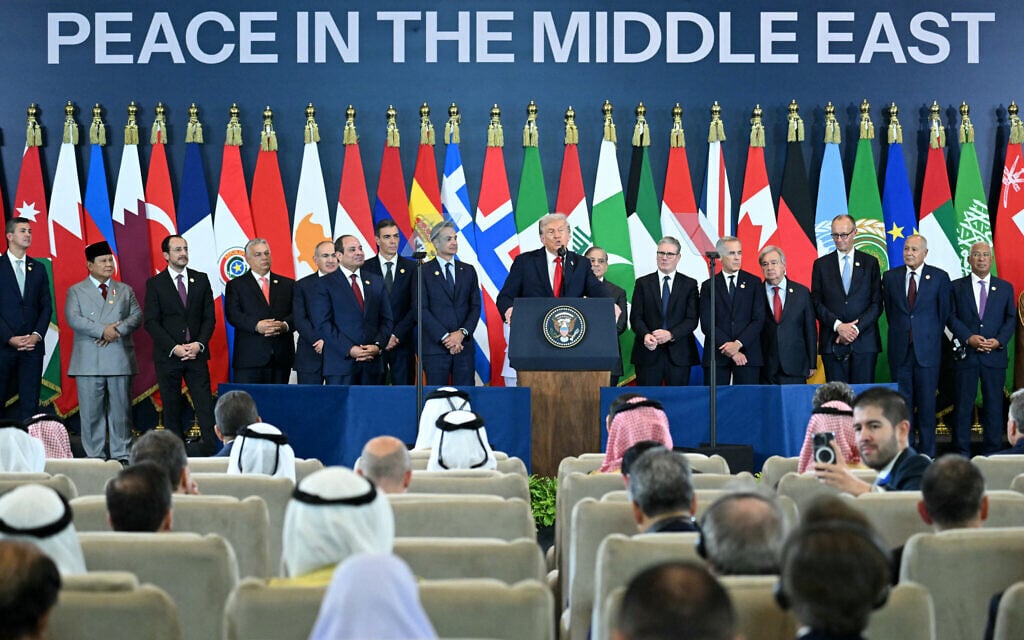 |
| US President Donald Trump (C) speaks during the Sharm El-Sheikh Peace
Summit in the Egyptian Red Sea resort town of Sharm el-Sheikh on October
13, 2025. (Photo by SAUL LOEB / AFP) |
American
allies, part of the Group of Seven, remain uneasily on the sidelines.
Originally the board was proposed to help oversee the reconstruction of
Gaza. A broader purpose has been newly revealed: to "secure enduring peace on areas affected or threatened by conflict",
a vision that places many U.S. allies on alert, concerned there is a
hidden agenda to rival and perhaps replace the traditional 'relevance'
of the United Nations.
That
a new draft plan suggests countries joining the board contribute $1
billion each should they wish to place themselves past the initial
three-year registration to permanent status, may have taken many aback.
The view being that Mr. Trump will remain its chairman in perpetuity,
making all the decisions as its "inaugural chairman". The invitation
extended to Russian President Vladimir Putin and Belarus's Alexander
Lukashenko certainly persuaded Volodymyr Zelenskyy to politely turn down
his own invitation, while raising eyebrows throughout Europe.
Altogether
some 60 leaders were given invitations to join. France, the United
Kingdom, Sweden, the Netherlands, Norway and Germany have declined their
invitations. Canada accepted, but given its trade overtures to Beijing
that followed, has been summarily disinvited. The UN Security Council
had originally endorsed the Gaza plan, but may since have had second
thoughts.
Labels: Board of Peace foe Gaza, Davos, Nobel Peace Prize, Switzerland, U.S. President Donald Trump, United Nations
Trump 'Monitoring the Situation in Iran'
"The
truth is only President Trump knows what he's going to do and a very,
very small team of advisers are read into his thinking on that."
"He continues to closely monitor the situation on the ground in Iran."
"All options remain on the table."
White House press secretary Karoline Leavitt
"President Trump is a man of action, not endless talk like we see at the United Nations."
"He has made it clear all options are on the table to stop the slaughter."
Mike Waltz, U.S. ambassador to the United Nations
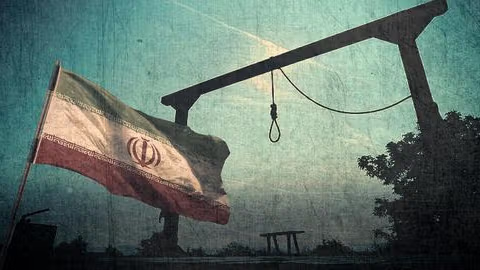 |
| At least 52 prisoners were executed in Iran based on prior non-political
convictions during a period of nationwide protests and an ongoing
internet shutdown. Iran International |
Last June Leavitt had read a message to reporters saying it had come "directly from the president". Trump himself would decide, he maintained, whether to strike Iran "within the next two weeks";
this at a time when Israel was carrying out strikes on Iran, and the
president was weighing whether he would order the U.S. military to
become involved. Before two days elapsed B-2 bombers were ordered to
carry out strikes on Iranian nuclear sites.
"It might be that they're delaying things and using the time for getting that posture correct",
ventured Jeremy Shapiro, research director of the European Council on
Foreign Relations, on the theory that the American president might have
been concerned over the current U.S. force posture in the Middle East
spurring him to hesitate. No U.S. aircraft carriers, an asset during a
military operation in the region were available having been deployed to
an operation focused on Venezuela.
The
perceived shifting tone of U.S. President Donald Trump leaning away
from his threats to attack Iran following his continued warning issuing
warnings against Tehran for its brutal crackdown on Iranians mounting a
countrywide protest against the oppressive Islamist Republic's
theocratic regime saw a drop in oil prices as markets reacted to the
uncertainty of this mercurial president's changeable sentiments.
The
intervention of top officials from Egypt, Oman, Saudi Arabia and Qatar
warning that an American military intervention would have the effect of
destabilizing the global economy as well as shaking an already volatile
region moving it close to a total regional war appears to have had an
effect on the president's decision-making. This is a Muslim Brotherhood
reaction to the potential removal of the Islamist theocracy ruling
Iran.
While
Oman and Qatar are in full support of Iran, as Muslim
Brotherhood-linked states, the Muslim Brotherhood has been officially
proscribed in Egypt, where it was formed almost a century ago, as a
fundamentalist Islamist group dedicated to strict Sharia and jihad by
any means, and in Saudi Arabia as well it is outlawed, though it seems
that the severe orthodoxy of totalitarian Islamism dictates the decision
making in favour of the Muslim Brotherhood whose agenda the Islamic
Republic of Iran represents a living example.
Qatar
in particular, with its massive oil wealth, has bought respectability
and recognition as a 'moderate' Muslim state in the United States. Its
persuasive power lies in its massive financial investments there, in its
universities where it has been able to influence academia to respect
its agenda of portrayals of Islam as benign, not the Western
values-destructive totalitarian threat it carries. President Trump
admires the trappings of wealth and power and is not immune to
appreciating those whose generosity benefits him personally.
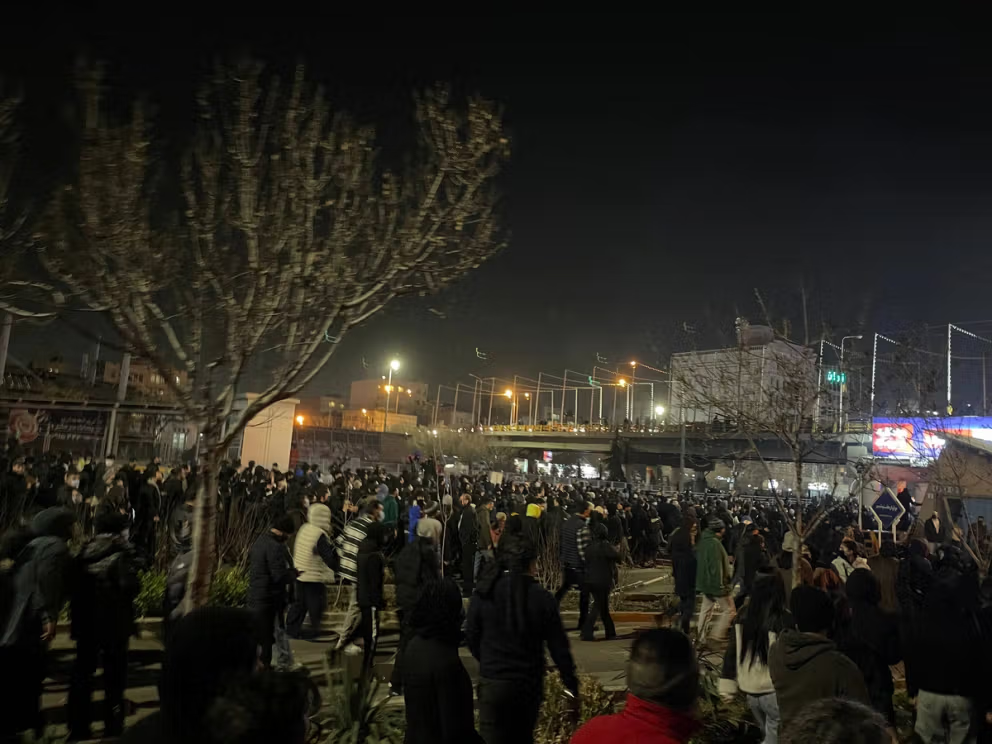
Iranians
took to the streets despite the danger they face from their despotic,
oppressive government that has, over almost a half-century persecuted
them through force of threats and state punishment from imprisonment,
torture and a relentless death penalty. Despite Iran's authorities
warning the population that taking part in mass protests against the
government would be construed as grounds for capital punishment,
Iranians kept turning out in their hundreds of thousands in cities
across the nation, facing police violence.
 |
| Iran International |
Estimates
of the rising death count have reached well over 30,000 people. The
wounded have overwhelmed hospitals and now reports emerge that the Basij
are entering hospitals to take away and execute those wounded in the
protests. As for families frantic to recover the bodies of their loved
ones for burial, without the thousands of dollars demanded by the regime
to release them, those families that cannot afford the price to redeem
the corpses are left disconsolate in their grief.
After
having issued vehement threats to the Iranian regime for the rising
death count, and promising Iranians that the U.S. military is prepared
to rescue them, Trump's assurances that "help is on its way", while urging Iranians to take over their country's institutions, abruptly declared information had been given him from "very important sources on the other side" that Iran had put a halt to killing protesters and executions were no longer proceeding. No need, therefore, to intervene.
At
the same time that Qatar, Oman, Egypt and Saudi Arabia persuaded Trump
to stand down from his word to the Iranian people, they urged Iranian
officials to end the visible repression of protesters, warning that
continued Iranian responses or an action against the U.S. would
significantly impact Iran. Through social media Trump repeated the
speaking lines of those persuading him not to strike Iran: "This is good news, hopefully, it will continue!", he posted over the commutation of a death sentence for a young Iranian shopkeeper-protester.
Iran's
response was to once more completely shut down the Internet connections
across the nation. And nor can cellphones be operational. No news in
or out of the theocracy, other than what the regime may permit. No
guarantees that the hunting down and slaughter of Iranians, disconsolate
over their abandonment by the world at large and fearing now to emerge
from their homes, is ongoing. This is what is meant by a pact with the
devil some might compare to the 'art of the deal'.
"[Thousands have been killed], some in an inhuman, savage manner."
"Those linked to Israel and the US
caused massive damage and killed several thousand."
"We consider the US president criminal for the casualties, damages and slander he inflicted on the Iranian nation."
"[Iran considered President Trump to be a] criminal. [The US must be] held accountable [for recent unrest]."
"America's goal is to swallow Iran."
Ayatollah Ali Khamenei
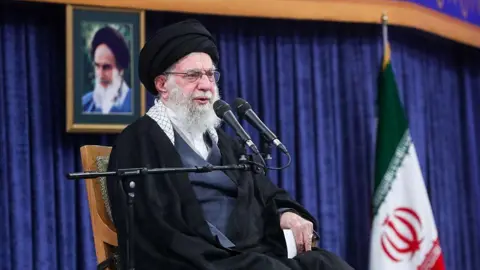 |
| Iran's
supreme leader has for the first time publicly acknowledged that
thousands of people were killed during recent protests, blames the West.
Iranian leader press office via Getty Images |
Labels: "Help is on he way!", Iranian Protests, Islamic Republic of Iran, Oppression, Persecution, Regime Slaughter, Terrorism Central, U.S. President Donald Trump
The New World Order
"Now it's clear, Vance's speech in Munich and the many tweets of President Trump have become official doctrine of the United States, and we must act accordingly."
"[Europe must understand that postwar alliances] have changed [ and to be read to] protect ourselves not only against our adversaries, but also against the allies who challenge us."
"What we cannot accept is this threat of interference in Europe's political life."
"The United States cannot replace European citizens in choosing which are the right parties and which are the wrong parties."
European Council President Antonio Costa
"There is a growing recognition that their strategy did not work."
"It's becoming clearer that, obviously, it's expressed by the Trump administration, but there seems to be a bigger MAGA sort of world view in which Europe is identified as Public Enemy No. 1."
Nathalie Tocci, director, Institute for International Affairs, Rome
"On the question of Europe and President
Trump's comments, what I see is a strong Europe, united behind Ukraine
and united behind our longstanding values of freedom and democracy."
"And I will always stand up for those values and those freedoms."
British Prime Minister Keir Starmer
 |
| U.S. President Donald Trump shakes hands with Russian President Vladimir
Putin before a joint news conference following their meeting at Joint
Base Elmendorf-Richardson in Anchorage, Alaska, U.S., August 15, 2025. (Sputnik/Gavriil Grigorov/Pool via REUTERS ) |
Continental Europe has been losing share of global GDP—down from 25 percent
in 1990 to 14 percent today—partly owing to national and transnational regulations
that undermine creativity and industriousness.
But this economic decline is eclipsed by the real and more stark prospect of
civilizational erasure. The larger issues facing Europe include activities of the
European Union and other transnational bodies that undermine political liberty and
sovereignty, migration policies that are transforming the continent and creating
strife, censorship of free speech and suppression of political opposition, cratering
birthrates, and loss of national identities and self-confidence.
Should present trends continue, the continent will be unrecognizable in 20 years or
less. As such, it is far from obvious whether certain European countries will have
economies and militaries strong enough to remain reliable allies. Many of these
nations are currently doubling down on their present path. We want Europe to
remain European, to regain its civilizational self-confidence, and to abandon its
failed focus on regulatory suffocation.
This lack of self-confidence is most evident in Europe’s relationship with Russia.
European allies enjoy a significant hard power advantage over Russia by almost
every measure, save nuclear weapons. As a result of Russia’s war in Ukraine,
European relations with Russia are now deeply attenuated, and many Europeans
regard Russia as an existential threat. Managing European relations with Russia
will require significant U.S. diplomatic engagement, both to reestablish conditions
of strategic stability across the Eurasian landmass, and to mitigate the risk of
conflict between Russia and European states.
It is a core interest of the United States to negotiate an expeditious cessation of
hostilities in Ukraine, in order to stabilize European economies, prevent
unintended escalation or expansion of the war, and reestablish strategic stability
with Russia, as well as to enable the post-hostilities reconstruction of Ukraine to
enable its survival as a viable state.
National Security Strategy of the United States of America, November 2025
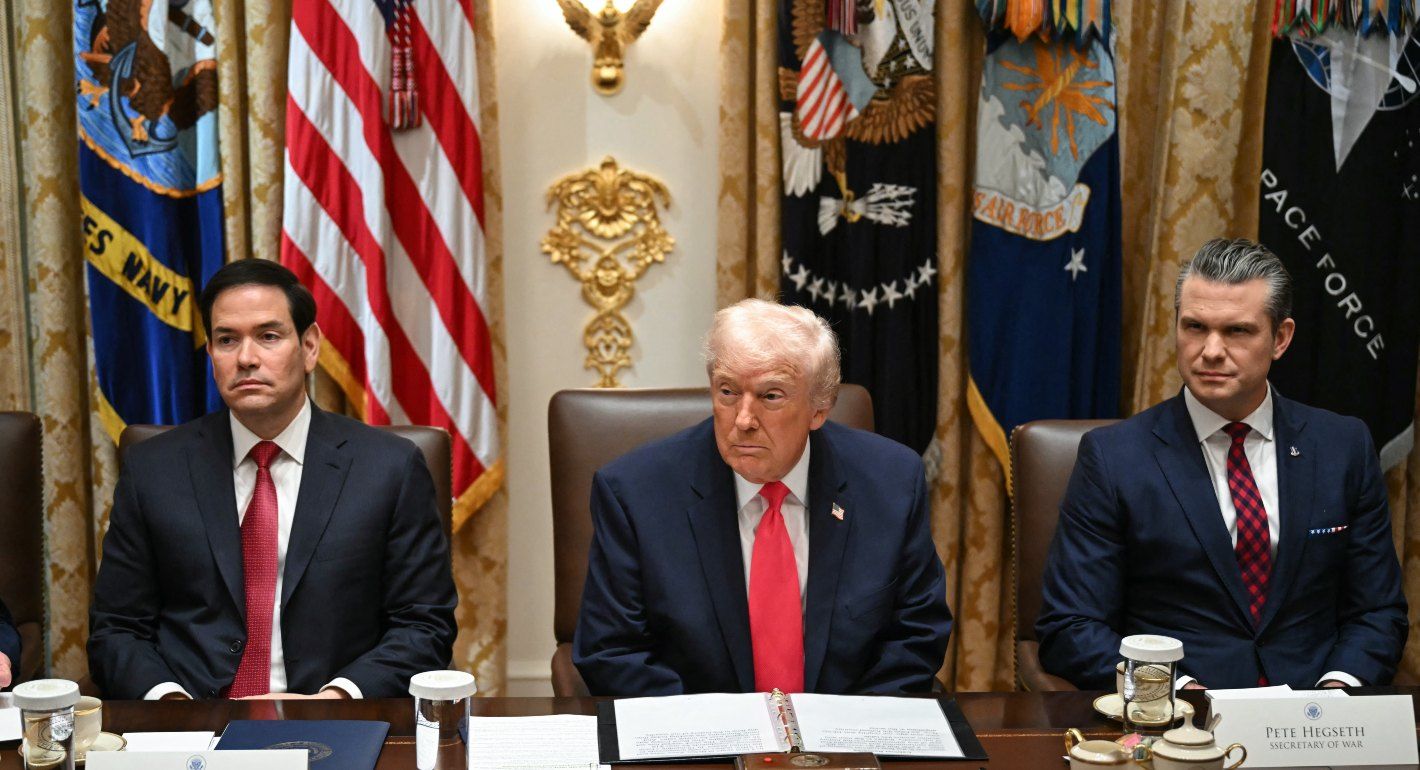
Across the pond, European leaders are furiously debating the new American national security strategy, in particular that portion that focuses on Europe and consigns it to a fast-fade into past history, berating it for not paying sufficient attention to its immigration policies and positing that Europe is on its way to losing all it holds dear, its history, culture, values. Yet, since America is so besotted with Europe it still hopes it can 'regain its civilizational self-confidence', so there is yet hope for poor, degraded, fumbling and weak Europe.
The offending document, according to European officials, has made formal policy from the Trump administration's critiques of European democracies. In very particular, Europe has been no help to the White House in its selfless bid to stop the war in Ukraine. A Ukraine, by Mr. Trump's reckoning that deserves to forfeit great chunks of its territory because it was too weak to defend itself from the territorial imperative of a strong neighbour, attached to a man whom Mr. Trump admires.
If Europe, much less the world at large, does not yet know that Donald J. Trump, president of the great United States of America has a keen admiration for strongmen, then perhaps there is no hope for any nation or nations that haven't yet grasped that they must counter a force of the nature of a man who sees much to admire in autocrats, dictators, even terrorists. Say, for example, President Trump's accommodation with such global menaces as Russia's Vladimir Putin, North Korea's Kim Jong Un, Turkey's Recep Tayyip Erdogan, Qatar's Tamim bin Hamad Al Thani and Syria's new president Ahmed al-Sharaa (a 'nice' young man).
Alluding disparagingly to the presence of malign Middle East actors in Europe who have immigrated, migrated, refugee'd themselves throughout France, Britain and Germany to dilute and imperil by sheer force of numbers in their genteel jihad of citizen-occupation as the death knell of Europe proceeds, President Trump conveniently overlooks the very fact that the United States of America has a more-than ample presence of the same in a stealth yet observable quotient, where even some infamously virulent anti-American Somalis and Palestinians have been voted into Congress.
It is the stinging rejection of European powers to the U.S. 'peace plan' for Ukraine that generates much of the current umbrage by the American president to Europe, which has made its way into the national security strategy, alongside the disregard that exudes from some key members of the Trump administration who have little but contempt for their European counterparts. Understandably, Ukraine rejects outright the brilliant plan brought to him courtesy of Mr. Trump, to demean himself and his nation by handing over territory to a rapacious enemy.
Strangely enough, Europe, fearing Vladimir Putin's greedy eye, has no wish to be party to rewarding him for his invasion of a neighbour, by supporting the 'peace plan', which is, after all, a complete repudiation of Ukraine's human rights and international right to sovereign protection. Downplaying NATO, and forcing the defence alliance to exclude Ukraine in the future, sternly advising that there be no NATO presence to guarantee a post-peace security for Ukraine, is in actual fact, Vladimir Putin's terms to end its vicious war, along with an insistence on Ukraine agreeing on reducing its military and armaments.
Then there are strictly financial/economic considerations; Europe has no 'right' to fine powerful and intrusive social media giants; after all, who do they think they are to interfere with American reach and profit? The American technology industry is answerable only to the United States, not to the European Union, and if Europe doesn't believe Mr. Trump, then Elon Musk's voice should surely make them tremble as he recommends their abolition.
Europe, still in a state of disbelief over Vice-President JD Vance's February speech at the Munich Security Conference -- accusing governments in Europe of censoring political opponents, the far right in particular through the restriction of hate speech, and they created 'horrors' through the acceptance of too many immigrants -- recognize that earlier attack as a forerunner of the new national security document. Injury after penalty, following on the surprise imposition of punitive tariffs in trade with the U.S. A U.S. at war with its own Democratic opposition party, fully invested itself in far-right ideology.
 |
| British Prime Minister Keir Starmer, Ukrainian President Volodymyr
Zelenskyy, French President Emmanuel Macron and German Chancellor
Friedrich Merz chat outside 10 Downing Street following a meeting, in
London on Dec. 8. (Adrian Dennis/Pool/Reuters) |
"[The U.S. strategy describes the continent as] the only world region apparently in which democracy is under threat [and] buys into a narrative [on Russia, which has blamed Europeans for its war in Ukraine]."
"The whole thing is completely, I mean, off the bender."
Nathalie Tocci
Labels: Aggression, Assaulting Europe, European Union, National Security Strategy of the United States of America, Trade, U.S. President Donald Trump, United States of America
"We Will Achieve This By Force"
 |
| Photo montage, Getty Images |
"We need to sit down and discuss this seriously."
"[President Donald Trump's plan is] a set of issues put forward for discussion [rather than a draft agreement]."
"If Ukrainian troops withdraw from the territories they occupy, hostilities will cease."
"If they don't withdraw, we will achieve this by force."
Russian President Vladimir Putin
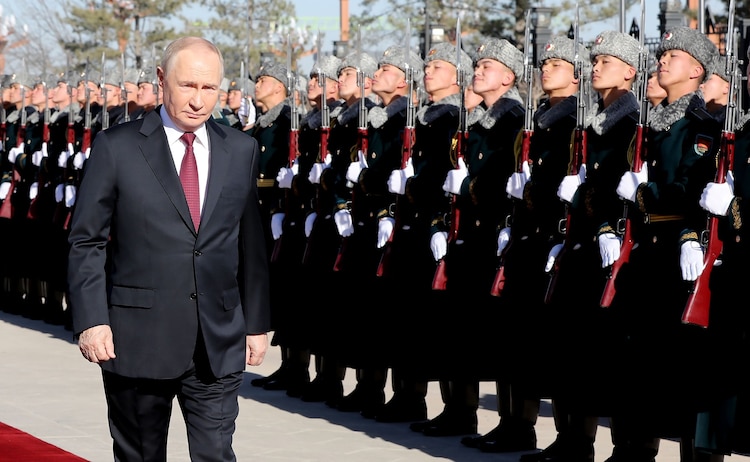 |
Russian
President Vladimir Putin reviews the honor guard during a welcoming
ceremony at Yntymak-Ordo in Bishkek, Kyrgyzstan, November 26, 2025. Igor Kovalenko/EPA/Shutterstock |
Force,
of course, is what this revanchist imperialist employed with his
'special military operation' launched against a sovereign Ukraine, with
the intention of dragging the nation back into the fold of the Soviet
Union that Vladimir Putin is planning on reconstructing. It is the
reason Russia's near neighbours shudder at the Kremlin's actions in
Georgia, Moldova, Transnistria, Abkhazia and South Ossetia.
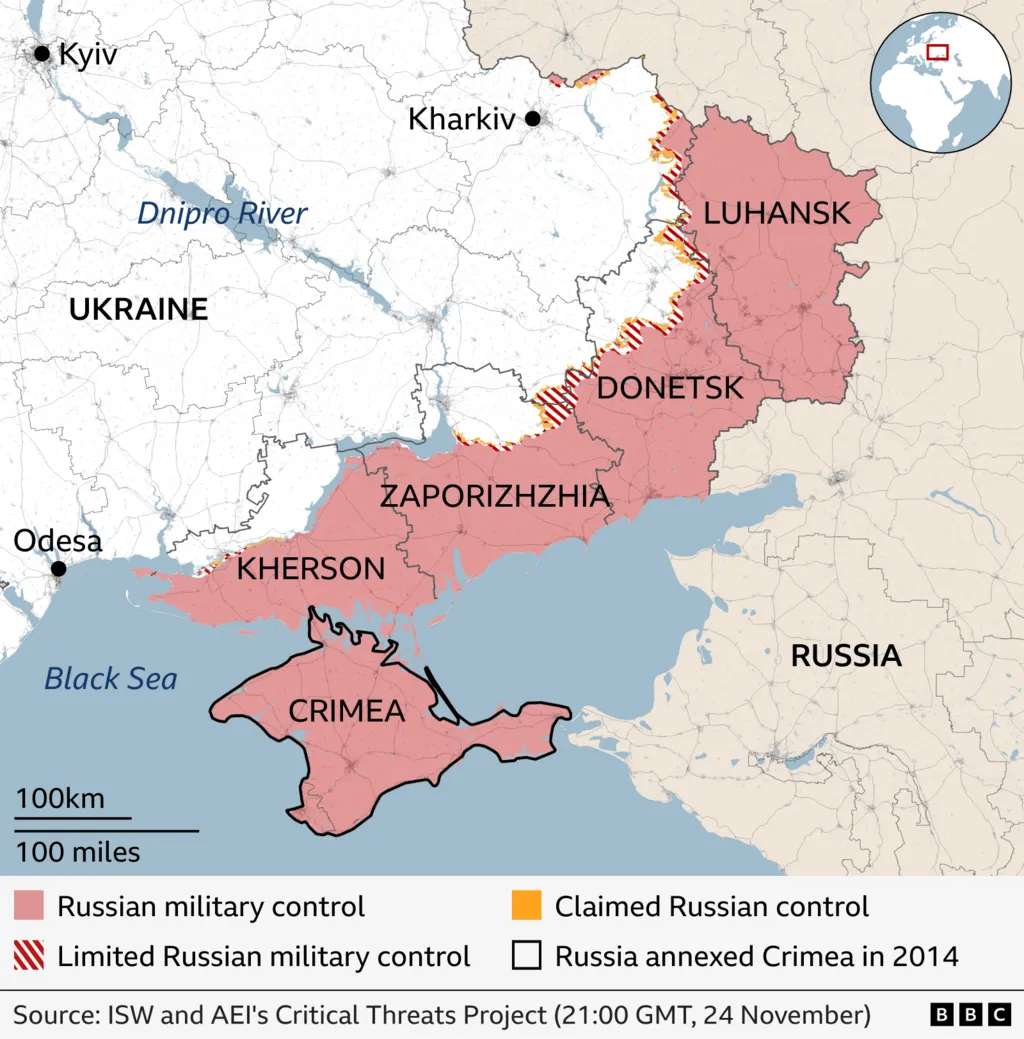
Speaking
of Ukraine in holding its own territories as 'occupied' is typical
Putian logic. It is, of course, Russia/Putin that 'occupies' Ukrainian
territory starting with the coveted Crimean Peninsula and going on six
years later to add Donetsk, Luhansk, Zaporizhia and Kherson oblasts.
Even that is not enough for Putin, vowing to fight on 'until the last
Ukrainian dies'.
"Putin does not
want an agreement."
"The only agreement he
wants is diktat -- a Ukrainian surrender. Otherwise, he wants to
continue fighting."
"I
suspect if Ukraine had accepted those dreadful 28 points, Putin would
come back for more."
"He realizes those 28 points reflected
great flexibility moving his direction on the part of the United
States, and he would say, 'See what else we can get'."
John Herbst, former U.S. ambassador to Ukraine
Vladimir
Putin's idea of an end to war and the arrival of peace, is that
Ukrainian forces must vacate the areas they 'occupy', for if they insist
on remaining in defense of Ukrainian territory, Russian troops will
roll right over them. With Russia's larger military, generously
equipped, the original Ukrainian defensive swiftly turned into an
offensive, demonstrating the courage and determination of a unique
social/political order and historical culture to protect its inalienable
sovereignty from the malign grasp of a warmonger.
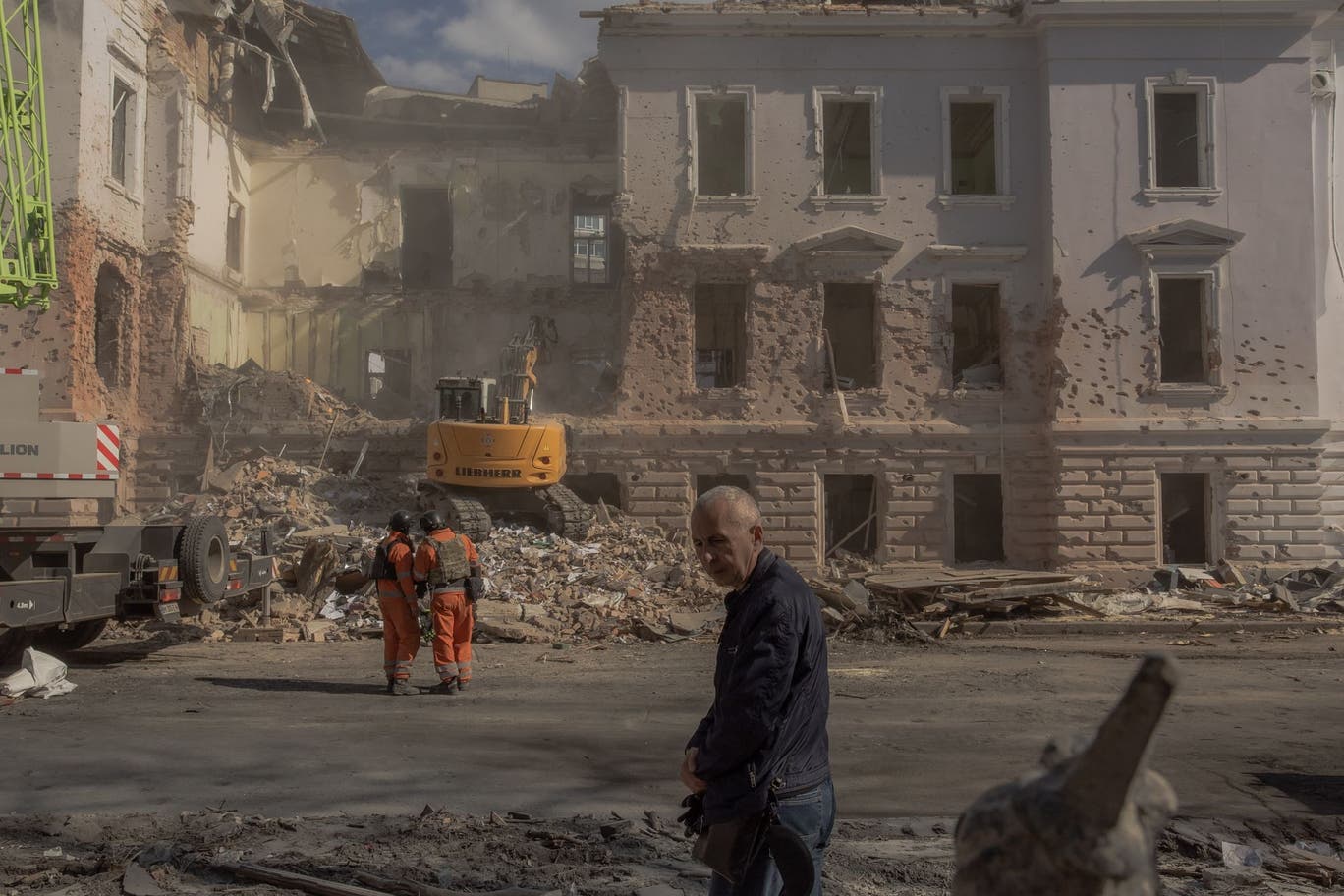 |
| Russia is demanding territory from Ukraine it has devastated throughout the course of the nearly four-year war (AFP/Getty) |
The
U.S. president's confidence that his status as the reigning world
leader would convince two warring parties to submit to reason; enough
blood shed, enough material destruction, enough displacement, enough
refugees, and more than enough madness in the fog of war, greed,
revenge, fear and misery. The tactics employed to date; strong-arming
and verbally abusing and threatening the defender, while deferring to
the offender have failed in their aberrant and clumsy overtures.
What
is obvious that Ukrainian President Volodymyr Zelenskyy will not bow to
the unreasonable pressures he has been plied with, while acknowledging
the need to placate to a certain measure some of the demands impressed
upon him. Putin, on the other hand, remains fixated on the enterprise he
set out to accomplish; acquiring by limitless force as much of the
geography of Ukraine for a Greater Russia that the sacrifice of lives on
both side can accomplish.
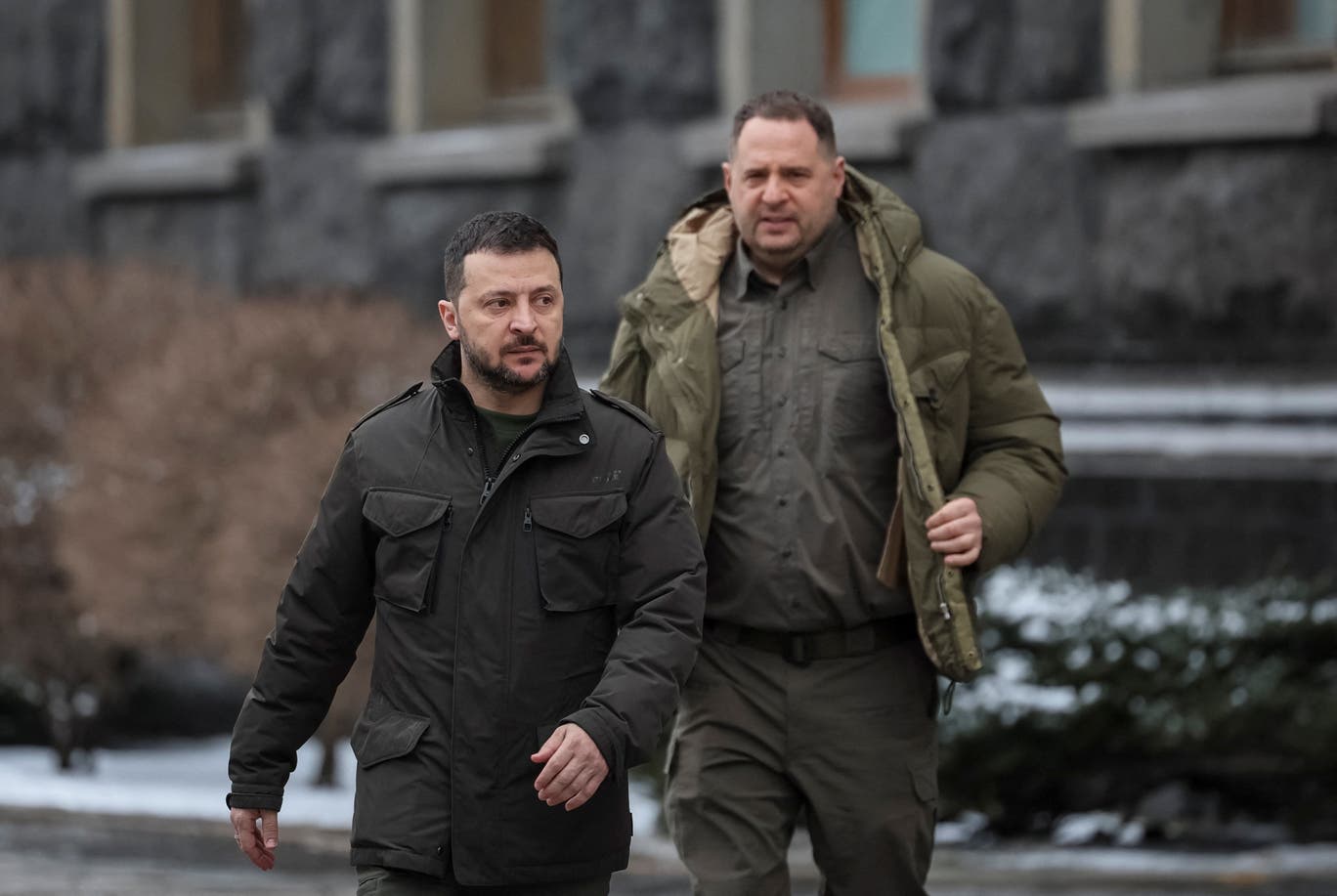 |
| Andriy Yermak (right) said Ukraine’s Zelensky (left) would never give up
land before he resigned on Friday amid an anti-corruption probe. Reuters |
Ukraine,
as far as Putin is concerned, must withdraw completely from all of
Donetsk, Luhansk, Kherson and Zaporizhia regions to make way for Russian
annexation. Until this demand is satisfied, Moscow has no interest
whatever in 'peace negotiations'. Nor can Ukraine be permitted to join
NATO. Much less be permitted to host NATO troops for security reasons.
European
leaders, in their support of Ukraine while regarding the scenario that
has been unfolding for the past three years in that country to be a
potential prelude to what they too might experience should Russia
prevail, are anxious to be consulted along with Ukraine for any
alterations to the draft peace plan the Trump administration has pieced
together.
Europe
is well aware that their adversary in Moscow plans to outwait their
commitment in supporting the Ukrainian war effort. They are also acutely
aware that it wouldn't take much for this irascible president who does
not take kindly to opposition, to walk away from American past
obligations in upholding the world order. Ukraine shudders at the
prospect of being left adrift without any support at all from the U.S.,
whether it be badly needed military arms, or intelligence.
"I see nothing at the moment that would force Putin to recalculate his
goals or abandon his core demands."
"He feels more confident than ever about the battlefield situation and
is convinced that he can wait until Kyiv finally accepts that it cannot
win and must negotiate on Russia's well-known terms."
"If the Americans can help move things in that direction -- fine. If
not, he knows how to proceed anyway."
Tatiana Stoyanova, founder, R.Politik, senior fellow, Carnegie Russia Eurasia Center
Labels: Formula for Peace, Russian Invasion of Ukraine, Russian President Vladimir Putin, U.S. President Donald Trump, Ukrainian President Volodymyr Zelenskyy