Prognostication: Canada's Future
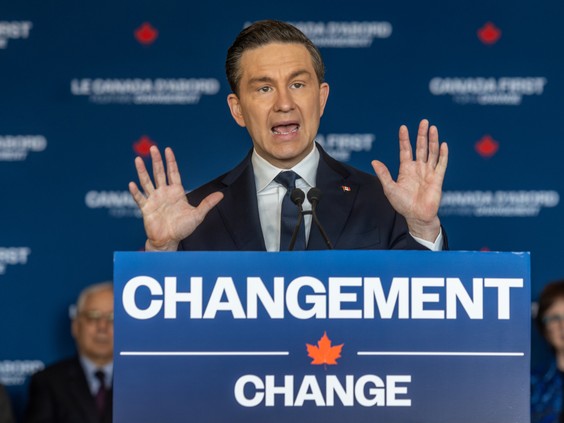
"[A report from an obscure government department warned of the potential that many Canadians may] face the very real possibility of downward social mobility [by 2040].""The report paints a terrifying picture of a spiral of economic depression and cost inflation."Conservative Leader, contender for Prime Minister, Pierre Poilievre
 |
"Thinking about future scenarios helps decision-makers understand some of the forces already influencing their policy environment.""It can also help them test the future readiness of assumptions built into today's policies and programs.""Finally, it helps identify opportunities to take decisions today that may benefit Canada in the future."Policy Horizons Report
The
report in question hazards hypothetical situations that could arise in
Canada by 2040, none of them reason to anticipate a bright future for
the country and its citizens. Indeed, the hypotheses lead to the very
real potential of young Canadians feeling forced to move elsewhere to
find a more promising future. Among the hypotheses is the grim
prediction that matters may regress to the point where the economic
situation facing young Canadians may lead them to begin foraging and
hunting to meet their basic food needs; back to the pioneer past.

Policy
Horizons is a government office, part of the Department of Employment
and Social Development Canada, founded in 1996 to engage in strategic
foresight. Policy Horizons, according to a department spokesperson,
analyzes the "emerging policy landscape, the challenges that lie ahead, the opportunities opening up", as well as "building foresight literacy and capacity in the public service".
The idea is for trained minds to engage in exploring ways an unfolding
future could take us, to inform current government priorities.
Such
enhanced strategic foresight as a thoughtful, practical exercise in
viewing, determining, analyzing and reaching conclusions that reflect
serious thought is not unknown in the business world. Policy Horizons in
its mission to aid government decision-making on critical issues
reflects methodologies used by both the private sector and other
national governments. The hypothetical futures it foresees become an
exercise in aid of preparing government for all possible future trends.

"Inequality between those who rent and those who own has become a key driver of social, economic and political conflict.""Social relations no longer offer pathways to connections or opportunities that enable upward mobility.""Job actions and strikes may disrupt economic development.""People could rethink what 'prosperity' means, or 'fulfilment'. They may reject conspicuous consumption. They may focus on policies that promote human flourishing.""This could include health care, housing, the environment, and education for its own sake."Policy Horizons Report
In the report, it is pointed out that the hypothetical 2040 Canada becomes a society that "increasingly resembles an aristocracy",
with one of the only ways of flourishing would be through inheritance
where intergenerational wealth passes down in wealth transfer. Where
post-secondary education no longer leads to social mobility; a future
educational structure too expensive for any but the wealthy and where
the attainment of that level of academic knowledge becomes a status
symbol of the "elite".

Where
the labour market becomes more limited with the rise and advancement of
Artificial Intelligence, most markedly in creative fields, where
reliable, steady, well-remunerated employment becomes a dream of the
past. Without a steady income Canadians will become increasingly
unlikely to be able to afford housing and will be forced to share
housing with others, living together under a single roof.
At
the very present, housing costs which have spiralled in the last decade
have become a signal defining issue of the current 2025 election. An
Ipsos poll from April 2024 concluded that 80 percent of Canadians
believe that home ownership is now for the wealthy, with 72 percent
claiming they have surrendered any hope of ever owning a home of their
own.
That
future, hypothetical Canada would inherit a less predictable economy,
wealth highly concentrated, a depressed consumer economy with people
having far less disposable income. While younger Canadians may choose to
move abroad, migrants may select countries other than Canada, the
result of which would be imperilled social services, too costly to be
borne by the depressed tax base.
"They may attack policies believed to favour older cohorts, who benefited from the era of social mobility.""In extreme cases, people could reject the state's legitimacy, leading to higher rates of tax evasion or other forms of civil disobedience.""The content of this document does not necessarily represent the views of the Government of Canada, or participating departments and agencies."Policy Horizons Report

Labels: 2025 Federal Election, A Decade of Liberal Mismanagement, Canada's future, Depressed Economy, Dismal Prognostication, Lost Social Mobility
posted by Pieface @ Friday, April 25, 2025


<< Home