Ukraine's Drone Attacks on Russian Airfields -- One for the History Books
 |
"The enemy thought that it could bomb Ukraine and kill Ukrainians with impunity and endlessly.""But this is not so. We will respond to Russian terror and destroy the enemy everywhere."Lt.-Gen. Vasyl Maliuk, SBU"This operation completely changes the perception of reality -- both within Russia and around the world. Our enemies are now forced to recognize that Ukrainian intelligence services are capable of penetrating even the most secure facilities.""When the enemy loses dozens of strategic bombers, it's not just a technical loss; it's a blow to its ability to blackmail the world with missile strikes."Ukrainian lawmaker Roman Kostenko"The smartest thing Putin could do right now would be to not respond immediately.""Putin's best response is to delay his response -- which he is good at.""Putin does not have many spectacular 'good' moves in the current situation. Ukraine has no comparable facilities that can be destroyed without infernal civilian casualties and enormous damage to the environment ... which would traumatize the already troubled Trump."Vladimir Pastukhov, Russian political scientist, London
 |
A serviceman from the mobile air defence
unit of the 115th Separate Mechanized Brigade of the Ukrainian Armed
Forces fires a Browning machine gun towards a Russian drone during an
overnight shift, amid Russia's attack on Ukraine, in Kharkiv Region,
Ukraine June 2, 2025. Sofiia Gatilova, Reuters |
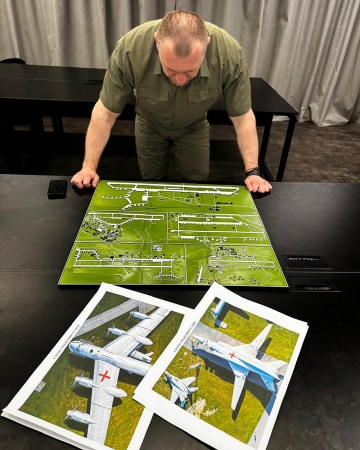
Ukraine's internal security service spent a year-and-a-half planning an assault on Russian airfields, an enterprise that was as audacious as it was spectacularly successful. The plan was to get drones into Russia and plant them close to key military runways. On the eve of a new round of peace talks Sunday, the signal to carry out the assault was lit and four unsuspecting Russian military bases were targeted -- remotely activated roofs lifted off mobile homes and sheds that had been parked on flatbed trucks.
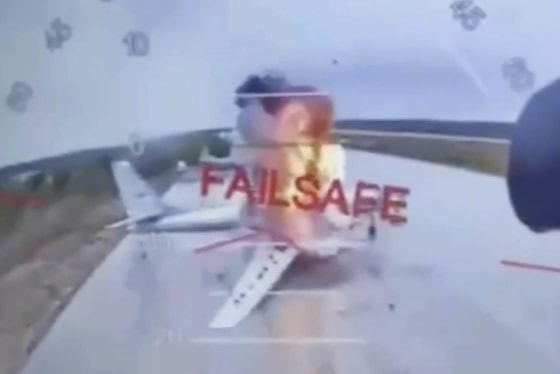
The result saw armed Ukrainian drones soar, then land on military aircraft lined up on the runways, many of them engulfed in flames. At least 13 Russian aircraft were destroyed, dozens of others damaged, shocking Russia as the attack reduced its capability to threaten nuclear attacks or to launch missile strikes on Ukraine. The event was a crucial jolt to Moscow and a reminder to Ukraine's Western partners that although outmanned and outgunned, Kyiv is eminently capable of exploiting Russia's weaknesses, disrupting its war plans.
 |
"[The attack was] a direct and highly sensitive blow to the nuclear triad [that destroyed] rare and expensive bombers.""Most importantly, it reduced the Russian Air Force's ability to strike Ukrainian cities."Yan Matveyev, military analyst, Navalny's Anti-Corruption Foundation
The destroyed and damaged planes, some of which were nuclear capable, included A-50, Tu-95, Tu-22 M3, and Tu-160 planes that Russia had used, according to Kyiv, nearly nightly to bomb Ukraine. Video footage published on social media, eliciting reactions, demonstrated that in Russia the drone strikes had stirred panic, confusion and rage from Russian pro-war commentators, some of whom called the attack "Russia's Pearl Harbor".
A young Russian soldier stationed at another airbase, posted videos of several aircraft burning. Furious chief Russian propagandist Vladimir Solovyov demanded that the young soldier be shot for filming the video, calling him a 'scumbag'.
The SBU, the Ukrainian security agency that had planned the strikes took public credit for them in Kyiv, revealing the operation's code name as Spiderweb. President Volodymyr Zelenskyy posted photos of himself hugging the agency head, Lt.-Gen. Vasyl Maliuk, in a celebration of congratulation for a spectacular work well done.
Ukraine had transferred its Tupolev bombers to Moscow -- explained former Ukrainian defence minister Oleksii Reznikov -- part of its 1996 agreement to surrender its nuclear capabilities in exchange for security guarantees from several countries, Russia included. "On June 1, 2025, Ukraine began removing those very aircraft from one of the memorandum's main guarantors. That guarantor had shamelessly used them against peaceful Ukrainians." Sunday's attack was "a peculiar form of military-legal sanctions".
Russian outlet Agentsvo, Russian state broadcasters Channel One and Rossiya 1 each devoted a total of 40 seconds' airtime to the attack on distant Russian airbases. The news of the event was completely absent by next morning from news bulletins. Mikhail Zvinchuk, a pro-Kremlin military blogger observed that the attack would be the cause of "substantial moral and psychological damage"; Ukraine's operation not only aimed to exploit gaps in Russian defence but also "creating colossal tension" in society while discrediting the security services.
Which seems like a fair enough exchange -- given that Moscow through its endless attacks on Ukrainian infrastructure, civilian targets including hospitals, targeting of civilian areas with deliberate intent, creating instability and fear like any terrorist attacks would to demoralize the public in an effort to turn it against their own government -- making it a timely and well-deserved turn-about of affairs, giving Russia and its population a graphic idea of what they have been imposing on Ukraine and Ukrainians.
Zvinchuk speculated that if Ukraine could attack airbases it could also attack highways and transport routes, stirring panic. But that kind of methodology leading to charges of war crimes is a specialty of Russia, not Ukraine. "Of course, from the point of view of undermining Russia's military potential, this is an extremely unpleasant story, especially in the context of the loss of the Tu-95Ms (Russia's fleet of nuclear bombers)."
 |
| Kyiv’s secret service stashed the attack drones inside the roofs of the sheds, which were loaded onto trucks that were driven to the perimeter of the air bases. AP |
"[The attack provided] an immense inspirational push for Ukrainian society and soldiers [that may inspire more resistance to compromise that could lead to a real ceasefire].""We're less likely to compromise in the nearest future. And some form of a compromise seems to be the only way to stop [or] pause the war.""[Still, the attack dramatically improved the SBU's reputation and] deserves to be described in history books."Former Ukrainian official, speaking anonymously
Labels: Operation Spiderweb, Russian Invasion of Ukraine, Ukrainian Counterattack, Ukrainian Drones, Ukrainian Secret Service, War Crimes
posted by Pieface @ Wednesday, June 04, 2025


<< Home