Dispensing Justice in an Ontario Court of Law
"This offence is significant, and his moral culpability is high. A proportionate sentence on these considerations alone would warrant a penitentiary sentence of 24 months.""I would have otherwise sentenced Mr. Rush to such a sentence but for the fact he is serving a significant penitentiary sentence of six years and the mitigating circumstances outlined Mr. Rush will be sentenced to 12 months custody.""The social context evidence in the form [of] an Impact of Race and cultural Assessment supports that Mr. Rush's life choices and opportunities have been informed by systematic discrimination as has his engagement in the criminal justice system as a young Black man.""Mr. Rush is not a Canadian citizen and he is likely to be deported as a result of these offences. this is a significant collateral consequence."Justice Robert Horton, Ontario court of Justice
 |
A Black cocaine trafficker from Jamaica who faced "a significant likelihood of deportation"
was sympathetically portrayed by a judge at the Ontario court of
Justice as a victim of Canadian society, whereas by his criminal actions
it might seem far more reasonable to deduce that as a criminal living
in Canada, Canadian society has been victimized by the man's activities.
That, under Critical Race Theory and DEI sensibilities that have swept
the country from academia to unions to government agencies and the
courts is not the interpretation that is now socially acceptable.
At
sentencing for criminal offences against society, people of colour, of
certain ethnic backgrounds, Indigenous people, and Blacks are to be
judged on a far different metric than would be the ordinary
garden-variety white low-life criminal. Being white, of an economically
and socially deprived background with little formal education and the
offspring of a dysfunctional family is no excuse in Canadian law for
criminal activities. White means privilege, irrespective of background.
Whereas the aforementioned categories carry a burden of lack of
privilege and that state is entirely responsible for criminal acts,
therefore excusable.
 |
| Justice Robert Horton in Ontario |
"There is no disputing cocaine is an extremely dangerous and insidious drug with potential to cause a great deal of harm to individuals and to society.""Likewise, possession of crack cocaine for the purpose of trafficking is a serious offence warranting emphasis on the principles of deterrence and denunciation .""He grew up in an area that was high with criminal activity, and which affected his family's safety. It was a regular occurrence to hear gunshots. When he was 12, Mr. Rush's uncle was stabbed by a friend. His family went to the scene and Mr. Rush witnessed this horror. Another uncle was beaten to death with an iron rod when he was in high school."Justice Robert Horton
"[A] permanent resident or a foreign national is inadmissible on g rounds of serious criminality [if they are sentenced to more than six months in jail]."Immigration and Refugee Protection Act
The
Crown's recommendation was for Mr. Rush to get two years in jail,
whereas his lawyer felt six months less a day would be more appropriate
for his client. His client, 32-year-old Roosevelt Rush was living in
Brampton. He was in Canada as a landed immigrant, a permanent resident.
Without citizenship someone in those categories committing serious crime
that merits a sentence of imprisonment in a federal penitentiary can be
deported back to their country of origin. In actual fact, this judge
halving the sentence for a man already convicted of similar crimes and
serving a six-year sentence already has placed his residence in Canada
in jeopardy of deportation.
Mr.
Rush was found with 55 grams of cocaine in his possession, following
release on bail from custody in December of 2022 for fentanyl
trafficking and gun convictions. He was, in fact, wearing a GPS
monitoring device when he was tracked to Belleville by authorities,
where he was caught with the cocaine, incriminating him further in drug
trafficking. The sentencing judge cited as a mitigating factor the
guilty plea, his "sincere level of remorse",
his tender age, his race, and that the father of three would likely be
deported. As well, the mothers of his children supported him.
He
was 19 years of age when he arrived in Canada and became a permanent
resident. As though to minimize his criminality, Justice Horton
characterized "Rush was a mid-level trafficker of cocaine. He is not an addict trafficker and elected to do this purely for financial gain".
What, other than financial gain motivates traffickers to push addictive
and dangerous drugs on the public? He ruined his own life and his drug
trafficking went a long way to ruining the lives of other people; if
they were white, however, his crime was evidently excusable.
"[Rush's] experiences as he attempted to earn an income to be able to survive are inextricably linked to his entity as a Black man within western culture. For Black men in middle adulthood their sense of manhood is often tied to their ability to fulfill roles such as provider, husband, father, employee and community member. Historically, they have earned below 75 percent of white men's wages.""[Men] of African descent are five times more likely to be incarcerated than their white counterparts. Black people now account for over nine percent of federal inmates, while comprising only four percent of the overall population."
"Rush experienced systematic and personal discrimination as a Black man, and ... this has certainly played a role in his criminality. [There's a] reasonable prospect [he can be rehabilitated]."Justice Robert Horton judicial decision
 |
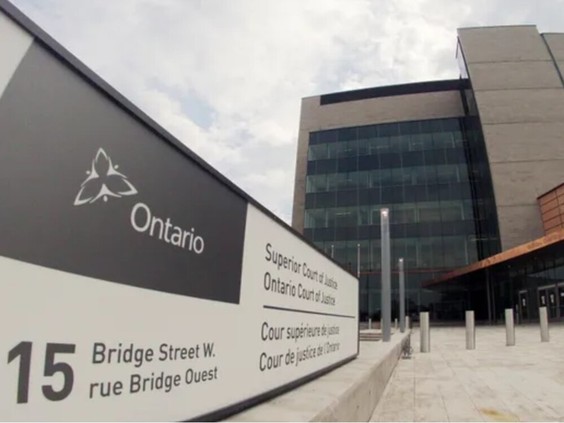
| The lenient sentence was handed down in the Ontario Court of Justice (pictured), as the judge listed 'mitigating circumstances' including that Rush is a 'young black man',' a father-of-three, took a guilty plea, and the likelihood that he would be deported |
Labels: Black Victimhood, Cocaine Trafficking, Deportation, Light Criminal Sentences, Repeat Offender, White Privilege
posted by Pieface @ Thursday, October 16, 2025


<< Home