Hamas Reasserting Its Authority in Gaza
"It became clear, and we can see this from the Gaza City incursion, that Hamas largely abandoned confrontation with the IDF in favour of strengthening its foothold internally for the day after: saving weapons, preserving manpower and planning reprisals against clans who either co-ordinated with Israel or threatened Hamas during the war."Shlomo Mofaz, director, Meir Amit Intelligence and Terrorism Information Center"How many families have received threats from Hamas? Now these families are demanding weapons to defend themselves.""This is the expected scenario in a few weeks: civil war."Tawfik Tirawi, former head, Palestinian Authority Intelligence Service"Are they obtaining new cards for bargaining after the hostages are handed over? Perhaps.""Hamas could manoeuvre on this issue and say, 'We are present, we are indispensable for imposing control'."Mustafa Ibrahim, political analyst, Gaza"[Hamas is comfortable with the guarantees provided by mediators that Israel will not restart the war, but the] gangs are an issue in Gaza.""[Hamas's argument is that negotiators] should differentiate between weapons that can still be held for personal protection, while heavier weapons should be given up."Rashid al-Mohanadi, fellow, Middle East Council on Global Affairs, Qatar"[The Sahem {piercing arrow, special unit of Hamas} are] commanders, intelligence people, drug enforcement captains -- all of them experienced.""They are scattered around Gaza, usually in plainclothes, holed up in hospitals or in tent-cities among the refugees.""The [captured injured Hamas fighter] gave us names, locations, directives and showed us the two separate communication lines used for unit operations."Ali Mujaida, senior Mujaida clan leader"[Most Mujaida clansmen] are not affiliated with Hamas and indeed many lean toward Fatah.""Hamas feared that, either of their own accord or else in co-ordination with the PA, these families would revolt against their rule, and so Hamas needed to nip this in the bud."Anwar Rajab, Palestinian Authority security official
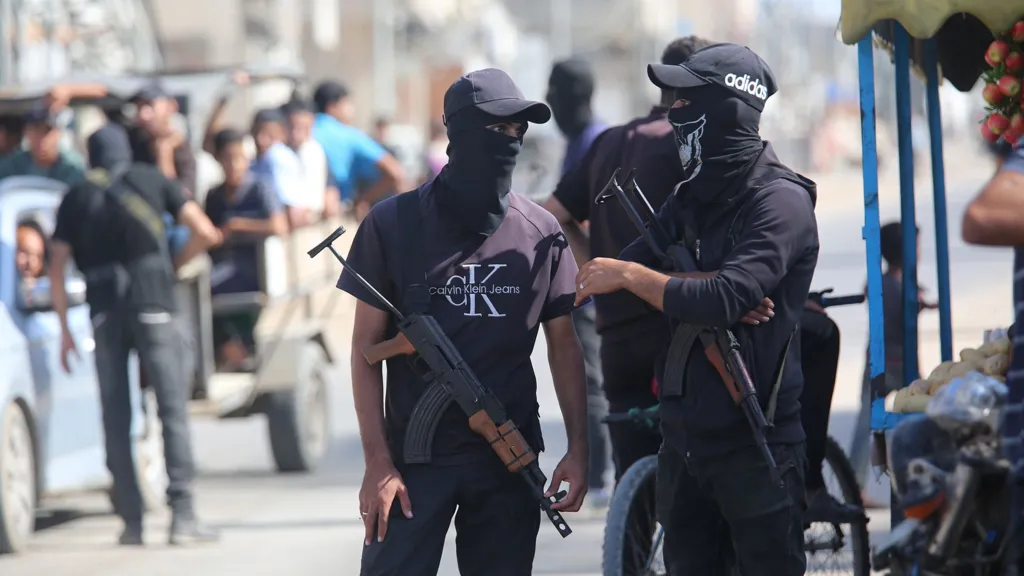 |
| Hamas-affiliated security forces have been deployed across Gaza to oversee the transition following Israeli withdrawal Anadolu via Getty Images |
Byzantine,
a labyrinthine as the tunnels that Hamas built under Gaza, are the
competing, adverse, historically suspicious family clans with their
regional power bases and antipathy toward one another. When Hamas first
entered Gaza in 2007 it was two years after Israel's unilateral decision
under Ariel Sharon to leave Gaza as a conciliatory gesture to the
Palestinians. At that time the Gaza Strip was under Fatah (Palestinian Authority) control.
A time during those two years when family clans' vendettas and criminal
activity was rampant. Hamas's entry soon changed all that; the group
brutally challenged Fatah and brought order of a kind to the Strip,
installing their brand of Islamist rule and policing gang activity.
Ordinary
Palestinian citizens in Gaza were impressed, as gang violence decreased
and order -- of a totalitarian nature, acceptable and expected in
Palestinian society -- prevailed. Some of the clans sided with Hamas and
accepted their rule, and some retained their animosity toward Hamas,
but forbore from challenging them, daunted by their formidable power.
Since the Israel Defense Forces invasion of the Gaza Strip following the
terrorist horde's incursion into southern Israel on October 7, 2023,
eliminating Hamas leaders and commanders in the Strip, the clans have
grown restive and their hatred of Hamas has resulted in violent armed
clashes.
Hamas
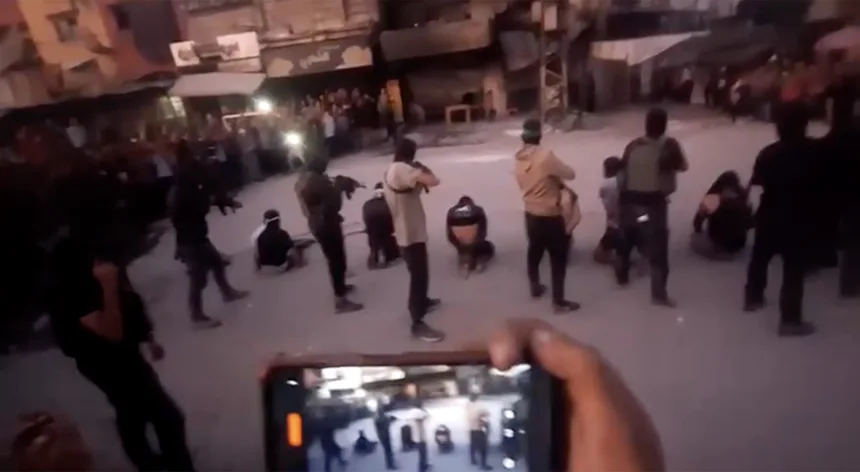
has responded with brutal efficiency, tracking down and killing their
opponents, and executing them in the streets. Israel had armed some of
the Hamas-opposing clans. Hamas in confronting them as the terrorist
group seeks to reassert its commanding control of the territory,
condemns them as traitors, rounds them up, and executes them in the
streets. The Astal militia whose leader co-ordinated with Israel, taking
up arms, were among those targeted by Hamas.
| Satellite imagery over Sabra in Gaza City taken earlier this month. (Planet Labs PBC) |
A
family clan, the Mujaida, diminished following a violent gun battle
decided to pledge fealty to the 'government' of Gaza -- Hamas. In the
ceasefire agreed to, Hamas has grasped the opportunity to launch a
campaign of violence in reasserting its control over the local families
in Gaza, along with the militias challenging its power throughout the
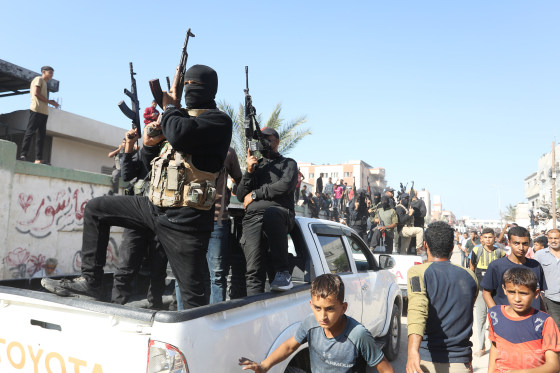
years of the war since 2023. Gaza City has seen public executions, and
armed raids have been carried out in the central Gaza Strip, Hamas
sending its message of return to authority.
Hamas
is thus engaged because President Donald Trump who engineered the
ceasefire in a triumph of muscling regional Arab countries into agreeing
that Hamas must be disarmed and its dominant role in Gaza broken for
good, charging Qatar, Turkey and Egypt to work out the details (all three of which have supported Hamas as a legitimate opposition to Israeli 'occupation' of 'Palestine).
In the interim, while the 20-point plan is worked on and implemented
with all players in discussion and coordination, allowing Hamas the time
to reassess their situation, rearm, reposition themselves, recruit and
reclaim their power base.
| Armed groups clash in what is claimed to be the Sabra neighbourhood, Gaza City. (Supplied) |
That
may not have been the intention of the U.S. negotiators and President
Trump, but what they recognize as a ceasefire is in fact in the parlance
of the region, a 'hudna'; a temporary ceasefire allowing the aggressor
terrorists time to reorder its priorities. For the moment those
priorities are to confront and murder those Palestinians whom they
regard as opponents of their ongoing rule of Gaza.
While
publicly Hamas 'officials' claim their willingness to relinquish Gaza
governance, they contend as part of the social fabric of Gaza their
administration should continue as a rebranded political party. Hamas
explains its crackdown on the Palestinian clans as normal, since they
have returned to Gaza as the commanding authority. Announcing the
appointment of five new governors to administer the Strip's urban
centres; they circulated videos on social media of its operatives
directing traffic.
The
Hamas social media accounts describe clashes with rebel clans as a duty
to bring criminals to justice. The rebellious clans were accused of
engaging in smuggling, gunrunning, extortion and looting of humanitarian
aid trucks. A number of factions including a primary tribal council
voiced support for Hamas enforcing the law, while condemning those who
collaborated with Israel. This is Palestinians being Palestinians,
embracing their 'victimhood' and exercising their hatred for Israel,
seated on its ancestral land, claimed by Palestinians as their own.
 |
Clan
and militia leaders experienced the methodical efficiency of Hamas
moving against them. Before the ceasefire was announced, one of the
first major clashes erupted on October 3 when hundreds of Hamas
uniformed operatives entered a Khan Younis neighbourhood in control of
the Mujaidas, a prominent family, historically affiliated with Fatah.
Hamas operatives armed with rifles and rocket-propelled grenades
advanced in formation from four directions and an intense firefight
ensued. When an Israeli drone noticed the attack it fired on Hamas and
they were beaten back.
"[Hamas is now] cleaning up their own territory, forcing the clans into submission and deterring the public.""When that is over, they will move into the less secure areas to root out the militias.""Abu Shabab will be last in line."Doghmush clan member
 |
| e |
Labels: Ceasefire, Enabling Hamas Terrorism, Hudna, Israel, Palestine, Peace Plan, Taqiyya, US President Donald Trump
posted by Pieface @ Sunday, October 19, 2025


<< Home