Canada: A Shy Energy Giant
"Canada holds 163,108,000,000 barrels of proven oil reserves as of 2025, ranking #4 in the world and accounting for about 9.24% of the world's total oil reserves of 1,765,151,568,000.""Canada has proven reserves equivalent to 188.6 times its annual consumption levels (based on 2024 data). This means that, without net exports, there would be about 189 years of oil left (at 2024 consumption levels and excluding unproven reserves)."world0meter
 |
| Visual Capitalist |
"Canada has significant reserves of conventional and unconventional oil and gas resources. Canadian oil production is focused in the west of the country, especially in Alberta. Canada’s proven oil reserves remain among the world’s largest — estimated at around 168 – 170 billion barrels (about 10 % of global reserves), with the majority in oil sands. The largest oil reserves are found in Venezuela and Saudi Arabia, which have around 18.2 % and 16.2 % of the total reserves, respectively.""Canada also produces natural gas, with reserves and production primarily in provinces such as British Columbia, Alberta, and the Northwest Territories. Producing natural gas involves extracting gas from underground reservoirs and processing it so it is suitable for various uses, such as heating. In 2025, Canada’s natural gas production averaged about 19 billion cubic feet per day (Bcf/d), making it the fifth-largest producer globally and accounting for roughly 5 % of world natural gas supply.""Canada is currently the fourth-largest oil producer in the world, with production near 6.0 million barrels per day in 2024, including oil sands, conventional, offshore, and liquids."Olivia Bush, Made in CA
 |
| A large oil refinery along the Athabasca River in Fort McMurray, Alta. |
New
Brunswick, an eastern province of Canada was the second place in the
world in 1859 to discover oil and gas would bubble to the surface when a
hole was drilled in the ground. New Brunswick has a wealth of fossil
fuel; an estimated 77.9 trillion cubic feet of natural gas, according to
Natural Resources Canada. New Brunswick held the knowledge of its great
natural resources close to its chest, making the choice not to develop
its reserves. The province imposed an indefinite moratorium on hydraulic
fracturing (fracking) in 2014 judging it to be environmentally
unfriendly.
Yet
it is precisely that system of extraction that is required to draw up
the provincial gas reserves. New Brunswick is not alone among Canadian
provinces in the abundance of its energy resources, given the Canadian
total of about 1.4 quadrillion cubic feet. And according to an analysis
conducted by the U.S. Department of Energy, that plenitude of energy is
sufficient for Canada to provide natural gas needs for the entire world
for a period of 200 years.
When
Japan's prime minister travelled to Canada in 2023 and a year later
Germany's chancellor followed, both leaders had a distinct and direct
purpose in mind. To persuade the Canadian government of those countries'
dire need for a reliable energy source in the wake of Russia's invasion
of Ukraine, when the U.S. and the EU took punitive steps against
Russian aggression by sanctioning Russian gas whose sale helped to fuel
the war. Their persuasive efforts fell on deaf ears. Canadian Prime
Minister Justin Trudeau's off-handed response was that there was no
business case to be made for Canada to export gas.

Under
the new Liberal government headed by Marc Carney that succeeded the
Trudeau government, Canada re-elected yet another figure influential in
environmental circles dedicated to ensuring that energy resources were
kept underground, as a source of carbon dioxide that was adding fuel to
global warming, responsible for dramatic weather changes and adding to
natural disasters in extreme weather conditions. Resistance to oil
pipelines to tidewater for shipping abroad, to continued exploitation of
the Alberta heavy crude oil to a world hungry for energy, continues
under the current prime minister.
A
situation where a country's vast natural resources are being left
underground, with the full potential of extraction not to be realized on
the basis of the harm it would do to the environment already in a
situation of degradation from climate change. This despite vast
technical advances in the extraction of oilsands for a cleaner product.
And in the face of the fact that Canada's contribution to global
greenhouse gas in the atmosphere is slightly more than 1-percent of the
world total.
A
situation that has led Canada to export its oil to U.S. refineries at a
discount, and where the U.S. sells that refined oil elsewhere at a
profit denied to Canada. In turn, Canada continues to import oil from
the Middle East for the energy needs of New Brunswick and Quebec,
lacking a pipeline that would provide them with Canadian oil from the
Western provinces; pipelines are dirty words to environment-dedicated
British Columbia, New Brunswick and Quebec.
 |
| The Maran Gas Hector |
And
out of this impasse the absurdity of an Australian oil tanker, the
Maran Gas Hector, sailing 25,000 kms from Gladstone, Australia, across
the Atlantic to New Brunswick's Saint John harbour where it docked and
proceeded to unload its cargo to fill the need of the very province
sitting atop a wealth of untapped oil reserves. A decade ago four LNG
export terminals were proposed for Canada's Atlantic coast, but the
prospect failed to resonate. Leading to the shipping across a vast
distance, of Australian natural gas.
Unlike
Canada, Australia has exploited its reserves for export since the 1980s
as supercooled liquefied natural gas through its 10 LNG export
terminals and thousands of kilometres of natural gas pipelines. As
opposed to Canada's single LNG export terminal in Kitimat, British
Columbia, just a year old, following a lengthy process of environmental
reviews and legal confrontations, amidst civil environmental
insurrectionists.
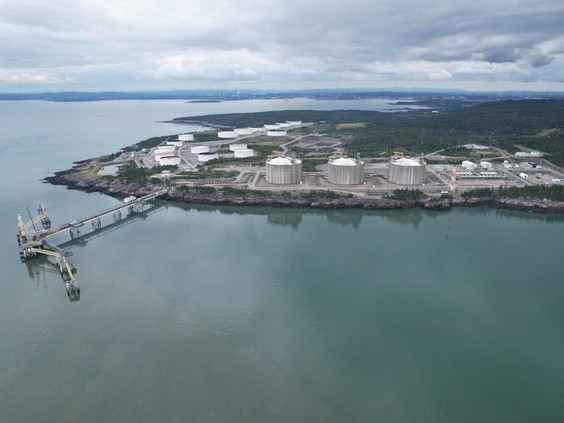 |
| The only LNG terminal on the Canadian Atlantic coast, and it's to import LNG, rather than export it. Photo by Twelve O'Clock High Drone Services |
Labels: Canadian Government, Climate Change, Environmental Agenda, Greenhouse Gas Emissions, Oil and Gas Extraction, Pipelines
posted by Pieface @ Saturday, February 28, 2026


<< Home