Hargeisa, Republic of Somaliland
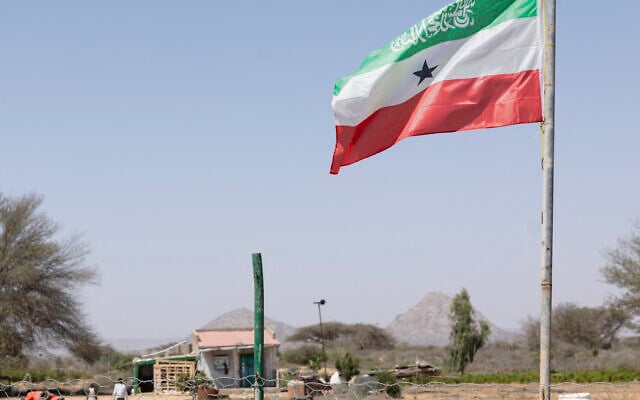 |
| The flag of Somaliland seen at a fruit farm between the capital city of Hargeisa and Port city of Berbera, Somaliland, on February 19, 2026. (Tony KARUMBA / AFP) |
"The recent recognition of Somaliland as a sovereign state by Israel, the first and only country to have done so in 34 years, has reignited international debate, drawing attention not only to a long-standing post-colonial anomaly but to the lived reality of the people of Somaliland. Too often reduced to a geopolitical abstraction, Somaliland is first and foremost a society that has spent more than three decades building stability, democratic institutions, and a shared civic identity despite lacking formal statehood.""This unresolved status is inseparable from the legacy of colonialism. The modern borders of the Horn of Africa, like those of much of the continent, were drawn in European capitals with little understanding of, or regard for, the peoples who inhabited those territories. This externally imposed cartography fractured historical communities, fused incompatible ones, and laid the foundations for conflicts that persist to this day. Africa is not the empty reservoir of resources or the passive geopolitical playground it has been treated as throughout colonial, Cold War, and neo-colonial eras alike. It is a continent of diverse societies, rich histories, and deeply rooted cultural identities that have long been constrained by the political frameworks imposed from outside and by the continued influence of external powers.""In this context, Somaliland’s situation is emblematic of what it means to be an unrepresented state today: functioning governance without recognition, democratic legitimacy without a seat at the table, and a population whose political will is acknowledged at home but ignored internationally. In a region marked by protracted conflict and chronic insecurity, Somaliland stands out not as a legal anomaly but as a community that has demonstrated resilience, coherence, and the capacity to govern, despite an international system still shaped by the colonial legacy that once defined it."Elena Artibani, Academy Analyst Assistant, UNP Academy (Unrepresented Nations and Peoples Organization)
| Hargeisa, capital of Republic of Somaliland |
Somaliland
is an authentically sovereign nation, not part of Somalia, and awaiting
world recognition for its democratic credentials, its peaceful
existence in the Horn of Africa surrounded by nations embroiled in
conflict -- most particularly Somalia, a functionally unstable,
violence-prone state. The Islamist groups that hunt down and kill other
Muslims who reject the fundamentalist demands of Sharia law are a plague
in Somalia, but are non-existent in Somaliland. The U.S. military
recently conducted an aggressive bombing campaign in Somalia against
the world-threatening presence of jihadist-Islamist predators.
The
U.S. Africa Command targeted 150 hits in Somalia to eradicate the
presence of those dangerously militant terrorist groups. U.S. President
Donald Trump is less than convinced of Somaliland's presence as a
completely separate nation, aspiring to be recognized as the African
continent's 55th sovereign country.
For
its part, the state of Israel had no problem recognizing Somaliland as
an independent sovereign nation, sharing democratic values of freedom
and rule of law. Both countries use their natural resources and their
people-power to meet their prosperous futures.
And
when Israel formally recognized Somaliland in response to its search
for recognition from the global community, emphasizing its independence
from Somalia, Israel was the first nation in the world to form an
alliance with Somaliland, in full recognition. Almost instantaneously,
the world responded, with China, France, Britain, Denmark, Russia and
the African Union criticizing Israel's move of diplomatically
legitimizing Somaliland's independence. Turkey, Iran, Saudi Arabia and
Egypt made it clear that they deplored Israel's action verifying the
Republic of Somaliland's right to declare itself independent of Somalia.
 |
| Hargeisa's street markets where large quantities of money that money changers stack around them without fear of theft. |
Regional
countries in the Horn are concerned with access to the Red Sea and the
Gulf of Aden, considered among the most vital waterways worldwide for
global shipping trade. Yemen's Houthi rebels linked to the Islamic
Republic of Iran in its global Shiite jihad, have been particularly
troublesome for global shipping in their hijacking of shipping vessels,
in particular targeting any shipping that may have an Israeli component,
linked to the Tehran-led Shiite terrorist axis supporting the Hamas
invasion of October 7, 2023 in southern Israel where sadistic barbarism
and mass slaughter led Israel to invade Gaza to eradicate Hamas
terrorists.
According
to analysts, Israel's recognition of Somaliland is being interpreted as
a measure whereby the conflict with the Houthis can be mitigated.
Israeli foreign policy expert Asher Lubotzky at the University of
Houston in Texas, stated his interpretation that a greater Israeli
footprint in Somaliland could assist in the deterrence of weapons
smuggling by the Houthis into Yemen. Israel and Somaliland in their
mutual recognition, however, are looking toward agreements in security,
trade, technology and agricultural techniques.
According
to Israeli Prime Minister Benjamin Netanyahu, the agreement with
Somaliland reflected the spirit of the Abraham Accords, that series of
agreements since 2020 that have established amicable relations between
the Jewish state and Muslim-majority countries that include Bahrain,
Morocco and the United Arab Emirates. Just as Israel defends
Somaliland's right as a sovereign state conducting diplomacy, so too
does the United States defend Israel's right to do likewise, even as the
U.S. itself holds back yet from recognizing the Republic of
Somaliland.
 |
| Afar tribe cultural show in Hargeisa |
Somaliland
is a federal republic with a series of semiautonomous regions. The
country broke from Mogadishu in 1991 following a war of independence,
during which Hargeisa, Somaliland's capital, and other cities were
bombed by the Barre regime. Since then, support by the United Arab
Emirates, and relations with Ethiopia and Taiwan have buoyed
Somaliland's prospects for future prosperity. The UAE invested in the
development of a modern port in Berbera on the Gulf of Aden in recent
years. In response, Somalia retaliated by canceling all contracts with
the UAE, a move in which it is Somalia that loses.
China
is enraged over Hargeisa's decision to maintain ties with Taiwan.
Ethiopia, on the other hand, signed a 2024 deal to build a naval
facility on Somaliland's coastline, in exchange for recognition.
Formalities
and diplomacy have moved apace between Israel and Somaliland, with
Israel's foreign minister, Gideon Saar, visiting Hargeisa in January.
And according to Mohamed Hagi, Somaliland's minister of state for
foreign affairs, Somaliland would soon join the Abraham Accords.
Reciprocal embassies are shortly to be opened and business leaders in
Israel are viewing investment possibilities with the Somaliland
government.
 |
| On the cusp between rural tradition and urban modernity, donkey carts can still be seen on Hargeisa streets amidst vehicular traffic. |
Labels: Berbera Sea Port, Ethiopia, Horn of Africa, Israel, Mutual Formal Recognition, Republic of Somaliland, United Arab Emirates, United States
posted by Pieface @ Wednesday, February 25, 2026


<< Home