Reducing the Nature of Nuclear Proliferation to the Status of State Profit
"[The documents raise] concerns that the Trump administration has not carefully considered the proliferation risks posed by the proposed nuclear cooperation agreement with Saudi Arabia or the precedent this agreement may set.""[The document contends that reaching a deal with the kingdom] will advance the national security interests of the United States, breaking with the failed policies of inaction and indecision that our competitors have capitalized on to disadvantage American industry and diminish the United States standing globally in this critical sector.""Nuclear cooperation can be a positive mechanism for upholding nonproliferation norms and increasing transparency, but the devil is in the details.""This suggests that once the bilateral safeguards agreement is in place, it will open the door for Saudi Arabia to acquire uranium enrichment technology or capabilities — possibly even from the United States.""Even with restrictions and limits, it seems likely that Saudi Arabia will have a path to some type of uranium enrichment or access to knowledge about enrichment.""It behooves Congress [to provide a check on the administration's power to strike an agreement with the kingdom and] consider not just the implications for Saudi Arabia, but also the precedent that this deal will set, and vigorously examine the terms of the proposed 123 Agreement."Kelsey Davenport, director for non-proliferation policy, Arms Control Association, Washington"[If Iran obtains the bomb], we will have to get one".[A weapon would be necessary] for security reasons, and for balancing power in the Middle East, but we don't want to see that."Saudi Crown Prince Mohammed bin Salmon
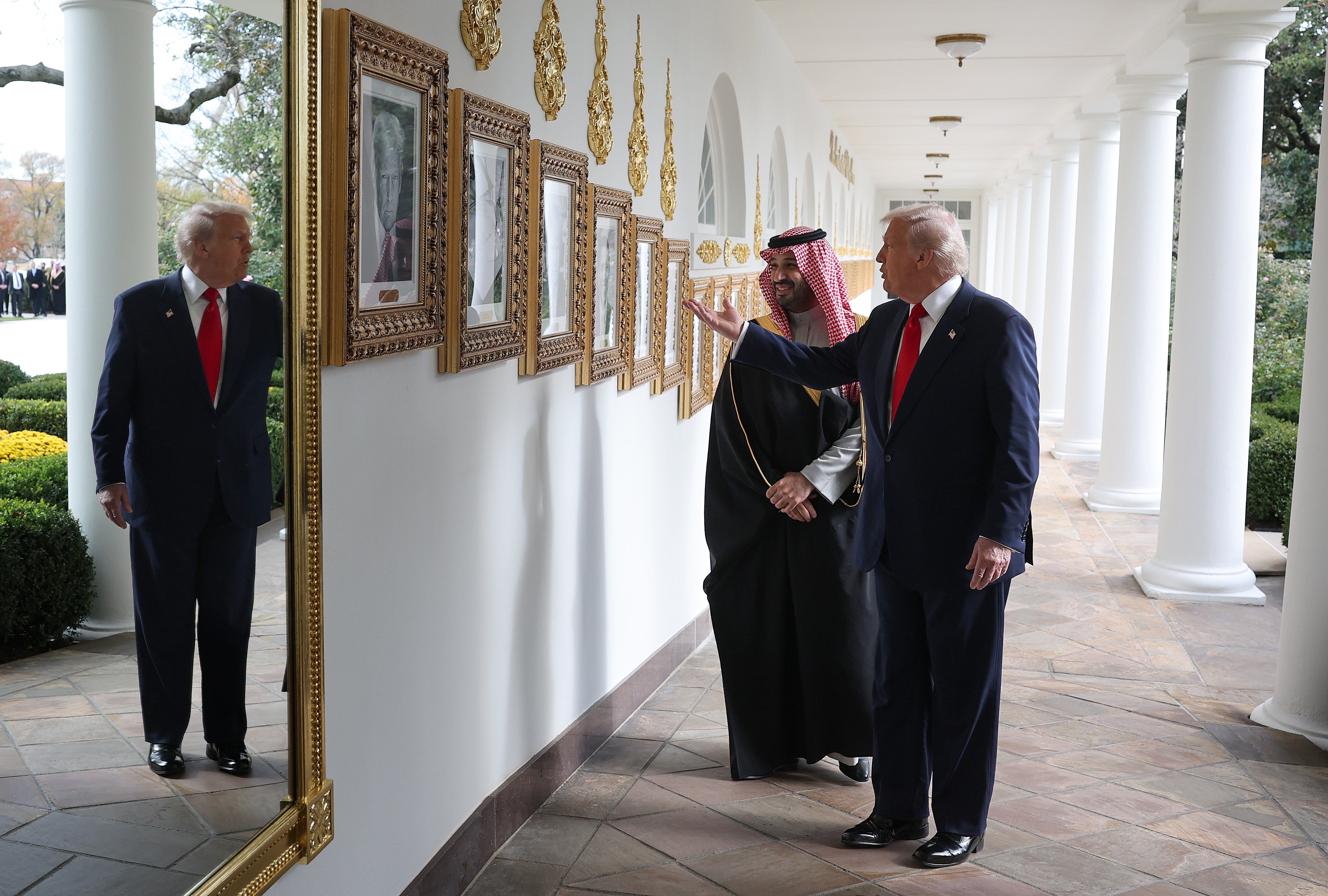 |
| President Donald Trump (R) shows Crown Prince and Prime Minister Mohammed bin Salman of Saudi Arabia the "Presidential Walk of Fame" as they walk on the colonnade at the White House on November 18, 2025 in Washington, DC Getty Images |
However, it seems the Trump administration has decided that Saudi Arabia could after all have some form of uranium enrichment under the proposed agreement with the U.S. as suggested by congressional documents. Raising proliferation concerns by arms control groups, in the midst of an atomic standoff between the Islamic Republic of Iran which has always denied its nuclear program would have a military component, now facing off against an American ultimatum to surrender all current and future prospects of nuclear research and production.
Any spinning centrifuges within Saudi Arabia, warn non-proliferation experts, could lead to a potential weapons program for the kingdom. A certain likelihood, given past assertions by Saudi Arabia's Crown Prince whose past statements were emphatic that should Tehran achieve the production of atomic bombs, he would pursue a similar program for Saudi Arabia. As it is, Saudi Arabia and Pakistan signed a mutual defence pact last year following Israel's attack on Qatar targeting Hamas officials.
 |
Labels: Explosive Middle East, Non-Proliferation, Nuclear Deal, Saudi Arabia, United States, Uranium Enrichment
posted by Pieface @ Monday, February 23, 2026


<< Home