"The fight with Iran is militarily WON."
"[An intervention by the North Atlantic Treaty Organization to open Hormuz -- a choke point for about one-fifth of global oil and liquefied natural gas flows -- would be] easy for them to do, with so little risk.""[Those members of NATO are] COWARDS.""[The fight with Iran is] militarily WON.""If we stay longer, they'll never rebuild."U.S. President Donald Trump, Truth Social
 |
| Democrats and some Republicans are alarmed by the Trump administration's pursuit of another $200 billion for the war against Iran, with some saying it signals a dangerous escalation of the conflict and highlights a lack of coherent strategy. Still from video |
In urging NATO-member countries, ostensibly allies of the United States, to become involved in helping to keep the global-shipping-critical Strait open to marine traffic and finding little response, President Trump's optimism took a frustrated turn, while the Islamic Republic of Iran, under constant fire in the three-week-old onslaught by combined U.S.-Israel warplanes continued its attacks on Gulf States' energy assets.
The United Kingdom, France, Germany, Italy, the Netherlands, Japan and Canada issued a joint statement on the blockage by Iran of the Strait of Hormuz expressing their "readiness to contribute to appropriate efforts to ensure safe passage through the Strait"; unsaid was their qualifying previous cautionary appendage: 'when active combat ends'.
There is an undercurrent of these not-eager-to-assist countries extending the courtesy of aid to their oil-rich allies in the Gulf, not necessarily the United States per se. When they speak of consultation with partners and allies, it is all-inclusive of Saudi Arabia, United Arab Emirates, Qatar and Kuwait, and likely NATO-member Turkey.
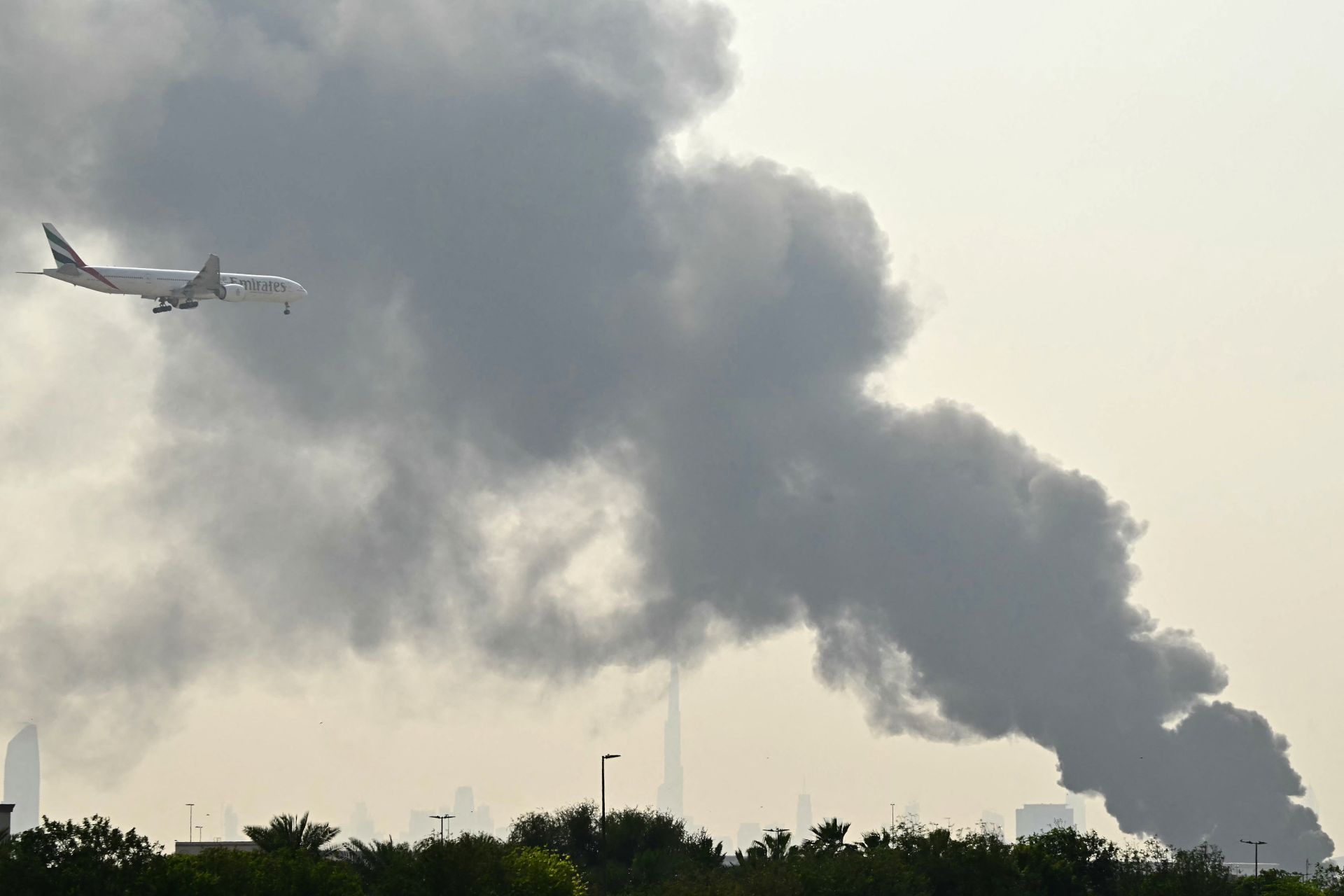 |
| An Emirates aircraft flies past plumes of smoke from an ongoing fire near Dubai International Airport on March 16, 2026. (AFP via Getty Images) |
Since the early days of the war, the Strait of Hormuz remains effectively closed, a blockage that has caused a surge in oil and gas prices worldwide. Even after Israel signalled its willingness to stop targeting Iran's energy infrastructure following an earlier strike on Iran's giant South Pars gas field, Iran pressed forward with its attacks nonetheless on Gulf Arab states in retaliation for their friendly relations with the United States and their agreements to house U.S. military bases.
Missiles were intercepted by the United Arab Emirates and Saudi Arabia, along with Iranian Shahed drones; Bahrain reporting a fire at a warehouse and Kuwait was forced to close several units of its Al Ahmadi refinery following multiple strikes by Iran.
Three additional American warships and thousands more Marines are scheduled to arrive in the Middle East, according to reportage by the Wall Street Journal, despite that President Trump has consistently stated there are no plans for the U.S. to send ground troops into Iranian territory. Clearly, the American President hasn't entirely ruled out that potential.
Over 4,200 people have died since the war began, across the region, the vast aggregate in Iran. Hezbollah, which chose to attack Israel from Lebanon when the February 28 conflict began with the death of the Supreme Leader Ali Khamenei, is now in a full-scale war with Israel, alongside the conflict in Iran. In Lebanon, an estimated thousand people have died in the parallel war linked to Tehran.
 |
| A cleric beats his chest as he mourns during the funeral procession of Iran's intelligence minister, Esmail Khatib, in Tehran on Friday. Israel's military said on Wednesday that it would not stop its 'series of eliminations' of senior Iranian officials after announcing it had killed Khatib. (Vahid Salemi/The Associated Press) |
Qatar has revealed that close to a fifth of its LNG production has been put out of commission for up to five years; QatarEnergy stating the attacks would cost about US$20 billion a year in lost revenue. There is high risk of lasting damage to energy supplies resulting from the war, even if events come to a swift end to stop the fighting. The war's fallout has a global spread, with fuel, shipping, fertilizer and household costs steeply rising.
Iran's major oil-export site, Kharg Island, is now under consideration by the U..S. for a takeover operation to impress on Iran that the Strait of Hormuz must be opened, according to Axios. That decision remains in a potential state, after the U.S. strike of military sites last weekend on Kharg, stopping short of targeting oil infrastructure. President Trump retains all options of actions to bring the war to an end and with it the urgency of critical shipping cleared through the Strait.
From their March 1st peak, Iran's average missile and drone launches have been diminished about 84 percent, according to a Bloomberg Intelligence analysis. The brunt of Iranian attacks have been borne by Gulf states, led by the United Arab Emirates. Tehran, warned Iranian Foreign Minister Abbas Araghchi, would show "ZERO restraint", should its oil and gas infrastructure be hit again.
 |
| Qatar says an Iranian strike on Ras Laffan, the world's largest liquified natural gas plant, has taken out 17 per cent of its export capacity. Persian Gulf states are also major producers of fertilizer, and concerns are mounting over what may happen to global food prices should that supply chain be disrupted. Still from video |
Labels: Global Shipping, Gulf States in Line of Fire, Islamic Republic of Iran, Srait of Hormuz, U.S.-Israel Airstrikes on Iran
posted by Pieface @ Sunday, March 22, 2026


<< Home