"You'll
have to start learning how to fight for yourself, the U.S.A. won't n e
there to help you anymore, just like you weren't there for us."
"Iran has been, essentially, decimated. The hard part is done."
"Go get your own oil!"
"[Paris has been] VERY UNHELPFUL]. The U.S.A. will REMEMBER!!!"
"We’ve been there automatically, including Ukraine. Ukraine wasn’t our
problem. It was a test, and we were there for them, and we
would always have been there for them. They weren’t there for us."
"All of those countries that can’t get jet fuel because of the Strait of
Hormuz, like the United Kingdom, which refused to get involved in the
decapitation of Iran, I have a suggestion for you: Number 1, buy from
the U.S., we have plenty, and Number 2, build up some delayed courage,
go to the Strait, and just TAKE IT”."
"I’ve long said that, you know, I wonder whether or not NATO would ever
be there for us. So … this was a great test, because we don’t need them,
but they should have been there."
U.S. President Donald J. Trump
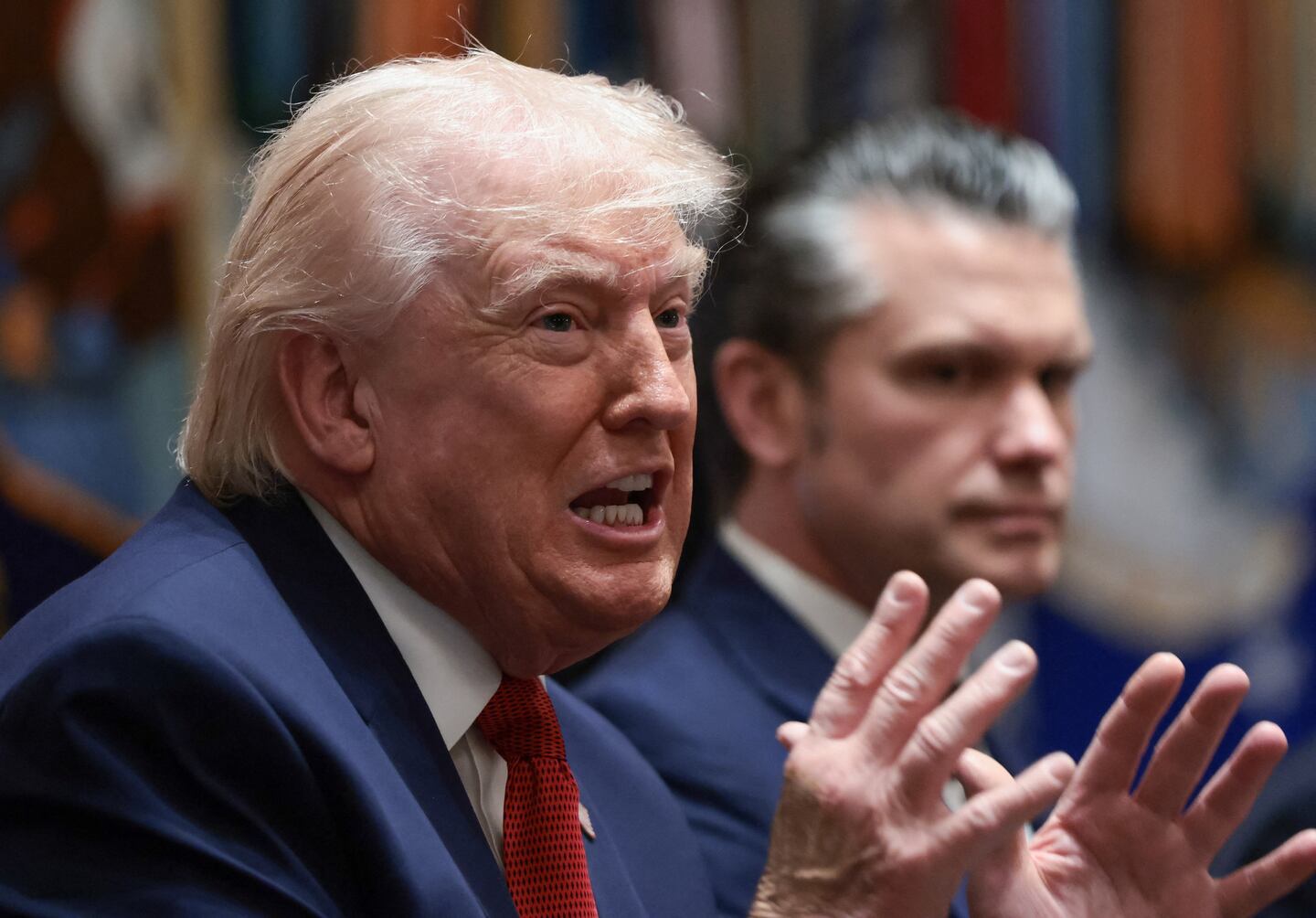
Donald Trump has also called NATO countries that do not help with the war in Iran "cowards." Evelyn Hockstein/REUTERS
"I hope that amid the emotions surrounding the President of the
United States today, a moment of calm will come."
"And why?
Because there is no NATO without the United States, and it is in our
interest that this calm comes."
"But there is also no American power
without NATO."
Polish Defense Minister Wladyslaw Kosiniak-Kamysz
Cargo ships in the Gulf, near the Strait of Hormuz, as
seen from northern Ras al-Khaimah, near the border with Oman?s Musandam
governance, amid the U.S.-Israeli conflict with Iran, in United Arab
Emirates, March 11, 2026. REUTERS/Stringer
Frustration
with allies unwilling to commit themselves through the NATO military
alliance in support of the U.S. conflict in Iran, has hit boiling point
with President Trump who is now telling his erstwhile allies to "go get your own oil" in respect to the closure of the Strait of Hormuz by Iran, has sent energy prices soaring.
Following
U.S. strikes hitting Isfahan, the central Iranian city, leading to
Tehran attacking a fully loaded Kuwaiti oil tanker in the Persian Gulf,
Mr. Trump's precarious patience appears to have hit its limit. A month
after the start of the aerial bombardment by the U.S. and Israel, the
intensity of strikes on either side has not levelled off and major
disruptions have erupted to the global supply of oil and natural gas,
reflected by panicked global markets.
Earlier,
Mr. Trump shared footage of the massive attack on Isfahan, home to one
of three nuclear enrichment sites that was attacked last June by U.S.
strikes, where it is suspected that much of Iran's highly enriched
uranium was stored. It seems evident that no agency foretold the extent
of Iran's stranglehold on the Strait of Hormuz, with its catastrophic
results to world shipping, much less the Iranian leadership's decision
to attack its neighbours' energy infrastructure.
The
roiling of world markets and the strait-closing effect on many basic
goods such as fertilizer normally shipped across the world, has had its
effect on the American president who directed responsibility at the
United Kingdom and France for refusing to enter a war for which no clear
endgame could be deduced, a war they were never consulted on, nor an
alert given that it would be forthcoming.
The U.S. attack on an Iranian ammunition
depot in Isfahan raises tensions and the risk of further military
escalation in the region.Los Angeles Today
France
permitted the U.S. Air Force use of the Isteres base in southern France
once it received guarantees that planes landing there would not be
carrying out strikes in Iran. Europe's loudest critic of the war, Spain
stated it chose to close its airspace along with its joint U.S.-Spain
airbases for any planes involved in the conflict. As for Italy, an
official confirmed that U.S. military assets were refused use of the
Sigonella airbase in Sicily for any operation with links to the
offensive in Iran.
American
bombers were intending to land at the Italian base prior to continuing
on toward the Middle East. However, affirmed Italy's Defence Minister
Guido Crosetto, Italy would still allow the US. use of its bases; no
cooling of relations between the two countries has resulted over the
Iran conflict.
The
world is now on notice that should a ceasefire not be "shortly" reached
and the strait reopened, the U.S. was prepared to broaden its
offensive, and that would include attacking the Iranian oil export hub
on Kharg Island.
Luojiashan tanker sits anchored in Muscat, amid the
U.S.-Israeli conflict with Iran, in Muscat, Oman, March 7, 2026.
REUTERS/Benoit Tessier
"We don't want to have to do more militarily than we have to."
"But I didn't mean it flippantly when I said, in the meantime, we'll negotiate with bombs."
"[An intervention by the North Atlantic Treaty Organization to open Hormuz -- a choke point for about one-fifth of global oil and liquefied natural gas flows -- would be] easy for them to do, with so little risk."
"[Those members of NATO are] COWARDS."
"[The fight with Iran is] militarily WON."
"If we stay longer, they'll never rebuild."
U.S. President Donald Trump, Truth Social
Democrats and
some Republicans are alarmed by the Trump administration's pursuit of
another $200 billion for the war against Iran, with some saying it
signals a dangerous escalation of the conflict and highlights a lack of
coherent strategy. Still from video
In urging NATO-member countries, ostensibly allies of the United States, to become involved in helping to keep the global-shipping-critical Strait open to marine traffic and finding little response, President Trump's optimism took a frustrated turn, while the Islamic Republic of Iran, under constant fire in the three-week-old onslaught by combined U.S.-Israel warplanes continued its attacks on Gulf States' energy assets.
The United Kingdom, France, Germany, Italy, the Netherlands, Japan and Canada issued a joint statement on the blockage by Iran of the Strait of Hormuz expressing their "readiness to contribute to appropriate efforts to ensure safe passage through the Strait"; unsaid was their qualifying previous cautionary appendage: 'when active combat ends'.
There is an undercurrent of these not-eager-to-assist countries extending the courtesy of aid to their oil-rich allies in the Gulf, not necessarily the United States per se. When they speak of consultation with partners and allies, it is all-inclusive of Saudi Arabia, United Arab Emirates, Qatar and Kuwait, and likely NATO-member Turkey.
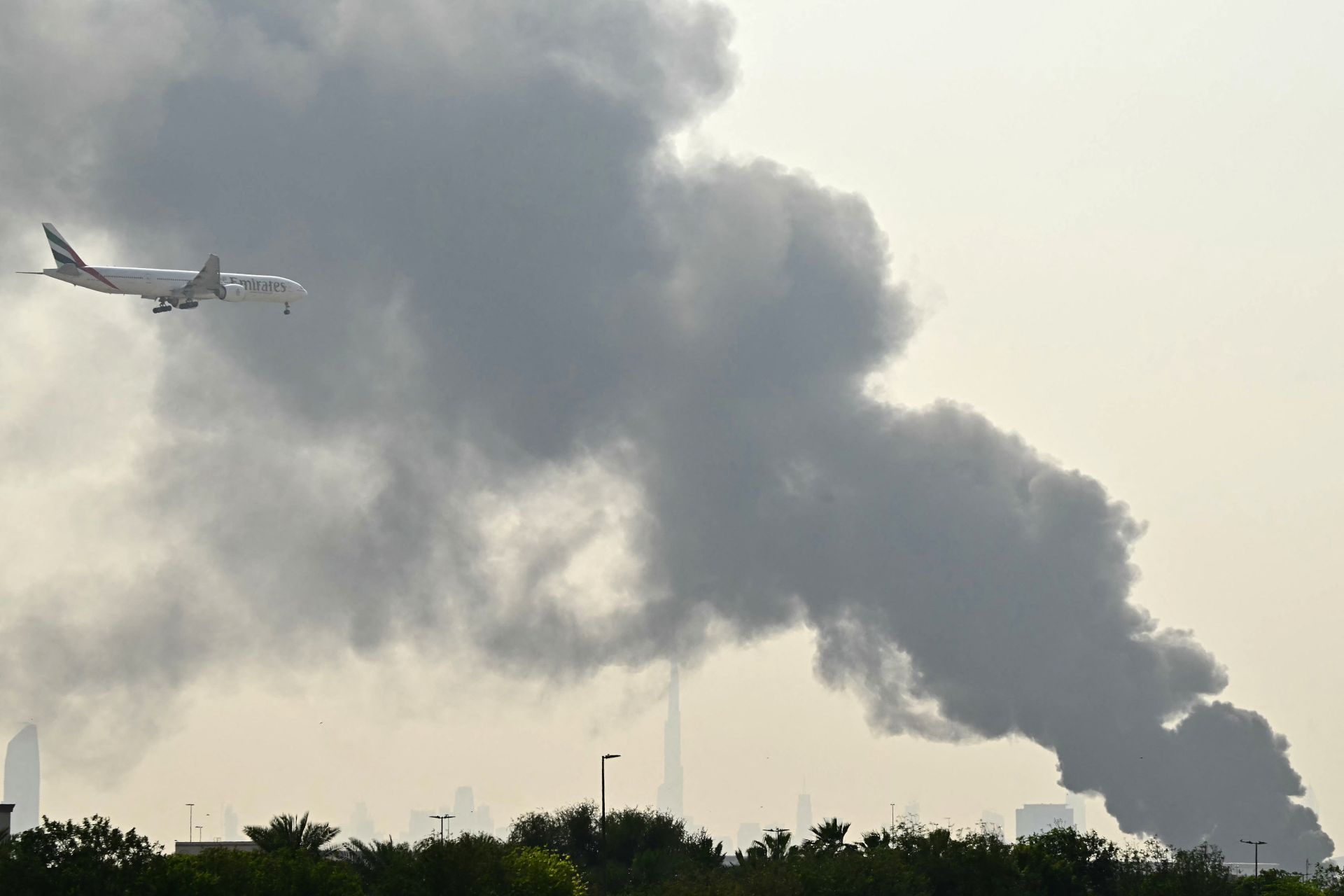
An Emirates aircraft flies past plumes of smoke from an ongoing fire
near Dubai International Airport on March 16, 2026. (AFP via Getty
Images)
Since the early days of the war, the Strait of Hormuz remains effectively closed, a blockage that has caused a surge in oil and gas prices worldwide. Even after Israel signalled its willingness to stop targeting Iran's energy infrastructure following an earlier strike on Iran's giant South Pars gas field, Iran pressed forward with its attacks nonetheless on Gulf Arab states in retaliation for their friendly relations with the United States and their agreements to house U.S. military bases.
Missiles were intercepted by the United Arab Emirates and Saudi Arabia, along with Iranian Shahed drones; Bahrain reporting a fire at a warehouse and Kuwait was forced to close several units of its Al Ahmadi refinery following multiple strikes by Iran.
Three additional American warships and thousands more Marines are scheduled to arrive in the Middle East, according to reportage by the Wall Street Journal, despite that President Trump has consistently stated there are no plans for the U.S. to send ground troops into Iranian territory. Clearly, the American President hasn't entirely ruled out that potential.
Over 4,200 people have died since the war began, across the region, the vast aggregate in Iran. Hezbollah, which chose to attack Israel from Lebanon when the February 28 conflict began with the death of the Supreme Leader Ali Khamenei, is now in a full-scale war with Israel, alongside the conflict in Iran. In Lebanon, an estimated thousand people have died in the parallel war linked to Tehran.
A cleric beats his chest as he mourns during the funeral procession of
Iran's intelligence minister, Esmail Khatib, in Tehran on Friday.
Israel's military said on Wednesday that it would not stop its 'series
of eliminations' of senior Iranian officials after announcing it had
killed Khatib. (Vahid Salemi/The Associated Press)
Qatar has revealed that close to a fifth of its LNG production has been put out of commission for up to five years; QatarEnergy stating the attacks would cost about US$20 billion a year in lost revenue. There is high risk of lasting damage to energy supplies resulting from the war, even if events come to a swift end to stop the fighting. The war's fallout has a global spread, with fuel, shipping, fertilizer and household costs steeply rising.
Iran's major oil-export site, Kharg Island, is now under consideration by the U..S. for a takeover operation to impress on Iran that the Strait of Hormuz must be opened, according to Axios. That decision remains in a potential state, after the U.S. strike of military sites last weekend on Kharg, stopping short of targeting oil infrastructure. President Trump retains all options of actions to bring the war to an end and with it the urgency of critical shipping cleared through the Strait.
From their March 1st peak, Iran's average missile and drone launches have been diminished about 84 percent, according to a Bloomberg Intelligence analysis. The brunt of Iranian attacks have been borne by Gulf states, led by the United Arab Emirates. Tehran, warned Iranian Foreign Minister Abbas Araghchi, would show "ZERO restraint", should its oil and gas infrastructure be hit again.
Qatar says an
Iranian strike on Ras Laffan, the world's largest liquified natural gas
plant, has taken out 17 per cent of its export capacity. Persian Gulf
states are also major producers of fertilizer, and concerns are mounting
over what may happen to global food prices should that supply chain be
disrupted. Still from video
Sleepwalking Into a Colossus's Web of Monopolistic Influence
Chinese President Xi Jinping and Greek Prime Minister Kyriakos Mitsotakis at the port of Piraeus, Greece, November 2019 Orestis Panagiotou / Reuters
"The
original Maritime Silk Road, as laid out in Chinese documents, focused
on three main routes. The plan has expanded to include the Atlantic and
the Americas. Latin America is one of the fastest-growing destinations
for Chinese port investments."
"China
manages ports at both ends of the Panama Canal. It is building from
scratch a US$3-billion megaport at Chancay in Peru that will transform
trade between China and Latin America, enabling the world's largest
container ships to dock on the continent for the first time."
Liz Sly/Julia Ledur, The Washington Post
"This is not coincidental."
"I
firmly believe there is a strategic aspect to the particular ports
they're [Beijing/Chinese Communist Party] targeting for investment."
Carol Evans, director, Strategic Studies Institute of the U.S. Army War College
Voice of America
President
Xi Jinping thinks long term, strategically. His is a carefully
thought-out program to bring the China that he administers to the head
of the global trade enterprise in every conceivable way. Once China was
inducted into the global community through membership in the World Trade
Organization thanks to then-U.S. President Bill Clinton's
interpretation of the West's useful collaboration in trade with China,
Beijing never looked back. In seemingly no time at all, cheap labour
brought inexpensive goods manufactured in China to the world's
consumers, bringing an end to domestic manufacturing in countries eager
to please their publics with less pricey goods.
That
loss of manufacturing stemming from an inability to compete with the
manufacturing colossus, made those countries dependent on China's
low-paid workforce in production of goods. China then turned to
rare-earth elements, minerals that modern technical advances were
dependent on, planning for a monopoly enabling China to cheaply produce
highly technical products, leaving the world dependent on it once again.
And when the economy was linked with the environment and a global
agreement to reduce environmental carbon and GHGs, it monopolized
alternate energy sources where China produces the world's greatest
number of wind turbines. And electrical grids.
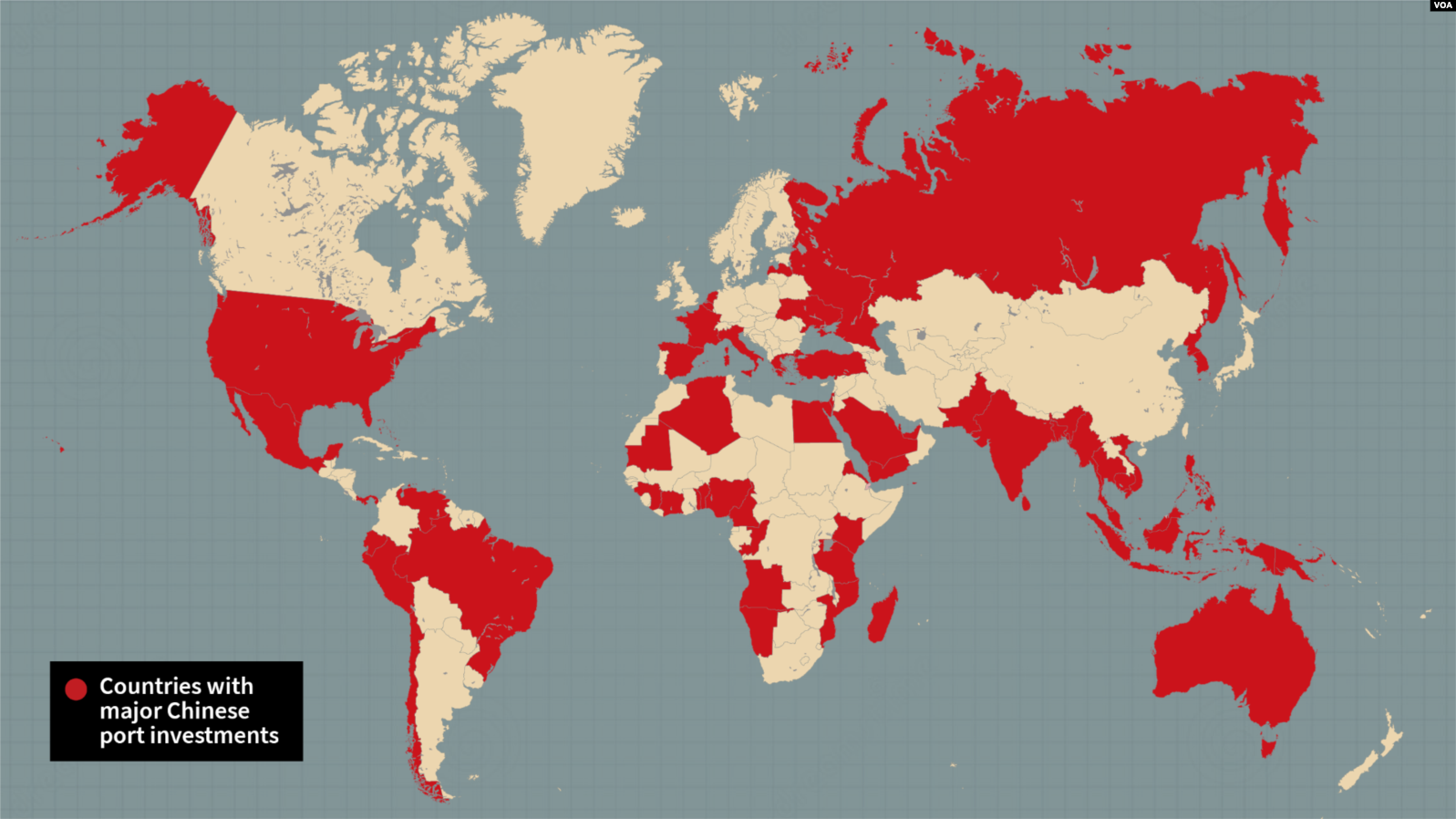
Beijing
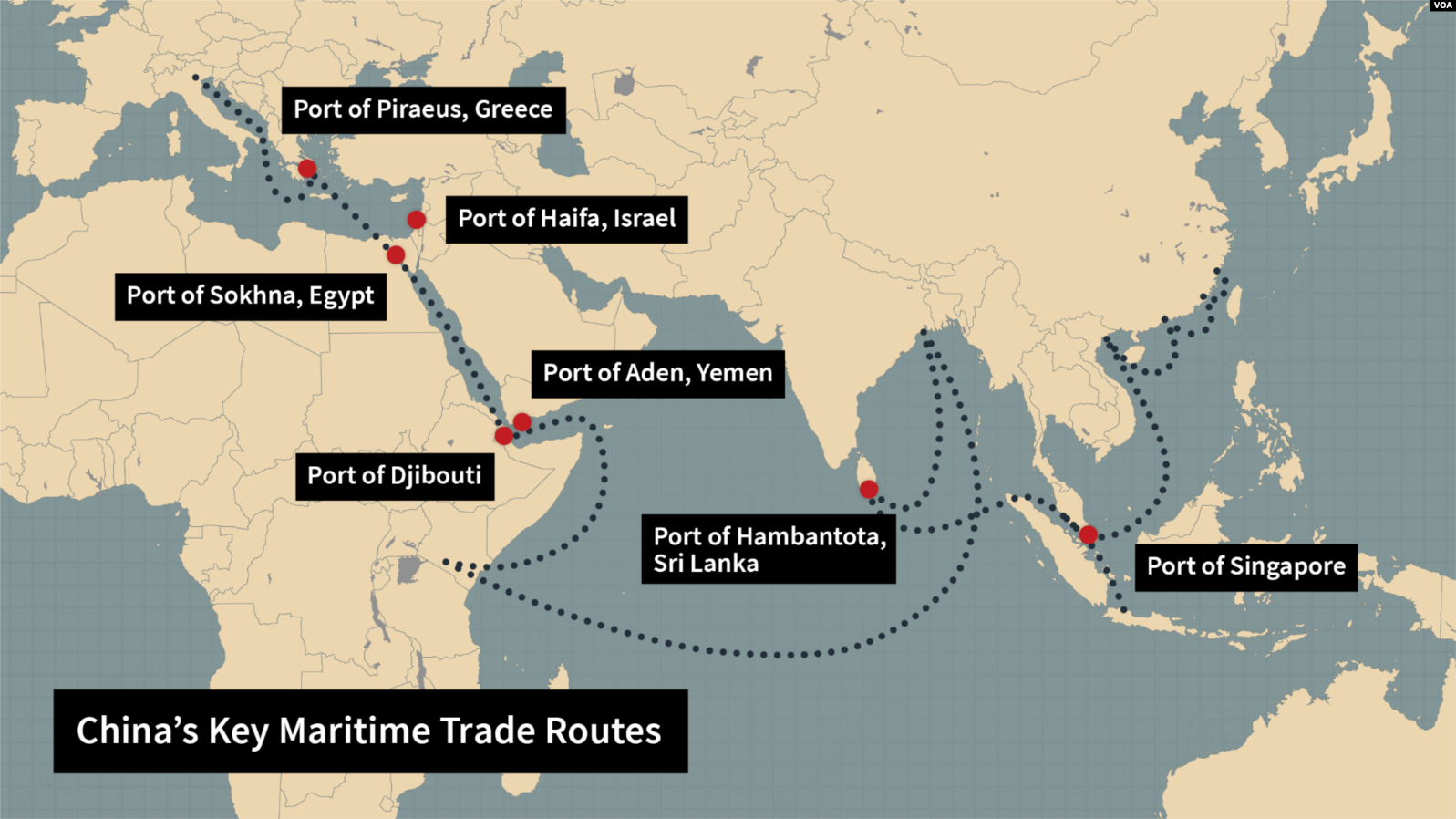
has stealthily established a secure network of global ports, central to
world trade and navigation. Beijing presented its goal in these
investments as commercial, but over time the United States and its
allies have become increasingly thoughtful of the potential military
applications and their implications for the future inherent in an
expansion of Beijing's plans for the future. The port networks
established to this point reflect China's ambitions, stated by President
Xi as a Chinese "maritime superpower".
VOA
A
decade ago, when President Xi made that statement, China had global
stakes in 44 ports; that has grown at the present to its owning or
operating terminals and ports at close to 100 locations in over 50
countries, incorporating every ocean and continent on the globe, many
located along the world's most strategic waterways. The investments made
by companies owned in the majority by the government of China, making
Beijing and the CCP the largest operator of ports supplying global
supply chains. That represents critical domination.
Furthermore,
these investments allow Beijing a window into business dealings of
competitors, useful in aiding China to defend its own supply routes, to
spy on any military movements of the United States and to engage
potentially in U.S. shipping, analysts point out. Chinese warships
already view these Chinese-owned ports or terminals as ports of call,
like the Chinese flotilla entering the Nigerian port of Lagos this past
summer.
Adjacent
the Chinese-operated port of Djibouti, China acknowledged in 2015 that
it was building a military base which officially opened two years later,
a mere six miles from a U.S. military base in the country. Djibouti
lies on one of the busiest shipping lanes -- located at the narrow
entrance to the Red Sea -- in the world; ten percent of global oil
exports and 20 percent of commercial goods pass through the narrow
strait, to and from the Suez Canal.
Chinese-operated port of Djibouti. (Carl de Souza/AFP/Getty Images)
Many
of the port locations are at strategic choke points, complete with high
shipping traffic where sea routes are narrow and ships can be
vulnerable. At Khalifa in the Persian Gulf by the crucial Strait of
Hormuz, just 50 miles from an important U.S. military base, China has
revived an intention to establish military facilities. Beijing's
influence has also been increasing in ports on Egypt's Suez Canal where
Chinese shipping companies announced investments in ports of Ain Sokhna
and Alexandria terminals.
China's
ambitions are large and far-seeking, to the extent that it controls or
has major investments in over 20 European ports, allowing Beijing
significant influence of the supply routes on the continent where many
serve as vital logistics and trans-shipment points for NATO and the
American Navy. "It's a significant national and economic security concern", stated Michael Wessel of the U.S.-China Economic and Security Review Commission.
A
little-known software system named Logink -- a digital logistics
platform owned by the Chinese government -- has enabled China to secure a
commanding position that allows it access to vast numbers of normally
proprietary information on the movement, management and pricing of goods
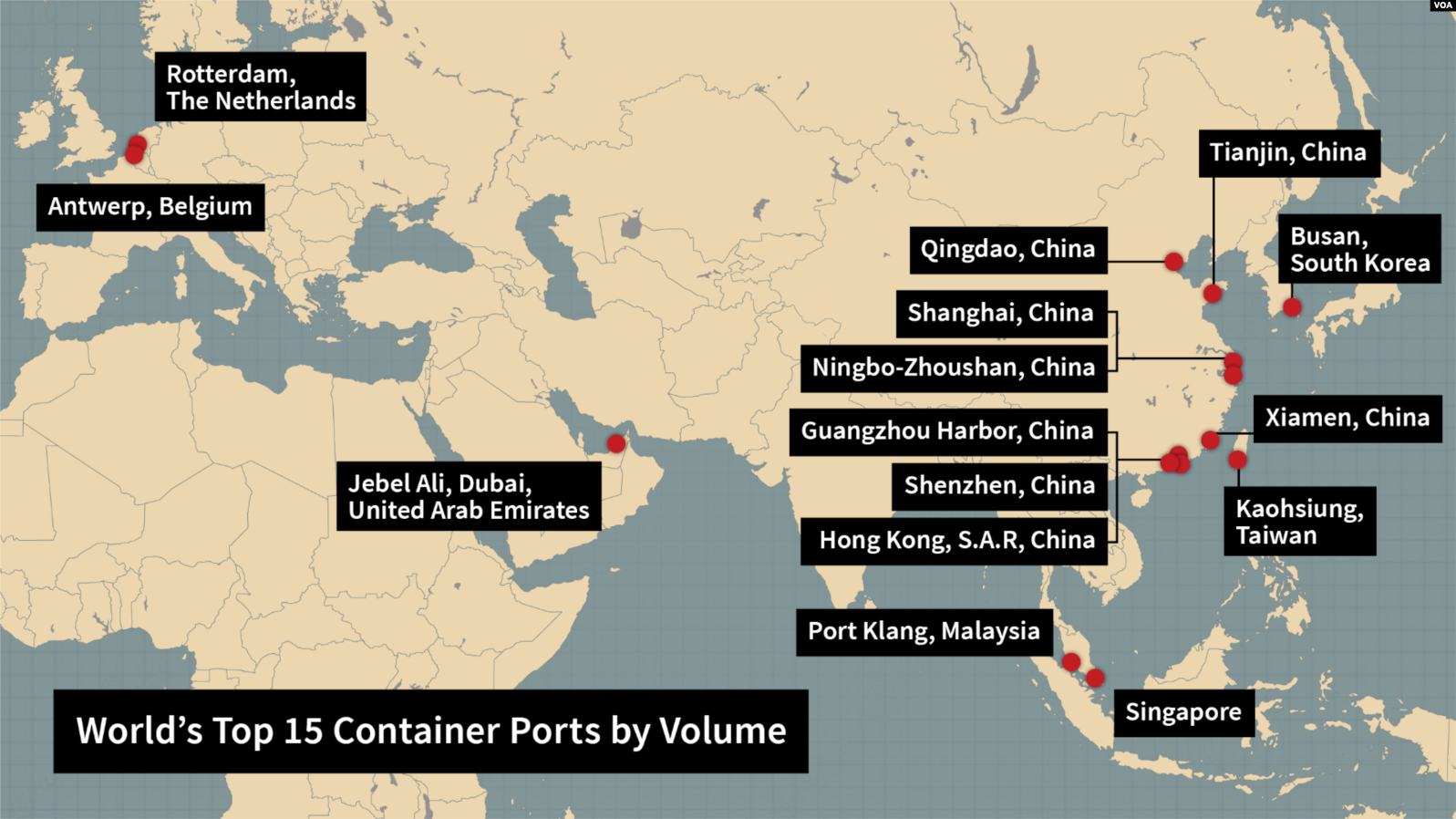
moving around the world. At least 24 ports, including Rotterdam and
Hamburg adopted the Logink system; an issue that compelled the U.S.
Transportation Department to put out an advisory, warning American
companies and agencies to avoid interacting with the system at risk of
espionage and cyberattack.
A Frenzy of Inaction : Container Ships at Anchorage
"This is probably the thing that is keeping me up most of the time."
"We have some nice live bands from time to time. Hopefully we can keep the crew happy with some barbecues, some team events like watching movies together, or playing some sports."
"If you like to have a beer, it's possible. Normally we have it on stock and you can have it."
"You, of course, always have to be ready for emergencies, so there cannot be any excessive stuff."
Captain Markus Grote, Hapag-Lloyd AG, Hamburg, Germany-based
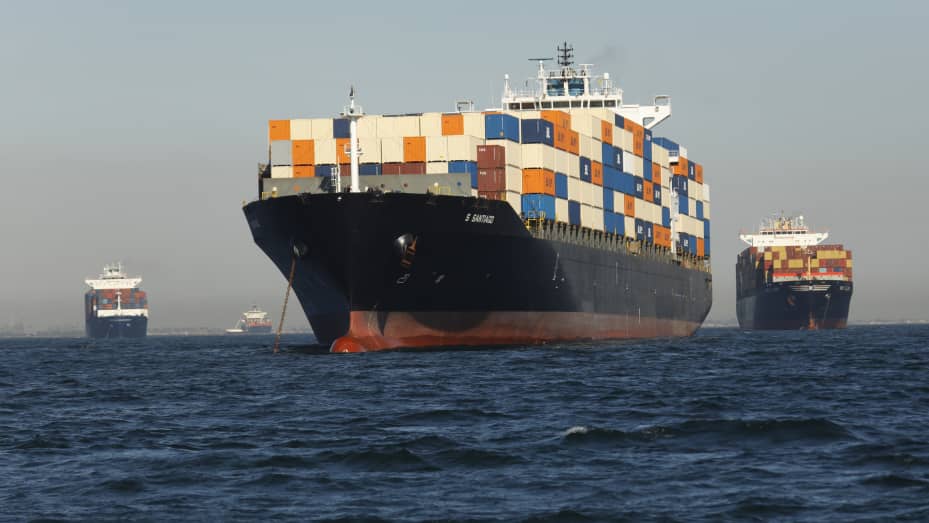
Container ships wait outside the Ports of Los Angeles and Long Beach waiting to unload on Oct. 13, 2021. Carolyn Cole | Los Angeles Times | Getty Images
There are at least 21 crew members on most ocean-going container carriers counting the officers. Routine chores such as maintaining equipment, keeping cargo secure and decks tidy see crew members consume their activities routinely, while at sea en route to a destination. The officers rotate on eight-hour watches and monitor instruments and radio traffic.
Busier days are those when the ship is in port, unloading containers and loading up others. This is when the crew works as a team, everyone knowing his job, meshing with the activities of their shipmates forming the crew. It's when critical paperwork is completed, along with the restocking of supplies and attention given to undertaking extensive mechanical fixes.
When a container ship is forced by conditions to sit at anchor awaiting their turn to approach the docks to unload and alternately load up, it is a time of inaction; waiting, boredom, plummeting morale. Remaining at anchorage for weeks at a time is psychologically debilitating; they're stuck, neither underway nor at port -- simply waiting, waiting...
If the ship happens to be anchored close enough to shore they're enabled to access local communication networks so they can call family and friends, or even order something to be delivered. Otherwise, nothing of the kind is possible, given the cancellation of shore leave opportunities in this time of pandemic travel restrictions.
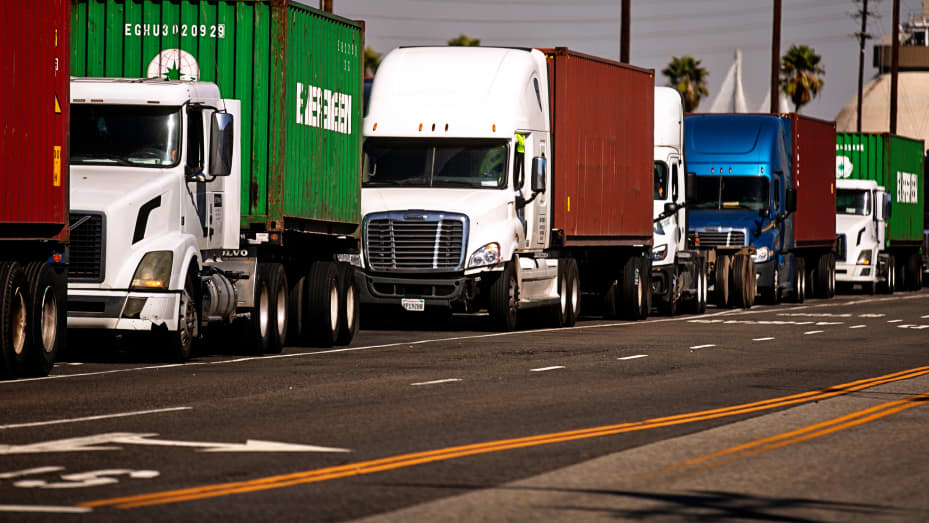
As far as the eye can
see cargo trucks wait in long lines to enter The Port of Los Angeles as
the port is set to begin operating around the clock on Wednesday, Oct.
13, 2021 in San Pedro, CA.
Jason Armond | Los Angeles Times | Getty Images
At anchor regular maintenance must continue, deck watches staffed. Some relief from the sameness is a necessity to keep minds engaged and fend off dissatisfaction and depression. In those circumstances a concerned captain, worried over the mindset of his crew, thinks of ways to lift the prevailing sullen mood of off-duty crew. Basketball, video games, table tennis or use of the pool and gyms on board for those ships with these amenities, are all on call
In other ways, crew members find ways to stimulate themselves. Picking up a guitar or drums, forming bands with on-board colleagues. Some choose the ever-popular karaoke as a relief mechanism. The captain of these container ships has plenty on his mind; the necessity to deliver cargo, to take on cargo, to arrive as expected at their destination, to ensure that all goes well; he is answerable to the profit margin of the shipping company he represents.
There are about 400,000 merchant mariners anxious to take time off to return home, to relieve their mounting sense of seafarer fatigue. Container deliveries have been pressed of late, with the imposition of uncertainties and new rules surrounding the impact of the SARS-CoV-2 virus causing COVID-19. Manpower shortages one issue, but another the shortage of shipping containers at a time the international community is trying to catch up with time and opportunities lost to the novel coronavirus's impact on business and critical deliveries from producer to consumers world-wide.
Ship crews are experiencing dizzying work swings from frenzied action to increasingly more idling time. Over 600 container ships were anchored recently awaiting the opportunity to enter ports at the traditionally busiest shipping ports in the world. Data from Seaexplorer.com and Swiss freight giant Kuchne+Nagel International AG speak of hold-ups and back-ups where the race to clear containers from ports to enable new shipments to take their place has stalled.
Roughly ten percent of the total container ships globally currently in service await the opportunity to unload. Some of them will remain at anchor waiting, waiting ... for weeks. Outside Los Angeles, North America's busiest port, ships wait an average of ovr 12 days at anchor to be allowed to pull into port. The same amount of time it would take them to navigate the Pacific from Asia.
This represents a general opinion site for its author. It also offers a space for the author to record her experiences and perceptions,both personal and public. This is rendered obvious by the content contained in the blog, but the space is here inviting me to write. And so I do.