Lunar Competition
"They [Chinese space exploration] may be early. And recent history suggests we might be late.""This time the goal is not flags and footprints [in returning astronauts to the moon].""This time the goal is to stay [sustaining a permanent presence on the moon]."Jared Isaacman, NASA administrator
The
United States, considering itself the alpha nation in scientific
innovation and advances was somewhat chastened and humiliated when it
was Soviet Russia, whose own scientific entrepreneurship was
considerable enough to enable it to be the first nation on Earth to send
a cosmonaut into space to orbit Earth in 1961, advancing space
exploration through a 108-minute mission to orbit Earth, making Yuri
Gagarin the first human to leave the bounds of the planet.
It
took another eight years for the United States to catch up with
Russia's space mission, when the Apollo 11 Mission carried three
astronauts to the surface of the Moon, resulting in first Neil
Armstrong's famous walk on the Moon, followed by Buzz Aldrin's, while
Michael Collins remained in orbit. No country has since returned to the
Moon. China has developed its own space program and ambitions for the
Moon. Although Neil Armstrong planted the American flag during his
2-hour walk on the Moon's surface, the race is now on to see who will
plant the next flag.
 |
| Buzz Aldrin on the Moon in a photograph taken by Neil Armstrong, who can be seen in the visor reflection along with Earth, the Lunar Module Eagle, and the U.S. flag. |
The
present era in space travel sees China and the United States in a
competition over who will first land humans on the Moon not merely for
continued exploration purposes and greater familiarity with its surface
and conformations and minerals, but to advance development plans for a
permanent presence there, a manned station from which other missions
further into the depths of outer space to reach Mars and possibly
establish a colony there.
 |
China's
space mission has already distinguished itself for having landed an
unmanned mission on the never-before seen far side of the Moon where a
robotic probe programmed to retrieve mineral samples succeeded in
bringing them back to Earth for Chinese scientific study identification.
China plans its seventh robotic mission to explore the lunar south
pole, with its Chang'e 7 space capsule. Chinese astronauts are to
revisit that part of the Moon where the Apollo 11 mission landed.
In
April U.S. astronauts were sent by NASA on a ten-day lunar flyby, doing
a figure-8 loop around the Moon and back, then returning to Earth,
having flown further and higher than any other manned mission. As a
prelude to plans to once again land astronauts on the Moon where both
China and the U.S. plan to build nuclear reactors to power the lunar
bases they intend to build as space-launch sites.
China's
plan is to build outposts around the south pole of the Moon, planning
to tap frozen water, hydrogen and helium in that region. China's target
for a return with a manned mission has a date of 2030. NASA hopes to
beat them at it, knowing it's a long shot, but they plan on returning to
the Moon with astronauts in 2028, two years sooner than China. The
reality is that China with its centralized control funding projects
decades ahead, has been where the U.S. has not yet ventured.
And
it is the south pole that the U.S. too plans to return to, a
competition that may determine, according to which country first reaches
its target, which will be able to assume the greater authority over the
region. NASA's plan is to launch six-month missions, arranging for a
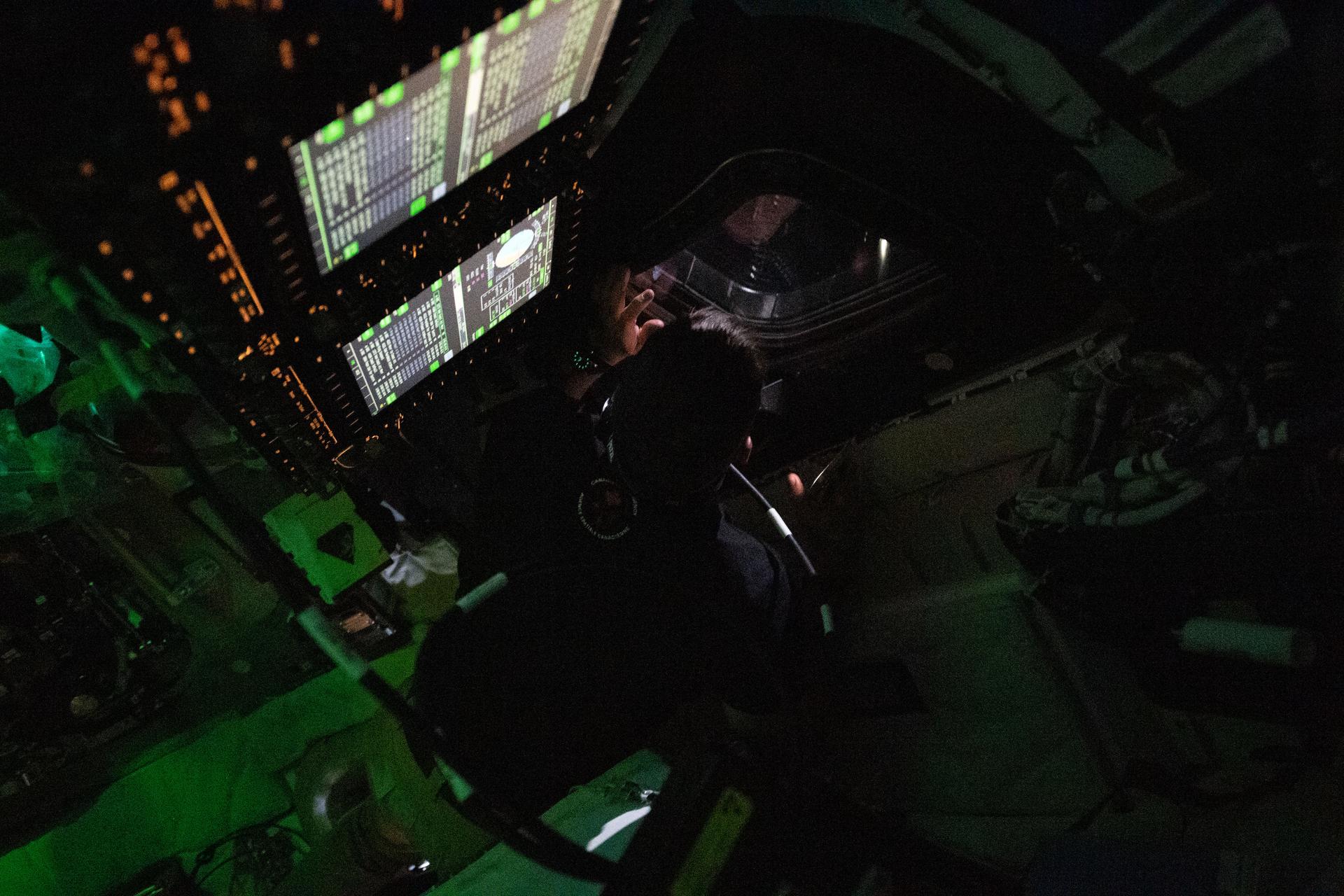
sustained presence. The U.S. spacecraft Orion carried the four
astronauts (one Canadian) on the Artemis 11 mission this month.
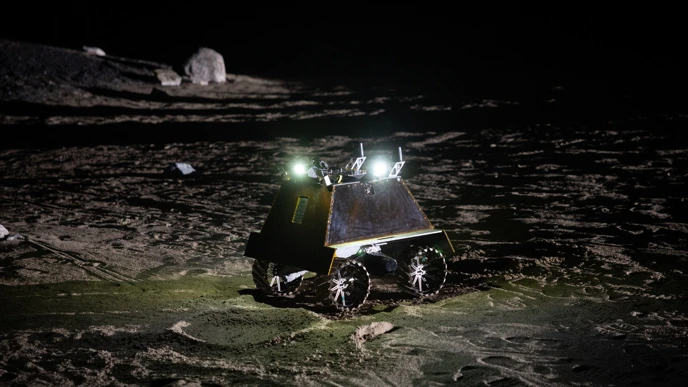 |
| The lunar robot initiative is part of China’s broader 'AI in steel' strategy—embedding artificial intelligence into physical machines for real-world tasks. |
Artemis
111 is to be launched next year, to test a lander being developed by
SpaceX called Starship, while Blue Origin has another lander in
development. Whichever lander is completed will be tested by NASA first.
Artemis could be sped up in a new timescale through a recent program
overhaul to include more launches to test components, lower risks and
gain confidence.
China
has two programs; crewed missions under the purview of the military,
and civilian robotic missions. The Long March 10 is a Chinese
government-built rocket, half as tall as a 30-story building, with seven
engines at its base. The United States has the jump on China with
rocket technology in that China cannot match SpaceX's reusale Falcon 9
rocket.
A new spacecraft called the Mengzhou ('Dream Boat')
is being developed by China to carry up to seven astronauts, designed
for lunar missions and trips to the Chinese space station, some 450
kilometers above Earth.
The
Mengzhou is to carry astronauts to a lunar orbit where a rendezvous
with a lander to take the astronauts to the moon's surface will be
carried out. Once the Chinese astronauts get to their Lanyue lunar
lander, it will turn toward the lunar surface where on landing it will
become the astronauts' temporary home, data center and energy source.
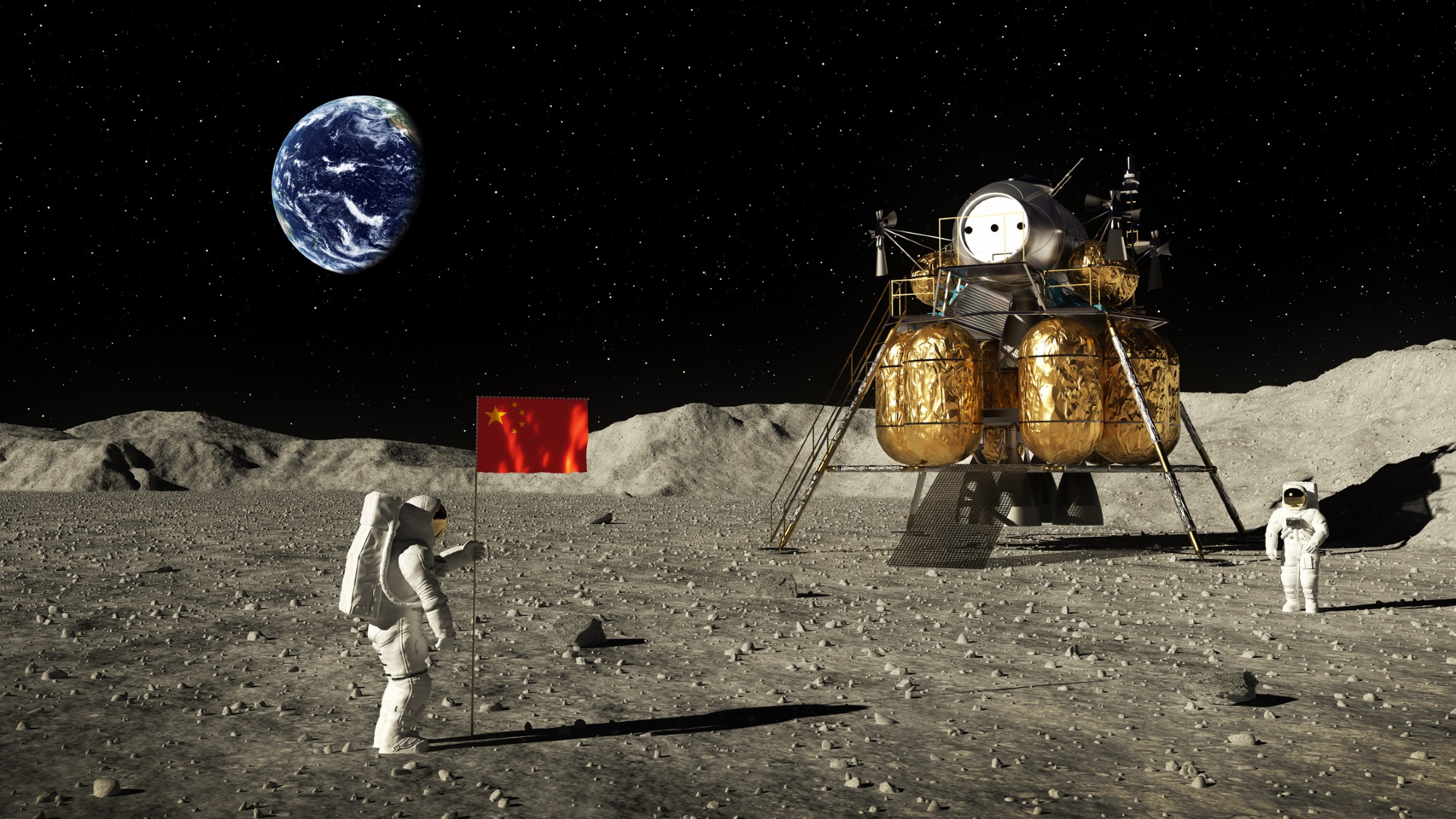 |
| Artist's illustration of astronauts on the moon planting a Chinese flag. (Image credit: 3DSculptori/Stock/Getty Images) |
Labels: Chinese Space Program, NASA, New Frontiers, Permanent Moon Bases, United States
posted by Pieface @ Tuesday, April 21, 2026


<< Home