The Strait of Hormuz
"[Any Iranian warships that come] anywhere close [to the U.S. blockade will be destroyed].""We can't let a country blackmail or extort the world because that's what they're doing.""We [the United States] don't use this strait. We have our own oil and gas, much more than we need."U.S. President Donald Trump"The entirety of the Iranian coastline, including ports and energy infrastructure [are included in the restrictions].""[Transit through the strait] to or from non-Iranian destinations is not reported to be impeded by these measures.""[However, ships] may encounter military presence [in the strait]."Maritime Trade Operations agency
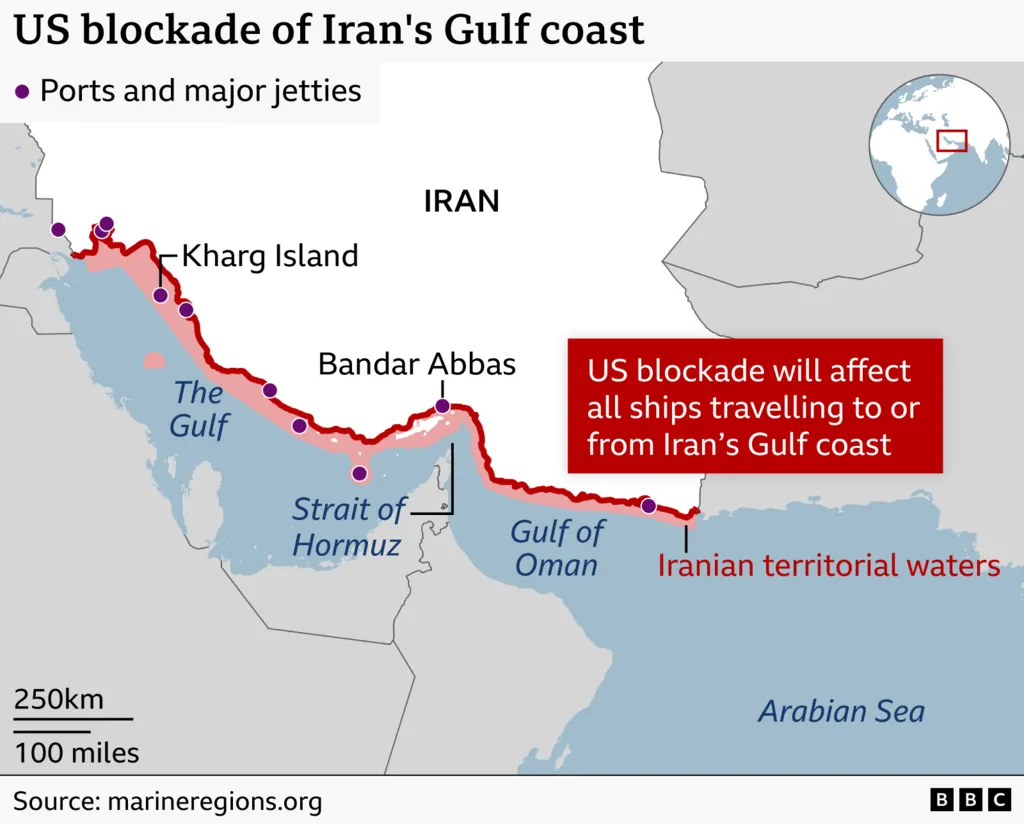
On Monday, the U.S. military began a blockade of all Iranian ports and coastal areas, a tamped-down version of President Trump's previously-expressed intention to block the strategic Strait of Hormuz entirely. Early reports are that ships had stopped crossing the waterway. Mr. Trump has emphasized that safeguarding the strait is of greater concern to Europe and other places around the globe than it is for the United States although none yet have made a move singly or in tandem with others to counter Iran's lock on the strait.
Iran has responded with threats to target ports in the Persian Gulf and the Gulf of Oman, just as it has the oil terminals and airports of Gulf countries it considers enemies, pounding them with missiles and drones to an even greater degree than it has been targeting Israel. Its goal appears to be that if enough damage can be done to Iran's neighbours, they will rise against the U.S. and Israel in their joint aerial campaign against the Islamic Republic.
Certainly not on the basis that other Muslim countries would not stand willingly by as a foreign interloper destroys military bases, launching sites, missile depots, and targets Iranian leaders and its IRGC elite for assassination. Iran's neighbours are Arab Muslims and for the most part majority Sunni. Aryan Iran is a Shitte power, its theistic regime has threatened the dominance of its Arab neighbours, none of whom with the exception of Qatar and Oman would mourn the disappearance of the regime's hold on Iran.
In its furious death throes the intransigent terrorist state structure has turned against its neighbours, both those that oppose it, and those who have in the past supported it, all of which have now sustained lasting damage to their infrastructure, both civil and oil-producing. Pakistan and Turkey, out of the IRGC's line of fire, but holding Islamist fundamentalist positions not far off from Iran's own, are actioning for a ceasefire to save what is left of the regime, when the entire point of the exercise is to excise it entirely.
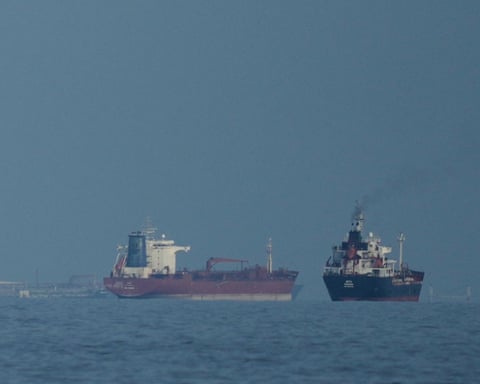 |
| Oil tankers and cargo ships line up in the strait of Hormuz, where the US military says it will enforce a naval blockade on all Iranian ports. Photograph: Altaf Qadri/AP |
Global markets have been shaken over the lack of movement through the Strait of Hormuz. The now-seven-week conflict has seen thousands of people killed. Tentative ceasefire talks have failed to reach an agreement; unsurprisingly, since Iran's demands are impossible to be met -- essentially insisting that all the reasons that the United States launched its attacks to begin with, from nuclear, to inciting terrorism, to slaughtering its own people, to threatening Middle East stability and beyond, be reinstated, along with an obligation by the U.S. to pay restitution for its strikes.
Even in defeat of its continuation to govern, the Islamic Republic publicly celebrates 'victory' over its opponents. The months of non-stop aerial bombing have wrought great damage to Iran's aspirations and very capacity to carry on, but what is left of any authority figures in the radical theocracy still direct the actions of the Islamic Revolutionary Guard Corps (or vice versa) and the Basij militia, as well as the Shiite militias in Iraq and Hezbollah in Lebanon.
Globally, the impact of basic goods and energy soaring in price has had its negative effect, reflecting the breakdown of traffic through the strait. Analysts are struggling to imagine how the blockage by the U.S. of the strait will work. Whether it will produce too-great economic stress on Iran, or whether if the strait still fails to allow normal traffic, global oil and other items like fertilizer will be driven high enough to force President Trump to change tactics.
According to the U.S. military's Central Command, the blockade is to be enforced "against vessels of all nations entering or departing Iranian ports and coastal areas", which would include all of Iran's ports on the Persian Gulf and Gulf of Oman. Ships travelling between non-Iranian ports would be allowed to transit the strait, on the other hand.
Trump stated that Iran's navy was "laying at the bottom of the sea, completely obliterated" though it still maintains "fast attack ships", warning that "if any of these ships come anywhere close to our BLOCKADE, they will be immediately ELIMINATED". To which Iran responded with: "Security in the Persian Gulf and the Sea of Oman is either for everyone or for NO ONE". "NO PORT in the region will be safe", another response from the IRGC warned. Hence the dire need to destroy those 'fast attack ships'.
 |
| Two police officers walk in front of an anti-U.S. billboard depicting American aircraft being caught by Iranian armed forces in a fishing net beneath the words in Farsi, "The Strait of Hormuz will remain closed, The entire Persian Gulf is our hunting ground," in Tehran, Iran, Sunday, April 5, 2026. (AP Photo/Vahid Salemi, File) |
Labels: Gulf States, Islamic Republic of Iran, Islamic Revolutionary Guard Corps, Strait of Hormuz, U.S.-Israel Aerial Bombardment of Iran
posted by Pieface @ Wednesday, April 15, 2026


<< Home