China: Defender of Stability, Diplomacy, Open Global Economy: Yup
"Many want Beijing to play a larger role as a defender of stability diplomacy, and an open global economy.""World leaders are heading to Beijing because they increasingly see China as a hedge against an unpredictable United States."Neil Thomas, fellow, Chinese Politics, Asia Society Policy Institute Center for China Analysis"Beijing also has concerns about managing its own relationship with Washington.""More direct and active involvement in negotiations [with the Islamic Republic] could win the Trump administration's affirmation as much as earn its ire and blame."Ja Ian Chong, associate professor of political science, National University of Singapore"It is very easy to criticize the U.S. Even America's allies are at odds with Trump and Washington these days.""But sooner or later, China needs to go beyond the position of critic, and get some real diplomatic skin in the game."Richard McGregor, senior fellow for East Asia, The Lowy Institute
 |
| Spain struck a trade deal with China on Tuesday |
China
no longer viewed by the West as an economic ogre, one whose finesse at
hostage diplomacy, whose penchant for cybertheft and purloining foreign
industrial/commercial formulae and government secrets for its benefits; a
gargantuan, omnivorous threat to the well-being of other nations'
wealth and aspirations? What a swift transition. And to think that it
has been occasioned by the president of the United States of America's
belligerence over trade tariffs and unity in Western security over
threats poised by Xi and Putin!
Yet
in one week alone Spain's Prime Minister Pedro Sanchez, Abu Dhabi's
Crown Prince Sheikh Khaled bin Mohamnmed, Vietnam's president To Lam,
all came visiting one after another. Impressed, no doubt over President
Xi Jinping's turning the leaf on his book of global exploits in
presenting China as a source of dependable stability and (newfound) respect for international rules. As, for example in contrast to President Trump's unspeakably dire threat to bomb Iran "back to the Stone Ages", a bit of bluster to match Iran's own, that horrified Pope Leo XIV.
In
fact, the contrast is a deep and unfolding reality, where Trump's
unchecked pronouncements on his social media site has served to further
confound, affront and distance erstwhile staunch supporters in Europe,
North America and Asia of U.S. policies and allied support. Italy's
Giorgia Meloni, the U.K.'s Keir Starmer were this week recipients of
President Trump's ire; not that it was undeserving, simply a trifle
undiplomatic, as is his inimitable style. Nor did Pope Leo come away
unscathed for his penchant at being "terrible for foreign policy"; that too not far from reality.
Oh,
and Italy's foreign minister also visited Beijing this week, coming
away with a pledge that China is prepared to deepen ties with Rome. Mr.
Trump's frustration with allies over their disinterest in teaming up
with the U.S. military to open the Strait of Hormuz to normal shipping
so that energy can continue to flow from the Persian Gulf to the people
who most need and use it, including those allies, has deepened with
their continued hands-off negativity.
"Donald Trump’s second Administration is bringing about a historic reconfiguration of transatlantic relations, compelling the EU and its member states to reassess multiple dimensions of their foreign policy. In response to the deepening rift with Washington, Europe is adopting a hedging strategy by strengthening ties with other global actors, including China.""This approach was underscored by Ursula von der Leyen at the World Economic Forum, referring to the 50th anniversary of the establishment of diplomatic relations with Beijing as ‘an opportunity to engage and deepen our relationship with China, and where possible, even to expand our trade and investment ties’. "Mario Esteban, Elcano Royal Institute
They've
chosen instead to go-it-alone as a group, sans the U.S. and that
purpose saw the U.K.'s Starmer in Paris to host a video conference
alongside Emmanuel Macron, steering a coalition of some 40 countries
planning to help independently restore free transit through the Strait
of Hormuz, South Korea, Japan and Australia included -- all supporting a
ceasefire in return for intervention. Nations in Southeast Asia have
been given support in their energy crisis by a $10-billion financial
package promised by Japan's Sanae Takaichi on a new "Power Asia"
initiative.
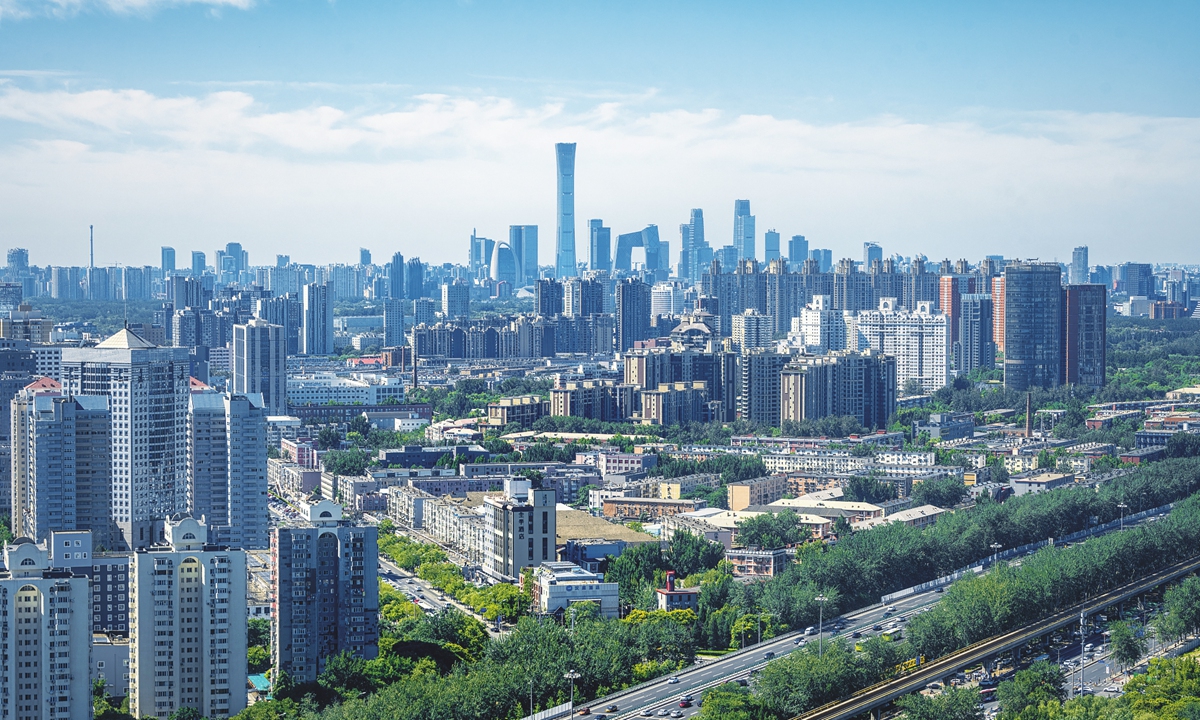 |
| An aerial view of the cityscape of Beijing, China Photo: VCG |
That
China stoutly maintains its support of Russia, despite its full-fledged
conflict in Ukraine makes the entire scenario somewhat bizarrely
Byzantine; even as European leaders, fixed in their support of Ukraine's
battle to sustain its sovereignty, visit China to explore lucrative
trade agreements, Xi met with Russian Foreign Minister Sergei Lavrov to
pledge deeper bilateral coordination. Not to be forgotten is Russian and
Chinese backing of Iran, their major oil supplier, despite global
sanctions.
As
the world's largest oil importer, China has vast commercial oil
reserves to tide it conveniently over the current shortage afflicting
its neighbours. China is content with taking an observer's back seat
with the ongoing conflict in the Middle East. Officially it calls for
restraint and de-escalation. Business as usual, for China.
 |
INVESTING IN CHINA
Powered by China Briefing, the experts at Dezan Shira & Associates, and their partners |
Labels: Conflict in Iran, Energy Flow Interrupted, European Allies, Strait of Hormuz, Trump Isolation, Trump White House, U.S./China Relations
posted by Pieface @ Sunday, April 19, 2026


<< Home