South African Crime and Punishment
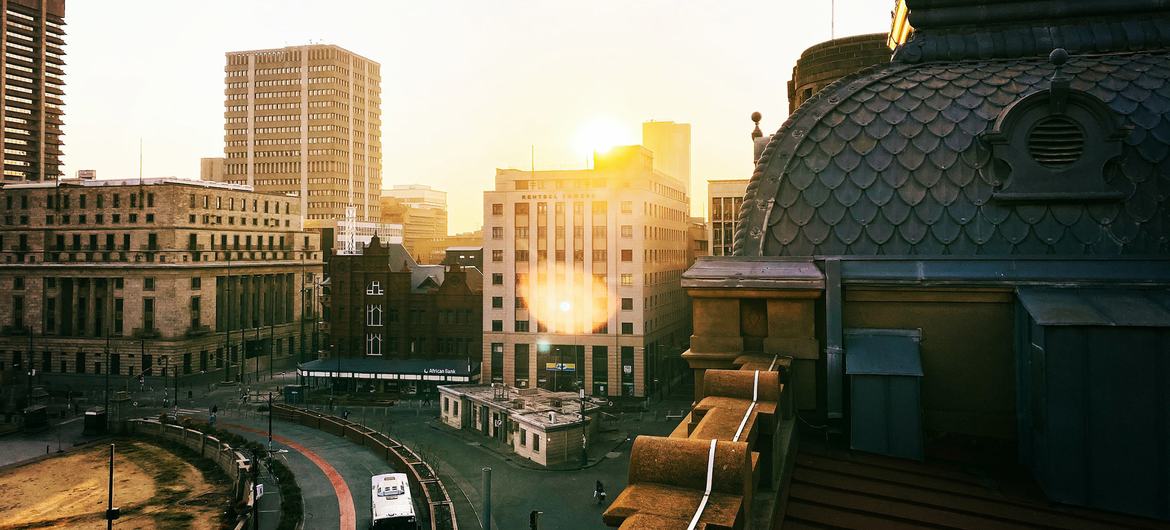 |
The sun rises over the capital of South Africa, Pretoria.
|
"The present report also focuses on grave abuses of the basic human rights of many
South Africans - but abuses which took place outside South Africa and for which the ANC,
not the South African Government, was directly responsible. Based on first-hand research
among surviving victims of such abuse, it documents a long-standing pattern of torture,
ill-treatment and execution of prisoners by the ANC's security department. It shows too that
this pattern of gross abuse was allowed to go unchecked for many years, not only by the
ANC's leadership in exile but also by the governments of the African front-line states who
allowed the ANC to set up bases, and prisons, on their territory. Such governments were at
best accessories to the abuses by the ANC; at other times they actively assisted those within
the ANC responsible for the grave human rights abuses which occurred." Amnesty International
* Torture exists and is real in South Africa today.
* Torture is a human rights violation and is prohibited in the Bill of Rights of the South African
Constitution
* Torture is now a recognized crime in South Africa and perpetrators of this specific crime can be
charged, tried and prosecuted under the Prevention and Combating of Torture of Persons Act
13 of 2013 (“The Anti-torture Act”).
* South Africa enacted anti-torture legislation on 25 July 2013 almost 15 years after ratifying
the United Nations Convention against Torture (CAT) – South Africa is yet to ratify the Optional
Protocol on the Convention against Torture (OPCAT)
* In Africa, 13 out of 54 countries have enacted anti-torture legislation.
* Article 5 of the African Charter on Human and People’s Rights prohibits torture and the Robben
Island Guidelines provides a guide on preventing torture in Africa
* In South Africa torture happens in police cells, correctional services, other places of detention
(or where freedom of movement is restricted), on the streets and in some cases in people’s
private spaces.
* Victims of torture in the post-apartheid South Africa include arrested persons, criminal sus-
pects, non-South African nationals and sex workers amongst others.
* The Anti-torture Act applies to state agents – members of the police, prison warders, nurses,
teachers and other officials responsible for detained persons or other people acting with the
consent and authorization of the State. Amnesty International
 |
| Poster design by Viewfinder, with an archival photo of a tubing demonstration used with permission of the Wits Law Clinic. (Image: Supplied) |
"They take two plastic bags – a Shoprite bag and a Pick n Pay bag –you know, those thick plastic bags.""Then they put water inside and put it over your head. The water comes into your nose and your mouth.""As soon as you think to breathe in again, the plastic bag comes right to your nose. You can't do nothing, nothing!""You can't even scream. You can scream as hard as you can, but no one can hear you.""Before they beat you, they throw water over you, because they know it will be more painful. They make you take your clothes off. They leave you with only your shirt."They take some sticks from the tree. Then they take the cable ties – those long ones: the black ones or the blue ones. They beat you over the head and here by your neck," he says, pointing to his larynx. "Then they make you push your chest out and they beat you on the chest.""They beat the hell out of me – like I'm not a man, you know? Like I'm a piece of paper. The way they beat me, I told myself: 'God, I'm dying today.'"Mail&Guardian -- Africa's better future -- Brandon, South Africa
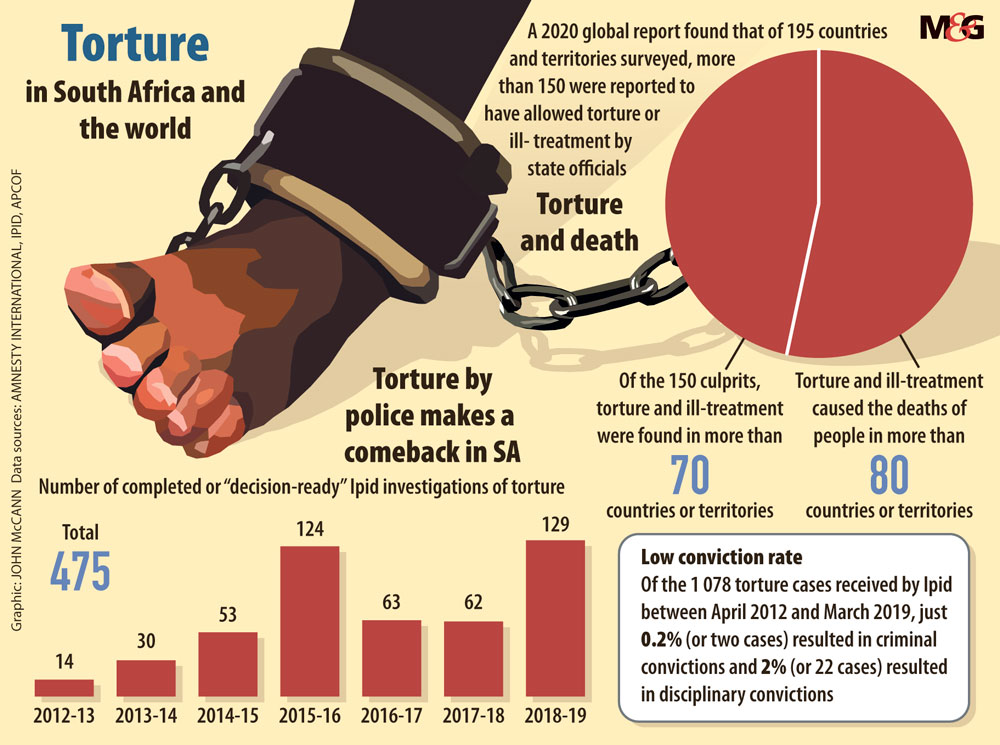
An average of three people weekly from 2012 to 2023, filed complaints that the police had tubed them, according to Viewfinder, a South African journalism nonprofit. The liberation of Black South Africans led by freedom fighters gave way to a government that somehow finds it expedient to oversee a police force specializing in the very same torture techniques as those they were liberated from. Tubing: pulling a plastic bag over a prisoner's head, while fastening it securely around the neck. A technique that practising officers are not held accountable for.
"I'm really shocked because it brings back very, very, very bad memories.""The leadership of the A.N.C., when they came to power in 1994 made it clear: No soul should be subjected to that."Khulu Mbatha, African National Congress liberation party
Some commanders ignore allegations of torture, under pressure to meet the quota targets, according to a former senior police official fired four years earlier for having publicly criticized the national police commissioner. "It's easy for criminals to tell lies about police officers", stated the general secretary of the South African Policing Union, dismissing claims of torture as overblown rhetoric.
A law criminalizing torture was passed by Parliament in 2013, with a maximum sentence of life imprisonment. Written guidance has been issued to officers in the police department, outlining the law. The training manual representing the police department includes techniques of interrogation reflecting global best prices. Yet there remain some commanders who believe that torture produces results, despite that experts are in agreement that anything gleaned through torture tends to be unreliable simply because victims tend to confess falsely while under physical duress.
 |
| Mail&Guardian -- Africa's better future |
Labels: African National Congress, Crime, South African Prison Detention, Torture Techniques, Tubing
posted by Pieface @ Monday, July 21, 2025


<< Home