Over to You, Donald J. Trump!
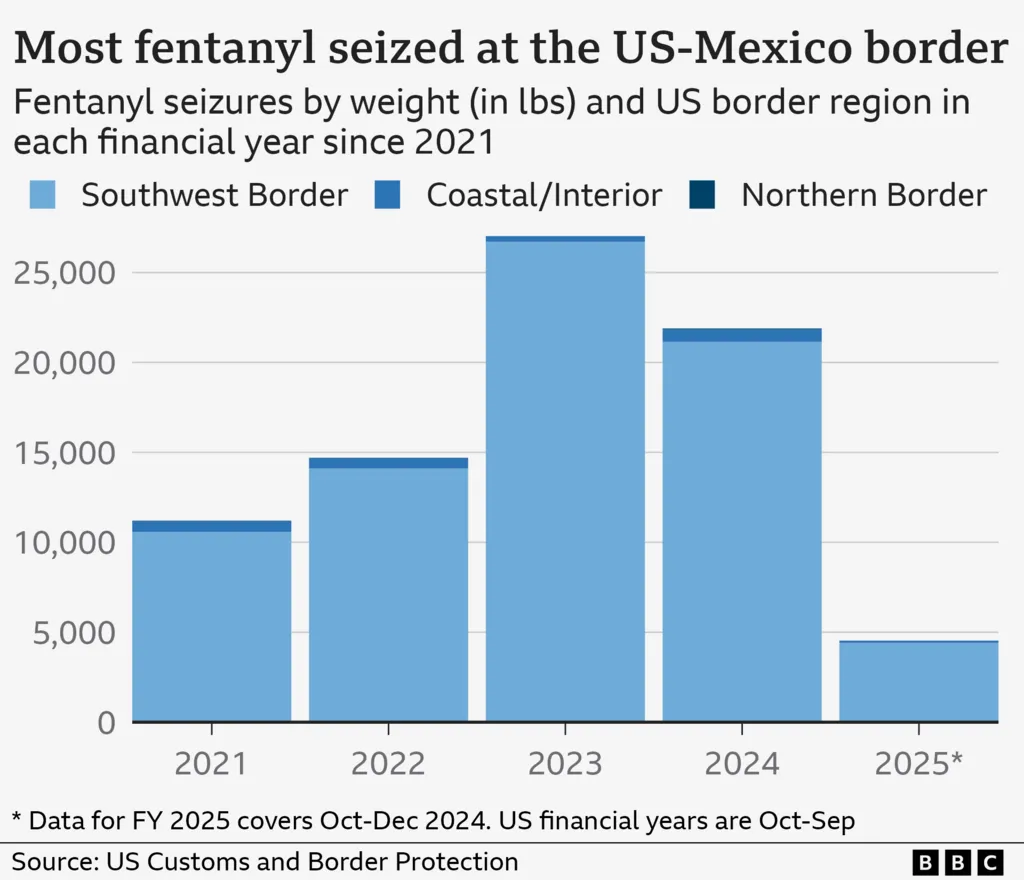
"[New data on fentanyl seizures] largely reinforce previous understanding that most IMF [illegally manufactured fentanyl] enters the U.S. from the south. These data call into question tariffs and other policies and policy justifications that treat the threat from the northern border as comparably severe.""Counties along the Mexican border account for only 2.35 percent of the U.S. population; but in 2023-24, they hosted about 40 percent of the nation-wide quantity of fentanyl appearing in large seizures, for both powder and pills.""By contrast, counties in the lower 48 states that border Canada account for 3.1 percent of the U.S. population but only 1.2 percent of the powder and just 0.5 percent of the pills obtained in large seizures."Manhattan Institute report"The basic punch line of this study is that seizures of fentanyl in the United States are disproportionately at borders; no surprise. It's mostly produced internationally and then shipped in.""But the vast majority of that is on the borders of Mexico, not on the borders with Canada.""It's what I expected [to see]."Jon Caulkins, report co-author. H. Guyford Stever University professor of operations research and public policy, Carnegie Mellon University Heinz College, Pittsburgh
A
new report published by the Manhattan Institute verifies a fact already
known to Canadian authorities. A fact that U.S. border and customs
officials have long had knowledge of. That the claims of the Canadian
border representing a threat to the United States through the smuggling
of large amounts of fentanyl across the border are quite simply false.
It is, in fact, the border between Mexico and the United States where
the vast bulk of fentanyl emanates from.
U.S.
President Donald Trump's repeated assertions accusing Canada equally
with Mexico of threatening the lives of Americans by channeling the drug
fentanyl into the United States largely forms the basis of his
punishing tariffs imposed on Mexican and Canadian exports to the United
States. Mr. Trump has tied the imposition of steep tariffs to the
grievance of fentanyl flooding across its North American borders to
threaten the United States.
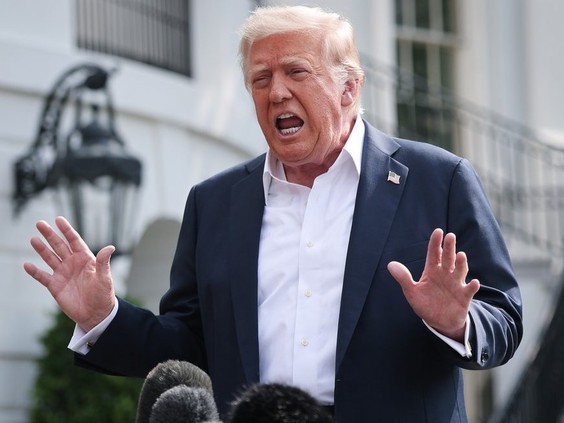 |
| President Donald Trump answers questions while departing the White House with first lady Melania Trump on July 11, 2025 in Washington, DC. Photo by Win McNamee /Getty Images |
Such
concerns, according to the report's authors, Jon Caulkins and Bishu
Giri, are completely unfounded, at least in the case of Canada. They
could as well, they posit, undermine the ability of the US. to
prioritize tightening the country's border with Mexico. The report
focused on "large" seizures of fentanyl, defined as over a kilogram of
power, or more than 1,00 pills -- that would reflect wholesale
trafficking as opposed to smuggling for personal use.
Their
finding was that officials made more large seizures in U.S. counties
along the northern and southern borders when compared to the rest of the
country, pointing out that it was in the south that far more seizures
were made. Cross-border drug flows, according to Mr. Caulkins, often
mirror where seizures occur, and data point to an uncontroversial
finding; "not terribly complicated or subtle".
On the other hand the report found that some counties in Alaska could be portals from Canada to the broader Alaska market "although those quantities are much too small to be of consequence beyond Alaska". Of the 26 seizures in Alaska bordering Canada "triple what would be expected based on those counties' population", yet small in comparison to the rest of the Alaska market.
"Maybe Alaska does get its fentanyl from Canada, because there's not necessarily a large presence of Mexican drug trafficking organizations in Alaska, and you can't easily drive from Mexico to Alaska without crossing several international borders.""I didn't know that was coming, and by all means, maybe U.S. and Canadian authorities can put a few more inspectors on those ferries or whatever.""But that's not going to move the needle for the country, but it might be useful, right locally."Jon Caulkins former drug police researcher
As
far as President Trump is concerned, having frequently cited the
9,000-kilometre U.S.-Canada border as a threat to national security and a
vulnerability that cartels and smugglers exploit, the way he sees it is
that Canada is entirely culpable. That belief is his cudgel to justify
the imposition of high tariffs on Canadian goods entering the United
States. For its part, the Manhattan Institute report suggested it might
be more useful for the U.S. to direct a more intense focus to the
southern border should it wish to reduce the fentanyl flow.
 |
| Fentanyl is extremely potent and incredibly dangerous. Just 2 milligrams – the size of a few grains of sand – can lead to an overdose. CBP is committed to stopping the flow of fentanyl and the devastation it is wreaking on American lives and communities. U.S. Customs and Border Protection |
"Counties along the Canadian border are not an important part of this story.""Whatever the merits or drawbacks of tariffs on imports -- such actions cannot be justified as part of a pragmatic and data-informed response to the threat of fentanyl to the United States."Manhattan Institute report
Labels: Canada, Canada as 51st State, Coercion, Fentanyl Transport, Mexico, Tariffs, Threats, Trade Wars, U.S. President Donald Trump, United States
posted by Pieface @ Wednesday, July 16, 2025


<< Home