"Unfortunately, literally everything I said would happen in 2015 has now come to pass."
"Trudeau's
deficits will not be small. Mr. Trudeau has made tens of billions of
dollars of spending promises; he said the budget will balance itself, he
has no idea what he is talking about when it comes to these things."
2015
"These
guys [2015 leadership opponents] would have had, in the last two weeks,
us throwing open our borders and literally hundreds of thousands of
people coming in without any kind of security checks or documentation."
"That would have been an enormous mistake."
Former (2006-2015) Prime Minister Stephen Harper
Stephen Joseph Harper, who led the Conservatives for 13 years, saw
his party win the first majority government in over a decade in the May
2, 2011, election, with 166 seats, representing an increase of 23 seats
from the October 2008 election, in which Harper won a strong minority.
(Geoff Robins/AFP/Getty)
He
was one of the most effectively reliable prime ministers Canada has
had; principled, intelligent, informed, a man of earnest integrity and
love of country. Some of those who voted him into office -- one minority
and two majority governments -- missed him from the moment the
Conservative Party of Canada lost the 2015 election and the Liberal
Party of Canada became the governing body under the most unsuitable,
unprepared and unprincipled prime minister Canada has ever had; Justin
Trudeau.
Now,
the current Liberal Prime Minister Mark Carney promises to be the
second-most unsuitable, out-of-his-depth prime minister of Canada.
Former
Prime Minister Stephen Harper was an economist before he became prime
minister and his administration bears no resemblance whatever to the
current office-holder, a central banker, whose grasp of economics seems
fairly incompetent. Perhaps not so much as his predecessor, Justin
Trudeau, who felt the economy would look after itself: "The commitment needs to be a commitment to grow the economy, and the budget will balance itself".
To
that end, after inheriting a balanced budget, the Liberals claimed they
would run a $10B deficit for three years to 'build infrastructure'
after which a balanced budget would be produced by 2019. The first three
years of Liberal mismanagement of the economy saw the deficit come in
at $19 billion for starters. By 2025, when Trudeau left the prime
ministership the national debt was $1.2 trillion, somewhat higher than
the $612 billion he had inherited a decade earlier.
While
in office, when the opposition Liberals and NDP insisted the government
bring Syrian refugees into Canada en masse, PM Harper responded: "We
do not want to pick up our entire communities ... and move them out of
the region where they have lived for as long as history has been
written. They do not want that. They want us to help them. That is why
we provide refugee placements, friends. That is why we provide
humanitarian aid."
August 2015 long weekend, Harper stood outside Rideau Hall — dressed in
Conservative blue — after asking Gov. Gen. David Johnston to dissolve
Parliament, launching his fifth federal election campaign as party
leader. He appealed to Canadians to consider leadership (and his
experience) as the central issue at play. (Blair Gable/Reuters)
Fast forward ten years and "hundreds of thousands of people"
entered Canada with scant security checks as the Liberal government
ignored entire categories of quotas and checks on temporary immigration
(many dating from the Harper government); in the process seeing
an unprecedented surge of temporary migrants entering Canada The number
of 'non-permanent' residents soared by 1.7 million in three years,
overwhelming the capacity to screen them. Leading to a 'standard' of
foreign nationals claiming refugee status through an ever-so-convenient
app.
The
Harper-era government brought in a measure to prevent corruption in
awarding of contracts by government, leading to the Public Prosecutions
Act, designed to prevent political interference in criminal
prosecutions. The law enacted by the Harper government placed the
situation in control of a politically independent 'director of public
prosecutions'. It was this act that succeeded in revealing the 2019
episode when Trudeau pressed his then-justice minister to forgo a
bribery case against a Quebec engineering company with close ties to the
Liberals.
During
his administration, PM Harper removed home delivery at the request of
Canada Post management, reflecting the downward spiral of mail volumes
making it too costly for letter-carriers to continue door-to-door daily
deliveries. At that juncture, the national mail corporation still turned
a profit and closing down home delivery meant the spigot of losing
money was turned off. The Liberals campaigned on a promise to restore
home delivery. Almost immediately it was restored hundreds of billions
annually began hemorrhaging for Canada Post, leading it to the door of
bankruptcy.
In
2010 the Harper government suspended Canada's contributions to the
UNRWA agency, a central provider of aid ad-infinitum to Palestinians in
Gaza and the West Bank. Accusations the agency was intermingled with
Palestinian terror groups such as Hamas led to that cancellation. The
Liberals restored funding to UNRWA in 2015. By 2023 following the
October 7 terrorist attack on southern Israel, hard evidence emerged of
UNRWA employing members of Hamas and Islamic Jihad; including a top
Hamas commander.
When
the Liberals took the reins of power in Canada they spoke of an
intention to 'modernize' the criminal justice system with the
introduction of 'restorative justice' to reduce the number of Indigenous
offenders in prison. Bill C-75, a crime bill, was made law in 2018 to
simplify bail for accused criminals and codifying treating offenders
more leniently based on race. Stemming from a 'vulnerable population',
criminals received bail faster and were released earlier from prison.
Since
then, Statistics Canada's crime severity stats reflect that when Mr.
Harper left office, homicides and violent crime were at lows never
before seen in the history of Canada. Since his departure from office as
prime minister, however, crime began trending uphill steadily, sitting
now at the point where homicides have hit 30-year highs. This
represents the Liberal version of progress.
Mr. Harper and his wife, Laureen, visit the Mount of Olives, in Jerusalem in
2014. The Mideast featured throughout Harper's tenure, including most
recently the exodus of refugees from the war in Syria. Harper pointed to
ISIS as the root cause of the refugee crisis in Europe and reiterated
Canada's military commitment to combating the extremist group. (Sean
Kilpatrick/Canadian Press)
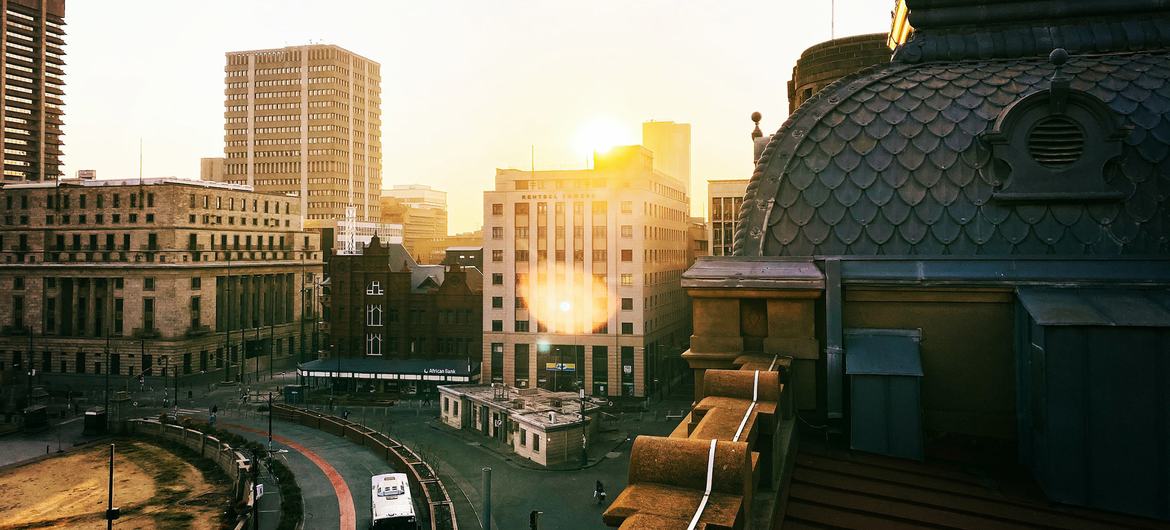
The sun rises over the capital of South Africa, Pretoria.
"The present report also focuses on grave abuses of the basic human rights of many South Africans - but abuses which took place outside South Africa and for which the ANC, not the South African Government, was directly responsible. Based on first-hand research among surviving victims of such abuse, it documents a long-standing pattern of torture, ill-treatment and execution of prisoners by the ANC's security department. It shows too that this pattern of gross abuse was allowed to go unchecked for many years, not only by the ANC's leadership in exile but also by the governments of the African front-line states who allowed the ANC to set up bases, and prisons, on their territory. Such governments were at best accessories to the abuses by the ANC; at other times they actively assisted those within the ANC responsible for the grave human rights abuses which occurred."Amnesty International
* Torture exists and is real in South Africa today. * Torture is a human rights violation and is prohibited in the Bill of Rights of the South African Constitution * Torture is now a recognized crime in South Africa and perpetrators of this specific crime can be charged, tried and prosecuted under the Prevention and Combating of Torture of Persons Act 13 of 2013 (“The Anti-torture Act”). * South Africa enacted anti-torture legislation on 25 July 2013 almost 15 years after ratifying the United Nations Convention against Torture (CAT) – South Africa is yet to ratify the Optional Protocol on the Convention against Torture (OPCAT) * In Africa, 13 out of 54 countries have enacted anti-torture legislation. * Article 5 of the African Charter on Human and People’s Rights prohibits torture and the Robben Island Guidelines provides a guide on preventing torture in Africa * In South Africa torture happens in police cells, correctional services, other places of detention (or where freedom of movement is restricted), on the streets and in some cases in people’s private spaces. * Victims of torture in the post-apartheid South Africa include arrested persons, criminal sus- pects, non-South African nationals and sex workers amongst others. * The Anti-torture Act applies to state agents – members of the police, prison warders, nurses, teachers and other officials responsible for detained persons or other people acting with the consent and authorization of the State. Amnesty International
A feature of the Apartheid era in South Africa was white-led police forces that terrorized Blacks with their brutal interrogation techniques. A tactic that involved plastic bags placed over a suspect's head, suffocating them while being questioned; a terrifying object lesson in a police state with no accountability, no link to human rights, no conscience alerting the abuser to the fact that in torturing a prisoner they were themselves criminals and those they suspected of criminality their victims whom they expected to incriminate themselves out of pure fear to put a stop to the unbearable atrocity they were suffering through.
A White-on-Black crime. With the obliteration of apartheid, South Africa adopted a constitution outlawing such methods of interrogation involving torture. South Africa became a signatory to international treaties banning torture. The country was committed to the prevention of torture under any circumstances. Latterly, an analysis of government data has been undertaken by investigative journalists fully three decades since apartheid, only to discover that police in South Africa are still making use of the same suffocation tactic, called tubing.
Poster design by Viewfinder, with an archival photo of a tubing
demonstration used with permission of the Wits Law Clinic. (Image:
Supplied)
"They take two plastic bags – a Shoprite bag and a Pick n Pay bag –you
know, those thick plastic bags."
"Then they put water inside and put it over your
head. The water comes into your nose and your mouth."
"As soon as you
think to breathe in again, the plastic bag comes right to your nose. You
can't do nothing, nothing!"
"You can't even scream. You can scream as
hard as you can, but no one can hear you."
"Before they beat you, they throw water over you, because they know
it will be more painful. They make you take your clothes off. They leave
you with only your shirt.
"They take some sticks from the tree. Then they take the cable ties –
those long ones: the black ones or the blue ones. They beat you over
the head and here by your neck," he says, pointing to his larynx. "Then
they make you push your chest out and they beat you on the chest."
"They beat the hell out of me –
like I'm not a man, you know? Like I'm a piece of paper. The way they
beat me, I told myself: 'God, I'm dying today.'"
Mail&Guardian -- Africa's better future -- Brandon, South Africa
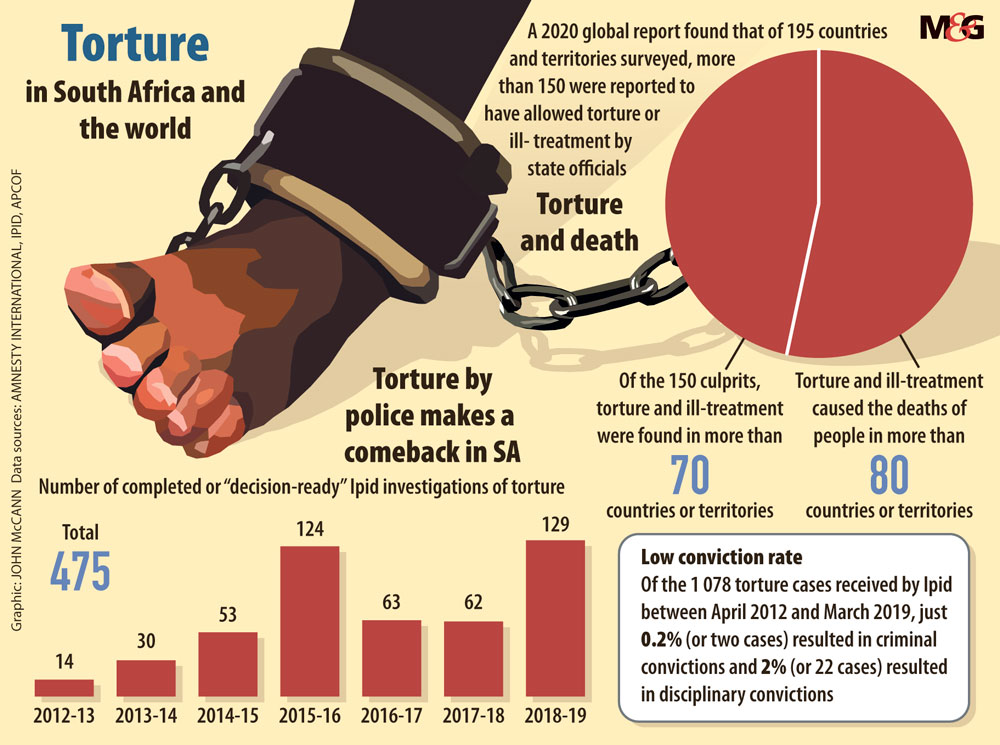
An average of three people weekly from 2012 to 2023, filed complaints that the police had tubed them, according to Viewfinder, a South African journalism nonprofit. The liberation of Black South Africans led by freedom fighters gave way to a government that somehow finds it expedient to oversee a police force specializing in the very same torture techniques as those they were liberated from. Tubing: pulling a plastic bag over a prisoner's head, while fastening it securely around the neck. A technique that practising officers are not held accountable for.
"I'm really shocked because it brings back very, very, very bad memories."
"The leadership of the A.N.C., when they came to power in 1994 made it clear: No soul should be subjected to that."
Khulu Mbatha, African National Congress liberation party
The South African Independent Police Investigative Directorate (a government watchdog) identified some 1,700 tubing complaints over an eleven-year period. In one of those instances police dismissed an officer, later reinstated. In another six instances, officers were convicted in court. A confidential United Nations report dated 2023, warned commanders in the South African Police Service, along with top government officials about the use of torture. There was no response from government -- as is generally required by a signatory of a U.N. anti-torture protocol.
The police service "regards any allegations of torture as a serious misconduct", with measures to prevent it, according to Colonel Athlenda Mathe, a police service spokeswoman. Infamously, South Africa has a well-earned reputation as being among the world's highest countries suffering incidents of murder; its brazen crime rate earns it both internal and external criticism of its police response. Aggressive quotas for arrests and weapons seizures were established by the police establishment, ostensibly to address the critical issue of crime in South African society.
Some commanders ignore allegations of torture, under pressure to meet the quota targets, according to a former senior police official fired four years earlier for having publicly criticized the national police commissioner. "It's easy for criminals to tell lies about police officers", stated the general secretary of the South African Policing Union, dismissing claims of torture as overblown rhetoric.
A law criminalizing torture was passed by Parliament in 2013, with a maximum sentence of life imprisonment. Written guidance has been issued to officers in the police department, outlining the law. The training manual representing the police department includes techniques of interrogation reflecting global best prices. Yet there remain some commanders who believe that torture produces results, despite that experts are in agreement that anything gleaned through torture tends to be unreliable simply because victims tend to confess falsely while under physical duress.
"I
think policy makers and decision-makers need to realize that there are
some very strong sentiments being expressed on these issues [involuntary
addiction treatment, criminal charge bail, decriminalization of
drugs]."
"We're seeing large percentages of people saying things are getting worse."
"I
think there was a perception, correct or not, that safe injection sites
would lead to a solution, and those problems are instead amplified
probably ten-fold from where they were. So there's this frustration of,
'What else can we do. This isn't working'."
Andrew Enns, executive vice-present, Leger Marketing
Little
wonder Canadians are fed up. Inflation is raging, the cost of consumer
goods sky-high, additional taxes on energy linked to the Trudeau
government's environmentalist agenda has sent the price of gas at the
fuel pumps soaring, homelessness is a growing concern, and more people
than ever before are turning to food banks. Canada's once-proud
universal health care system has been gutted; wait times for surgery,
for access to medical specialists have become dangerously inadequate.
The 911 emergency system is collapsing, ambulances are increasingly late
responding to calls, and so are police.
But
the latest poll by Leger Marketing looked at other acute concerns of
Canadians; that of growing crime rates, of growing addiction rates and
consequent deaths from overdosing. Fixes that governments have been
relying on have proven to be failures. Leaving the public frustrated and
angry. And those sentiments of failed government actions in addressing
these societal problems were emphasized on the latest poll.
The
status quo is unacceptable and the response of governments has been
inadequate to say the least. Canadian public opinion was found through
this latest poll to be completely opposite government priorities
channelled through programs that have proven to be worthless. The issues
of bail, involuntary addiction treatment, and the decriminalization of
drugs in a desperate attempt to ease the growing problems in society are
topmost in people's minds behind the cost of living.
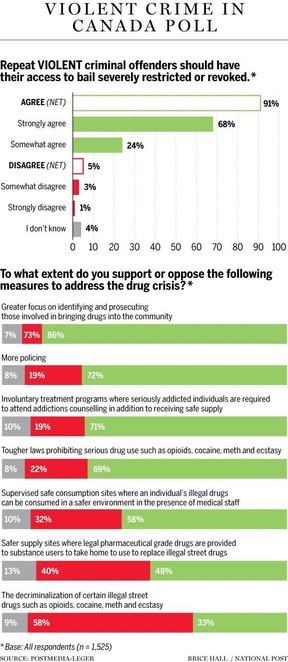
A
clear majority of poll respondents agree the Canadian justice system is
mishandling bail, too lenient on violent criminals. Example: the
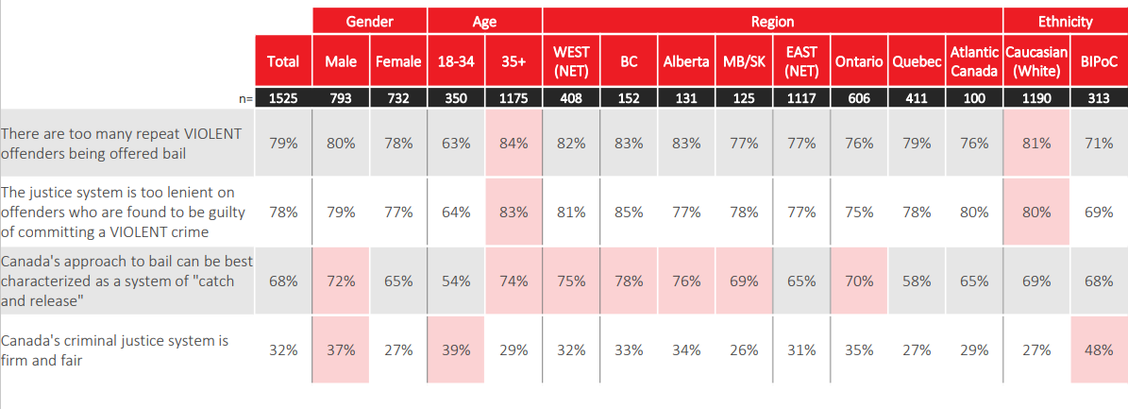
statement "there are too many repeat violent offenders being offered bail" had the agreement of 79 percent of the surveyed. The statement "the justice system is too lenient on offenders who are found to be guilt of committing a violent crime" was endorsed by 79 percent. While less than 32 percent agreed that Canada had a "firm and fair" system of justice.
On
the issue of strengthening bail, solid agreement was seen, with 82
percent of Western Canadians, 77 percent of Eastern Canadians, 80
percent of men, 78 percent of women, 81 percent of white Canadians and
71 percent of BIPOC (Black, Indigenous, People of Colour)
Canadians, reporting that too many violet offenders were given bail.
General agreement was seen on the viewpoint that Canada's top priorities
on criminal justice should be "violent crime", "illegal firearm possession" and "drug and substance abuse".
A
course has been adopted in Canada of setting aside law enforcement from
the equation of drug addiction, prioritizing harm reduction policies
with the like of safe consumption sites. Included was British Columbia's
experiment in decriminalizing personal use quantities of hard drugs
like heroin and cocaine. Canadians indicated a more nuanced view of how
Canada's climbing rates of fatal overdose could be addressed.
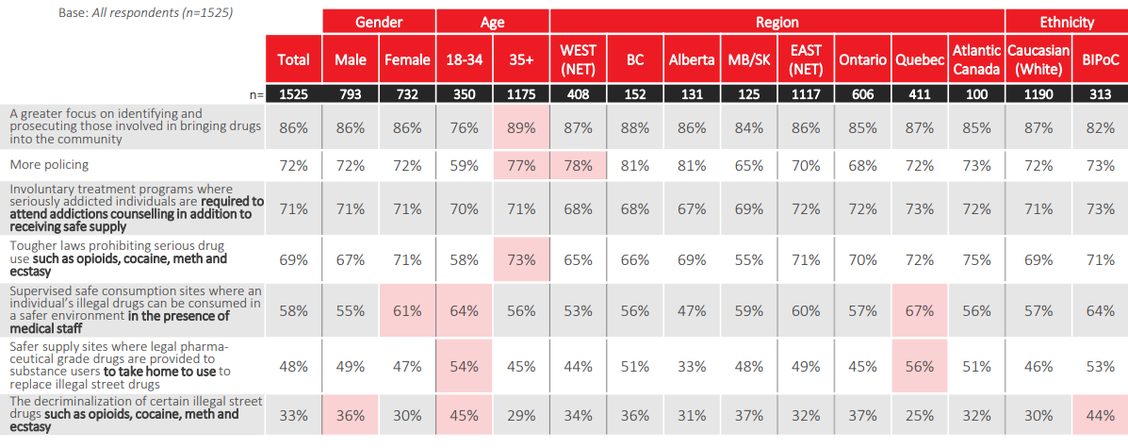
Major support was expressed (58 percent) for "supervised safe consumption sites",
yet almost all respondents wanted to have drug dealers prosecuted and
chronic addicts to be mandated to the necessity of treatment. Over 7 in
ten respondents opted for "more policing" on drugs, the highest being expressed (at 81 percent) in British Columbia, the recognized epicentre of the overdose crisis. Asked should Canada focus on "identifying and prosecuting those involved in bringing drugs into the community", 86 percent agreed.
"There
was one [safe consumption site] when we came into office in 2015, now
there are dozens and dozens and dozens across the country and they are
saving lives significantly", boasted Prime Minister Justin Trudeau. He slammed it as "unfortunate" and "anti-science"
when Alberta began the pursuit of a treatment-centered approach to
address its overdose crisis. His boast is a hollow sham; lethal
overdoses, in the face of 'dozens and dozens' of 'safe injection' sites,
are on a pronounced upward curve. Moreover, the 'safe' opioids handed
out at the sites are leaking onto the streets.
Although
involuntary treatment for chronic addicts has been denounced as extreme
by the Canadian political and public health establishment, it was
endorsed by 71 percent of poll respondents who agreed "involuntary
treatment programs where seriously addicted individuals are required to
attend addiction counselling in addition to receiving safe supply", sounded like a solution.
As
for the criminal justice system reflected by government policy, opinion
polls find majority support for capital punishment which since the
1970s was officially abolished in Canada. Incarceration and detention
issues have hardened in the wake of recent murders and assaults
committed by suspects either on bail or recent early releases from
prison. Random fatal stabbings by people on parole for similar random
attacks infuriate the public.
The
fatal shooting of an Ontario Provincial Police constable by a repeat
violent offender on bail, prompted a letter co-signed by all 13 Canadian
premiers urging the federal government to reform bail (the Trudeau government had loosened bail issues after the previous Conservative-led government had tightened them) and take steps to get violent criminals "off the streets".
Canadian bail policies were described as a system of "catch and release"
by over two-thirds of poll respondents, with white respondents at 69
percent and non-white respondents, 68 percent. If offenders keep
committing crimes while on bail, in the opinion of the survey
respondents, stop giving them bail. 92 percent of poll respondents
endorsed the statement "repeat violent criminal offenders should have their access to bail severely restricted or revoked".
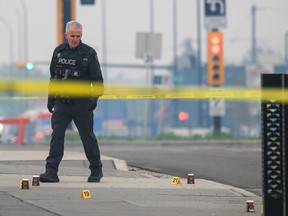
Canadians
were generally in agreement that the country’s top priorities on
criminal justice should be “violent crime,” “illegal firearm possession”
and “drug and substance abuse.”Photo by Gavin Young/Postmedia
"The spate of executions during this last year of the Trump administration has been extraordinary."
"I don't think that there's anybody who's been paying attention to the federal death penalty who thinks that anything like that will continue once Trump leaves office."
David Dow, Cullen Professor, University of Houston Law Center
"The federal death penalty applies in all 50 states and U.S.
territories but is used relatively rarely. About 55 prisoners are on the
federal death row, most of whom are imprisoned in Terre Haute, Indiana.
Three federal executions have been carried out in the modern era, all
by lethal injection, with the last occurring in 2003."
"The federal death penalty was held unconstitutional following the Supreme Court’s opinion of Furman v. Georgia
in 1972. Unlike the quick restoration of the death penalty in most
states, the federal death penalty was not reinstated until 1988, and
then only for a very narrow class of offenses. The Federal Death Penalty
Act of 1994 greatly expanded the number of eligible offenses to about
60."
"The use of the federal death penalty in jurisdictions that have
themselves opted not to have capital punishment—such as Washington,
D.C., Puerto Rico, and many states—has raised particular concerns about
federal overreach into state matters."
Death Penalty Information Center
The first federal execution of 2020 was that of Daniel Lewis Lee in July
at the Federal Correctional Complex in Terre Haute, Indiana.
"With a stroke of your pen, you can stop all federal executions,
prohibit United States Attorneys from seeking the death penalty,
dismantle death row at FCC Terre Haute, and call for the resentencing of
people who are currently sentenced to death."
Letter to incoming President-elect Joe Biden signed by 40 members of Congress
"No president in the 20th or 21st century before this year presided over
double-digit executions in any calendar year. The Trump administration
has carried out ten in the space of five months,"
"You'd have to go back to 1896 and President Grover Cleveland's second
presidency to find this many federal civilian executions in a single
year."
"Traditionally, out of respect for the incoming administration, and
because executions are a matter of life and death, executions weren't
carried out during a transition period."
"Everybody else knew that it was more important to protect the public
health than it was to kill prisoners now, who could be executed when it
was safe to do so later. Only the federal government moved forward with
those executions."
"Nearly 25% of the population of death row is now in counties where
prosecutors say they won't use the death penalty or are going to
significantly restrict its use. All of that suggests the numbers will
stay low in most of the country going forward."
Robert Dunham, executive director of the Death Penalty Information Center
Normally, when the thinking public's mind turns to the death penalty, Iran, and Saudi Arabia come to mind, ultra-fundamentalist regimes whose idea of punishing extreme crimes finds the death penalty more than suitable to sending a message to their populations. Countries like Pakistan and Afghanistan also qualify, where the justice system views insulting the Prophet and Islam or conversion away from Islam to be deserving death-penalty issues. On the other hand, dictatorships like China consider criticism of Beijing and its politboro worthy of the death penalty.
The United States is considered by itself and the world community to be a civil democracy with fairly liberal values that for the most part set the standard for responsible governance, the rule of law and a fair and equitable system of justice. But it has never, like most democratic nations of the world, abolished the death penalty, which places it in the company of countries like China, Iran and Pakistan. There has been an increasing tide of rejection of the death penalty, where many States take it upon themselves to no longer recognize the death penalty.
The federal government appeared to be reaching a like conclusion that the death penalty had no place in the justice system of a civilized society. Lately, however, there has been a decided swing back to enacting justice by taking a life as punishment for taking a life. The Trump administration saw the recent execution of two men who committed dreadful crimes while in their teen years. On death row for over a decade each, both were executed in 2020.
The execution of the first, 19 at the time he murdered two people, represented the first federal execution in 68 years of an offender, a teen at the time of his crime. The second, Brandon Bernard, on trial with Christopher Vlalva for the same offence, was 18 at the time of the double murder. He was 40 years old by the time he was taken off death row and executed for his crime committed in 1999. A high profile campaign to spare his life failed, and he met his destiny with death through federal execution in December.
The U.S. Department of Justice amended its federal execution method rules in late November with a ruling that any methods permitted by states may be used to executive federal prisoners. Lethal injection being the most common method, though nine states allow the use of the electric chair, six the use of the gas chamber, and three firing squad while another three allow for hanging executions.
A year-long search for drugs that would work efficiently culminated in ten men being executed in the U.S. federal death chamber in Indiana; the lethal drug cocktails used historically no longer available leading to experimental execution drugs which occasionally saw executions gruesomely botched. Many death row inmates sought alternative ways to die, given their fear of the needle, after the well-publicized executions that malfunctioned with experimental drug cocktails.
When Florida's electric chair malfunctioned several times and the heads of two condemned men were set on fire, that method of execution went into retirement. Yet fear of death by three-drug cocktail spurred Nicholas Sutton in February of 2020 to be executed by the state of Tennessee by electric chair, citing the dangers of lethal injection drugs.
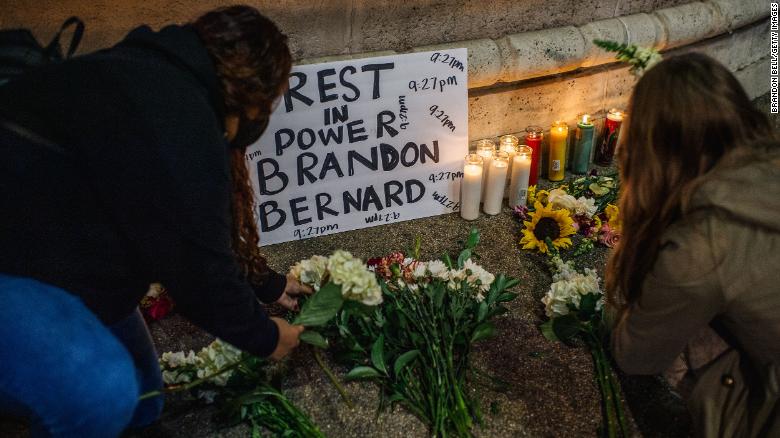
Women lay flowers at a candlelight vigil for Brandon Bernard on December
13 in Los Angeles. Bernard, 40, was the youngest person to be executed
in the US in nearly 70 years, and was put to death for a crime committed
when he was a teenager.
"Military-style security operations that leave a trail of death in poor neighborhoods do not enhance public security. On the contrary,
these killings make communities fear the police and much less likely to
collaborate with the police in the fight against crime." "The mission of the police is to protect people, including those who
live in poor neighborhoods. The excessive use of
lethal force puts everyone at risk." Daniel Wilkinson,
Americas managing director, Human Rights Watch
“I think we are facing a great defeat of this civilizing project. For us and some of the more open-minded sectors of the police, the Pacifying Police Unit
(UPP) program was an opportunity to change the security model—leaving
behind the old model of confrontation and trying to turn towards a
protection-based model, aiming at harm reduction and minimizing
confrontations." "This didn’t happen and now we’re seeing a cyclic return to old policies of confrontation." Ignacio Cano, coordinator, Violence Analysis Laboratory, Rio de Janeiro State University (UERJ)
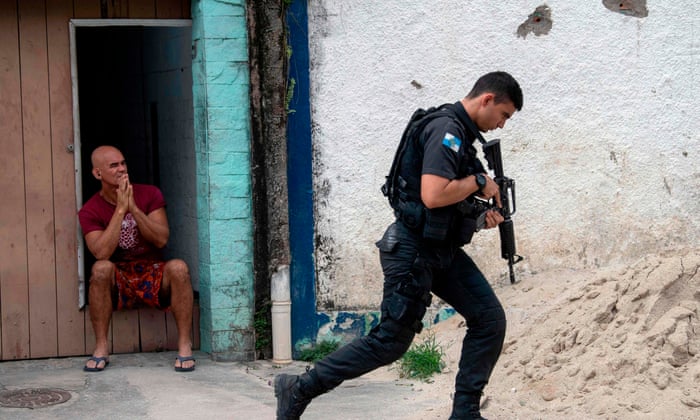
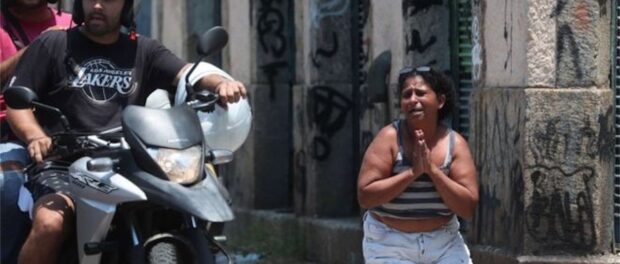
Rio de Janeiro state has registered a record number of five people
killed a day on average during police operations in the first quarter of
the year.
Photograph: Mauro Pimentel/AFP/Getty Images
Latin America has immense, seemingly intractable social and criminal problems with drug cartels, gangsters and endemic crime. This is a situation reflective of much of the rest of the world to various degrees. But the violence infesting countries like Brazil, Venezuela, Mexico, Colombia and the Philippines -- along with many others -- is impacting on the security of the state, imperilling the lives of ordinary civilians, and bringing police into action that resembles that of the gangs they are instructed to eradicate.
Brazil, in the state of Rio de Janeiro, appears to be taking a page out of Rodrigo Duterte's military/police instructions to kill on sight as a remedy for the pervasive drug-crime culture in the Philippines. During the first four months of 2019, police in Rio de Janeiro shot to death 558 people -- representing the highest number of police killings since records began being kept by the state twenty years earlier.
Years of state policies that reduced police killings have been set aside with the determination of the new government to put an end to the trafficking and violence that has contributed to a political crisis and economic decline. Since 2014, criminal gangs have responded to a vacuum by reclaiming lost territory where across Brazil violence has exploded; the evidence seen in over 51,500 people killed in 2018, a staggering number of deaths.
According to state statistics in response to that situation, police in Rio de Janeiro have themselves killed a growing number of those they consider criminals, increasing to a high of 1,538 in 2018. In October, Brazilians voted in a new government, supporting candidates promising to fight violence with violence. Gun ownership rules were relaxed and police were given permission to fire on armed suspects. Since then, close to five killings a day have taken place.
Wilson Witzel, Rio de Janeiro's new governor, points to a drop in homicides as justification of an approach that is working. Police were promised greater leeway to kill suspected criminals by President Jair Bolsonaro, who had stated that a "good criminal was a dead criminal", sounding quite like the Philippines' Duterte. As for Governor Witzel, a former federal judge "We'll dig graves", he said when a question arose of a shortage of prison space for criminals.
Snipers, the governor stated, were gunning down armed suspects who "have to be lethally neutralized". But it is the suspicion of extrajudicial killings that is motivating criticism against the police. State representative Renata Souza urged the United Nations and the Organization of American States to investigate the situation, on the basis that "Summary executions are being carried out in favelas and other peripheral areas."
A task force was created in 2014 by the state prosecutor's office, to investigate allegations of this nature and since then police have been responsible for killing over four thousand people. There were 72 officers charged with homicide. At least 19 of that number have been acquitted, and none of the accused have been placed in prison. According to a leader of the task force, the team has a crushing workload, struggles with deficient forensic investigations and attempts to cope with witnesses who fear retaliation.
In Rio de Janeiro districts were settled by squatters decades ago and are controlled by drug traffickers and paramilitary groups. In the Fallet-Fogueteiro district on February 8, a shootout occurred as an elite police squad rumbled up a hill and suspected traffickers scrambled into a house where they removed their shirts as a gesture understood to represent surrender. Despite which police opened fire, leaving nine men dead on the ground, and four others dead outside the house. "They didn't come to take them into custody. They came to kill", charged Tatiana Antunes de Carvalho, mother of a 21-year-old student who had been among those shot. Another operation took place in early May when the police shot down from a helicopter leaving eight people they targeted dead in the Complexo de Mare favela. An elderly woman witnessed two men surrendering in an alley. "My order is to kill", she heard an officer respond as they were shot, along with two others on a terrace. "Confrontation generates an unsafe environment, mental illness and stress for police officers and residents" commented Roberto Sa, who served in an elite police unit earlier in his career, overseeing security policy in the state from 2016 to 2018.
A police operation left 13 dead in the Fallet-Fogueteiro district. EPA Photo: Marcello Sayao
"I believe they wanted to search our conversations and messages for clues to the murder of Javier [Valdez, prominent investigative reporter], but we are absolutely against this." "Nothing obtained illegally should be used in an investigation, and especially not from those who are involved professionally and emotionally to the victim." "A change in government does not mean there will be a change in the context of impunity or aggressions against journalists." "If there is no change to the impunity, the murder of journalists will continue." Ismael Bojorquz, founder, news director, Rio Doce
"These infection attempts are reckless, and probably indefensible." "Where was the internal oversight? And where was NSO's oversight?" John Scott-Railton, researcher, Citizen Lab
"We do not tolerate misuse of our products against civil rights activists, journalists or any innocent person." "If there is suspicion of misuse, we investigate it and take the appropriate actions, including suspending or terminating a contract." Statement, NSO Group, Israeli cyber arms dealer
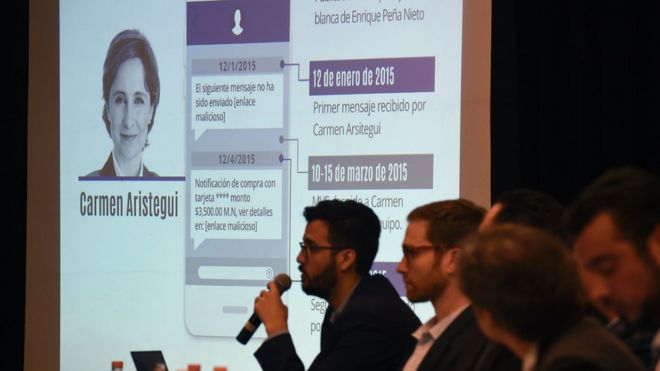
Mexican journalist Carmen Aristegui holds her mobile phone during a
journalists’ press conference in Mexico City (2017) about the
software.
Photograph: Alfredo Estrella/AFP/Getty Images
It's a grim situation. Mexico's journalist community is under fire, threatened, and spied upon, and journalists are being murdered. When Javier Valdez, working in the employ of Rio Doce -- a Mexican news organization that refuses to be intimidated by government or organized crime in its investigative reportage -- was murdered it took no time at all for the news source's news director Andres Villareal and its founder Mr. Bojorquez to receive a text message that Valdez's killers had been detained.
Both news men were suspicious and ignored the text message. They refused to click on the links. Operating one of the few independent news groups in the country dedicated to uncovering stories on organized crime, exposing the country's network of crime and corruption, they knew very well how vulnerable they were. Frequent recipients of threats emanating from organized crime syndicates, but also suspicious that government agents were involved.
Data, in fact, demonstrated that public officials are themselves responsible for the majority of attacks on journalists. Since Pena Nieto took office as president in late 2012, over 47 Mexican journalists have been killed. Fifteen of those murders took place in the wake of Mr. Valdez's death in May of 2017, according to information available from Article 19, a journalist protection group. It was government spyware to which Mr. Bojorquez had become alerted.
The Citizen Lab at the Munk School, at University of Toronto alerted them to the existence of the spyware and what it was capable of. The text messages that the two newsmen were so suspicious of were infected with spyware labelled Pegasus, purchased by the Mexican government from an Israeli cyber arms dealer, the NSO Group, according to a Citizen Lab forensic analysis. A click on the links embedded in the message would infect the cellphones with spyware.
That spyware is sufficiently powerful to break through encrypted messaging, monitor emails and remotely activate the camera and microphone of any cellphone it successfully infected. It became obvious to the two newsmen that someone was intent on spying on Mr. Valdez's colleagues immediately following his death and they suspected the government of Mexico.
The surveillance technology in the possession of Mexican authorities was being illegally used, beginning with the administration of President Enrique Pena Nieto. The spyware was bought with the strict proviso that it would be used only for the purpose of targeting terrorists and criminals. Despite which, in the last year-and-a-half, the Citizen Lab confirmed close to two dozen questionable targets which included some of Mexico's most prominent journalists, human rights lawyers and anticorruption activists.
At news of the surveillance, the Mexican government denounced the spying, opening an investigation into it. Since then, no one has been identified, arrested, much less punished. Mexico's authorities had been embarrassed by the revelations of spying. They had attempted to hack doctors and activists promoting sugary drinks taxes. The latest targeting of Mr. Valdez's colleagues led the government to state it was committed to the pursuit of any charges should evidence emerge.
Unsurprisingly, none has. But there is now a newly-elected government taking the place of the old one through a wave of popular support at the ballot box. It remains to be seen whether journalists' status will undergo any change; whether their targeting and abuse and state over-reach will subside. But time will tell.
"Espionage in Mexico has become an effective mechanism for intimidating
human rights defenders, activists and journalists." "It makes it possible to control the
flow of information as well as [allowing] abuses of power." Journalist group statement
Journalist Carmen Aristegui is among those allegedly targeted by the government Getty Images
"They think our country is beautiful and safe and they can do whatever they want, wear bikinis, wherever they like."
"I'm asking, if they wear bikinis in Thailand, will they be safe? Only if they are not beautiful."
Thailand Prime Minister, Prayuth Chan-ocha
Promoters call the Thai island of Koh Tao a paradise. Dive resorts boast
of its crystal-clear waters, and Western tourists flock to its lively
beach bars. Pic source Koh Tao Paradise Facebook
The island of Koh Tan off the coast of Thailand is recognized as a geological tropical paradise calling out for Western tourists to flick to its beach bars and wonderful waters, and they most certainly do. Increasingly, however, some foreigners regard the island as having been overtaken by a sinister influence dangerous to the presence of tourists from abroad. Nine tourists from Europe have died or disappeared since 2014 while vacationing in that paradise. Leading British tabloids to rename it Death Island.
Despite which Thailand remains one of the world's most popular destinations for tourists. Last year lone 35 million people visited, a source of pride and income for Thailand. Which doesn't the least bit appreciate the renaming of Koh Tan to Death Island. It is clearly a patriarchal society where any vestiges of equality between the sexes and respect for personal space is in short order. Leading some officials to suggest that visiting women bring rape on themselves wearing clothing that is provocative.
A short while after two British backpackers, David Miller 24, and Hannah Witheridge 23, were murdered on Koh Tai in 2014, the country's prime minister censured women tourists who think nothing of flaunting their physical beauty in scant apparel. A throwback to another era if you're in a Western country, but accepted wisdom in Thailand, evidently. Wearing scant attire earned Hannah Witheridge the rape she suffered before being murdered, according to Prime Minister Prayuth Chan-ocha.
Hannah Witheridge. Picture: SuppliedSource:AAP
David Miller and Hannah Witheridge were found dead on Koh Tao in 2014.Source:AAP
His statement didn't do much to embellish the reputation of Thailand and its beautiful island, and he later apologized. He'd meant, he explained that foreign visitors should exercise care. Two migrant Burmese workers were arrested and convicted of the murders, found guilty by a judge who sentenced them to death, regardless of questions about DNA evidence and the manner in which police handled the case leading supporters of the two men to claim they were framed. Foreign workers, it seems, are to be treated as shabbily as foreign tourists.
Thai rescue workers gather the bodies of David Miller and Hannah Witheridge.Source:AP
A Frenchman was discovered, hands tied behind his back in 2015, hanged. In that case police ruled suicide. A Russian tourist disappeared with her diving gear last year. After an investigation police drew the conclusion that she had unfortunately drowned at sea. Police ruled out foul play when a man from Moldova drowned in October out swimming late at night. In some of these instances family members of the deceased challenged police conclusions.
It doesn't help that Koh Tae has a reputation of hosting organized crime, and where police protect local interests. According to the police major general who led the rape investigation of a 19-year-old British woman, police cracked down subsequently on crime syndicates on the island since the killing of the backpacker's. As for the young woman who claimed to have been raped in June while vacationing on Koh Tae, police announced in October no evidence has been found to support her claim.
The case was then closed. Police did say they were prepared to reopen the case should new evidence emerge. "The whole thing has been a farce from the very beginning. Why on earth would someone make this up?" demanded the young woman's mother, furious at the short shrift police gave her daughter's complaint. She was led herself to a conclusion, that the police were incompetent, bungled the investigation and were invested in covering up the island's crime reputation. "We know how lucky we are to have our daughter back home. Although she will be scarred for life, she is alive. Something
needs to be done about the two mafia families who run Koh Tao, as one
or both are knowingly harbouring a serial rapist and murderer."
The young woman's mother was informed of CCTV cameras near the beach which could
have captured her daughter’s attack had they not been broken. The same broken cameras that missed the 2014 murders of British couple
Hannah Witheridge and David Miller. As for CCTV footage from the bar where the 19-year-old thinks her drink had been spiked, it was erased. "Officers went to the scene and try to investigate and search for CCTV footage. Unfortunately,
there was no evidence or any part of the footage showing the crime so
the criminal case regarding this incident never been officially recorded
in Koh Tao", explained an island police officer.
The police are busy, however, seeking the editor of an online news outlet that reported on the deaths and rape case. Suzanne Buchanan, the editor, laughs off the warrant issued against her, since she lives in Britain and likely wouldn't dream of going to Thailand for fairly obvious reasons. "They are accusing me of peddling fake news when it is not fake", she scoffed. And likely will continue going about the business of warning off would-be vacationers to the paradise of Death Island.
She has ample to write about, actually, a litany of crimes from rape to murder:
DEATH ISLAND’S VICTIMS Nick Pearson,
25, from the UK. On New Years Day in 2014, he was found floating in a
bay beneath a 15m cliff. He had no broken bones. Police ruled out foul
play but his family believe he was murdered. Hannah Witheridge, 23, and David Miller,
24, from the UK. In September 2014, the couple were found bludgeoned to
death close to where they were staying. Ms Witheridge had been raped. Dimitri Povse,
29, from France. On New Years Day in 2015, he was found hanging in a
bungalow. Police ruled his death a suicide but couldn’t explain why his
hands were tied behind his back. Christina Annesley, 23,
from the UK and born in New Zealand. In January 2015, she was said to
have died of natural causes after mixing antibiotics with alcohol. No
toxicology report was conducted. Her family are suspicious. Valentina Novozhyonova,
23, from Russia. In March 2015, she vanished from her hostel, with her
mobile phone, passport and camera left behind. She is still missing. Luke Miller,
24, from the UK. In January 2016, he was found at the bottom of a
swimming pool at the Sunset Bar at Sairee Beach. His family has accused
police of a cover-up. Elise Dallemagne, 30, of Belgium. In April 2017, she was found hanged in the jungle. Questions surround her death.
Party island Koh Tao, Thailand, has been dubbed ‘Death Island’.Source:istock
"We have to create better opportunities for people so they can stay home." "We also have to work on countering smugglers who have convinced people that their best opportunities to be successful lie in the [United] States." Victor Manuel Asturias Cordon, head, National Competitiveness Program, Guatemala
"No one will turn them in [report smugglers to the government, even for rewards], because within the community they are not seen as bad people." "But everyone knows who they are." Dora Alonzo, Quetzaltenango anti-migration group
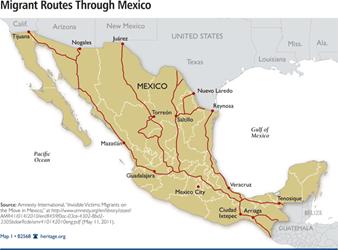
Over the period of time, Immigrants have discovered many illegal routes of Immigrating to USAThe government of Guatemala is keenly aware it has a problem of smugglers persuading Guatemalans to leave their country to find work elsewhere; and that elsewhere is invariably the United States. It has set aside $1.3-million for a messaging campaign to attempt to persuade people not to listen to the smugglers, to remain in Guatemala with their children and to strive to achieve some measure of income security through business endeavours at home.
As for the United States, while it is doing its best to discourage migrants from illegally entering the United States for underground work, it is also planning to invest over $200-million on projects over the next few years in the western highlands of the country to ideally create jobs and reduce endemic poverty. Few people interviewed in Quetzaltenango, the largest city in the Guatemalan highlands claim to have seen or heard the warnings.
Even had they seen them, many of those interviewed stated baldly those efforts would be wasted in persuading them to remain in Guatemala, convinced that opportunity, good employment and prosperity awaits them on entry to the United States. Residents of the city do see advertisements by the smugglers, on the other hand, and at least one community radio station in the city helps promote the smugglers' offer to transport and aid in financing northbound travel.
In the past year alone, 42,737 Guatemalans chose to travel as family units only to be apprehended or stopped at the border between the U.S. and Mexico, according to U.S. Customs and Border Protection. That number represents close to fifty percent of all migrants seeking entry to the United States with their relatives for that period. In Concepcion Chiquirichapa, a town where about ten thousand people live, everyone has family or contacts in the United States.
And the residents explain that the extreme poverty they live with is their sole motivation where about 75 percent of the population lives an impoverished life and where 67 percent of children under five suffer chronic malnutrition, the U.S. Agency for International Development figures attest. In the country, over a million people in rural areas have no access to electricity and many earn scant profit from coffee, corn, beans and other produce they grow.
And nor are their lives immune from the deleterious effects of drug trafficking, widespread corruption through local government and gang extortion, all of which aggravations, dangers and fears associated with them, conspire to influence their decisions to leave. Once that decision is made, people face a 1,900-kilometer journey to reach the U.S. For some, failures leading to return, only makes them determined to make the same attempt time and again until they succeed.
Despite the experience of facing countless dangers such as unscrupulous smugglers, fraught desert crossings and the possibility of being kidnapped by members of the deadly Mexican drug cartels. What propels them are the feelings of hopelessness in remaining in Guatemala where opportunities for a decent living wage are scarce and safety and security never a guarantee.
The billboards, radio and television warnings by the U.S. and Guatemalan governments alerting people against the dangerous journey to reach the United States go unheeded, if they are seen at all. Thousands determined to seek work and the prospect of a better life continue to flee the western highlands of Guatemala, their remote, rural, impoverished homes.
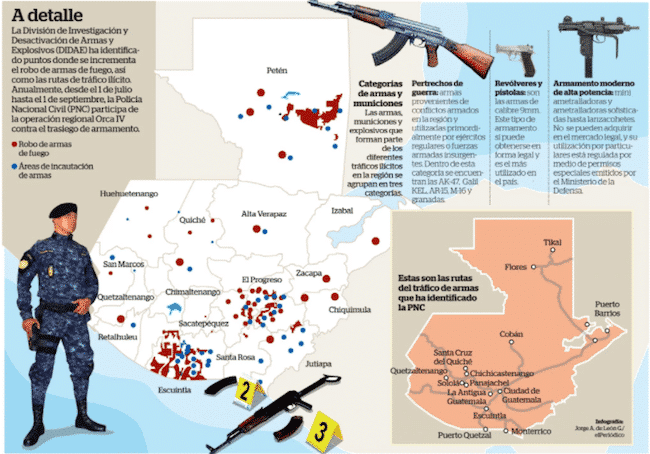
And to complicate things even further, there are smuggling routes into Guatemala where guns and drugs are being run. In the opposite direction, into Guatemala. Not into the rural areas where people are fleeing from, but into the centre of the country, its largest cities where criminal gangs tend to operate. A scourge that has contaminated the quality of life in most Central American countries.
"We need to bring back a sense of safety in Swedish society because the government has failed us." "We need to employ more police -- put 10,000 of them on the streets." "No women, no teenager, no old person, no one, should be scared." Jimmie Akesson, leader, Sweden Democrats
He's a man of confidence, a man of the world who's not afraid to tell people what he thinks." "Sweden Democrats is not an anti-immigrant party, and we are not anti-refugee, but we do feel we have taken in far too many people." Jimmy Gronfoss, 34, Sweden Democrats supporter
"He is too extreme. I think he is exploiting people by taking extreme examples [of migrant violence] and saying it's normal." Boll Wallberg, 50, Motala, Sweden
Sweden’s violent reality is undoing a peaceful self-image An armed police officer in Malmo, Sweden. The topic of crime is a
sensitive one in the country | Johan Nilsson/AFP via Getty Images
Sweden's Jimmie Akesson, whose party came in third in the popular vote in Sunday's election, garnered an impressive 20 percent of the vote. While other parties, all of whom he has stated he is willing to work with, refuse to cooperate with the party he founded with its expressed desire to "Keep Sweden Swedish", there are sufficient Swedes fed up with the number of refugees that have invaded the country to give his party their support. The issue is that Sweden absorbed a greater number of refugees per capita than any other country in Europe during the migration flooding Europe.
The younger members of Sweden Democrats were known to have expressed clear racist leanings, and Jimmie Akesson responded by inviting them to leave his party. He will have nothing to do with the terms "populist" and "far right", considering the party to be nothing less than a respectable conservative and nationalist movement. One occasioned by the flood of refugees changing the face of Sweden, its concerns and its values, straining its social contract and introducing a level of crime hitherto unknown.
At 39 years of age the man has taken up a difficult task. Aside from purging racist mentalities from the party, he must convince the majority of Swedes that he is not an extremist but a patriotic Swede distressed as most others are, at the literal changing face of their nation. The government would have it statistically that gun crime, rape and sexual assault rates have increased since the 2015 refugee influx, but will not divulge the perpetrators' nationalities. It is an open secret that identifies refugee populations as the major source of those crimes.
The state broadcaster shed some light on the matter when it released its own figures, finding that in the past five years 58 percent of sex crimes were foreigner-committed. Europe in general is gradually moving in its sentiments toward the centre-right and Sweden is only the latest country in Europe to recognize the problem inherent with an intake of majority Muslim refugees.
"I think that [the connection between sex attacks and Muslim immigrants] is due to cultural differences in how you view women and women's rights", stated Mattias Karlson, MP and former party leader.
"Most of our crimes start with drinking in public places." "They have a drink, they hold people up, shoot each other, cause mischief." Inspector Adonis Sugui, chief investigator, Tondo police station, Manila
"It [martial law] ended with the arrest, torture, detention and disappearance of so many young people who were branded as enemies of the state." "I think you can expect more repression, more confusion, more contradictory statements from the president [Rodrigo Duterte]." "To the point that even his own people will not be sure what they should be doing." Jose Manuel Diokno, dean, De La Salle University College of Law, Manila
Homeless people detained by police in Manila Photo AFP Noel Cens
In the slums of Manila, 45-year-old Edwin Panis acted as a neighbourhood security officer. It was his duty to ensure local law and order in a nation that under its hardline enforcer president has slammed anyone suspected of pushing or even using drugs into bullet-ridden eternity. Mr. Panis, a law-and-order fan, voted to put Mr. Duterte into office, trusting him to clean up the crime-ridden streets and drugs-and-guns problems haunting the Philippines, as he had done as mayor of Davao City.
The law-abiding people of the Philippines were tired of struggling, of being harassed by the presence of criminal gangs, of fearing for their lives, and they welcomed Rodrigo Duterte's brash personality, his coarse persona, his promise that criminals would run at his presence, and he wasn't averse himself to dealing personally with criminals. He had killed, and he said, he would do so again.
Mr. Panis, on a hot night, stepped outside his cramped living quarters to have a smoke and share a beer with friends and neighbours. "The war on drugs has become a war on drunks", he observed following his surprise arrest at the rough hands of six plainclothes policemen with their holstered guns who had swept purposefully through the winding alleys of the slum where they had come across the informal gathering.
Drinking beer in public is now a criminal offence in a nation suffused with violent crime. From an unseemly social misstep to a criminal offence in one fell swoop under the rubric of 'cleaning up the streets'. A new initiative which Mr. Duterte had authorized, for the police to begin arresting people for infractions such as public urination, men outdoors with bare chests, smoking and drinking in the streets; representing public order violations. Violations in fact that men like Mr. Panis were authorized to deal with.
Over 50,000 people have been summarily taken into custody for offences such as these; Manila's slums are on notice. "There's no way not to be scared", Amy Jane Pablo, 37, noted, a neighbour of Mr. Panis. In the wake of two high-profile murders, "radical changes in the days to come" was promised by Mr. Duterte; that people idling in the streets represented "potential trouble for the public". No idling, no public drinking, no going out shirtless, no kidding.
It took no more than a week after the announcement for police to arrest 7,000 for loitering, public drinking and additional violations of neighbourhood ordinances. The public's mind has shifted to memories of martial law imposed in the Philippines under the military rule of Ferdinand Marcos in the suspension of normal law replaced by the imposition of military rule. From 1972 to 1981 martial law ruled in the Philippines to ensure that "ridiculous rules" were not flouted.
A backlash ensued when a man arrested for going out in public shirtless somehow died while in custody. The official story was he was having"difficulty breathing". Arresting loiterers was "foolish", denounced the president, not at all in line with what he had ordered. He had informed police to break up gatherings, not authorized them to harass people; they had obviously misinterpreted his intention.
This was not, after all, the war on drugs with its bloody, lethal consequences. Merely people being people.
Contradictory messages and sloppy communications echoing the persona of Donald J. Trump, an admirer of Mr. Duterte, who for all anyone knows returns the compliment.
This represents a general opinion site for its author. It also offers a space for the author to record her experiences and perceptions,both personal and public. This is rendered obvious by the content contained in the blog, but the space is here inviting me to write. And so I do.