Colonizing the Moon and Mars With Nuclear Power Generation

"Since March 2024, China and Russia have announced on at least three occasions a joint effort to place a [nuclear] reactor on the Moon by the mid-2030s.""The first country to do so could potentially declare a keep-out zone, which would significantly inhibit the United States from establishing a planned Artemis presence, if not there first."NASA directive"The facility will be fully manufactured and assembled on Earth, then tested for safety and to make sure it operates correctly.""Afterwards, it will be integrated with a lunar lander, and a launch vehicle will transport it to an orbit around the moon.""A lander will lower it to the surface, and once it arrives, it will be ready for operation with no additional assembly or construction required."CNBC 2020 report"We're in a race to the moon, in a race with China to the moon. And to have a base on the moon, we need energy. And some of the key locations on the moon, we're going to get solar power.""But this vision technology is critically important, and so we've spent hundreds of millions of dollars studying.""Can we do it? We are now going to move beyond studying, and we are going.We have given direction to go.""Let's start to deploy our technology, to move to actually make this a reality."U.S. Transportation Secretary and acting NASA Administrator Sean Duffy
 |
There was a sudden, surprise announcement out of Washington, that the United States is rushing to place nuclear power reactors on the moon and on the surface of Mars. Hopes by the Trump administration and by extension NASA, are that the first system would be launched by the end of the decade; 2029 at the earliest. First reported by Politico, a new NASA directive calls for the appointment of a nuclear power czar for the selection of two commercial proposals within a six-month period.
The Trump administration frames the push as a critical issue with a laser focus on outpacing a linked China-Russian effort to do the same.
Acting NASA chief Sean Duffy signed the directive in his dual capacity as U.S. transportation secretary. The latest sign of the agency's shift in prioritizing human space exploration over scientific research under U.S. President Donald Trump, the July 31 memorandum makes it clear that this president sits atop a world that he has taken unusual steps to dominate, so why not extend it to outer space?
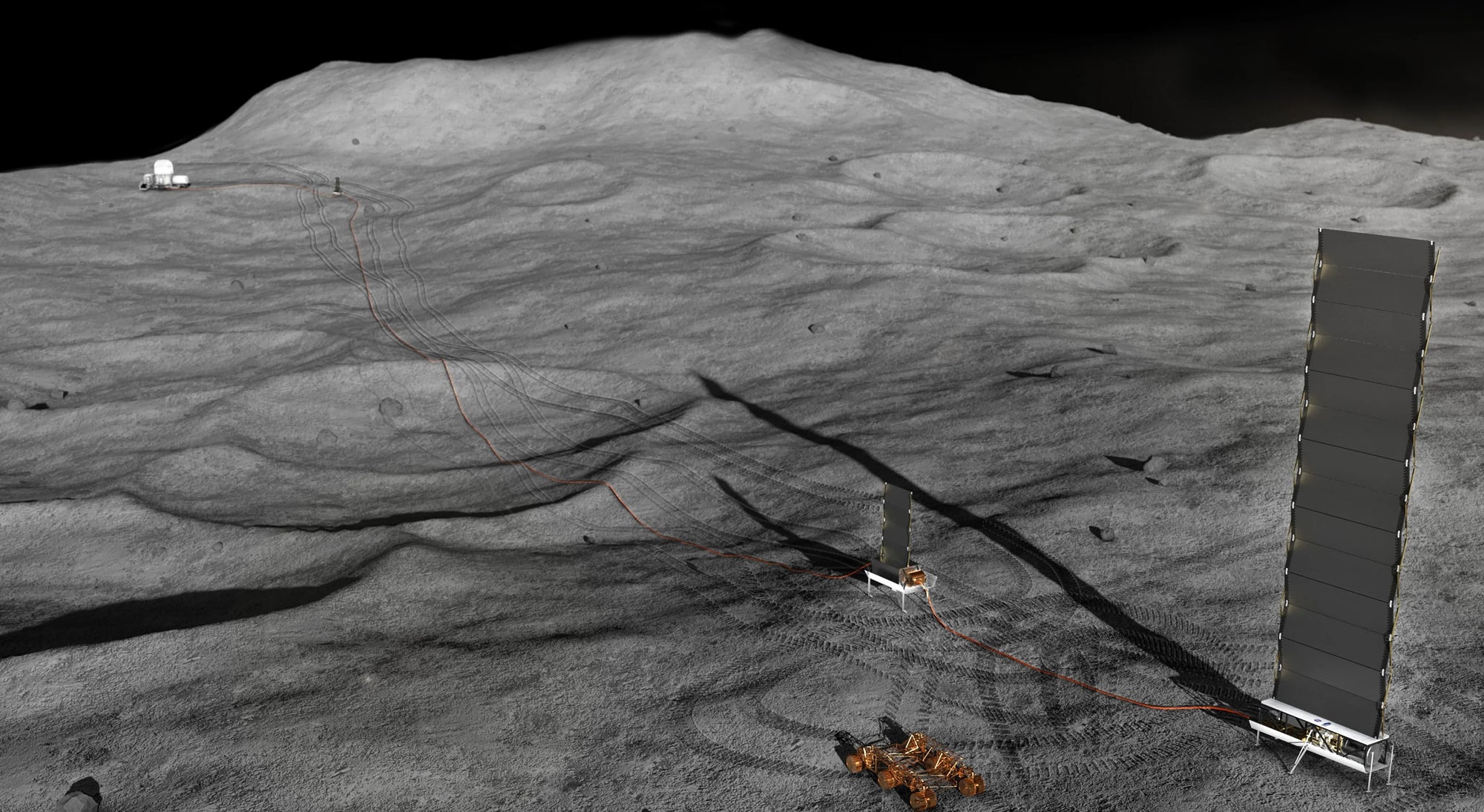 |
A concept illustration showing NASA’s Fission Surface Power Project on the moon. Under a new directive, the space agency is seeking to develop bigger and more powerful nuclear reactors that could reach the lunar surface by 2030. NASA |
NASA, since 2000, invested $200 million in the development of small, lightweight fission power systems. None has yet progressed toward flight readiness, but the urgency of the administration's wish to power ahead makes it clear that technological work will proceed apace to ensure those power systems will be ready in light-year time to ensure flight readiness without compromising the administration's and NASA's ambitions to beat Russia and China to the game.
 |
| Humanity has long dreamed of establishing a robust and continuous presence on another world, such as the Moon or Mars. One of the keys to such a successful colony would be the continuous generation of power, with nuclear power plants remaining a prime, and arguably our best, option. But that may not be the true motive behind NASA administrator Sean Duffy's recent announcement. Credit: NASA; edited by E. Siegel |
Surface power needs are expected to be at least 100 kilowatts, based on feedback by industry, to enable the support of "long-term human operations including in-situ resource utilization". Issues of such crucial matters as the provision of reliable life support measures, communications and mining equipment to be able to collect surface ice, in the absence of running water are being tended to.
Plans to proceed assume use of a "heavy class lander", capable of carrying up to 15 tonnes of mass, to target a "readiness to launch by the first quarter of FY30", aka late 2029. To the present, the sobering news that NASA's Artemis program -- the intention to return to the moon to establish a lasting presence near the south pole -- has faced repeated delays.
 |
| Humans have often dreamed of colonizing other worlds: both within our Solar System and beyond. While we may be a long way from a Martian colony involving skyscrapers, as illustrated here, many contend that a small, domed structure on another world, such as Mars or the Moon, could represent a key step toward that ultimate goal. Credit: Corepics VOF/Shutterstock |
Labels: China, Extraterrestrial Human Habitation, Mars, Moon, NASA, Nuclear Power Reactors, Russia, United States
posted by Pieface @ Thursday, August 07, 2025


<< Home