The Afghanistan/Pakistan Love Affair
 |
| Ariana News |
"Strong combat broke out in numerous areas of the 2,600-kilometer Durand Line in early October 2025, especially in the vicinity of Kunar, Spin Boldak–Chaman and the Kurram tribal region. While Kabul denounced Pakistan’s retaliatory airstrikes in Kandahar and Paktika as flagrant violations of sovereignty, Pakistan accused the Taliban government of providing sanctuary to Tehrik-e-Taliban Pakistan (TTP) militants responsible for deadly raids inside Khyber Pakhtunkhwa and Balochistan. Numerous people were killed in the fighting, which also blocked important commerce routes and interfered with humanitarian supplies.""After the two regimes declared an emergency ceasefire on October 19, Qatar and Turkey mediated the conflict in Doha. Both governments promised to stop the attacks, restore communication channels, and set up verification processes. Although the truce provided temporary respite, it revealed underlying structural divisions, especially in relation to Pakistan regime’s demand that Taliban regime stop TTP activities and the Taliban’s insistence that Pakistan respect Afghan territorial integrity."Australian Institute of International Affairs
The
U.S.-led invasion of Afghanistan in 2001 under UN approval in the wake
of 9/11, saw a multitude of countries joining Operation Enduring
Freedom, mostly NATO members. At that time Pakistan aligned itself on
the surface with the U.S.declaring itself part of a coalition fighting
terrorism. While in actual fact, the Taliban was given haven in
Pakistan, as was Osama bin Laden, living at Abbottabad not far from a
Pakistan military base. Pakistan's own Taliban was just getting started,
inspired no doubt, by the Afghan Taliban.
Fast
forward to the present, and Afghanistan now governed by the
fundamentalist Taliban. Pakistan's designs on controlling Afghanistan,
and keeping India out of the country have rather soured now that the
Taliban for better or for worse -- and as it happens, much worse -- is
in power and Pakistan now struggling against its very own terrorist
Taliban, blames the government in Afghanistan with sheltering
Tehreek-e-Taliban Pakistan, and for its troubles having Pakistan
penalize it by cutting off a vital trade route.
One
of the largest, once-bustling markets in Peshawar where thousands of
shops owned by Afghans selling a wide variety of consumer goods is now a
wan image of itself with the closure of hundreds of Afghan shops. A
deep chasm has resulted between Afghanistan and Pakistan with their
traditional trade routes impacted with cross-border trade having been
cut by Pakistan as punishment for the Taliban administration failing to
cooperate with Pakistan's demands it stop giving haven to the terrorists
that have attacked and killed members of Pakistan's military.
Millions
of farmers, traders and communities in both countries have been
impacted by the suspension of trade. Trucks carrying coal, cement,
pomegranates, cotton, medicine and other goods valued to $2 billion in
bilateral trade have been held up for months. Pakistan's 250 million
population represented a plentiful consumer base for Afghanistan. But
they and access to India -- vital to the Afghan economy -- have been hit
a powerful blow for the Taliban government, already suffering from the
forced return of over 2.5 million of its nationals from neighbouring
countries, and the damage inflicted by two deadly earthquakes.
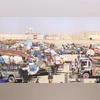 "Hundreds of trucks and trailers have been standing idle since October 11 near the busiest border crossing between Pakistan and Afghanistan, after deadly clashes resulted in suspension of trade") |
| Hundreds of trucks and trailers have been standing idle since October 11 near the busiest border crossing between Pakistan and Afghanistan, after deadly clashes resulted in suspension of trade |Photo: Reuters |
Hundreds
of trailer trucks have been parked along the road running through the
border near Peshawar, since October 11. Most crossings have been barred
by Pakistani border guards, with the exception of Afghan nationals
returning home. "When they stopped us here, it was still summer. Now winter is right upon us",
moaned Abdul Wakeel at the Torkham border crossing. Although the
Taliban denied supporting Pakistani Taliban, Pakistan expelled over a
million Afghans and carried out strikes on Kabul and Kandahar, resulting
in the deaths of dozens of soldiers on both sides.
Over
half of Afghanistan's 42 million people require humanitarian
assistance, while containers brimming with aid stand blocked at the
border. Pakistan itself faces a rising poverty rate of 25 percent; the
trade standoff benefits neither country. Peshawar, about 48 kilometers
from the border with a sizeable Afghan population among its two million
residents, has been struck particularly brutally by the situation. "We're caught in between the politics of two countries", observed Syed Naqeeb Badshah, president of a lobby group representing Afghan traders in Pakistan, resignedly.
 |
| These trucks are loaded with the belongings of Afghans attempting to return to their country after Pakistan closed border crossings with Afghanistan. They were pictured at the border crossing in Chaman, Pakistan, on Oct. 16. Reuters |
Labels: Afghan-Taliban, Afghanistan, Pakistan, Pakistani Taliban, Trade Blockade
posted by Pieface @ Monday, December 29, 2025


<< Home