"He Overcame Trauma By Becoming a Witness"
 |
Elie Wiesel: Israel advocate 1928 – 2016 |
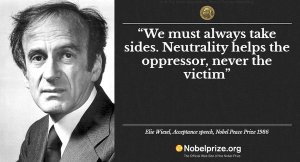
"I wanted my language to be a monument to my people -- especially those who died.""I wrote it [And the World Remained Silent ... Night] -- for the other survivors, who found it difficult to speak and I wanted to tell them, Really ... you must speak.""I have tried to fight those who would forget.""Because if we forget, we are guilty, we are accomplices.""We must always take sides Neutrality helps the oppressed, never the victim."Elie Wiesel, Holocaust Survivor"My father clearly articulated that the antisemite will always hate, even if they mask that hate as anti-Zionism -- as though it were something separable from antisemitism.""Our object as Jews is to keep embracing our Jewish faith and heritage and our connection to our over seven million Jewish brothers and sisters in Israel."Elisha Wiesel, businessman, activist, philanthropist
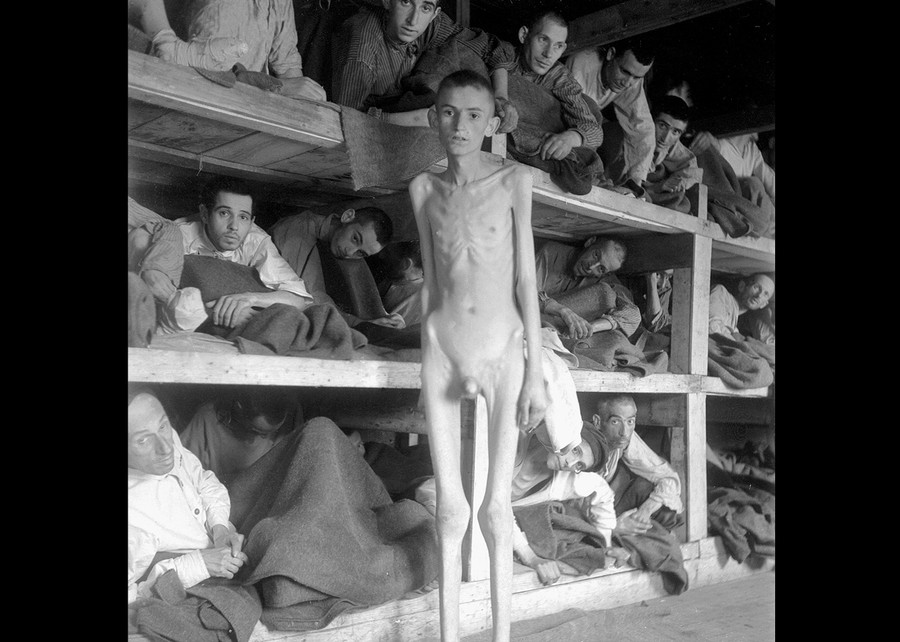 |
| Jewish survivors in Buchenwald concentration camp, after the liberation of the camp in 1945 AFP/Getty |
Holocaust
Remembrance Day is held each year on January 27. This year, Elie
Wiesel: Soul on Fire, premieres at the Montreal Holocaust Museum. Elisha
Wiesel, 53, will speak of his father and his mission to ensure the
world 'never forgets'. Elisha Wiesel is chair of the board of the Elie Wiesel Foundation for Humanity.
Along with his mother, Marion Wiesel, a Holocaust survivor, the
Foundation was launched after the death in 2016 of father-and-husband,
to continue the work Elie Wiesel dedicated his life to.
Directed
and written by Oren Rudavsky the 90-minute film addresses the personal
story and legacy of a man known as one of the world's most respected
Holocaust survivors, known as well as a prolific author, humanitarian,
passionate educator and Nobel Peace Prize laureate.
Eliezer
Wiesel was a boy of 15 when he was deported from Sighet, Romania with
his parents and three sisters in May of 1944 to Auschwitz-Birkenau where
his mother and younger sister Tzipora were killed on their arrival at
the death-and slave labour camp. Elie and his father were selected to go
to the slave labour component of the notorious death camp.
By
early 1945, as Germany was losing the war and emptying the camps by
forcing starving, skeletal inmates on death marches, Elie and his father
were sent on a march to the Buchenwald concentration camp where his
father later died. In April of that year the camp was liberated by
American soldiers. The Jewish orphans in the camp, Elie among them, were
transported to France, where his sister Hilda recognized him in a
French newspaper photograph.
The
siblings reunited, along with their sister Beatrice who moved
eventually to Montreal. Working as a journalist in France, Wiesel
studied at the Sorbonne. "He overcame trauma by becoming a witness",
noted a family friend. His memoir of a young boy's reaction to
Auschwitz, originally published in Yiddish in 1945 was a 846-page
recollection of pain, loss and suffering. Abridged and translated to
French, it was published as La Nuit in 1958, and in 1960 as Night, in English.
Night sold
over six million copies in 30 languages, and he went on to write many
more books. Moving to New York in 1956, Wiesel became a writer, teacher
and academic, teaching at City College of New York, then at Boston
University in 1976, as Andrew W. Mellon Professor in the Humanities. "Your
suffering is not what defines you, but it can inform you. It shapes you
and then it is your job to make it the best tool you can", a former student added of her own mental journey under his tutelage.
 |
Having
suffered the most inhumane circumstances and losses in his young life,
Elie Wiesel matured a determined human rights upholder, refusing to
stand silent in the face of immoral human rights abuses, speaking up and
bringing attention to some of the modern world's most shameful human
rights atrocities. His trauma led him to undertake action of moral
outrage against wrongs committed against the vulnerable. Human rights
violations that took place in Rwanda, Cambodia, the Sudan and the former
Yugoslavia engaged his moral outrage and his propensity to speak
loudly, publicly, determined to move others to do the same.
"[My father] never failed to stand up for Israel, asserting that only Israelis can best decide how to reach their goals of living in peace and security in an extremely hostile neighbourhood.""And lastly, he insisted that we never relinquish our desire to have a positive impact on the world as a whole.""He strongly resisted isolationism as a principle."Elisha Wiesel
Labels: Elie Wiesel, Holocaust, Holocaust Survivor, Memorial, Night, Raging Against Atrocities, World War II
posted by Pieface @ Tuesday, January 27, 2026


<< Home