The Gaza Board of Peace
"[The Board of Peace would] work with many others, including the United Nations.""Once this board is completely formed, we can do pretty much whatever in conjunction with the United Nations. You know, I've always said the United Nations has got tremendous potential.""Every one of them [those signing on the 'Board of Peace'] is a friend of mine. A couple, let's see, a couple I like, a couple I don't like.""No, I like, actually, this group. I like every single one of them, can you believe it? Usually I have about two or three that I can't stand.""[I wish that] we didn't need a Board of Peace [but the UN had failed to help solve the world's conflicts]."U.S. President Donald J. Trump
 |
| U.S. President Donald Trump, centre, sits with leaders of other countries during a signing ceremony for his 'Board of Peace' initiative aimed at resolving global conflicts, at the World Economic Forum in Davos, Switzerland, on Thursday. (Jonathan Ernst/Reuters) |
"I think what you're seeing is a board that has been cobbled together for Gaza with much bigger aspirations. But with a set of skills and a set of people that is really very Middle East centric, and I think has quite little relevance to crises outside of that region.""Yes, the UN has very serious problems. But I think that doesn't mean that Europeans [and] many others — in South America, for example — want to see a world in which the White House, in which Trump, in which Americans acquire disproportionate power over these sorts of decisions.""This is not just a contest that the U.S. can shape by itself and say, 'I'm done with the UN, it's over.' The Chinese will keep playing this game. Very powerful rising countries like Brazil and India will have a stake in the UN, and they will seek to influence its agencies and bodies more and more as the U.S. draws back."Shashank Joshi, defence editor, The Economist
President
Donald Trump in Davos officially launched his Board of Peace
initiative, claiming his very personal project so dear to his heart
which may yet gain him 2026's nomination for the Nobel Peace Prize,
joined on stage by his board's founding members comprised of political
allies such as President Javier Milei of Argentina, Hungarian Prime
Minister Viktor Orban and representatives from Bahrain, Morocco,
Azerbaijan, Bulgaria, Pakistan, Saudi Arabia, Turkey, the United Arab
Emirates and Uzbekistan.
All
of whom were pleased to join Mr. Trump at the document signing table
where the board's charter was declared to be 'in full force', as an "official international organization".
Phase two of the Peace Plan is set to proceed, despite the fact that
Phase one has not been fully implemented. And considering the critical
nature of fully implementing the first portion of the plan focusing on
dismantling and disarming the Hamas terrorist group governing Gaza, to
follow on seems a trifle premature. It represents, in fact, a failure.
Not
according to Mr. Trump who considers the initial peace plan phase
successful, emphasizing his intention and that of the United States to
have Gaza 'properly rebuilt'. There are some heads of state who, given
the uncertainties that lie ahead and their concerns regarding the makeup
of the board's membership who prefer to hang back before finalizing
their decisions to join, and others who are certain there is no good
reason for them to be part of the notional planned success.
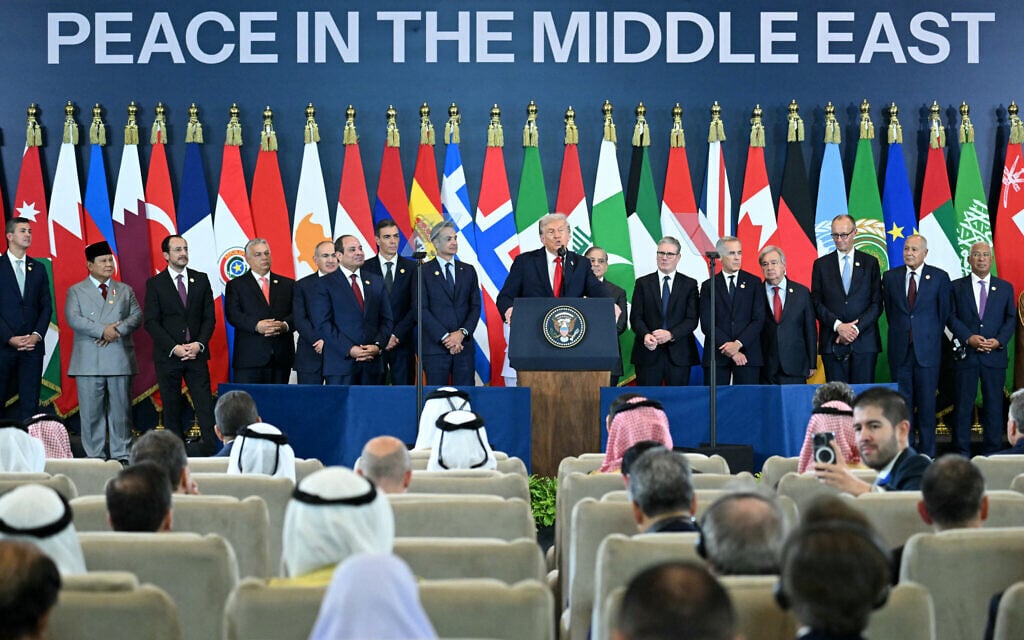 |
| US President Donald Trump (C) speaks during the Sharm El-Sheikh Peace Summit in the Egyptian Red Sea resort town of Sharm el-Sheikh on October 13, 2025. (Photo by SAUL LOEB / AFP) |
American
allies, part of the Group of Seven, remain uneasily on the sidelines.
Originally the board was proposed to help oversee the reconstruction of
Gaza. A broader purpose has been newly revealed: to "secure enduring peace on areas affected or threatened by conflict",
a vision that places many U.S. allies on alert, concerned there is a
hidden agenda to rival and perhaps replace the traditional 'relevance'
of the United Nations.
That
a new draft plan suggests countries joining the board contribute $1
billion each should they wish to place themselves past the initial
three-year registration to permanent status, may have taken many aback.
The view being that Mr. Trump will remain its chairman in perpetuity,
making all the decisions as its "inaugural chairman". The invitation
extended to Russian President Vladimir Putin and Belarus's Alexander
Lukashenko certainly persuaded Volodymyr Zelenskyy to politely turn down
his own invitation, while raising eyebrows throughout Europe.
Altogether
some 60 leaders were given invitations to join. France, the United
Kingdom, Sweden, the Netherlands, Norway and Germany have declined their
invitations. Canada accepted, but given its trade overtures to Beijing
that followed, has been summarily disinvited. The UN Security Council
had originally endorsed the Gaza plan, but may since have had second
thoughts.

Labels: Board of Peace foe Gaza, Davos, Nobel Peace Prize, Switzerland, U.S. President Donald Trump, United Nations
posted by Pieface @ Monday, January 26, 2026


<< Home