The Gallantry and Honour of the French WWII Military
June
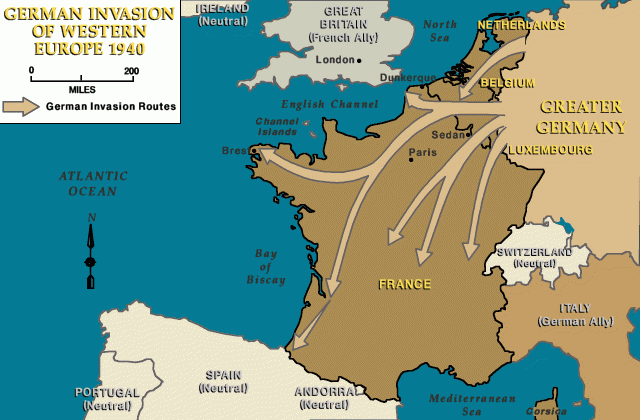
27, 1940: ...But from what I've seen in Belgium and France and from
talks I've had with Germans and French in both countries, and with
French, Belgian, and British prisoners along the roads, it seems fairly
clear to me that:
France did not fight.
If
she did, there is little evidence of it. Not only I, but several of my
friends have driven from the German border to Paris and back, along all
the main roads. None of us saw any evidence of serious fighting.
The
fields of France are undisturbed. There was no fighting on any
sustained line. The German army hurled itself forward along the roads.
Even on the roads there is little sign that the French did any more than
harry their enemy. And even this was done only in the towns and
villages. But it was only harrying, delaying. There was no attempt to
come to a halt on a line and strike back in a well-organized counter-
attack.
But
since the German chose to fight the war on the roads, why didn't the
French stop them? Roads make ideal targets for artillery. And yet I have
not seen one yard of road in northern France which shows the effects of
artillery fire. Driving to Paris over the area where the second German
offensive began, an officer from the High Command who had missed the
campaign kept mumbling that he could not understand it, that up there on
that height, dominating the road and providing wonderful artillery
cover with its dense woods, the French must have had the sense to plant a
few guns. Just a few would have made the road impassable, he kept
repeating, and he would order us to stop while he studied the situation.
But there had been no guns on those wooded heights and there were no
shell-holes on or near the road. The Germans had passed along here with
their mighty army, hardly firing a shot.
At
no point in France and at only two or three in Belgium did I see a road
properly mined, or, for that matter, mined at all. In the villages and
towns the French had hastily thrown up tank-barriers, usually of blocks
of stone and rubbish. But the Germans brushed them aside in minutes. A
huge crater left by an exploded mine could not have been brushed aside
in a few minutes.
D.B.
in Paris, having seen the war from the other side, concludes that there
was treachery in the French army from top to bottom -- the fascists at
the top, the Communists at the bottom. And from German and French
sources alike I heard many stories of how the communists had received
their orders from their party not to fight, and didn't...
Many
French prisoners say they never saw a battle. When one seemed imminent,
orders came to retreat. It was this constant order to retreat before a
battle had been joined, or at least before it had been fought out, that
broke the Belgian resistance.
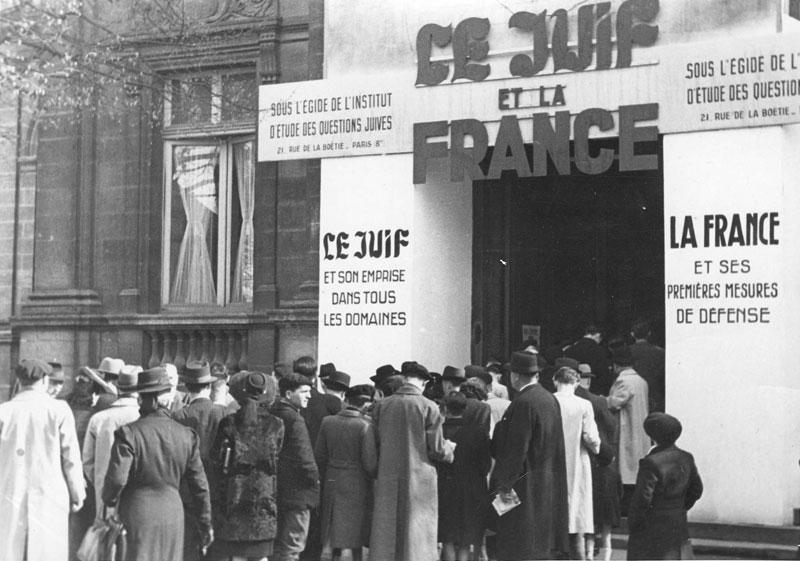
Bordeaux, 1942: the entrance to the anti-Semitic exhibition “The Jews and France”.
The
Germans themselves say that in one tank battle they were attacked by a
large fleet of French tanks after they had themselves run out of
ammunition. The German commander ordered a retreat. After the German
tanks had retired some distance to the rear, with the French following
them only very cautiously, the Germans received orders to turn about and
simulate an attack, firing automatic pistols or anything they had out
of their tanks, and executing complicated manoeuvres. This they did, and
the French, seeing an armada of tanks descend upon them, though these
were without ammunition, turned and fled.
Another mystery: After the Germans broke through the Franco-Belgian border from Maubeuge to Sedan,
they
tell that they continued right on across northern France to the sea
hardly firing a shot. When they got to the sea, Boulogne and Calais were
defended mostly by the British. The whole French army seemed paralysed,
unable to provide the least action, the slightest counter-thrust.
On
the whole, then, while the French here and here fought valiantly and
even stubbornly, their army seems to have been paralysed as soon as the
Germans made their first break-through. Then it collapsed, almost
without a fight. In the first place the French, as though drugged, had
no will to fight, even when their soil was invaded by their most hated
enemy. There was a complete collapse of French society and of the French
soul. Secondly, there was either treachery or criminal negligence in
the High Command and among the high officers in the field. Among large
masses of troops Communist propaganda had won the day. And its message
was: 'Don't fight'. Never were the masses so betrayed.
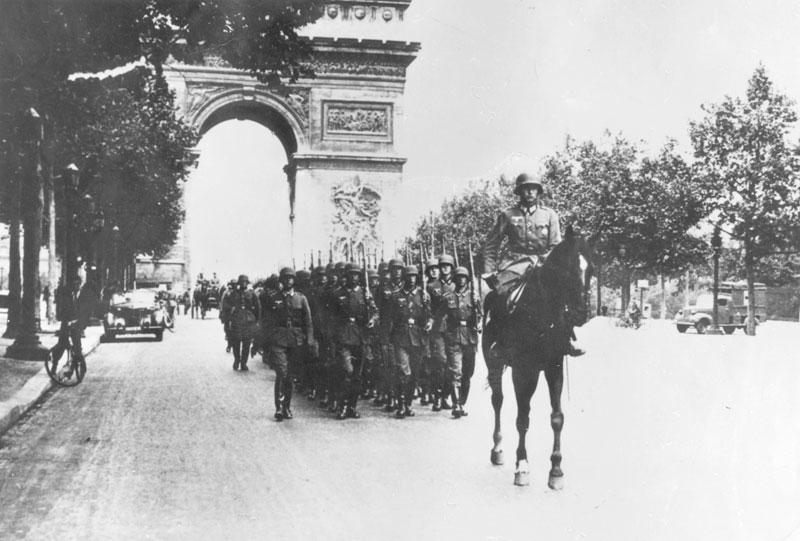
A German military unit, marching down the Champs-Élysées; Paris, 4 July 1940 Yad Vashem
July 8, 1940:
Tomorrow France, which until a few weeks ago was regarded as the last
stronghold of democracy on the Continent, will shed its democracy and
join the ranks of the totalitarian states. Laval, whom Hitler has picked
to do his dirty work in France -- the notorious Otto Abetz is the main
go-between -- will have the French Chamber and Senate meet and vote
themselves out of existence, handing over all power to Marshal Petain,
behind whom Laval will pull the strings as Hitler's puppet dictator. The
Nazis are laughing.
July 9: The Nazis are still laughing. Said the organ of the Foreign Office Dienst aus Deutschland,
in commenting on Vichy's scrapping the French Parliament today: 'The
change of the former regime in France to an authoritarian form of
government will not influence in any way the political liquidation of
the war. The fact is that Germany does not consider the Franco-German
accounts as settled yet. Later they will be settled with historical
realism ... not only on the basis of the two decades since Versailles,
but they will also take into account much earlier times'.
July 10:
Hans came in to see me. He had just driven from Irun, on the
Franco-Spanish border, to Berlin. He said he could not get over the
looks of Verdun, which he visited yesterday. Not a house there has been
scratched, he said. Yet in the World War, when it was never taken, not a
house remained standing. There you have the difference between 1914-18
and 1940.
William L. Shirer ... The Journal of A foreign Correspondent, 1934-1941 BERLIN DIARY
"I wanted my language to be a monument to my people -- especially those who died."
"I
wrote it [And the World Remained Silent ... Night] -- for the other
survivors, who found it difficult to speak and I wanted to tell them,
Really ... you must speak."
"I have tried to fight those who would forget."
"Because if we forget, we are guilty, we are accomplices."
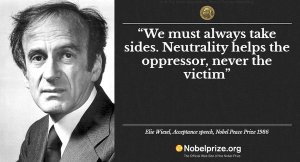
"We must always take sides Neutrality helps the oppressed, never the victim."
Elie Wiesel, Holocaust Survivor
"My
father clearly articulated that the antisemite will always hate, even
if they mask that hate as anti-Zionism -- as though it were something
separable from antisemitism."
"Our
object as Jews is to keep embracing our Jewish faith and heritage and
our connection to our over seven million Jewish brothers and sisters in
Israel."
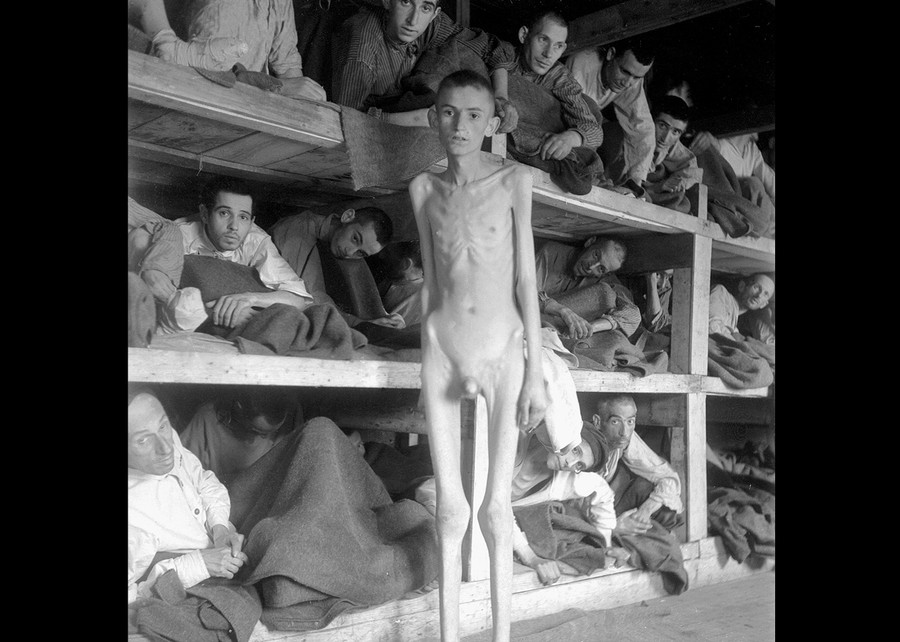
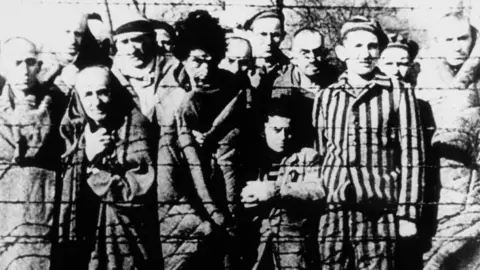
Jewish survivors in Buchenwald concentration camp, after the liberation of the camp in 1945 AFP/Getty
Holocaust
Remembrance Day is held each year on January 27. This year, Elie
Wiesel: Soul on Fire, premieres at the Montreal Holocaust Museum. Elisha
Wiesel, 53, will speak of his father and his mission to ensure the
world 'never forgets'. Elisha Wiesel is chair of the board of the Elie Wiesel Foundation for Humanity.
Along with his mother, Marion Wiesel, a Holocaust survivor, the
Foundation was launched after the death in 2016 of father-and-husband,
to continue the work Elie Wiesel dedicated his life to.
Directed
and written by Oren Rudavsky the 90-minute film addresses the personal
story and legacy of a man known as one of the world's most respected
Holocaust survivors, known as well as a prolific author, humanitarian,
passionate educator and Nobel Peace Prize laureate.
Eliezer
Wiesel was a boy of 15 when he was deported from Sighet, Romania with
his parents and three sisters in May of 1944 to Auschwitz-Birkenau where
his mother and younger sister Tzipora were killed on their arrival at
the death-and slave labour camp. Elie and his father were selected to go
to the slave labour component of the notorious death camp.
By
early 1945, as Germany was losing the war and emptying the camps by
forcing starving, skeletal inmates on death marches, Elie and his father
were sent on a march to the Buchenwald concentration camp where his
father later died. In April of that year the camp was liberated by
American soldiers. The Jewish orphans in the camp, Elie among them, were
transported to France, where his sister Hilda recognized him in a
French newspaper photograph.
The
siblings reunited, along with their sister Beatrice who moved
eventually to Montreal. Working as a journalist in France, Wiesel
studied at the Sorbonne. "He overcame trauma by becoming a witness",
noted a family friend. His memoir of a young boy's reaction to
Auschwitz, originally published in Yiddish in 1945 was a 846-page
recollection of pain, loss and suffering. Abridged and translated to
French, it was published as La Nuit in 1958, and in 1960 as Night, in English.
Night sold
over six million copies in 30 languages, and he went on to write many
more books. Moving to New York in 1956, Wiesel became a writer, teacher
and academic, teaching at City College of New York, then at Boston
University in 1976, as Andrew W. Mellon Professor in the Humanities. "Your
suffering is not what defines you, but it can inform you. It shapes you
and then it is your job to make it the best tool you can", a former student added of her own mental journey under his tutelage.
Having
suffered the most inhumane circumstances and losses in his young life,
Elie Wiesel matured a determined human rights upholder, refusing to
stand silent in the face of immoral human rights abuses, speaking up and
bringing attention to some of the modern world's most shameful human
rights atrocities. His trauma led him to undertake action of moral
outrage against wrongs committed against the vulnerable. Human rights
violations that took place in Rwanda, Cambodia, the Sudan and the former
Yugoslavia engaged his moral outrage and his propensity to speak
loudly, publicly, determined to move others to do the same.
"[My
father] never failed to stand up for Israel, asserting that only
Israelis can best decide how to reach their goals of living in peace and
security in an extremely hostile neighbourhood."
"And lastly, he insisted that we never relinquish our desire to have a positive impact on the world as a whole."
"He strongly resisted isolationism as a principle."
The Cynical Hypocrisy of the International Community
"Relatively many people survived, which for example barely happened in sites which didn't have such a forced labour component."
"[As
testimony to the past purpose of Auschwitz, maintaining the death camp
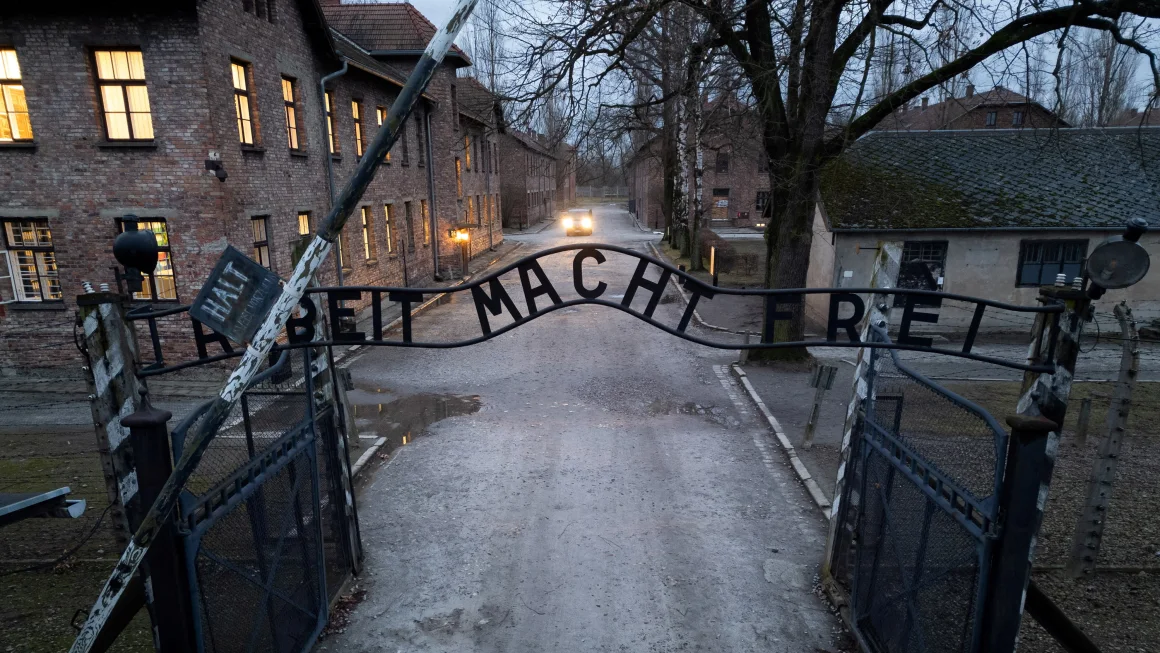
as a memorial site has its value]: You have the gate [Arbeit Macht
Frei], you have the wagon [transport]. You have the incredibly long
railway platform which leads to the former crematoria and gas chambers."
Thomas Van de Putte, scholar specializing in Holocaust memory, King's College London
"I
saw thousands of tortured people whom the Red Army had saved -- people
so thin that they swayed like branches in the wind, people whose ages
one could not possibly guess."
Boris Polevoy, Pravda correspondent, eyewitness to Soviet liberation of Auschwitz Jan.27, 1945
"This is the anniversary of liberation. We remember the victims, but we also celebrate freedom."
"It is hard to imagine the presence of Russia, which clearly does not understand the value of freedom."
Auschwitz Museum director Piotr Cywinski
The entrance gate to the former Nazi German concentration and extermination camp Auschwitz pictured on January 10. Kacper Pempel/Reuters
The
world is set to mark the 80th anniversary of the most dreadful mass
atrocity that a country at war designed in an orgy of hatred against an
ethnic population drawn from the countries of Europe whose citizenry
included millions of diaspora Jews forced in antiquity from their
ancestral homeland for exile abroad by a Roman occupation of the holy
land that implacably put down an insurrection of Judean origin in a
paroxysm of violence that millennia later was replicated with more
modern and equally savage technological means of broader dimensions.
It
is highly doubtful that Romans of the period felt it incumbent upon
themselves to harvest the hair, skeletal remains, attire, gold dental
fillings, marriage rings, to enrich themselves and produce stuffing for
pillows, the production of soap from the remains of their victims as
Nazi Germany felt disposed to do. The slaughter of children, women and
men of all ages may be a casualty of war anywhere at any time when
civilian populations bear the brunt of conflict that uproots and
victimizes them in loss of home, necessities of life and life itself,
but Nazi Germany brought its obsession with the extermination of Jews to
a fine art.
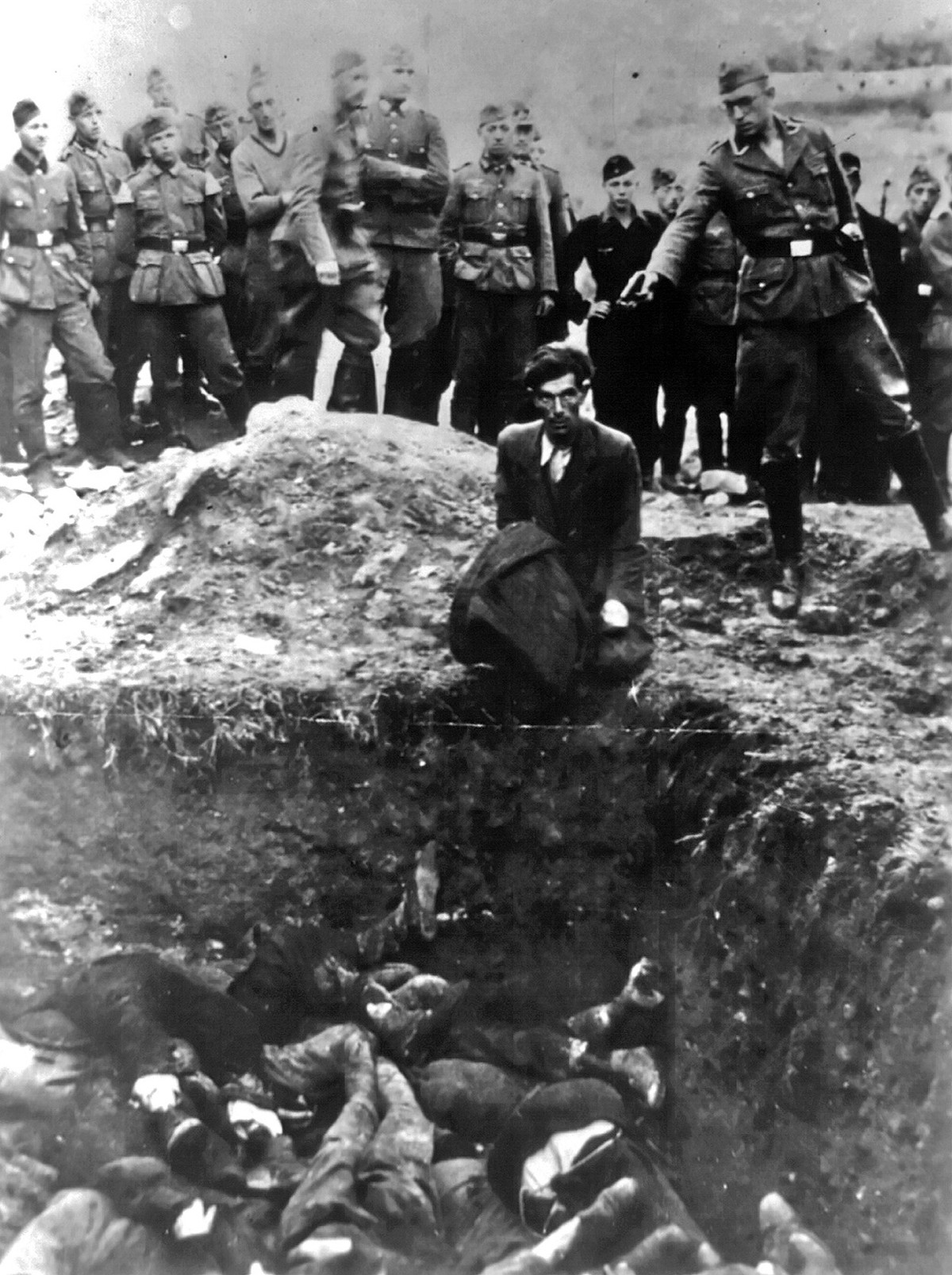
This photo provided by Paris' Holocaust Memorial shows a German
soldier shooting a Ukrainian Jew during a mass execution in Vinnytsia,
Ukraine, sometime between 1941 and 1943. This image is titled "The last
Jew in Vinnitsa", the text that was written on the back of the
photograph, which was found in a photo album belonging to a German
soldier
It
took an orgy of mass dementia to organize round-ups, persuade
populations that a nest of vipers lived amongst them that German
authorities prepared to save them from, infesting those non-Jewish
citizens with a suspicion and loathing of Jews they had lived among for
centuries to convince them that the goal of extermination would make for
a more refined, pure society once the presence of Jews was eliminated.
People adapted nicely and deliberately turned their faces away from the
putrid agonies of exclusion and humiliation their fellow Jewish citizens
suffered, glad when they suddenly vanished into slave labour camps
since out of sight, out of mind was a great relief,
Now,
generations after the Holocaust for most people inhabiting our familiar
world the memory of mass annihilation is beyond faint and growing
fainter. Just as the thousands of Jews who managed miraculously to
survive have grown old and are growing older, their witness status soon
to fade itself, in and out of history. To be sure, others besides Jews
died; political prisoners, Poles, Roma, Sinti, Soviet prisoners of war,
homosexuals, but it was Europe's Jews that comprised the target focus.
This
year, on the 80th anniversary memorializing the Holocaust, an estimated
50 survivors are expected to be present, and they will speak to the
world once again of their loss, their ordeal, their endurance, their
unforgettable memories. Two-thirds of the Jews of Europe perished in
that orgy of hate and demonic destruction of human life. They were
murdered in the death camps established all over Europe, places like
Treblinka, Majdanek, Stutthof, Auschwitz, Buchenwald, Dachau, Mauthausen
and Bergen-Belsen among a plethora of others.
There
were survivors at Auschwitz for the simple reason that though it was a
death camp it also was a labour camp. Where those who survived the
journey to Auschwitz in crowded train transports were separated on
arrival into groups deemed sufficiently healthy to work, the others
directed to groups who would enter the 'shower rooms' where they were
gassed to death with Zyklon B, their remnants cremated in giant
furnaces, their ashes belched out of massive chimneys to nurture the
surrounding soil.
Presidents,
royalty, ambassadors, politicians, rabbis and priests will be among
those in attendance to memorialize the fixation of a nation and a
continent on the destruction of a tiny ethnic/cultural/religious group
that had lived among them for generations, enriching those countries
with their presence as artists, scientists, teachers, factory workers,
lawyers, doctors, justices, soldiers, entertainment figures,
industrialists, bankers and journalists, bakers and cobblers.
The
royalty, presidents, ambassadors, politicians and priests of the time
who failed to exert their moral outrage over the persecution, then the
demonization, then the isolation, then the ghettoization, then the
imprisonment and finally the murder of six million Jews were in a very
real sense complicit with the perpetrators of the vast act of genocide.
Their present day counterparts are in a very real sense not much
different than those during the Holocaust who couldn't be moved to make
an effort at prevention and deterrence.
The
rising tide of antisemitism which bears such an uncanny resemblance to
that of the 1930s and 1940s and the growing calls of accusations against
a tiny Jewish state established in its ancestral geography to restore
pride in Judaic heritage but above all to give strength to the cry of
"Never Again!" by its pledge to protect and guide Jews into the future
is once again under existential threat. Collegial nations of the West,
supporters of the Jewish state, have managed to remain on the sidelines
once again, leaving Israel and Jews to their own defense.
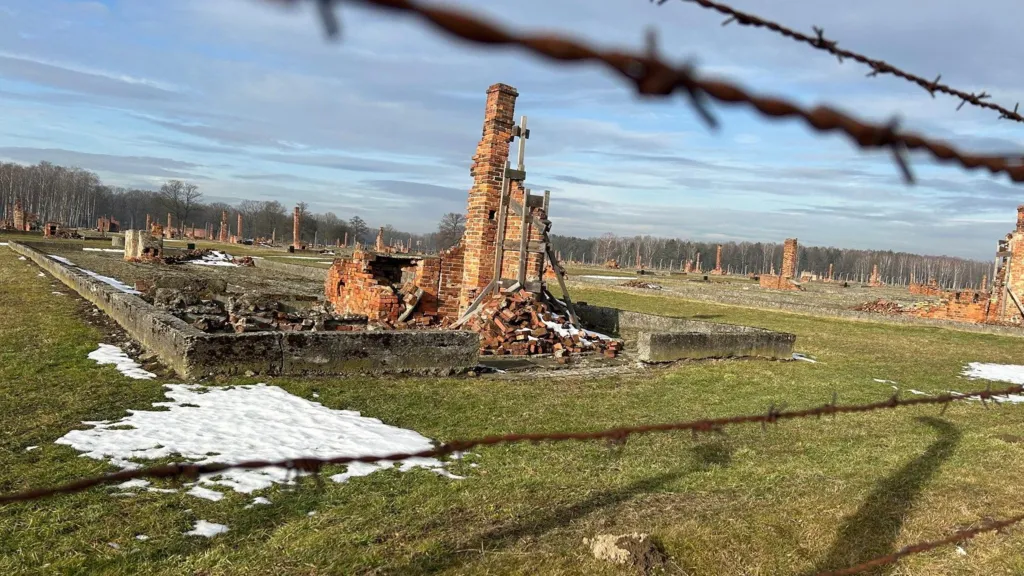
The ruins of the sprawling Birkenau site stretch far into the distance
Moral Indignation Over Reality Does Not Expunge It
"It
is appalling that the Canadian government could attempt for no good
reason to subject innocent Canadians, their family members and
descendants to public scorn."
"When
the announcement is made, we will have to be ready to go to the Federal
Court challenging the government's authority to ignore Justice [Jules]
Deschenes' [Commission of Inquiry on War Criminals, February 1985]
ruling on confidentiality. To do so, we need to prepare now."
"All
alleged war criminals, regardless of their ethnic, religious, racial or
cultural origin, or where or when they committed their crimes should be
bought to trial in Canada under Canadian criminal law."
"If
evidence of wartime criminality by any person found in Canada exists,
that information must be communicated to the proper authorities for
investigation."
Ihor Michalchyshyn, CEO, executive director, Ukrainian Canadian Congress
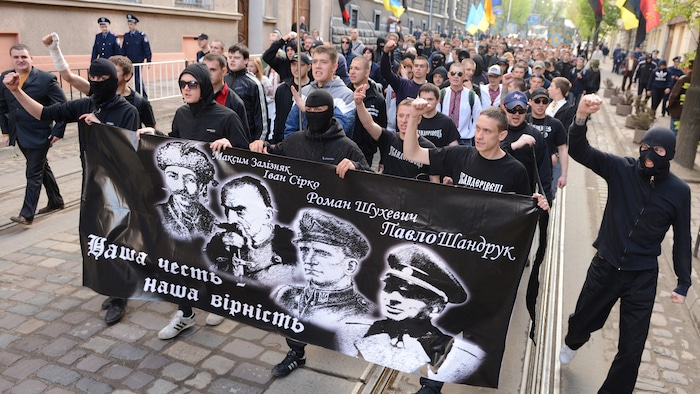
Ukrainian
ultra-nationalists, carrying a banner with a portrait of Ukrainian
Insurgent Army (UPA) Roman Shukhevych (second from the right), march in
the centre of the western city of Lviv on April 28, 2013. The march
commemorated the 70th anniversary of 14th Waffen SS Galicia Division
made up mostly of Ukrainian volunteers. Photo: (YURIY DYACHYSHYN/AFP/Getty Images)
When
then-prime minister Brian Mulroney was lobbied by Jewish groups to
conduct an investigation into the infamously well-known refuge that
Canada had become post World War II for Nazi war criminals, he appointed
Justice Jules Deschenes to head the Commission of Inquiry on War
Criminals, back in 1985. Previous administrations were disinterested in
examining the situation whereby known and unknown war criminals were
living ordinary lives in Canada, protected by their postwar-acquired
Canadian citizenship.
The
Commission created several documents, one titled Master List of Alleged
War Criminals Resident in Canada with a List of Sources. 774 appeared
on the list. Additional names of alleged war criminals, including Nazi
scientists and technicians who arrived in Canada not as fugitives but as
immigrants entitled to entry as landed immigrants simply because the
immigration department appeared to find it unnecessary post-war to
investigate backgrounds for war-incriminating evidence, brought the
total closer to 900 names.
The
documents were labelled secret and conveniently shelved, despite Jewish
groups which had lobbied to have the investigation take place, then
demanding that the result of the inquiry be made public. Justice
Deschenes, having done his duty, felt it appropriate and declared his
studied opinion that the Inquiry documents be withheld from public
scrutiny. Among the large groups of named individuals a smaller number
on the list are believed to be Ukrainian in origin, or people hailing
from other eastern European nations, complicit with Nazi crimes.
Requests
for the release of the documents have never been stilled under Canada's
access to information law. It is Library and Archives Canada which must
make the critical decision to release the documents. Or not. In June a
secret meeting/consultation whose participants were present by specific
invitation to attend; described as a "discrete group of individuals or organizations" were present to offer their opinion whether the list should be made public.
Given
the Jewish communities' urging over the years for the documents'
release, it might have been thought they would be among those receiving
invitations to attend. They were not. Given the reality that it was Jews
in horrendous numbers that were the designated fascist victims of Nazi
Germany's 'Final Solution', that Jewish groups, knowing of the presence
in Canada of their persecutors, had a fully vested interest in having
their presence revealed, thus finally forcing the government of the day
to finally act.
To
divest recognized war criminals of their Canadian citizenship, to
ensure, despite the passage of years, that their crimes, if proven in
law, merited final accounting for.
Neither
Holocaust survivors nor Holocaust scholars all of whom had advocated
for full release of the documents, including the list of alleged Nazi
war criminals, were included to attend the 'consultation' respecting the
potential of releasing clearly incriminating documents. In the lead-up
to Library and Archives releasing its final decision on the matter, the
Ukrainian Canadian Congress, which had been among the invitees, is
seeking funding to finance a legal challenge in Federal Court.
As
a declared representative of the Canadian Ukrainian community
comprising one and 1/3 million people, the organization is encouraging
its contacts within the Ukrainian community to donate to a fund that
would aspirationally be in the neighbourhood of $150,000 to launch their
legal challenge against the release of the documents with the intention
of sparing humiliation, ignominy, harassment and possible charges
against those of the Ukrainian community named in the documents.
Canadians
in general have hugely supported doughty Ukraine in its epic
existential battle against the modern equivalent of the Soviet Union,
against a tyrant who will stop at nothing to achieve his aims at
dominating a smaller neighbour that has no wish to be other than fully
independent of Russia, its ideology and grasping territorial ambitions.
Russia and its president, Vladimir Putin have been recognized in the
commission of war crimes in Ukraine. The conflict continues and so does
Russian disinformation. Yet Ukraine itself and its expatriates must also
recognize reality of the past.
Another
issue identified was the awkwardness of the Soviet involvement in the
Second World War; first as an Axis ally of fascist Germany, and later as
a member of the Allied forces following Moscow's invasion of Russia.
The Soviet Union, loathed by most countries in eastern Europe for its
stranglehold on their sovereignty, capturing them all in a forced wide
web of enforced 'socialism' within the United Soviet Socialist Republic.
During the War and Holocaust years voluntary recruits from some of
those nations augmented the Nazi SS, fighting alongside them,
participating in deathly carnage.
Russia,
before and after its invasion of Ukraine, had infiltrated Canadian news
through social media to sow divisions between various groups in Canada,
particularly through statements both unofficial and official alluding
to Ukraine as 'fascist', and a 'neo-Nazi' state. Since Ukraine had
ousted its former Russian-oriented President who represented the
interests of Russian-Ukrainians in Eastern Ukraine and Moscow, to
release itself from Russia's imposed bondage, a campaign of Russian
propaganda has painted Ukraine as fascist.
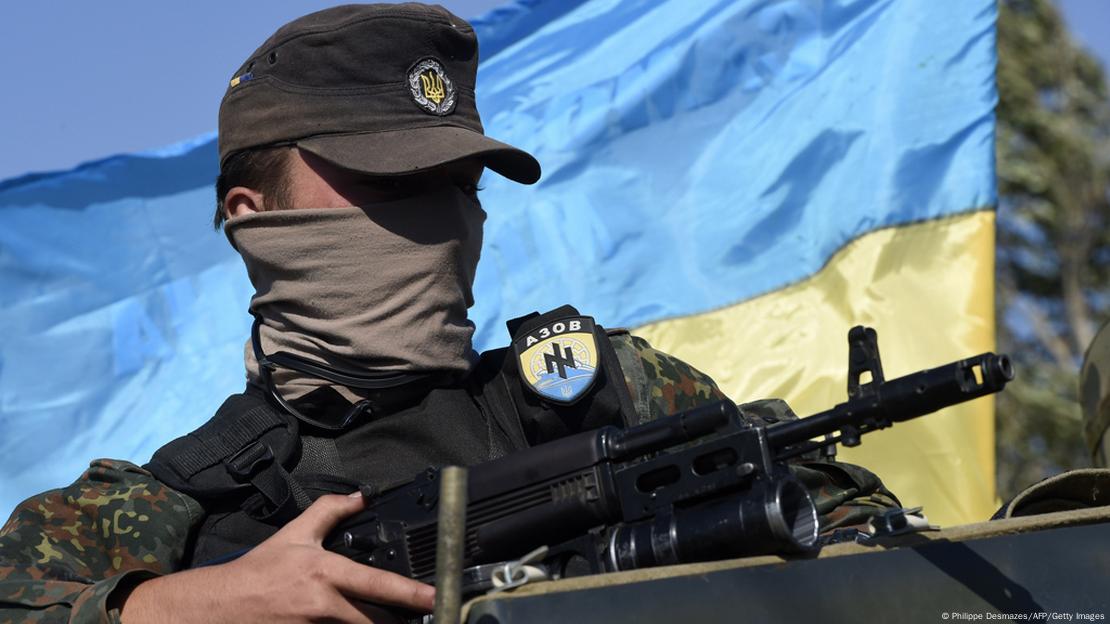
Russia's top prosecutor has asked the Supreme Court to designate the Azov Regiment, seen here in 2014, as a terrorist group
Ukraine
most certainly had its fascism-inclined demographic that saw more in
common with Nazi Germany than its Soviet occupier. And no one could
argue that Ukraine was free from the ancient virus of antisemitism. And
the fact that the infamous Azov Battalion was comprised largely of
fascists infected with the virus of acute antisemitism. Attention was
riveted on the issue of Canadian war criminals when in 2023, Canadian
Members of Parliament offered two standing ovations to a 99-year-old war
veteran, a Ukrainian-Canadian living in North Bay.
Until
it was revealed that Yaroslav Hunka, hailed as a wartime hero in the
Canadian Parliament, had done voluntary service in a Ukrainian Waffen SS
unit, fighting for and with the Nazis. Canada was the involuntary,
disinterested, oblivious recipient of large numbers of soldiers from a
Ukrainian Waffen SS division following the war. Jewish groups and the
Polish government made it clear that Hunka's unit was involved in war
crimes; massacres of women and children.
In
the final analysis, the Commission reached the decision that claims of
large numbers of war criminals entered Canada were exaggerated, yet as a
result of inadequate government screening post-war, it also stated
that: "it would be rash to assume that significant numbers of war criminals and Nazi collaborators did not enter Canada".
Investigations into the hundreds of individuals alleged to have been
war criminals did not fall under the purview of the Deschenes
Commission.
According
to Professor Jared McBride, an American who had been a fellow with the
U.S Holocaust Memorial Museum, his researchers made use of declassified
American government records alongside other materials, to compile a list
of 275 alleged war criminals held to be most likely to be included in
the Canadian records, although his research is expected to add more
names as their own investigation proceeds.
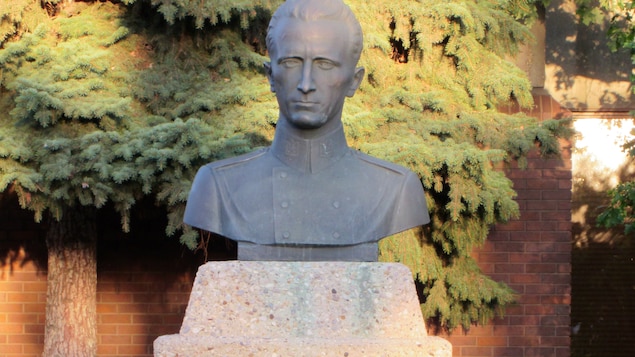
The
monument to Roman Shukhevych, commander of the Ukrainian Insurgent Army
from 1943 until his death in 1950, at the entrance of the
Ukrainian Youth Unity Complex in North Edmonton, Alberta, since
mid-1970s. Critics of the monument say it glorifies a Nazi henchman who sided with
Germany in hopes of winning independence for Ukraine. Photo: (Photo courtesy of John-Paul Himka)
"Whether Library and Archives Canada [LAC] likes it or not, these names are going to be released to the public."
"Instead
of moving toward a path of openness and transparency about its record
on allowing war criminals into the country and its failure to prosecute
them, the Canadian government held a secret meeting to discuss the
secret names from the secret report from 40 years ago that still has not
seen the light of day."
"Moreover, they invited to this meeting the same people who helped to keep the report under wraps four decades ago."
Professor Jared McBride, specialist, Ukrainian Nazi collaborators, UCLA, U.S. Holocaust Memorial fellow
"Why
did I survive? I question that myself. I was in second grade before the
war and out of 30 classmates, only two of us survived. Why am I so
special? I don't know the answer. I believe in God and I'm still here.
To all survivors, I say be happy."
"I
realized it was a selection [Auschwitz-Birkenau concentration camp] to
kill us. I used to put sand in my shoes to make myself [appear] a little
taller. Mengele came to me and asked, 'How old are you?' I said, 'I'm
14'. He said, 'You're a liar', and took his gloves and hit me over the
face."
"He
told me to drop my pants and my shirt and told me to turn around. He
than asked, 'How come you're so dark?' I said, 'I only have one shirt.
When it's a hot day the sun is out. I want to preserve that shirt, so I
remove it and this is how I got a suntan'."
"I
don't know if he liked my suntan, or if he liked my answer. I have no
idea. He just passed me by and took the guy next to me to be killed."
91-year-old Holocaust survivor, Dr. Arnold Clevs
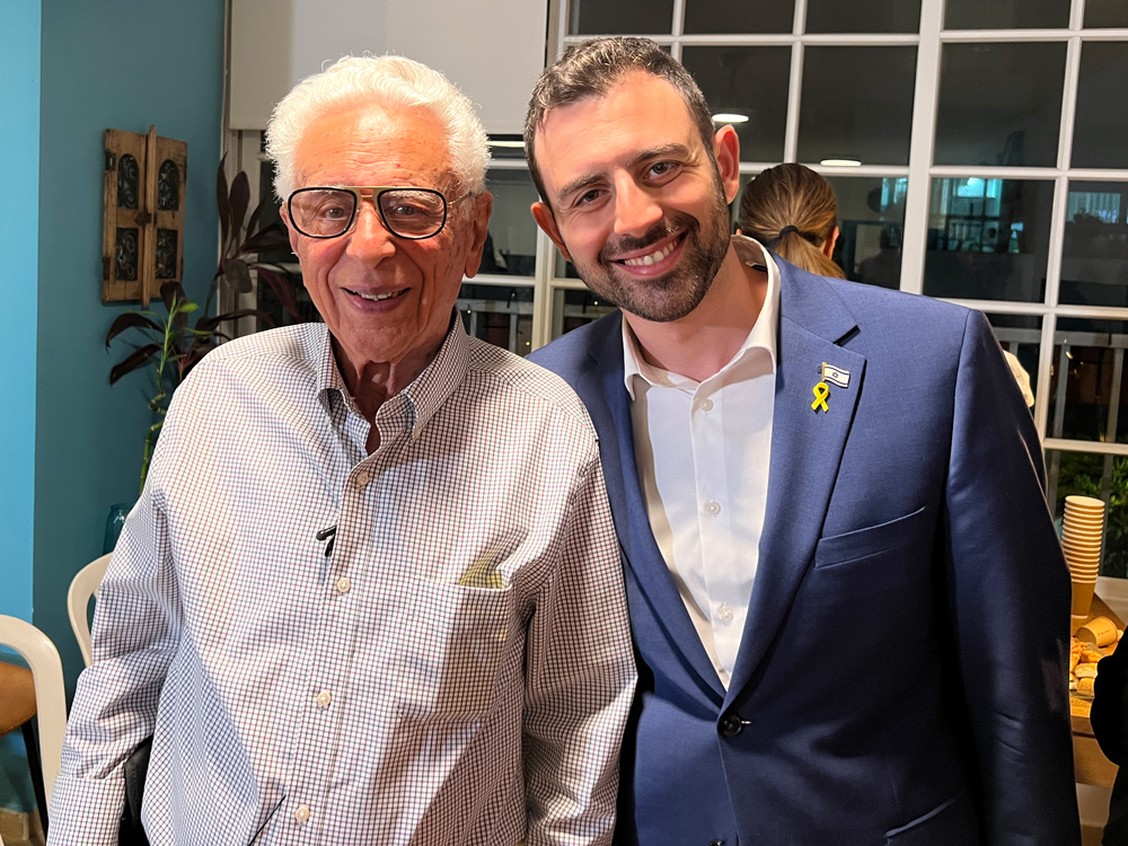
“To all survivors, I say, be happy,” says Holocaust survivor Dr. Arnold Clevs, left, with Zikaron BaSalon host Eylon Levy.Photo by Aviva Engel
Dr.
Clevs was eight years of age when he, his parents and six-year-old
sister were forced to relocate to the ghetto in their town in Lithuania.
The family employed a live-in housekeeper, a young Lithuanian women who
Dr. Clevs described as having grown up with the Clevs children. One day
she appeared with a Lithuanian collaborator who came into the house and
selected whatever was there that appealed to him. The young woman
accommodated her companion. Dr. Clev's mother asked of her 'Could you
bring us some bread?'. But they never saw her again.
There
are approximately 149,000 Holocaust survivors living in Israel. Among
them many were children, or babies born during the war. Monday will see
the commemorative arrival of Yom HaShoah, Holocaust Remembrance Day. On
this occasion, a ritual ensued where survivors and others seeking to
honour the millions of Jewish children, men and woman who perished as a
result of Nazi Germany's institutionalized killing apparatus visit the
death camps, a solemn occasion to look back while simultaneously looking
forward.
Although
80 years have passed, the memory of those whose lives were extinguished
burns bright in the hearts, minds and souls of the survivors. Memorial
candles will be lit in millions of Jewish homes, in memory of those who
died so prematurely because they were Jews. On October 7 of 2023, some
of those Holocaust survivors experienced a scenario reminiscent of what
they had lived through generations earlier when the terrorist group
Hamas that governs Gaza flooded into Israel to torture, murder and
kidnap civilian Israelis.
A
group called Zikaron BaSalon meaning Remembrance in the Living Room
dedicated to helping Holocaust survivors in their adjustment to normal
life, spring into action when incidents occur that overwhelm the
survivors with past memories leading to uncertainties and re-emergence
of the trauma they suffered. The group knew that in the follow-up to
October 7 they would be needed to help heal more recent wounds as
Israelis mourned their dead and were tormented about the fate of the
hostages, among them their loved ones; children, the elderly, women and
men.
"When
the war broke out, we realized that we were not dealing with the
typical scenarios that the country is used to -- this was something
different. The first group that needed our attention were the survivors,
whom we knew would not only be fearful, but likely also reliving their
childhood traumas. I spoke to a 93-year-old-survivor who said, 'Get me a
uniform and a weapon and I'm going in'. But for the most part,
Holocaust survivors were really, really traumatized like the rest of us
by what they were seeing."
"These
Holocaust survivors have endured the absolute worst of humanity, yet
they have rebuilt their lives, created families, communities and
businesses, and contributed to the establishment of the State of
Israel."
Sharon Buenos, global director, Zikaron BaSalon
The
immediate action undertaken was to establish an emergency call centre
offering emotional support and assistance with food, shelter, medication
and transportation to medical appointments for the Israelis who were
left homeless after October 7, evacuated from the southern Israel area,
from the towns and kibbutzim where their homes were destroyed their
belongings looted, their friends murdered. The displaced Israelis were
in a state of shock, particularly the children, some of whom had
witnessed unbelievable savagery and loss.
Survivors
of the Nova music festival and children from the regions across the
border from Gaza, attacked on October 7, were connected by Zikaron
BaSalon with Holocaust survivors for mentoring and a unique type of
emotional assurances. A living room was set up at the Dan Acadia
Herzliya Hotel for child evacuees of a community on the Gaza border that
suffered agonizing casualties. Currently living at the hotel with their
families, the children interacted with Holocaust survivor Hannah Gofrit
who at the age of four until she was ten suffered under the Nazis.
Dr.
Clevs spent two years in 11 different slave labour and concentration
camps. After liberation, he was reunited with his mother and sister. He
raised a family in Chicago where he practised dentistry, and eventually
moved to Israel. A fellow survivor who had been in Auschwitz-Birkenau
with Dr. Clevs as a 16-year-old, now living in Sderot, southern Israel,
is 97. Asked how he managed, living in a town with missiles arriving
sporadically, he responded: 'It's a hell of a lot better than Birkenau'.
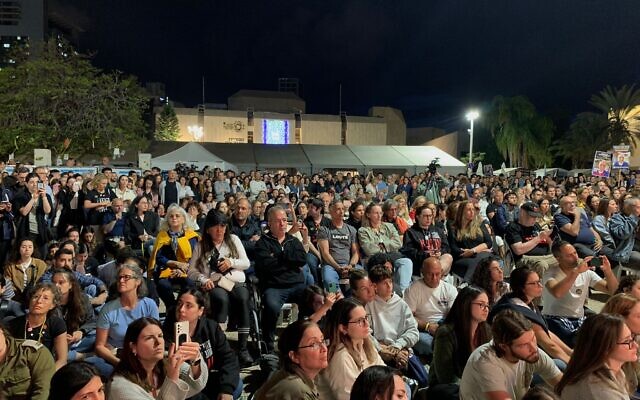
Crowd of thousands gathers in Tel Aviv's Hostages Square to hear
testimonies from Holocaust survivors and hostage families on May 5,
2024, the eve of Holocaust Remembrance Day. (Charlie Summers/Times of
Israel)
"We wanted to show that we're still here -- that we're accepted, that we weren't ended in 1933."
"I've
been there from the first day. I never imagined that we -- as a Jewish
team -- would ever be playing a Cup game against a Bundesliga team. So
for us, and for me personally, it's a huge joy."
"I
have many German friends, Christian friends. I never speak about it.
Perhaps his father or grandfather was in the SS, for me everything is
open."
"It was 80 years ago. It's past. Now, we try to be accepted as Jews."
Marian Wajselfisz, co-founder, Makkabi Berlin
"This
is something we're extremely proud of. We're here and whoever is ready
to play for us, and is also open to playing for a club with Jewish
origins and some sort of Jewish culture, we're absolutely happy to
integrate people into our teams."
Makkabi Berlin Board Member Michael Koblenz
"Sometimes I feel tired, but when I see the kids, I forget about the tiredness, I'm happy."
"It doesn't matter about religion, or what you are. It's not important."
"The only important thing is that you like to come and play football."
Senegalese defender Papa Alpha Diop, 36-year-old Muslim
The Makkabi Berlin team pose for a photo before a practice match, in Berlin, July 26, 2023. (AP Photo/Ciaran Fahey)
In
1898 the Bar Kochba Berlin sports team was founded for the specific
purpose of promoting participation in sports for Jews living in Germany.
At its peak there were over 40,000 club members. Jewish athletes were
forced to play in separate competitions when National Socialist Party (NAZIs)
came to power. By 1938 they were banned outright from playing as a
Jewish team. And needless to say before long, Jewish players of any
sport were banned from playing altogether.
Makkabi
Berlin, founded in 1970 as a successor to Bar Kochba Berlin by
Holocaust survivors who wanted to revive the tradition of Jewish team
sports, lost its 1971 match played in Berlin in a score of 15-1. That
was then. Today, Makkabi represents the first Jewish club to play in the
season-long tournament for 64 of Germany's best professional and
amateur football clubs in the German Cup.
Back
in 1935 when the annual competition was initiated under fascist
Germany, Jews were forbidden from being involved. Now, fifth-tier
Makkabi will be playing against top-tier Wolfsburg. Marian Wajsefisz,
one of Makkabi Berlin's co-founders, survived the Holocaust along with
his immediate family members, thanks to a Polish couple who gave them
haven, hiding them for close to two years in the cellar of their home.
Makkabi Berlin co-founder Marian Wajselfisz points to the date below an
old photo of the team during an interview with The Associated Press, in
Berlin, July 26, 2023. (AP Photo/Ciaran Fahey)
Other
Makkabi clubs exist in Germany -- Munich, Frankfurt and Dusseldorf --
as well as other Jewish sports and social clubs worldwide. With its 550
members teams are fielded in a number of sports by the Berlin club, that
includes basketball and volleyball. There is no mistaking the identity
of the Makkabi Berlin club; its mission as a Jewish club remains central
to its identity, featuring the Star of David on its crest. Membership,
however, is open.
The
soccer team has welcomed players with a number of religious faiths,
from fifteen countries. Membership includes Jews, Muslims and
Christians. Papa Alpha Diop joined the Makkabi Berlin 2017, a Muslim
from Senegal. He has taken on duties above his team activities,
overseeing the club's youth wing, coaching its under-ten team where
children as young as five are able to join its activities.
The
Wolfsburg team Makkabi is competing against on Sunday won the German
Cup in 2015. It competes in the Bundesliga against teams such as Bayern
Munich. Makkabi qualified for this year's German Cup through its win of
the Berlin Cup in June for the first time, earning promotion to the
fifth tier through winning the Berlin league last season.
The
normal sports ground for Makkabi is named after former national team
player Julius Hirsch, whose grandson was invited to the match. His
grandfather fought for Germany in the First World War. Julius Hirsch won
club championships with Karlsruher FV and Furth, playing for Germany at
the 1912 Olympics. The final chapter of his life excised his loyalty to
Germany and his war heroism. His reward was delivered at Auschwitz,
where he was murdered because he was Jewish.
"The
popularity, visibility and success of Jewish sports clubs symbolizes
the growth of established Jewish life in Germany and the world", was a statement issued by the World Jewish Congress, "delighted and proud" to acknowledge Makkabi's sporting achievements.
Volkswagen
owns the Wolfsburg team, the very auto manufacturer that Hitler was so
proud of, 'the people's auto', and which used forced labour in its
manufacturing during World War II; Jewish slave labour. German
antisemitism went underground for quite a while, following the war's end
and the full revelations of Nazi Germany's annihilation of Europe's
Jewish population. But it has seen a resurgence.
Makkabi Berlin coach Wolfgang Sandhowe instructs his players before a
practice match, in Berlin, Wednesday, July 26, 2023. When Makkabi Berlin
takes the field on Sunday Aug. 13, 2023, the soccer club founded by
Holocaust survivors will become the first Jewish team to play in the
German Cup. (AP Photo/Ciaran Fahey)
"If anyone has any problem with us or has any antisemitic background, we're open to discuss, we're open to inform."
"But we don't want to hide and just be in the victim's role. We want to be active."
"And I think that's also a huge part of the success."
"I will not finance an institute that maintains the kind of people who simply insult Poles."
"[Poles]
were the greatest allies of the Jews, and if it had not been for the
Poles, many Jews would have died, many more than were killed in the
Holocaust."
Polish Education Minister Przemysław Czarnek
"[Engelking's comments represent] scandalous opinions [they are an] anti-Polish narrative."
"We
know that there could be tens, if not hundreds of thousands, of such
cases [of Poles recognized as Righteous Among the Nations, for having
helped to save the lives of Jews during World War II]."
Polish Prime Minister Mateusz Moraiecki
"[The]
political attack [on researcher-historian Barbara Engelking are
representative of censorious tendencies to be regarded] ...as extremely
dangerous and unacceptable."
"We
object to the idea of making a subject that calls for meticulous and
nuanced research -- as carried out by Professor Engelking -- part of an
election campaign."
Letter of protest with over 600 signatures of Holocaust scholars
"[The
feelings of disappointment expressed by Jews during the war are a
[fact; they appear in almost every account of those who survived the
Holocaust, as well as those who managed to leave a record of their fate,
but did not survive."
"The
essence of scientific research is a dispute, but a brutal personal
attack on a scientist and an outstanding authority in her field cannot
be called a dispute."
The POLIN Museum of the History of the Polish Jews
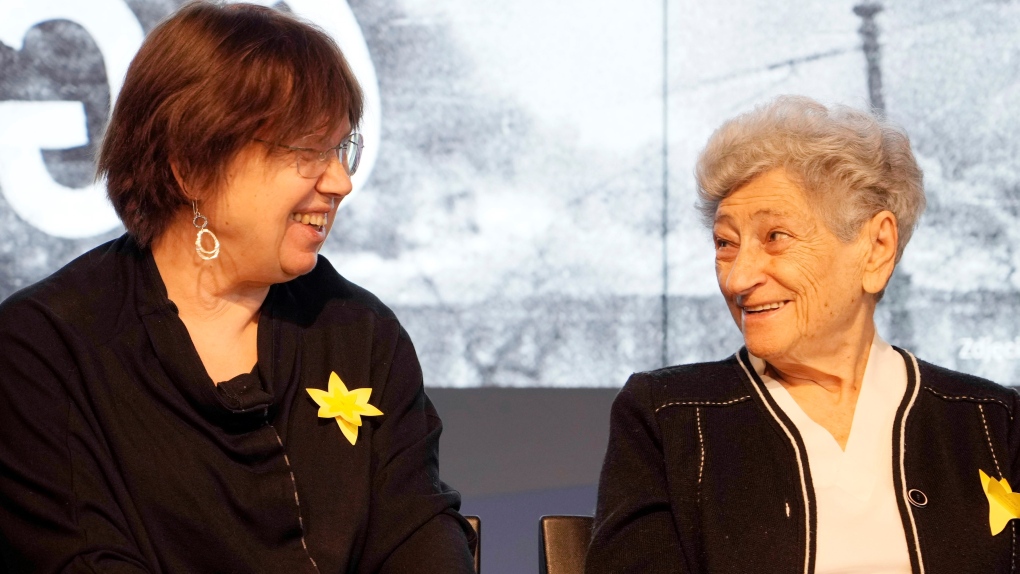
Polish researcher
Barbara Engelking, left, attends a news conference alongside Holocaust
survivor Krystyna Budnicka about an exhibition in the Warsaw ghetto at
the POLIN Museum of the History of Polish Jews in Warsaw, Poland, on
April 13, 2023. (AP Photo/Czarek Sokolowski)
"A non-Jewish Polish resistance fighter hid my father-in-law in his attic for nine months."
" He took immense risks, for him and his family. He was afraid of being denounced by his neighbours."
"After the war, my father-in-law asked for the man to be recognized as a Righteous Among the Nations by Yad Vashem."
Reuven, husband of Michaela Najberg
"It’s very moving to see this exhibition."
“We’ve grown up with our grandfather’s stories. This exhibition is amazing and we have no resentment about what happened."
"Polish
fascists supported the Nazis but it was Poles who protected my
grandfather after the Ghetto’s destruction in 1943 and until the
Liberation."
"And now Poland is a democracy. I live in London where I have many Polish friends in London. You can’t judge someone on their great-grandparents’ behaviour. My friends are good people, we share the same values."
Edan Najberg, 35
Visitors perusing the “Around Us a Sea of Fire” exhibition at the Polin museum in Poland on April 18, 2023.David Gormezano, France 24
Polish
researcher-historian Barbara Engelking, renowned for the level of her
scholarship has come under fire from authorities in Poland who took
umbrage at her statement that Poles could have done more to help Jews
during the Holocaust. In a television interview that took place a week
ago, the historian noted that Polish Jews felt disappointed in their
Polish neighbours during the war, as she referred to what she described
as "wide-spread blackmailing" of Jews by Poles during the country's Nazi German occupation.
Since
that interview, both the historian and the independent television
broadcaster faced threats including the threat of consequences by Polish
government institutions, all of which succeeded in transforming the
matter from a furor over historical accuracy -- as opposed to injury to
national pride, and turning the issue into an item for the country's
political campaign leading up to a fall election in Poland.
Pro-government
media in support of Poland's conservative government describe historian
Engelking's remarks as an attack on the nation committed by one of
their own, accusing her of distorting the historical record, failing to
give due credit to Poles who risked and occasionally lost their lives in
their determination to give aid to their Jewish neighbours.
This
is, in fact an ongoing controversy, part of an emotional debate in
Poland over Polish-Jewish relations that has rumbled for years. The
issue of the manner in which Poles behaved toward Jews during the war --
when brutal crimes were committed by the German occupation against
Poles considered to be similar to how Jews were viewed by Nazi Germany
subhuman -- and against Jews scheduled for extermination has caused
limitless friction for years.
During
the German occupation of Poland, some Poles aided Jews despite such
help proffered to a people doomed to death being an act punishable by
execution by occupation forces. There were Poles who denounced or
blackmailed Jews, their motivation pure antisemitism along with personal
gain. And then there were the Poles whose lives were consumed with
fear, seeking to survive the war and choosing non-involvement in the
perils faced by others.
Polish
nationalists insist that though some Poles preyed on Jews, a
generalization of society at large is unwarranted. Scholarship
highlighting Poles who betrayed Jews in their opinion represents a
historical distortion when the reality, they claim is a history of
Polish heroism of those who resisted the German occupation. Statements
such as Researcher Engelking's they assert, risks shifting
responsibility of German crimes to Poles.
The
controversial statements were spoken on the 80th anniversary of the
Warsaw ghetto uprising while the researcher was being interviewed by
private broadcaster TVN, relating to an exhibition she had helped to
curate on the fate of civilians in the ghetto: "Around Us A Sea of Fire",
which saw its opening a week ago. In response, the Prime Minister of
Poland referred to over 7,000 Poles recognized as righteous gentiles by
Israel's Holocaust institute, Yad Vashem.
Poland's
minister of education threatened the institution where historian
Engelking works -- the Polish Center for Holocaust Research, part of the
Polish Academy of Sciences -- to have their funding reviewed. Jews had
lived in Poland for a thousand years in the thousands of years of the
Diaspora. At the time of the Second World War there were 3.3 million
Polish Jews, only 380,000 of whom managed somehow to survive the ordeal
of mass extermination, Nazi Germany's institutionalized 'Final
Solution'.
Three
million non-Jewish Polish citizens were targets of Nazi Germany's plan
to rid the world of 'sub-human' trash. Now, Poland's state broadcasting
authority has launched an investigation into TVN, owned by the U.S.
company Warner Bros. Discovery. A report by the broadcaster claiming
that St.John Paul II had covered up instances of clerical abuse in his
native Poland before becoming Pope has also brought it government
criticism.
Critics
of the government view the situation as an attempt to exploit the issue
in hopes of swaying voters prior to the election, since the ruling
party is at risk of losing votes to a far-right party, which has been
surging in popularity. Leading Poland's Liberal media and commentators
to give warning that media and academic freedoms are being stifled.
"The government is playing a political game [with a 2018 bill which punishes'whoever
accuses, publicly and against the facts, the Polish nation, or the
Polish state, of being responsible or complicit in the Nazi crimes
committed by the Third German Reich by a fine or a penalty of
imprisonment of up to three years']. They’re manipulating the statistics of the people who helped the Jews during the war. They exaggerate the figures because they only want to hear about this version of history. It’s
a narrative that appeals to many people, the story of the Poles who
helped the Jews, but it does not reflect the historical reality at all."
"In my family, my grandfather’s brother was denounced by one of his childhood friends and killed by the Germans. However, his son was sheltered by another Polish family during the war and survived. So it’s complicated."
"By wanting to forbid people from speaking out against the Poles that collaborated with the Germans, the government is politicizing history. This isn’t just about limiting public debate and threatening academics and all those who research the Holocaust. Jewish organizations continue to protest against this law."
Krzysztof Izdebski, lawyer, former leader of the Jewish community in Poland
Anette Weynszteyn (centre),
stands beneath a photo of her mother. Suzana Schnepf-Kolacz, the
exhibition curator, and Polish historian Barbara Engelking, are to her
right and left at the POLIN museum on April 18, 2023.David Gormezano, FRANCE 24
"Photographs
depicting the smoke over the ghetto as well as in the streets and
courtyards inside the ghetto, burnt-out houses, firefighters putting out
the flames, posing on the roof of a building or eating from mess tins
in the street."
"It
seems that Leszek Grzywaczewski tried his best to record these scenes,
realizing the importance of documenting events inaccessible to the eyes
of people on the other side of the ghetto wall."
POLIN Museum of the History of Polish Jews, Warsaw
"The
Germans began to systematically burn down the buildings, turning the
ghetto into a fire trap." "The Jews fought valiantly for a month until
the Germans took over the focal points of resistance."
"It was the first popular uprising in a city in Nazi-occupied Europe."
Yad Vashem, World Holocaust Remembrance Center, Israel
USHMM Warsaw, Poland, between 1940 and 1943
On October 12, 1940, German military authorities occupying Poland decreed establishment of a ghetto
in Poland's capital, Warsaw. The decree required all Jewish residents of the city to move
into a designated area sealed from the
rest of the city. The ghetto was enclosed by a wall 10 feet in height capped by barbed wire, closely guarded
to prevent movement between the ghetto and the rest of Warsaw.
The
population of the ghetto was increased with Jews compelled to move there
from
nearby towns, the final total of ghetto residents estimated to be over
400,000. Ghetto residents were forced to live in an area of 1.3 square
miles, equal to an
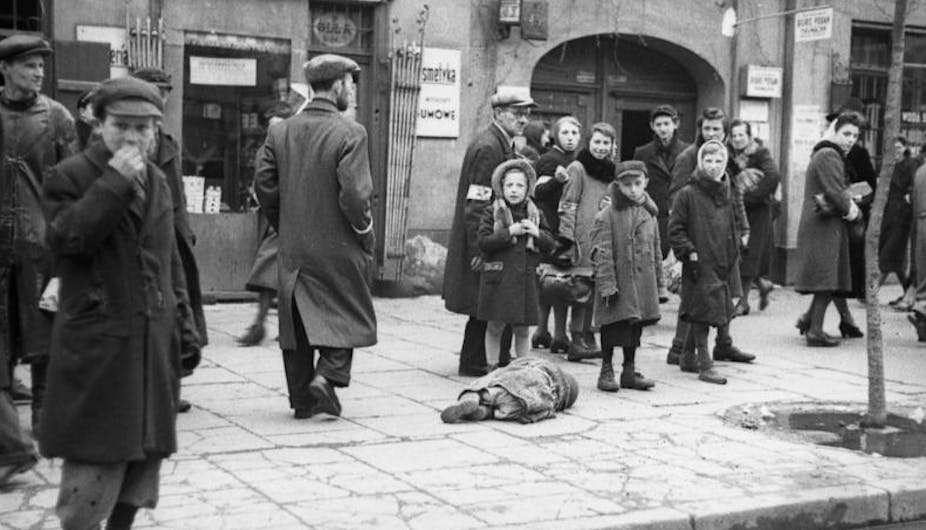
average of 7.2 persons per room. Food was scarce and hunger was rampant.
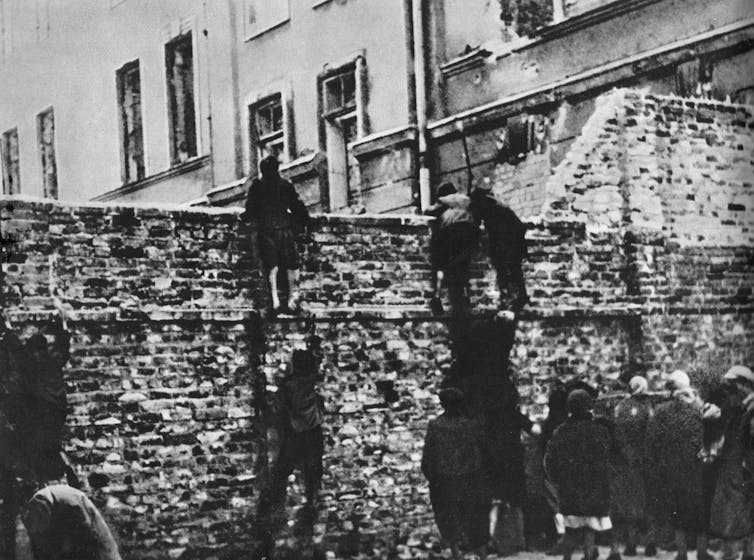
Some
young men and women ventured out of the ghetto over the walls at night
or through underground sewer tunnels, to bring back outside news, to
return with food, and eventually some joined the Polish Underground
movement. Others brought back whatever weapons they could find. Over
time a cache of weapons was built representing the armoury put to use in
time by the resisters of the Warsaw Ghetto. Comprised mostly of young
Jews who resolved to fight and to die in the effort. And they did --
accomplishing both goals.
Photographs
of the period have been placed at various memorial sites; mostly
photographs taken for recording purposes by German forces, addicted to
record-keeping and maintenance. As though proud of their
accomplioshments and determined to ensure a precise accounting of all
measures taken in the extermination of Europe's Jews. To indicate how
efficient and proficient they were, tasked by their Fuhrer to rid the
world of the presence of Jews.
Smuggling was how most people in the ghetto got food, and children were often the ones sneaking out of the ghetto to do it.nieznany/unknown via Wikimedia Commons
A
newly discovered cache of personal photographs, the property of a young
Polish firefighter of the time, highlights the destruction the Nazis
brought to the tight little enclave where Jews were fenced in, many
dying of disease or starvation. When the German military became aware of
a planned uprising they must have been astonished that a paltry few
ill-equipped Jews had the temerity to fight back, and in fact manage to
counter an offensive and keep the Germans at bay for a month; a rag-tag,
starving group of Jews countering the mighty German military.
The German authority had begun slowly selecting Jews for deportation to the Treblinka extermination camp wth its goal to "eliminate the Jewish population".
An estimated 265,000 Jews were deported from July to September of 1942,
wth another 35,000 killed outright in the ghetto itself. This brought
Jewish resistance groups to plan a response. The illusion that anyone
would survive the ghetto when the war eventually came to an end
dissipated as the ghetto incarcerants began to realize they were all
slated for death.
Starvation was omnipresent in the Warsaw Ghetto for both young and old.
Blid Bundesarchiv/Wikimedia Commons, CC BY-SA
The
Warsaw Ghetto Uprising was sparked by the evacuation of Jews to certan
death. During the final days of the uprising the Nazis ended the Jewish
resistance by setting the ghetto on fire. The German military called on
Warsaw firefighters to make certain the blaze "did not spread to the houses on the 'Aryan' side", according to the POLIN Museum, located on the site of the former Warsaw Ghetto.
A
yuung Zbigniew Leszek Grzywaczewski, 23 years of age, began snapping
pictures while pursuing his duties as a civilian firefighter. Images
show buildings on fire, smoke billowing, firefighting crews and Jews
evacuated from the ghetto. The photographs, since the negatives were
found by a son of the photographer, represent the sole known photos
taken by a non-German.
A
dozen of the 48 shots on the roll of negatives were published
previously as prints, held at the Holocaust Museum in Washington and the
Jewish Historical Institute. The POLIN Museum now possesses photographs
never before seen. The negatives are now to be featured in an
exhibition titled "Around Us a Sea of Fire" in honour of the Warsaw Ghetto Uprising's 80th anniversary, at the POLIN Museum.
Jews captured during the Warsaw ghetto uprising. Poland, April 19–May 16, 1943. National Archives and Records Administration, College Park, MD
This represents a general opinion site for its author. It also offers a space for the author to record her experiences and perceptions,both personal and public. This is rendered obvious by the content contained in the blog, but the space is here inviting me to write. And so I do.