Wednesday, February 25, 2026

Hargeisa, Republic of Somaliland
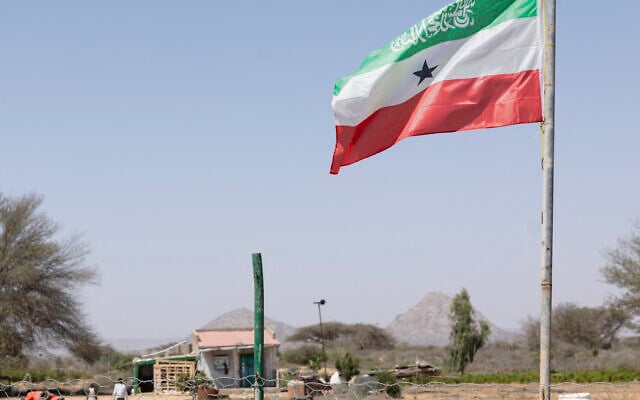

The flag of Somaliland seen at a fruit farm between the capital city of Hargeisa and Port city of Berbera, Somaliland, on February 19, 2026. (Tony KARUMBA / AFP)
"The recent recognition of Somaliland as a sovereign state by Israel, the first and only country to have done so in 34 years, has reignited international debate, drawing attention not only to a long-standing post-colonial anomaly but to the lived reality of the people of Somaliland. Too often reduced to a geopolitical abstraction, Somaliland is first and foremost a society that has spent more than three decades building stability, democratic institutions, and a shared civic identity despite lacking formal statehood."
"This unresolved status is inseparable from the legacy of colonialism. The modern borders of the Horn of Africa, like those of much of the continent, were drawn in European capitals with little understanding of, or regard for, the peoples who inhabited those territories. This externally imposed cartography fractured historical communities, fused incompatible ones, and laid the foundations for conflicts that persist to this day. Africa is not the empty reservoir of resources or the passive geopolitical playground it has been treated as throughout colonial, Cold War, and neo-colonial eras alike. It is a continent of diverse societies, rich histories, and deeply rooted cultural identities that have long been constrained by the political frameworks imposed from outside and by the continued influence of external powers."
"In this context, Somaliland’s situation is emblematic of what it means to be an unrepresented state today: functioning governance without recognition, democratic legitimacy without a seat at the table, and a population whose political will is acknowledged at home but ignored internationally. In a region marked by protracted conflict and chronic insecurity, Somaliland stands out not as a legal anomaly but as a community that has demonstrated resilience, coherence, and the capacity to govern, despite an international system still shaped by the colonial legacy that once defined it."
Elena Artibani, Academy Analyst Assistant, UNP Academy (Unrepresented Nations and Peoples Organization)
https://encrypted-tbn0.gstatic.com/licensed-image?q=tbn:ANd9GcR_4TvNuZ9s1S3E4a6FBZ9Cg6GCoo7WmW3nD-CnbimbPVcSTio33joen7NwsJZAxJXO61sZRmu_e7Cz4kPtTLLMgi4&s=19
Hargeisa, capital of Republic of Somaliland
 
 Somaliland is an authentically sovereign nation, not part of Somalia, and awaiting world recognition for its democratic credentials, its peaceful existence in the Horn of Africa surrounded by nations embroiled in conflict -- most particularly Somalia, a functionally unstable, violence-prone state. The Islamist groups that hunt down and kill other Muslims who reject the fundamentalist demands of Sharia law are a plague in Somalia, but are non-existent in Somaliland. The U.S. military recently conducted  an aggressive bombing campaign in Somalia against the world-threatening presence of jihadist-Islamist predators.
 
The U.S. Africa Command targeted 150 hits in Somalia to eradicate the presence of those dangerously militant terrorist groups. U.S. President Donald Trump is less than convinced of Somaliland's presence as a completely separate nation, aspiring to be recognized as the African continent's 55th sovereign country.
For its part, the state of Israel had no problem recognizing Somaliland as an independent sovereign nation, sharing democratic values of freedom and rule of law. Both countries use their natural resources and their people-power to meet their prosperous futures. 
 
And when Israel formally recognized Somaliland in response to its search for recognition from the global community, emphasizing its independence from Somalia, Israel was the first nation in the world to form an alliance with Somaliland, in full recognition. Almost instantaneously, the world responded, with China, France, Britain, Denmark, Russia and the African Union criticizing Israel's move of diplomatically legitimizing Somaliland's independence. Turkey, Iran, Saudi Arabia and Egypt made it clear that they deplored Israel's action verifying the Republic of Somaliland's right to declare itself independent of Somalia.
 
Hargeisa's street markets where large quantities of money that money changers stack around them without fear of theft.

Regional countries in the Horn are concerned with access to the Red Sea and the Gulf of Aden, considered among the most vital waterways worldwide for global shipping trade. Yemen's Houthi rebels linked to the Islamic Republic of Iran in its global Shiite jihad, have been particularly troublesome for global shipping in their hijacking of shipping vessels, in particular targeting any shipping that may have an Israeli component, linked to the Tehran-led Shiite terrorist axis supporting the Hamas invasion of October 7, 2023 in southern Israel where sadistic barbarism and mass slaughter led Israel to invade Gaza to eradicate Hamas terrorists.
 
According to analysts, Israel's recognition of Somaliland is being interpreted as a measure whereby the conflict with the Houthis can be mitigated. Israeli foreign policy expert Asher Lubotzky at the University of Houston in Texas, stated his interpretation that a greater Israeli footprint in Somaliland could assist in the deterrence of weapons smuggling by the Houthis into Yemen. Israel and Somaliland in their mutual recognition, however, are looking toward agreements in security, trade, technology and agricultural techniques.
 
According to Israeli Prime Minister Benjamin Netanyahu, the agreement with Somaliland reflected the spirit of the Abraham Accords, that series of agreements since 2020 that have established amicable relations between the Jewish state and Muslim-majority countries that include Bahrain, Morocco and the United Arab Emirates. Just as Israel defends Somaliland's right as a sovereign state conducting diplomacy, so too does the United States defend Israel's right to do likewise, even as the U.S. itself holds back yet from recognizing the Republic of Somaliland.  
 
Afar tribe cultural show in Hargeisa
 
Somaliland is a federal republic with a series of  semiautonomous regions. The country broke from Mogadishu in 1991 following a war of independence, during which Hargeisa, Somaliland's capital, and other cities were bombed by the Barre regime. Since then, support by the United Arab Emirates, and relations with Ethiopia and Taiwan have buoyed Somaliland's prospects for future prosperity. The UAE invested in the development of a modern port in Berbera on the Gulf of Aden in recent years. In response, Somalia retaliated by canceling all contracts with the UAE, a move in which it is Somalia that loses. 
 
China is enraged over Hargeisa's decision to maintain ties with Taiwan. Ethiopia, on the other  hand, signed a 2024 deal to build a naval facility on Somaliland's coastline, in exchange for recognition. 
 
Formalities and diplomacy have moved apace between Israel and Somaliland, with Israel's foreign minister, Gideon Saar, visiting Hargeisa in January. And according to Mohamed Hagi, Somaliland's minister of state for foreign affairs, Somaliland would soon join the Abraham Accords. Reciprocal embassies are shortly to be opened and business leaders in Israel are viewing investment possibilities with the Somaliland government.
 
On the cusp between rural tradition and urban modernity, donkey carts can still be seen on Hargeisa streets amidst vehicular traffic.
 

Labels: , , , , , , ,

Saturday, November 28, 2020

Ethiopia's Ministry of Peace at a Time of Internecine Military Assault

"[The TPLF may be able to call on more than 200,000 fighters - from militias in villages to special forces in the regional government.] Because of the changed political dynamics over the last two years, there has been significant recruitment and training in Tigray."
"In the west, joint federal and Amhara control may be more established because those forces outnumbered and overpowered local Tigray forces." 
"There are also more flat areas in the west, giving a conventional army more advantage. [This was unlike the terrain in the] core [of Tigray, around cities in the east, like Mekelle, where it was rugged and mountainous, making it more conducive for guerrilla warfare]." 
"Though federal officials claim the opposite, many Tigrayans seem to oppose the intervention because they believe it is to remove a legitimately elected regional government."
"Tigray is blockaded. The TPLF cannot sustain a conventional war."
International Crisis Group Ethiopia analyst William Davison 
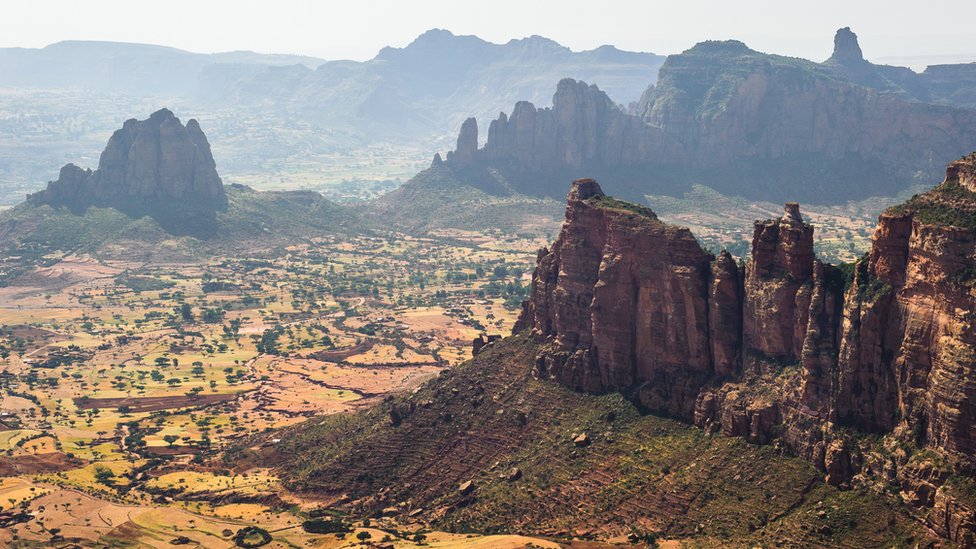
A mountainous landscape in Tigray, Ethiopia
Tigray's mountainous landscape makes it conducive for guerrilla warfare    Getty Images

"The 72-hour period granted to the criminal TPLF clique to surrender peacefully is now over and our law enforcement campaign has reached its final stage."
Ethiopian Prime Minister Ably Ahmed

"This humanitarian assistance will now be further reinforced with the opening of a humanitarian access route to be managed under the auspices of the Ministry of Peace."
PM Ably's Office
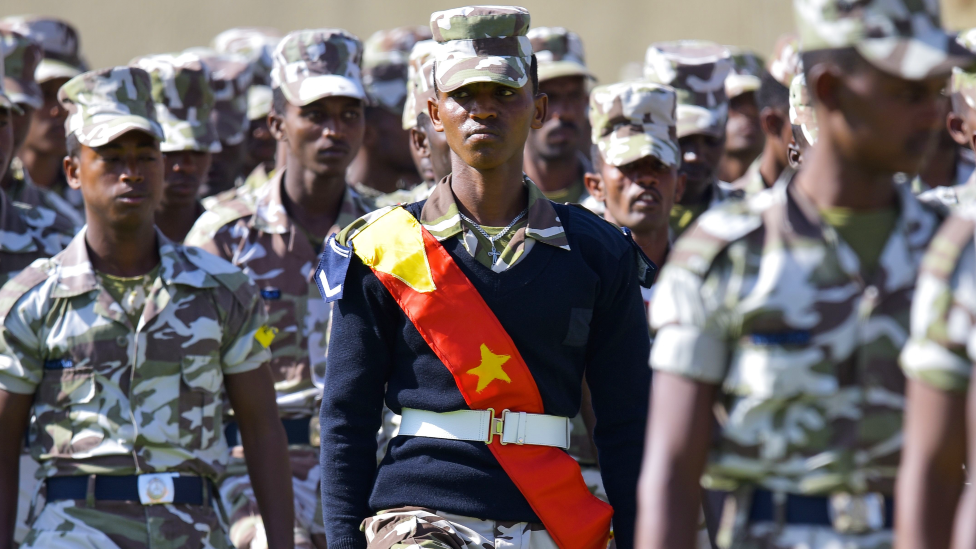
Tigray special forces pictured in February 2020
The regional government in Tigray has a powerful force  AFP
 
While the Ethiopian Nobel Laureate honoured for making peace with neighbour Eritrea which had broken away from Ethiopia and a long war had been occasioned between them with Ably finally making peace between the two, a different story emerges with the autonomy of Tigray Province. Tigreans in their majority province of Ethiopia, a country riven by tribal differences, are now under military assault by the Ethiopian army.

The government of Ethiopia refuses to negotiate with the Tigrean leaders because they are 'terrorists', a familiar mantra well known to those who study countries at war over sectarian and tribal divides; those who declare a wish to govern themselves in their heritage, majority landscapes, are automatically prescribed the role of 'terrorists'. Cue the Kurds in Turkey, the Sunni Syrians in Shia-dominated Syria.

Close to 43,000 Ethiopian refugees have fled to Sudan. The humanitarian coordinator in Ethiopia for the United Nations has no idea what and where and how the described humanitarian access route referred to by is; she's never heard of it, seen it, or suspected its existence. Yet the Ministry of Peace in a country that has declared part of its population 'terrorists' and denies bombing civilian areas, has launched a military campaign against that population.

Ethiopian authorities claim to be bearing down on the Tigray capital region. While at the same time Ethiopian army chief Birhanu Jula claimed that WHO head Tetros Adhanon Ghebreyesus has been procuring arms and diplomatic backing for the TPLF whom he once served as a minister when the TPLF led Ethiopia's coalition government. He, according to Ethiopia's government is a 'criminal'. Dr.Tedros responded by denying the accusation, calling on both sides to work for peace.

Hundreds if not thousands have been killed in the three-week-old conflict, along with the tens of thousands of refugees crowding into Sudan. Last week a federal air strike injured university students in the Tigray capital of Mekelle with its half-million population which the Tigray People's Liberation Front rules. "It [the air strike] resulted in heavy casualties of many university students and other civilians", noted a post from the TPLF on Facebook.

"Our defence forces are moving forward and closing in on Mekelle. There are a number of towns that have fallen", stated government spokesperson Redwan Hussein of the war that has pitted the central government against one of the most heavily militarized of ten ethnic states that comprise Ethiopia. Claims by the government are that the TPLF is holding power illegally in Tigray while the TPLF responds that the war is an unconstitutional assault on regional rights.
 
The Tigray region's special police forces

According to UN estimates, 1.1 million Ethiopians will require humanitarian aid resulting from the conflict. It is unable to enter Tigray to deliver aid given the bombing by government forces. Those that have fled to Sudan are also in desperate need of help. Though both sides claim that serious damage has been inflicted on the other side, the Deputy Director of the Africa Program at the International Crisis Group states "...Federal forces appear closer to Mekelle amid reports of heavy combat between the two sides yesterday."

But for some Ethiopians good news comes not too soon as Israel’s Ethiopian-born Minister of Immigrant Absorption is set to return briefly to Ethiopia to bring back to Israel hundreds of Ethiopian Jews. Minister Pnina Tamano-Shata will fly to Ethiopia with representatives of the Jewish Agency, where they're prepared to meet with a group of  prospective immigrants from Addis Ababa and Gondar, and will accompany them back to Israel on two Jewish Agency planes. Called Beta-Israel, thousands have left Ethiopia over the years to become Israeli citizens.

Jewish Agency chairman Isaac Herzog (center) and Minister of Aliyah and Integration Pnina Tamano-Shata welcome 119 Ethiopian immigrants to Israel, May 21, 2020. Photo: Shlomi Amsalem.


Labels: , , ,

Friday, March 22, 2019

The Profit Motive Sidelining Corporate Responsibility and Safety -- Boeing Dereliction

"As the pilots of the doomed Boeing jets in Ethiopia and Indonesia fought to control their planes, they lacked two notable safety features in their cockpits. One reason: Boeing charged extra for them.
For Boeing and other aircraft manufacturers, the practice of charging to upgrade a standard plane can be lucrative. Top airlines around the world must pay handsomely to have the jets they order fitted with customized add-ons."
"Sometimes these optional features involve aesthetics or comfort, like premium seating, fancy lighting or extra bathrooms. But other features involve communication, navigation or safety systems, and are more fundamental to the plane’s operations."
Many airlines, especially low-cost carriers like Indonesia’s Lion Air, have opted not to buy them — and regulators don’t require them."
"Now, in the wake of the two deadly crashes involving the same jet model, Boeing will make one of those safety features standard as part of a fix to get the planes in the air again."
The New York Times
Boeing 737 Max 8 planes have been grounded in the UK.
Christopher Furlong/Getty Images
"They’re [manoeuvring characteristics augmentation system (MCAS)] critical, and cost almost nothing for the airlines to install."
"Boeing charges for them because it can. But they’re vital for safety."
Bjorn Fehrm, analyst, aviation consultancy Leeham

"[The 737 Max will be grounded until] the problem is solved. This country was one of the first to ground the 737 Max planes. That is absolutely the right thing to do. There are clearly some very alarming circumstances around the two accidents [Lion Air flight 610 and Ethiopian Airlines flight 302] that have taken place."
"It is something that Boeing clearly have to deal with because, unless and until the problem is solved, I can’t see countries like ours allowing those planes to fly again."
UK Transport Secretary, Chris Grayling
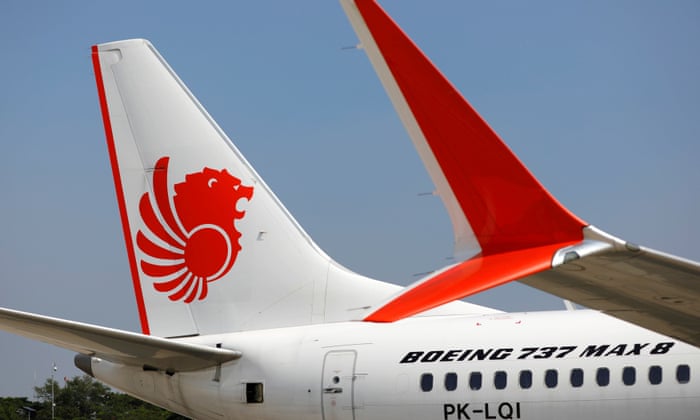
A Lion Air Boeing 737 Max 8 plane parked on the tarmac of Soekarno–Hatta international airport near Jakarta, Indonesia Photograph: Reuters
It has become standard for manufacturers such as Boeing not to include upgrades that can be critical to a plane's performance and ultimately the survival of its passengers and crew unless the purchaser is willing to pay an additional, hefty fee. Typically, low-cost airlines will consider upgrades as non-essential and opt not to spring for them. In the instance of both the Indonesian and Ethiopian carriers this has proven to be a massive error in judgement.

Almost as serious as the decision by Boeing to extract every last dollar possible out of their customers even if the end result might be airborne carnage.

Upgrades that in fact represent essential standard safety features eliminated because the buyer feels they're unnecessary and the seller feels their product can be used to squeeze every last bit of profit out of a reluctant buyer or they can face the consequences. It's hard to imagine that a 'reputable' manufacturer with global sales could not foresee that it too would face fallout as a consequence of their unwillingness to be responsible unless they're paid to be.

Now that the worldwide fleet of this model of a popular passenger jet is grounded and its future unknown after the entirely preventable mass deaths of two failures in air transport safety, the company deserves the censure coming its way. The company made the decision not to include a critical safety process leaving it up to airlines whether to pay to upgrade a standard plane and regulators are certainly at fault for enabling manufacturers to get away with a situation where low-cost carriers can opt not to buy 'optional' extras.

Safety is not optional.

The stunning communications failures all around demonstrate just how careless all major actors involved have been. When the downed Lion Air plane in a flight previous to the disaster exhibited the threat in its erratic performance and its pilots had no idea  how to respond, an off-duty pilot who happened to be flying with them leaped to the rescue, diagnosing the problem, instructing the crew how to respond to disable the malfunctioning flight-control system, saving the jet and its passengers and crew

That this air crew and the helpful pilot failed to report the incident and the plane once again took off with another crew having as lax training as the previous one, leading to a similar malfunction and the crash into the Java Sea where all 189 aboard were killed is beyond belief. But as hostile to reason as this event was, it evidently has aided investigators in understanding what happened to the Ethiopian airliner March crash and why it is some 737 Max pilots have no idea how to respond when the plane malfunctions.

Indonesia's National Transportation Safety Committee's report on the November crash contained no data that might have been useful to other carriers with this plane in their fleet, and their pilots inadequately trained in its operating details. The Lion Air crash on its second malfunctioning flight reveals through the cockpit voice recorder on investigation that the pilots desperately checked their quick reference handbook to attempt a response before crashing as the Indonesian officer called "Allahu akbar" as the plane hit the water.

Airline mechanics with Lion Air attempted to fix issues on the plane four times after reports from pilots of incorrect displays of speeds and altitude in two prior flights, replacing a key sensor. Both the plane manufacturer and Indonesia's safety committee are guilty of malfeasance in failing to tend to due diligent safety procedures. In requesting maintenance for the plane that had come close to disaster on its October 28 flight, no mention was made by the pilots of the stall warning and faulty sensor, still delivering false readings when it took off the next morning then crashed.

The March 10 crash of Ethiopian Airlines Flight 302 followed the same trajectory of events. Now questions are emerging over Boeing's design of the new 737 model, and how they were even approved. The inspector general of the U.S. Transportation Department is undergoing a review of the plane's certification while the U.S. Justice Department has struck a grand jury seeking records in a potential criminal probe of that certification.

The U.S. pilot's unions speak of the potential risks of the system, the Maneuvering Characteristics Augmentation System as having not been sufficiently explained in training. Boeing, required by the FAA to notify airlines about the system in the wake of the Lion Air crash, sent a bulletin to its customers with the Max in their fleets reminding them of the disabling process in response to an emergency.

Had their clients, including the Ethiopian Airlines disseminated that 'reminder' to upgrade the expertise of its pilots, why would the pilots on the March flight not have known how to disable the system?

Priests swing incense over empty caskets draped with the Ethiopian flag at a mass funeral at the Holy Trinity Cathedral in Addis Ababa on March 17. (Mulugeta Ayene/Associated Press)

Labels: , , , , ,

Monday, April 20, 2015

In The Name Of Islam

"I believe this is just another case of the [ISIL] group killing Christians in the name of Islam. Our fellow citizens have just been killed on a faith-based violence that is totally unacceptable. This is outrageous."
"No religion orders the killing of other people, even people from another religion."
Abba Kaletsidk Mulugeta, official, Ethiopian Orthodox Tewahdo Church's Patriarchate Office
Ethiopia’s Anti-Extremist Policies Could Put It in Militants’ Crosshairs

On the other hand, that reasonable conclusion from someone who believes religion should promote the faithful to acts of charity and kindness toward others, including those from other religions, reflects a decent mindset. The unfortunate fact in the world today is that there is one religion whose ardent followers contrive to construe its mandate as one of violently militant jihad, to threaten and to intimidate, to maltreat and to kill those who refuse to convert to Islam.

The malignancy of their 'conversion process' sacrifices the lives of even those who do convert of their own accord, if they are judged by the fundamentalists to be insufficiently submissive to the fanatical version of Sharia-led Islam. So it is not quite reality to repeat ad infinitum, as non-Muslims tend to do, cutting Islam slack it does not deserve, that Islam, like all other religions, is a reasonable construct of divine purpose, meant to lead humankind to peace with one another.

The latest 29-minute video that Islamic State terrorists have unleashed on the world in effect boasts that the group continues to realize success in their ability to convince other terrorist groups that they should become affiliated with Islamic State, since it is they who are presenting on the world stage as the most committed to acts of atrocious brutality, inciting the admiration of less successful groups, in terms of the kind of public relations that draw young Muslims to their cause.

From Ethiopia to Afghanistan, the Philippines to India, Libya to Pakistan and Yemen, Islamic State cells are beginning to increasingly introduce themselves proudly to an aghast world, witness to the proliferation of hate-infested militias dedicated to Sharia law imposed wherever they succeed in spreading their virulent brand of anti-Infidel, anti-Jewish, anti-Christian, anti-Western venom. Those Muslims who fail to support them are just as likely to be slaughtered as the ethnic and religious minorities they abhor.

Ethiopian Christians became the latest target after Egyptian Copts were beheaded in Libya, with the Egyptian Air Force bombing the Libyan ISIS camps. Ethiopia, lending itself to the fight against marauding Islamists in Somalia with al-Shabab proclaiming its alliance with ISIS, has been targeted just as Nigeria has been by Boko Haram, now another ISIS affiliate. Dressing their captives in the orange jumpsuits ISIS adopted from Abu Ghraib, ISIS bypasses mere humiliation for effectively atrocious methods of slaughter, Islam-style.

One group of captives on the latest video in eastern Libya, identified as Ethiopian Christians, another in southern Libya, with the south captives shot dead, those in the east beheaded on a beach. In Ethiopia, government spokesman Redwan Hussein stated his belief that those who were slaughtered were Ethiopian migrants planning to cross the Mediterranean for haven in Europe through the Libyan human smuggling hub.

If so, their fate may yet prove a deterrent to others aspiring to travel to Libya en route to Europe through a perilous ocean passage that has claimed thousands of lives.

Labels: , , , , ,

Follow @rheytah Tweet