Traditional U.S. Alliances: Now You See Them ... Soon You Won't

 |
| Chinese President Xi Jinping made a rare visit to North Korea to meet with Kim Jong Un, where the two moved closer to improving economic ties despite North Korea strengthening its relationship with Russia. Still from video, CBC News |
Mr.
Trump's great good friend saw to it that Pyongyang test-fired a
ballistic missile recently over the Sea of Japan, warning it was
prepared to respond to the annual joint military exercises shared by the
United States and South Korea as practise runs in preparation for a
potentially possible attack by North Korea on the South. All of the
region has been made nervously expectant by the obvious militancy of Kim
Jong Un, leading North Korea on a military and nuclear arms trajectory
that traditional U.S. allies like South Korea, the Philippines, Japan
and others view as threatening, along with that of Beijing, North
Korea's 'big brother'.
There
is also no secret about an alliance between Russia, North Korea, China
and Iran. Much less the fact that Russia's war on Ukraine has been aided
by the presence of North Korean troops. All four of those countries are
anything but friends of the Democratic West. And while the U.S.
military views Russia, North Korea and China as volatile military
enemies, and is at war, directed by their president, with Iran, this
tangled version of friends and allies versus military belligerents and
adversaries of all that the West values is as puzzling as it is
nonsensical.
 |
| A museum in North Korea honors soldiers who have fought for Russia |
The U.S. president wrote on his Truth Social site that he had ordered the Pentagon to scale back "inappropriate and hostile"
military drills with South Korea, mere hours prior to the drills taking
place. The exercises, according to South Korean officials, proceeded as
planned. South Korea officials, in fact, expressed the hope that the
personal relationship Mr. Trump speaks of with the South's political
nemesis could yield a resumption of talks, and with that, some forward
movement in reconciliation between the two Koreas.
While
U.S. allies in East Asia cringe over displays of weapons' technical
capabilities forever moving forward and displayed with militant pride by
Pyongyang, along with the hermit nation's growing alignment with
Vladimir Putin's territorially aggressive agenda, not to mention North
Korea's historical mentorship by China, the annual drills offered a
notional reassurance of having the support of the United States should
the situation of military threats continue to accelerate.
"I
recently asked the President of South Korea if they would like to join
us in the Denuclearization of the Islamic Republic of Iran, and they
said, 'No thanks!'." That disinclination to become
embroiled in a conflict outside their own internal interest zone appears
to have sealed and delivered a verdict that Mr. Trump has applied
elsewhere, when allies have failed to join America's spontaneous
military decisions with no outreach before conflict has been launched
with the heads of governments later expected to lend themselves to the
American enterprise of war.
 |
| U.S. army soldiers are seen during joint military exercises with South Korea in Yeoncheon, South Korea, in March 2025. (Ahn Young-joon/The Associated Press) |
The
normal 11-day Ulchi Freedom Shield exercises, designed to prepare the
region for a potential war with North Korea, proceeded, though to "substantially reduced" impetus.
That, reflecting the fact that when Mr. Trump decided he no longer
wished the United States under his rule to continue with the drills, it
was too late to cancel them, but Defence Secretary Pete Hegseth was
ordered to reduce them.
Seoul's presidential office assured the press that it remained in "close coordination" over the exercises with Washington, expressing the
"hopes that the friendly relationship between the leaders of the United
States and North Korea will lead to meaningful dialogue".
That's called diplomacy. Or looking on the bright side of things as
expressed by Monty Python, in a skit somewhat resembling his
tongue-in-cheek, sardonic episodes of portraying human lunacy.
There
are some 28,500 American troops stationed in South Korea as a show of
support for the country's defences since the 1950-53 armistice that
ended the Korean War. Tellingly, American commitments to security in
East Asia now appear fairly wobbly given U.S. President Trump's repeated
criticism of what was once universally thought of as rock-solid
alliances.
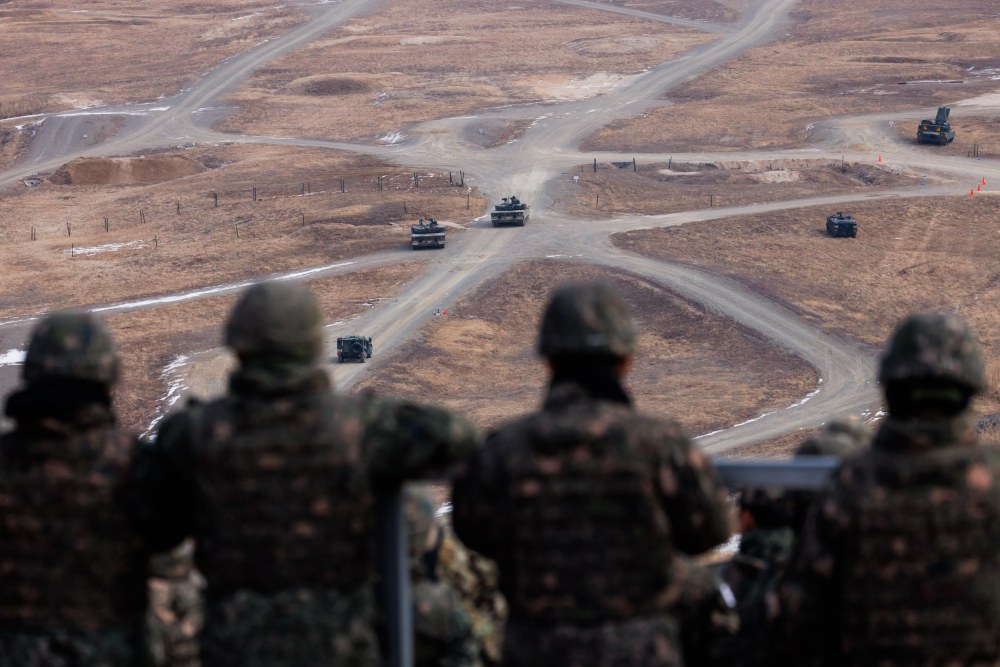 |
| South Korean soldiers watching a joint live-fire exercise with the U.S. Army in Pocheon, South Korea, last year. SeongJoon Cho / Bloomberg via Getty Images file |
Labels: Jim Jong Un, North Korea, Pyongyang, Seoul, South Korea, Strange Alliances, Twinned War Games, U.S. President Donald Trump
posted by Pieface @ Tuesday, August 18, 2026


<< Home