"What
we want is to find the disappeared. And we are reinforcing the
institutions of the Mexican State to better prevent and respond to this
tragic crime."
"We reaffirm our commitment. We will continue searching for all missing persons until we find them."
"Our obligation is to continue looking for everyone, for every person."
"And, at the same time, to eradicate this
crime. There should be no more disappeared in Mexico."
Mexican President Claudia Sheinbaum
"The idea that forced disappearances don’t happen, or that most
disappearances are related to voluntary absences, minimizes the
responsibility of the state."
"Limiting the number of missing persons to 43,128 minimizes the
magnitude of a crisis that has a human face and that won’t be solved
through administrative searches."
Centro Prodh human rights group
"We are reverting once again to the idea that only those with case files
at the public prosecutor’s office will be considered."
"There is deep mistrust of the prosecutors’ offices; there is
significant collusion between these offices and criminal groups – that’s
common knowledge."
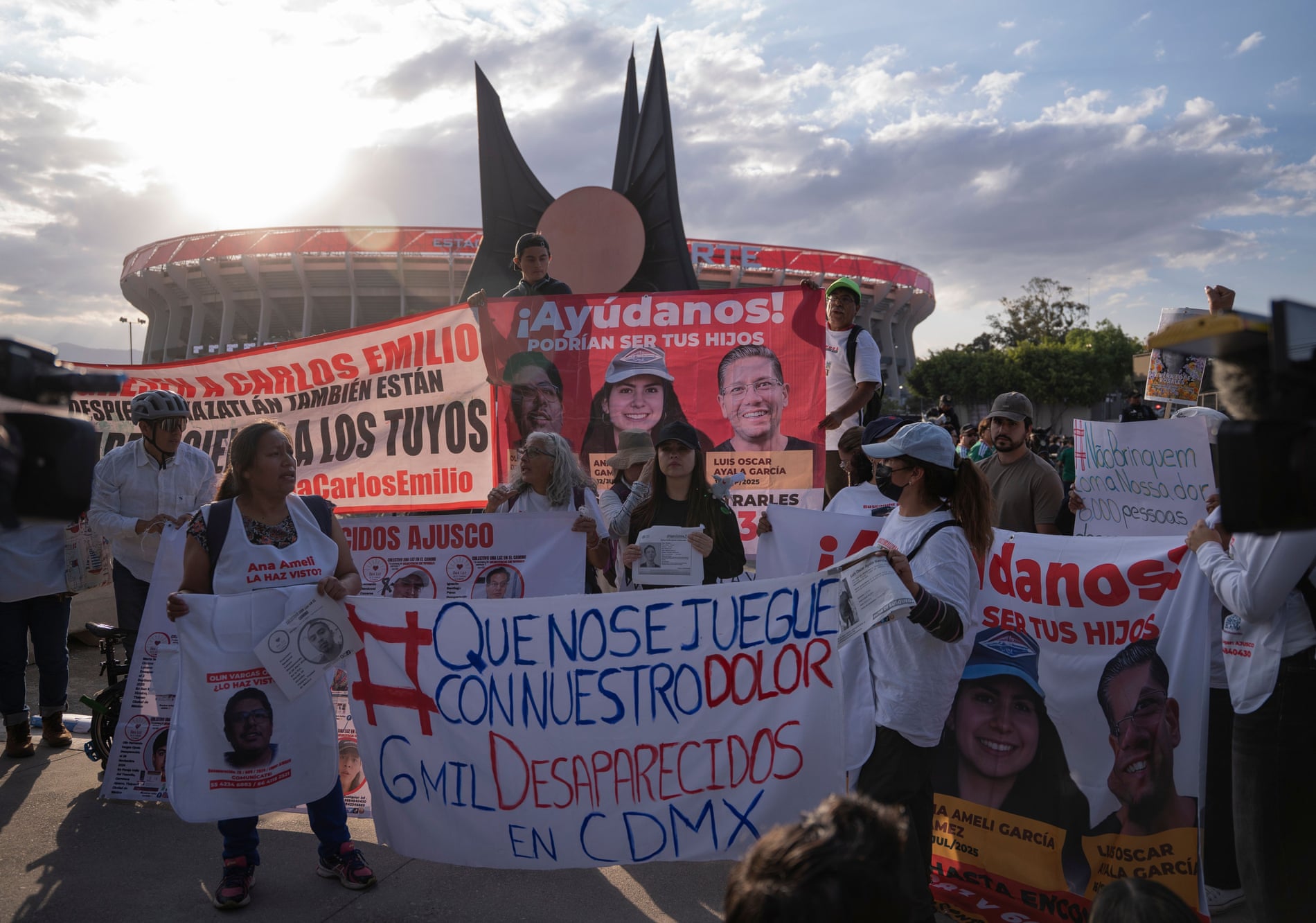
Mothers gather
outside Banorte Stadium before the Mexico v Portugal match in Monterrey
on 28 March, asking for justice for their missing loved ones.Photograph: Franco Uriel Pérez Ramírez/NurPhoto/Shutterstock
Volunteer
search teams last year discovered an abandoned ranch where inexplicably
a multitude of shoes were found. To the search teams this was evidence
of an extermination camp operated by a drug cartel. When charred human
remains were found there as well, Mexican authorities went into denial
mode, insisting that the Izaguirre ranch in Jalisco, western Mexico, was
actually a training camp for new recruits of the Jalisco New Generation
Cartel, the most powerful of Mexico's many criminal groups.
Dissatisfied
with the outcome of the investigation, volunteers returned to the site
to continue searching for answers and another disturbing discovery was
revealed. There, they found a septic pit stuffed with human teeth and
bone fragments. Yet another discovery consolidating the inescapable
reality of an ongoing grim chapter in Mexico. Over 133,000 people have
vanished across the country and Mexican authorities have gone out of
their way fruitlessly to solve the situation, then resorted to
minimizing it and finally denying its existence.
People
hold pictures of missing persons in front of the National Palace during
the commemoration of the International Day of the Disappeared in Mexico
City, on 30 August 2019.Photograph: Rodrigo Arangua/AFP/Getty Images
The
fact that Mexicans have been struggling with, in an ongoing effort to
stem the tide of the disappeared -- or at the very least comprehend how
and why it is occurring -- hoping for a clue that might direct them
toward prevention focuses on the reality that tens of thousands of
people have disappeared in the past several decades, and the suspects
causing these sudden absences in civil society are organized crime,
aided and abetted by colluding government officials.
President
Claudia Sheinbaum has sworn to pursue justice until such time as the
mystery of these wholesale disappearances has been brought to a
conclusion. The rate at which the government has moved in an effort to
solve the frighteningly deadly situation has been glacial and
ineffective in the opinion of government critics. Societal condemnation
of government has placed new pressure on the president for the urgent
need of greater progress.
According
to government statistics, homicides have dropped by 41 percent under
this administration, while the number of missing persons has more than
doubled since 2015. Prosecutors have been mandated by the president to
open an investigation once a disappearance report has been received. A
nationwide emergency alert system was launched to respond to missing
person reports. Nonetheless controversy has followed these initiatives.
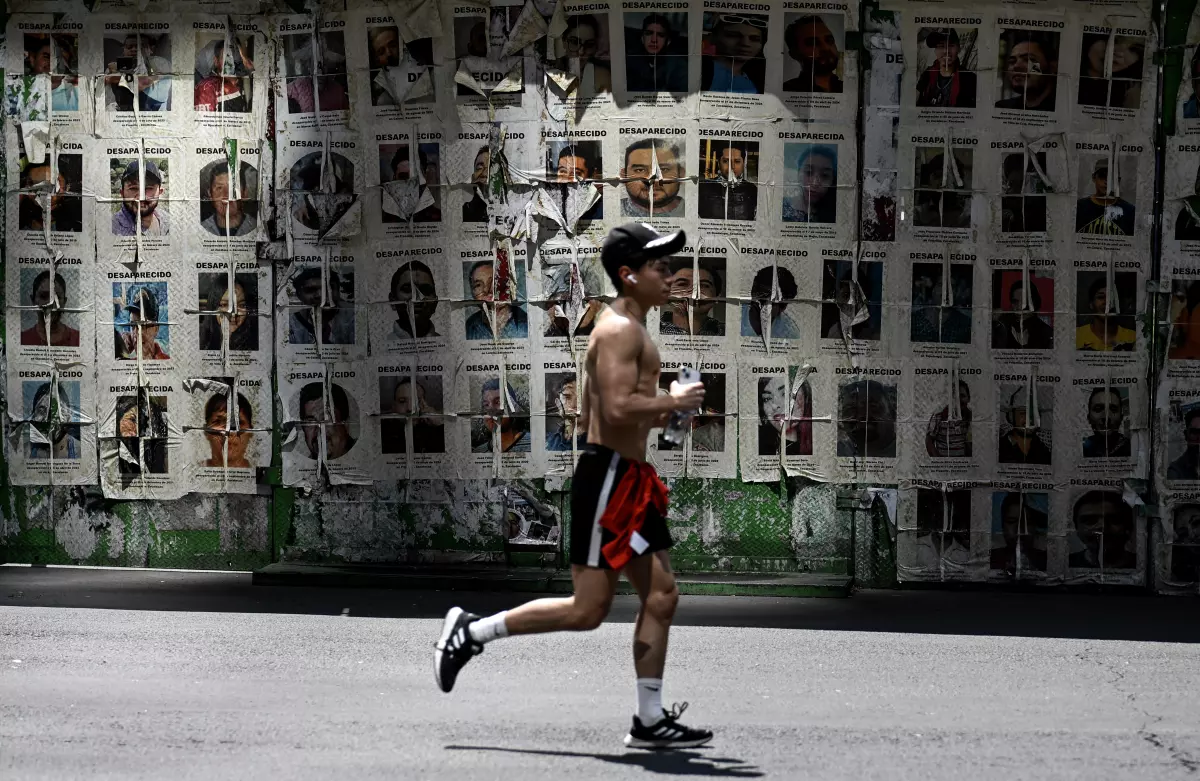
A person runs along the Sunday bike route in
front of a section of the metal guardrail at the so-called “Roundabout
of the Disappeared,” plastered with photographs of missing persons, in
Mexico City.
(Yuri Cortez/AFP via Getty Images)
An
audit to review the national disappearance registry was ordered in the
wake of the Izaguirre ranch discovery, with a goal to ensure accurate
data collection. Created in 2018, the registry merged lists from state
prosecutors, search commissions and volunteers, an assimilation
difficult to analyze. "There were no standards, no methodology",
stated security official overseeing the effort, Marcela Figueroa. The
total of 130,000 entries were divided into three groups by Ms.
Figueroa's research team. Given the lack of information, argued the
government, searching for one set of the missing would be impossible.
One
third of the entries were categorized as individuals who had been
reported missing, but who had been found to have married, filed taxes or
received vaccinations. Of the remaining 43,600 people of whom nothing
had been heard from after being reported missing, sufficient information
exists to enable continued searches. This conclusion drew mixed
reactions from the concerned public with some researchers claiming
government failed to make its data public and as such, verifying the
audit's accuracy was not possible.
"I want to give a vote of confidence."
"The
problem is they can show whatever figures they want, but if there's no
evidence to back them up, it's going to be really hard to defend what
they're doing."
Fernando Escobar, researcher, Common Cause, Mexico
Forestry workers scrape soil looking for evidence of human remains
during a massive, multi-agency search through Cumbres del Ajusco
National Park, which sits south of Mexico City. (Jorge Barrera/CBC)
"[Havana]
aligns itself -- and provides support to numerous hostile countries,
transnational terrorist groups and malign actors adverse to the United
States [including Russia, China and Iran]."
"[The
communist government provides] defense, intelligence and security
assistance to adversaries in the Western Hemisphere [while violating the
human rights of its citizens]."
"[Cuba] will be failing pretty soon. They got their oil from Venezuela. They're not getting that anymore."
"[I will impose tariffs on any country that] directly or indirectly provides oil to Cuba."
U.S. President Donald J. Trump
"We
did not touch on the topic of Cuba [during their 40-minute telephone
conversation], and in the evening then this [executive order] came out."
"The
imposition of tariffs on countries that provide oil to Cuba could
create a far-reaching humanitarian crisis [severely impacting the
operations of hospitals, the electrical grid and the food supply]."
"[Cuba is currently] going through a difficult moment [but Mexico cannot be put] at risk in terms of the tariffs."
Mexican President Claudia Sheinbaum
A drone view shows the Pajaritos terminal of Mexico's state-owned oil company Pemex, in Coatzacoalcos, Veracruz state. (Angel Hernandez/Reuters)
An executive order was signed on Thursday by U.S. President Donald Trump when he declared Cuba represented an "unusual and extraordinary threat"
to U.S. national security for which tariffs would be imposed on all
U.S. imports from any country supplying Cuba with oil. In the wake of
the lightning military raid on Caracas in mid-January that took
Venezuela's President Nicolas Maduro into U.S. custody for trucking with
drug cartels, Mr. Trump turned his attention directly on Cuba.
Subsequent
to the raid, the Trump administration now controls Venezuela's oil
exports and took the occasion to block deliveries of oil to Cuba, long
reliant on its regional ally in Venezuela to supply it with petroleum.
Mexico, under critical trade duress found it necessary to cancel its
latest scheduled delivery for the month to Cuba, taking into account the
looming renegotiation of Mexico's free-trade pact with the United
States and Canada.
Under
these constraining issues, the sobering 'sovereign decision' was made
to temporarily halt Mexican oil shipments to Cuba. Earlier in the day
following the Trump order appearing on the White House website, the
Cuban government attempted to rally Latin American and Caribbean
neighbours to its rescue. "The peace, security and stability of Our America are in danger", Cuban Foreign Minister Bruno Rodriguez stated in a social media post, denouncing the U.S. for imposing "peace through force".
In
an appearance before the Senate Foreign Relations Committee the day
before, Secretary of State Marco Rubio -- of Cuban descent -- was asked
whether he would rule out forcing "regime change" in Cuba. "I think we would like to see that regime change", responded Mr. Rubio. "That
doesn't mean that we're going to make a change, but we would love to
see a change. There's no doubt about the fact that it would be of great
benefit to the United States if Cuba was no longer governed by an
autocratic regime".
Long
dependent on Venezuelan supplies of oil which it trades for security
and medical personnel with Venezuela under Maduro and previously Hugh
Chavez, Cuba produces little oil of its own. Imports averaged 37,000
barrels daily, the bulk of which arrived from Venezuela in 2025. Cuba is
now left with a mere 15 to 20 days of oil, according to the Financial Times. Island-wide blackouts are common and frequent, impacting basic human services like drinking water.
Preparing dinner during a blackout in Havana on Wednesday, as
Cubans from all walks of life hunker into survival mode, navigating
seemingly interminable blackouts and soaring prices for food, fuel and
transport as the U.S. increases pressure on the communist‑run nation. (Reuters)
Signing
a new defence co-operation pact with Havana last fall, Moscow pledged
$1 billion in investment over the next five years in efforts to retain a
hemispheric foothold. Diplomatic support has emanated to Cuba by both
China and Russia. The determination of the U.S. to direct oil supplies
away from Cuba along with a fleet of navy and coast guard ships in the
Caribbean for operations against Venezuela tasked to stop drug
smuggling, the oil blockade of Cuba was next on the agenda.
Seven
sanctioned oil tankers carrying Venezuelan crude have been seized by
the U.S. to date -- blockading legitimate shipments to Cuba risks global
criticism of violating international law, according to maritime
experts. In response to questions in the immediate aftermath of the
Caracas raid, the U.S. president responded that he felt no additional
actions were required against Cuba, since lacking oil from Venezuela, "Cuba looks like it's ready to fall".
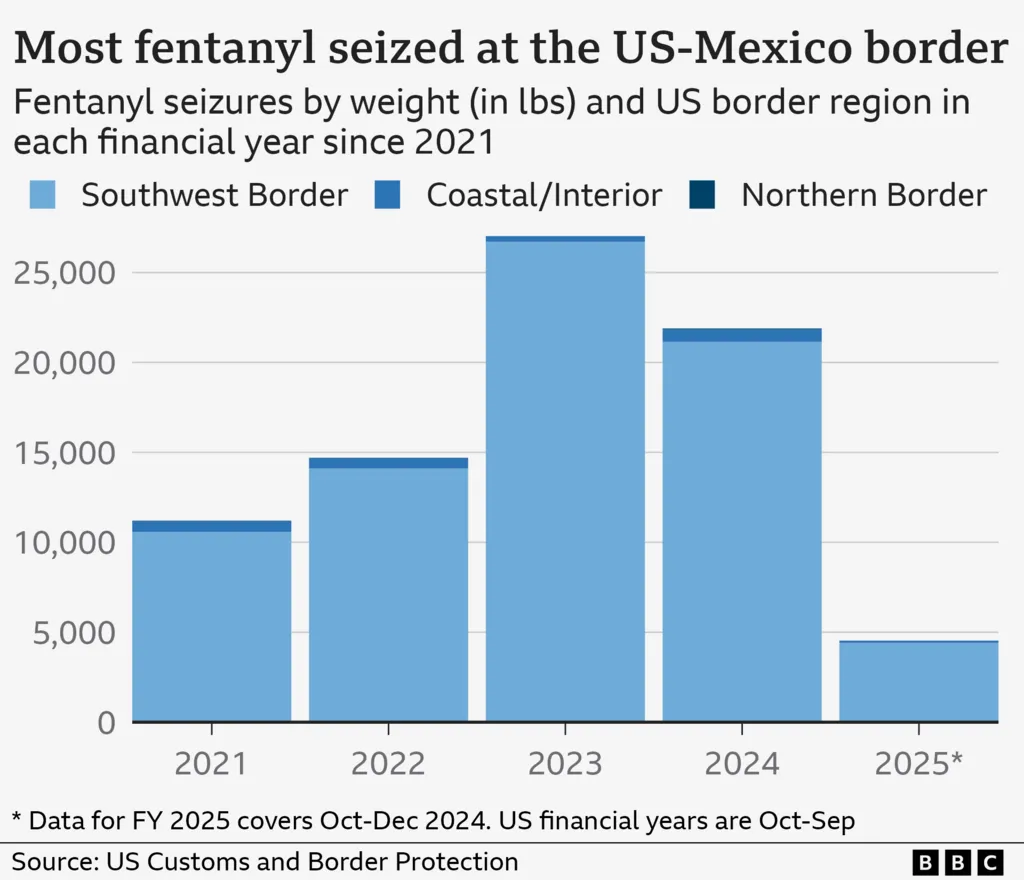
"[New
data on fentanyl seizures] largely reinforce previous understanding
that most IMF [illegally manufactured fentanyl] enters the U.S. from the
south. These data call into question tariffs and other policies and
policy justifications that treat the threat from the northern border as
comparably severe."
"Counties
along the Mexican border account for only 2.35 percent of the U.S.
population; but in 2023-24, they hosted about 40 percent of the
nation-wide quantity of fentanyl appearing in large seizures, for both
powder and pills."
"By
contrast, counties in the lower 48 states that border Canada account
for 3.1 percent of the U.S. population but only 1.2 percent of the
powder and just 0.5 percent of the pills obtained in large seizures."
Manhattan Institute report
"The
basic punch line of this study is that seizures of fentanyl in the
United States are disproportionately at borders; no surprise. It's
mostly produced internationally and then shipped in."
"But the vast majority of that is on the borders of Mexico, not on the borders with Canada."
"It's what I expected [to see]."
Jon
Caulkins, report co-author. H. Guyford Stever University professor of
operations research and public policy, Carnegie Mellon University Heinz
College, Pittsburgh
A
new report published by the Manhattan Institute verifies a fact already
known to Canadian authorities. A fact that U.S. border and customs
officials have long had knowledge of. That the claims of the Canadian
border representing a threat to the United States through the smuggling
of large amounts of fentanyl across the border are quite simply false.
It is, in fact, the border between Mexico and the United States where
the vast bulk of fentanyl emanates from.
U.S.
President Donald Trump's repeated assertions accusing Canada equally
with Mexico of threatening the lives of Americans by channeling the drug
fentanyl into the United States largely forms the basis of his
punishing tariffs imposed on Mexican and Canadian exports to the United
States. Mr. Trump has tied the imposition of steep tariffs to the
grievance of fentanyl flooding across its North American borders to
threaten the United States.
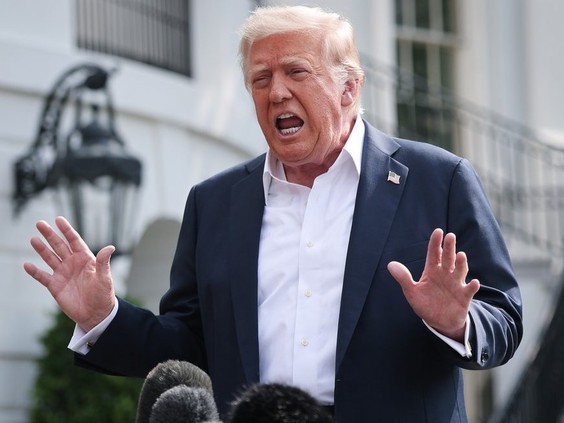
President Donald Trump answers questions while
departing the White House with first lady Melania Trump on July 11, 2025
in Washington, DC. Photo by Win McNamee /Getty Images
Such
concerns, according to the report's authors, Jon Caulkins and Bishu
Giri, are completely unfounded, at least in the case of Canada. They
could as well, they posit, undermine the ability of the US. to
prioritize tightening the country's border with Mexico. The report
focused on "large" seizures of fentanyl, defined as over a kilogram of
power, or more than 1,00 pills -- that would reflect wholesale
trafficking as opposed to smuggling for personal use.
Their
finding was that officials made more large seizures in U.S. counties
along the northern and southern borders when compared to the rest of the
country, pointing out that it was in the south that far more seizures
were made. Cross-border drug flows, according to Mr. Caulkins, often
mirror where seizures occur, and data point to an uncontroversial
finding; "not terribly complicated or subtle".
On the other hand the report found that some counties in Alaska could be portals from Canada to the broader Alaska market "although those quantities are much too small to be of consequence beyond Alaska". Of the 26 seizures in Alaska bordering Canada "triple what would be expected based on those counties' population", yet small in comparison to the rest of the Alaska market.
"Maybe
Alaska does get its fentanyl from Canada, because there's not
necessarily a large presence of Mexican drug trafficking organizations
in Alaska, and you can't easily drive from Mexico to Alaska without
crossing several international borders."
"I
didn't know that was coming, and by all means, maybe U.S. and Canadian
authorities can put a few more inspectors on those ferries or whatever."
"But that's not going to move the needle for the country, but it might be useful, right locally."
Jon Caulkins former drug police researcher
As
far as President Trump is concerned, having frequently cited the
9,000-kilometre U.S.-Canada border as a threat to national security and a
vulnerability that cartels and smugglers exploit, the way he sees it is
that Canada is entirely culpable. That belief is his cudgel to justify
the imposition of high tariffs on Canadian goods entering the United
States. For its part, the Manhattan Institute report suggested it might
be more useful for the U.S. to direct a more intense focus to the
southern border should it wish to reduce the fentanyl flow.
Fentanyl is extremely potent and incredibly dangerous. Just 2 milligrams
– the size of a few grains of sand – can lead to an overdose. CBP is
committed to stopping the flow of fentanyl and the devastation it is
wreaking on American lives and communities. U.S. Customs and Border Protection
"Counties along the Canadian border are not an important part of this story."
"Whatever
the merits or drawbacks of tariffs on imports -- such actions cannot be
justified as part of a pragmatic and data-informed response to the
threat of fentanyl to the United States."
Reeling International Markets ... A Trump Specialty
"The reaction from the worlds of business and finance has been swift."
"Wall Street witnessed its worst two-day sell-off in the past five years last week."
"International markets continued their downward trend on Monday, with Japan's Nikkei index and the Shanghai Composite Index dropping over seven percent."
Jesse Kline, The National Post
A drone view of Stellantis's Chrysler Windsor Assembly facility in
Windsor, Ontario, Canada, February 4, 2025. REUTERS/Carlos Osorio
World markets are reacting to the Trump White House announcements on everything from its realignment of chosen allies, to its characterization of NATO members as free-loaders on the American military, to punishing nations across the globe for their protectionism in trade through tariffs on American goods. A very similar protectionism in President Trump's own 'Make America Great Again', prioritizing U.S. jobs and production by suddenly heaping stiff tariffs on imports to the United States worldwide, leaving all those targeted reeling, and international markets in a confusion of utter chaos.
Business confidence and investment, high finance hardly knows where next to look for additional shocks to global markets. One man and his seemingly irrational decision-making has managed to roil the world with a major economic crisis, one that threatens to take not only the countries he has targeted into recession, but the United States as well. It was, after, all, North American and European consumers that decided they preferred to buy manufactured goods produced in cheap-labour markets and their buying power bypassed home-produced goods effectively shutting down factories in favour of inexpensive overseas-produced goods ranging from kitchenware to footwear, bedding and clothing.
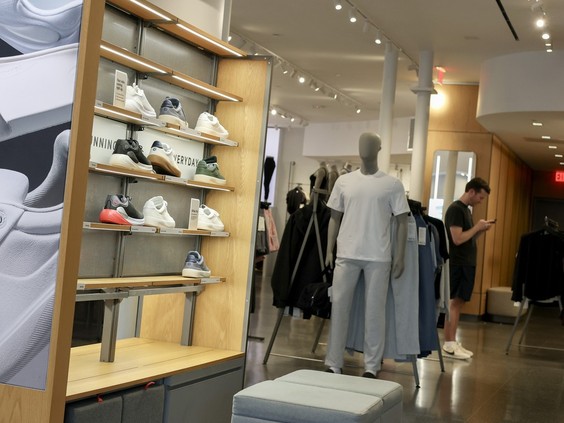
Lululemon
said 40 per cent of its products were manufactured in Vietnam, which
was slapped with a 46 per cent tariff initiated by U.S. President Donald
Trump.Photo by Joe Raedle /Getty Images
There have been a plethora of tariff statements linked to specific dates, complicated by second-thought reprieves which simply had the effect of destabilizing markets even more, and leaving economists and trade authorities in the dark over what next to expect from a mercurial president of the powerful United States of America. Universal tariffs ranging from ten to 49 percent set to come into effect on the 10th of April have now been temporarily suspended, once again. When they are reinstituted they will be applied to imports from 180 different countries.
In Canada, America's northern neighbour, President Trump's order to carmakers that he expected manufacturing to return to the United States and the closure of U.S. manufacturing plants in Canada and Mexico to facilitate that move, one that in practical terms will raise the price of the finished product to bite the bank accounts of Americans, yet a transition that would take years in the making, to undo a complex system of established integrated manufacturing between the U.S., Canada and Mexico, both of which Mr. Trump accuses of ripping off America.
Automaker Stellantis last week announced its production pause at two of its North American plants -- one in Canada, affecting 3,200 employees, the second in Mexico where 900 workers are to be laid off at five U.S. factories. Canada, as a result of this turmoil, lost 33,000 jobs in March and even greater numbers of full-time jobs. So that's how America's partners in the CUSMA Free Trade agreement are faring at the present time.
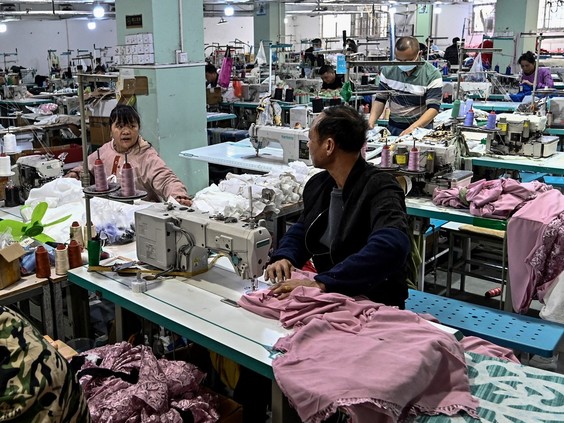
Employees working in a clothing sewing workshop in Guangzhou, China’s southern Guangdong province.Photo by PEDRO PARDO /AFP via Getty Images
And in the United States, textile and footwear industries have warned that 97 percent of the clothing and footwear sold in the U.S. are imported; the new tariffs on textile-producing countries like Vietnam, Cambodia and China could raise prices by over 50 percent. With free trade, offshoring and strong competition keeps prices down, leaving U.S. consumers with stable pricing on goods over extended periods of time.
An average car cost is likely to rise between $5,000 to $10,000. These new tariffs are set to cost American households an estimated $1,900 for starters this yer, according to the Tax Foundation think tank; "the largest tax hike since 1982".
President Trump's endgame is to force production in manufacturing back to the United States as it was before the global community gave its complacent blessing to China to become a colossus of manufacturing, flooding the world with cheap products to please the ordinary consumer focused on cost to the exclusion of closing down their own job markets. In his determination to haul production back home, some matters have not been taken into account.
Such as the fact that the low-skilled workforce in the United States no longer exists; goods currently made in developing countries in economies of scale will not be reproducible in the U.S. Even as the Trump White House is sending notices to temporary residents of the U.S. that their freeloading on the U.S. taxpayer is over and millions of undocumented immigrants are being rounded up and returned to sender. Is the U.S. prepared to reduce its high minimum wages to challenge the low wages received by skilled workers in 'undeveloped' countries of the world?
Another example was brought to the fore when the Footwear Distributors and Retailers of America contacted the new U.S. Trade Representative informing him that the typical shoe contains 70 materials that cannot be sourced within the United States. Even should American companies begin producing domestic footwear, tariffs would still apply on many of the raw materials they would have to import to produce footwear.
And then there's the issue of moving automobile production back to the United States. Transplanting auto part producing factories and vehicles would take years to come to fruition. American-made vehicles also contain thousands of components sourced world-wide. For producing companies to make long-term reshoring plans they would be risking hundreds of millions at a time of uncertainty and instability; both complicating economic conditions the Trump administration has made itself known for.
U.S. President Donald Trump's Trade War With Canada
"All gloves are off."
"Canada
is being hit hard from its historically strongest ally, and it may be
politically expedient to target individuals like Musk who garner
outsized influence over the U.S. administration."
James Hinton, senior fellow, Centre for International Governance Innovation
"Provinces would need to heavily subsidize new infrastructure to replace Starlink, which could take years to implement."
"Legally,
targeting Musk's companies could be seen as overreach and Musk could
sue in Canadian or U.S. courts to challenge such measures."
"[A bull's-eye on Musk's back also] risks looking like a personal vendetta rather than a rational economic response."
Andreas Schotter, professor of International business, University of Western Ontario Ivey School of Business
Starlink
satellite antennas are seen at the Internationale Funkausstellung
(IFA), the international trade show for consumer electronics and home
appliances, on August 31, 2023.Photo by ODD ANDERSEN /Getty
As
it begins to appear more and more inevitable that Donald Trump is
prepared to launch another painful trade war with Canada, Mexico, China
and the European Union in his determination to, in his opinion, put a
stop to other countries' reliance on America's generosity, helping them
to fund their own economic advance to the detriment of that of the
United States, former allies and trade partners are mulling their
options in an effort to stop the roller-coaster destruction of the
global economy.
Economists
everywhere agree that a substantial trade war such as what Mr. Trump is
gearing up for will have the end effect of harming the world's economy,
as it plays havoc in targeted nations' economies, bringing many to the
point of inflationary stress, certain to impact heavily on national
populations' quality of life. There is also the recognition that the
United States itself will not come away free from the impact of such a
draconian move as Mr. Trump contemplates.
In
Canada, government authorities at every level are making plans and
consulting with one another in a combined effort to produce a protective
shield as much as possible to avoid the harm certain to arise when a
commanding country whose industries are enmeshed with those of the very
countries being targeted will produce harmful effects that will bring
economies to their knees. In Ontario, Canada's wealthiest province, a
plan is afoot to target Elon Musk in recognition of his influence with
the Trump White House.
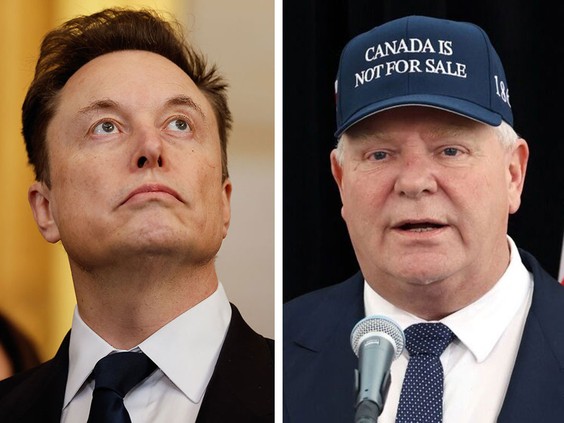
Ontario
Premier Doug Ford announced his intention to begin the process by
"ripping up" the province's $100 million contract with Starlink, Elon
Musk's satellite internet provide operated by aerospace company Space
Exploration Technologies Corp. Signed last November, the deal was on
tap to provide internet access for Canadians resident in rural
communities. "Ontario won't do business with people hellbent on destroying our economy", blustered Premier Ford, leading other premiers to scrutinize their own Starlink contracts.
Ontario Progressive Conservative Leader Doug Ford holds a news
conference in Etobicoke on Feb. 3, 2025. Later Ford said, with the U.S.
pausing tariffs, Ontario will also pause its retaliatory measures. (Evan Mitsui/CBC)
A
situation that elicited a shrug from Mr. Musk who responded to the
Premier's X warning statement with a two-word "Oh well". This type of
criticism will be no surprise to a man who has aligned himself so
intimately with the Trump administration, taking on the role of
efficiency czar to a President whose unexpected turn against his U.S.
allies has drawn surprise and resentment from his international
colleagues.
Emmett
Macfarlane, political science professor at University of Waterloo in
Ontario, approved of the move to send a powerful message to Musk. "Appeasement does little to stop a bully. We should exercise our powers to punch the bully (metaphorically) in the nose", he said in support of the Starlink cancellation threat.
Aside
from the Starlink contract, there is the issue of Musk companies in
operation across Canada; Tesla alone operates 32 stores, Canada's most
popular electric vehicle brand. Should a 100 percent tariff be slapped
on Tesla vehicles the purchase price would be pushed from its current
$56,000 tab into a sphere most electric vehicle buyers would consider
hands-off.
Doug Ford, right, says Ontario is ending its contract with Starlink, the satellite company controlled by Elon Musk, left.Photo by Getty Images/The Canadian Press
"A $100 million contract when he's worth [over] $400 billion -- this is just a flea on his side."
"If
we want to truly irritate the Americans, we need to move beyond
thinking about what kind of ketchup we buy and think of ways of hitting
their [digital] service providers without unduly harming Canadian
consumers."
Daniel
Trefler, trade economist, Canada research chair in competitiveness and
prosperity, Rotman School of Management at University of Toronto
"A
10 percent tariff passed through to the consumer will raise gasoline
and diesel prices about 15 cents per gallon [for American consumers]."
"The extent to which the consumer is affected depends on where the consumer lives."
"Prices
could spike well over 30 cents a gallon [if Canadian oil producers
divert supplies from the Midwest and create localized shortages in
response to the Trump Administration's threats of a 10 percent levy on
Canadian oil and gas]."
Andy Lipow, Lipow Oil Associates
"95 percent of the heating oil used by most Mainers to hear their homes comes from refineries in Canada."
"The Air National Guard Base in Bangor depends completely on jet fuel and diesel from Canada."
Maine Republican Senator Susan Collins
"Under
25 percent tariffs ... the loss of U.S. GDP would increase to up to 0.9
percent, and up to 5.6 percent in Canada with full retaliation, or 3.8
percent without."
Scotiabank November analysis
"The
automobile industry is one of the most highly integrated in North
America, with parts sometimes crossing a border half a dozen times
before final assembly of a vehicle."
Toronto Dominion Bank Economics
"The
rule of thumb is that it takes three to four weeks between an oil price
movement and a corresponding change in prices at the pump."
"That means drivers should notice it toward the end of February."
Pavel Molchanov, Raymond James, Houston
Wisconsin Refinery
In
U.S. regions more reliant on Canadian oil supply, retail prices could
begin to spike sooner. Maine, for example, is where the majority of fuel
retailers buy their product on spot markets priced at the New York
Harbour. Once tariffs raise pricing on that critical pricing hub, gas
stations would swiftly pass the cost on to consumers.
And
then, there is this to consider: crude oil is an import lacking an
immediate alternative since many U.S. refineries are specifically
configured to refine the heavier oil arriving from Alberta. The United
States buys Alberta oil at a discount; it represents some of the
cheapest oil available anywhere. These refineries would be incapable of
switching immediately to processing domestic oil if crude oil from
Canada was hit with a 25 percent premium.
Fuel
prices may rise suddenly by some 15 cents a gallon in response to
President Trump's threat to carry through with a 10 percent tariff on
Canadian oil and gas; basic commodities he has boasted that America
doesn't need from Canada. His threat to hit both Canada and Mexico with
punitive taxes in the form of tariffs will also have a profound, albeit
not ruinous effect on American consumers.
About
four million barrels a day of Canadian crude is imported into American
refining and fuel markets. A last-minute delay of the threatened tariffs
meant to be imposed by February 1st has seen the imminent imposition
put off for 30 days. Whether there will be another extension, or whether
the axe will fall in thirty days' time is anyone's guess.
On
the U.S. West coast where fuel is already the most expensive market in
the U.S., prices could rise 20 cents per gallon. Western Pennsylvania,
Montana and Washington state are reliant on Canadian crude oil supplies,
while Massachusetts, Vermont and New Hampshire rely on Canadian
gasoline and diesel imports. New Brunswick-based Irving Oil Ltd.
informed customers in New Hampshire that propane prices will be raised
in reflection of Trump's tariffs.
Diesel
was $3.70 a gallon last weekend, while gasoline prices average d $3.10 a
gallon at U.S. pumps, according to data derived from the American
Automobile Association. Canada/Mexico tariffs once imposed could drop
U.S. GDP by 0.3 percent and conceivably could have the effect of 286,000
job losses, raising per-household costs by roughly US$670 annually.
Marathon Galveston Bay Refinery
"Unfortunately for Midwest refineries,
heavy oil cannot easily be substituted with the light oil that makes up
most of U.S. shale oil production. StanChart has pointed out that such a
switch would create a significant loss of optimization in the highly
expensive cracking units that require feed from vacuum distillation of
the heavy residual obtained by simple distillation."
"Canada has supplied
99.89% of all heavy imports into Midwest refineries over the past
decade; the low substitutability of this flow implies that a tariff
would largely feed through to local retail prices. Refiners will also
have to cut runs due to the loss of refinery optimization."
"A
10 percent tariff passed through to the consumer will raise gasoline
and diesel prices about 15 cents per gallon [for American consumers]."
"The extent to which the consumer is affected depends on where the consumer lives."
"Prices
could spike well over 30 cents a gallon [if Canadian oil producers
divert supplies from the Midwest and create localized shortages in
response to the Trump Administration's threats of a 10 percent levy on
Canadian oil and gas]."
Andy Lipow, Lipow Oil Associates
"95 percent of the heating oil used by most Mainers to hear their homes comes from refineries in Canada."
"The Air National Guard Base in Bangor depends completely on jet fuel and diesel from Canada."
Maine Republican Senator Susan Collins
"Under
25 percent tariffs ... the loss of U.S. GDP would increase to up to 0.9
percent, and up to 5.6 percent in Canada with full retaliation, or 3.8
percent without."
Scotiabank November analysis
"The
automobile industry is one of the most highly integrated in North
America, with parts sometimes crossing a border half a dozen times
before final assembly of a vehicle."
Toronto Dominion Bank Economics
"The
rule of thumb is that it takes three to four weeks between an oil price
movement and a corresponding change in prices at the pump."
"That means drivers should notice it toward the end of February."
Pavel Molchanov, Raymond James, Houston
Wisconsin Refinery
In
U.S. regions more reliant on Canadian oil supply, retail prices could
begin to spike sooner. Maine, for example, is where the majority of fuel
retailers buy their product on spot markets priced at the New York
Harbour. Once tariffs raise pricing on that critical pricing hub, gas
stations would swiftly pass the cost on to consumers.
And
then, there is this to consider: crude oil is an import lacking an
immediate alternative since many U.S. refineries are specifically
configured to refine the heavier oil arriving from Alberta. The United
States buys Alberta oil at a discount; it represents some of the
cheapest oil available anywhere. These refineries would be incapable of
switching immediately to processing domestic oil if crude oil from
Canada was hit with a 25 percent premium.
Fuel
prices may rise suddenly by some 15 cents a gallon in response to
President Trump's threat to carry through with a 10 percent tariff on
Canadian oil and gas; basic commodities he has boasted that America
doesn't need from Canada. His threat to hit both Canada and Mexico with
punitive taxes in the form of tariffs will also have a profound, albeit
not ruinous effect on American consumers.
About
four million barrels a day of Canadian crude is imported into American
refining and fuel markets. A last-minute delay of the threatened tariffs
meant to be imposed by February 1st has seen the imminent imposition
put off for 30 days. Whether there will be another extension, or whether
the axe will fall in thirty days' time is anyone's guess.
On
the U.S. West coast where fuel is already the most expensive market in
the U.S., prices could rise 20 cents per gallon. Western Pennsylvania,
Montana and Washington state are reliant on Canadian crude oil supplies,
while Massachusetts, Vermont and New Hampshire rely on Canadian
gasoline and diesel imports. New Brunswick-based Irving Oil Ltd.
informed customers in New Hampshire that propane prices will be raised
in reflection of Trump's tariffs.
Diesel
was $3.70 a gallon last weekend, while gasoline prices average d $3.10 a
gallon at U.S. pumps, according to data derived from the American
Automobile Association. Canada/Mexico tariffs once imposed could drop
U.S. GDP by 0.3 percent and conceivably could have the effect of 286,000
job losses, raising per-household costs by roughly US$670 annually.
Marathon Galveston Bay Refinery
"Unfortunately for Midwest refineries,
heavy oil cannot easily be substituted with the light oil that makes up
most of U.S. shale oil production. StanChart has pointed out that such a
switch would create a significant loss of optimization in the highly
expensive cracking units that require feed from vacuum distillation of
the heavy residual obtained by simple distillation."
"Canada has supplied
99.89% of all heavy imports into Midwest refineries over the past
decade; the low substitutability of this flow implies that a tariff
would largely feed through to local retail prices. Refiners will also
have to cut runs due to the loss of refinery optimization."
"One Dies and Ten More Addicts are Born ... We Don't Worry About Them"
"You
inject this into a hen, and if it takes between a minute and a minute
and a half to die, that means it came out really good."
"If it doesn't die or takes too long to die, we'll add xylazine."
Fentanyl cook
"The illicit market gets much more benefit from its substances by cutting them with different things such as xylazine."
"You enhance it and therefore need less product, and you get more profit."
Alexiz Bojorge Estrada, deputy director, Mexico mental health and addiction commission
Mexico’s government on Dec. 3 announced the largest-ever seizure of
fentanyl in Sinaloa state. The Sinaloa Cartel has been split by warring
factions, but production continues. Omar H. Garcia Harfuch/Handout via
REUTERS
Cartel
laboratories in Mexico are where the synthetic opioids that reach North
American markets derive from. Those who are called 'cooks' mix
chemicals to the point where they are felt to be acceptable for the
street market; precision is not a prime consideration, whereas the
cartel knows that the products that provide a big hit are; dangerous but
totally effective, as far as the end-users are concerned and this is
where their profits lie.
Those
who spend their time mixing chemicals in rudimentary cook sites, by
default expose themselves to toxic substances, so much so that on
occasion some cooks end up retching, then they pass out and occasionally
die. University chemistry students are being recruited by the cartels
to work as cooks. One of these students spoke to an undercover
investigator revealing that drug users living on the street are
sometimes brought in to test their formulas.
New York Times
Injecting them as guinea pigs with the synthetic opioid. "We've had people convulse, or start foaming at the mouth", the student said. No one has yet died in her experience she said, but bad batches have been responsible for bad outcomes.
In
Culiacan, Mexico, cartel operatives visit homeless encampments,
bringing with them syringes filled with the latest fentanyl formula,
offering to pay those living at such camps up to $30, to those agreeable
to allowing the experimental batches to be injected into them. There
are times the operatives visit daily to watch as the drugs take effect;
snapping photos and filming reactions to the drugs.
"When it's really strong, it knocks you out or kills you. The people here died",
explained one of the homeless men who had volunteered himself
repeatedly. The chemicals required to produce the opioid have become
more difficult to access as a result of efforts to crack down on the
synthetic opioid. Originally sourced from China, exports of the raw
ingredients have now been restricted, leading the cartels to these risky
new methods of maintaining production of fentanyl.
A member of the Mexican navy and a canine sentry patrol Mexico’s Port of Manzanillo last year. REUTERS/Daniel Becerril
This
type of experimentation involves the drug being combined with a wide
range of additives -- including animal sedatives and other anesthetics
that can be dangerous. Testing the results they come up with involves
injecting these mixtures into animals like rabbits and chickens, as well
as human subjects willing to lend themselves as guinea pigs. According
to a number of cooks, should the rabbits survive beyond 90 seconds, the
drug is considered to be too mild for the American market.
The
U.S. government places the blame on fueling a synthetic opioid on the
Sinaloa Cartel. According to one cook's explanation, he began recently
mixing fentanyl with an oral surgery anesthetic. Another cook using a
cartel safe house in Sinaloa State explained that if the batch was too
insipid, he would add xylazine, an animal tranquilizer.
According
to cartel members, drug users and experts, many users in North America
look to access a particularly deadly batch they know will get them high.
"One dies, and ten more addicts are born", one operative for the cartel
said: "We don't worry about them".
Mexican President Claudia Sheinbaum at the National Palace in Mexico
City last month with a letter destined for Donald Trump. The U.S.
president-elect has threatened steep tariffs if Mexico fails to stem a
tide of drugs and migrants flowing north. Carlos Ramos
Mamahua/Presidencia de Mexico/Handout via REUTERS
"In terms of migrants per day, December 2023 has been larger than any average we have ever seen."
"Every official who is commenting on it, on all levels, says they're near or past the breaking point."
"If
you move to a place that's super remote, there won't be a lot of agents
on staff, and that increases your chances of being released into the
U.S."
"There is nowhere to put people They can't hold you."
Adam Isacson, migration expert, Washington Office on Latin America
Women wait in a hallway Friday, Dec. 15, 2023, at a Border Patrol station in Ajo, Ariz. (AP Photo/Gregory Bull)
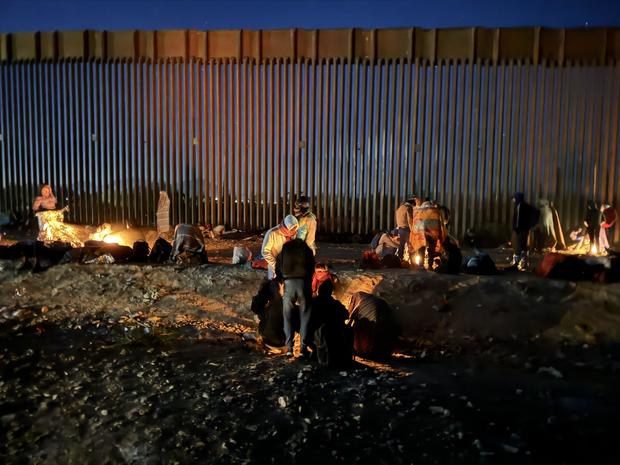
In
a remote, cold and lonely place while awaiting the arrival of border
guards, dozens of migrants huddle close to a hole in the border wall.
They have been given coffee by aid group No More Deaths. Given blankets,
food and emergency telephone calls should there be any there who
sustained life-threatening injuries on their journey. Those hailing from
Sudan have escaped another Darfur-like conflict, patiently waiting for
their search for haven to end far from their homeland.
Among
them are others, not only themselves fleeing war in Sudan, but those
escaping from Central American violent gangs and Mexican cartels. All
have crossed illegally into the United States, trekked over rugged
terrain for tiring hours, to arrive near Sasabe, Arizona exhausted,
hungry and cold. They wait to turn themselves over to authorities to be
given the opportunity to ask for asylum; stranded in the Arizona desert,
but hopeful.
Just
as night time temperatures begin dropping, a convoy of American Border
Patrol agents roll in. The men are loaded into a van where they're
briefly processed. The van continues driving in its search for more
people needing rescue. "We are not equipped to deal with this. It's a humanitarian disaster", comments Scott Carmon, a Border Patrol watch commander, of the crisis unfolding at the southern U.S. border.
A migrant walking along a road shadowed by the steel columns of the separation border between Mexico and Arizona. AP
Once
again, migrant encounters reach toward record levels, testing the
capacity of American law enforcement. Thousands of migrants arrive
daily, on their way from Africa, Asia, the Middle East or South America.
Relentless violence, desperation, fear and poverty drive them from
their places of birth where they can no longer find a future.
There
was a broad sigh of relief in the spring when crossings into the U.S.
declined after the lifting of pandemic border restrictions. The
anticipation was that the floodgates would burst, but they held. More
lately, numbers have spiked. The number of apprehensions in a recent
week soared to over 10,000 a day -- the Border Patrol found itself
stretched beyond capacity.
Small
towns on both sides of the border were overwhelmed with people funneled
through new routes by human smugglers, to evade capture.
American
officials monitored a caravan moving north through Mexico comprised of
over 2,000 migrants, heading toward the United States; unlikely to
complete their journey according to experts, but drawing significant
media notice to the migrant tide crossing the border. What has caused
the recent swell is as yet unknown.
Theories
include larger numbers of Mexicans fleeing from cartel turf battles;
rumours of a key legal pathway ending; smugglers who push desperate
people of all nationalities to attempt entry at increasingly remote
parts of the vast border. Border officials in Arizona closed a key port
of entry to legal crossings early in December to enable them to focus on
the unlawful entries.
Migrants huddle around fires for warmth along the U.S.-Mexico border near Lukeville, Arizona.Camilo Montoya-Galvez/CBS News
"We found that people had other destinations, but they were being
compelled only to come to New York City, and we are assisting in
interviewing those who seek to go somewhere else."
"Some want to go to Canada, some want to go to warmer states, and we
are there for them as they continue to move on with their pursuit of
this dream."
New York City Mayor Eric Adams
"A lot of the Americans used drugs there. I feel like Canada will be safer. It is a much quieter country than America."
"It is very difficult to get papers in America. I need to work, so I am going to Canada."
Migrant Manuel Rodon, 26, Venezuelan
"The military gave me and my family free bus tickets"
" I am going to Canada for a better quality of life for my family."
Migrant Raymond Pena, Venezuelan
"Word
has spread among the migrant community [that Canada - where Prime
Minister Justin Trudeau touted the country's] proud and longstanding
tradition of welcoming people seeking safety [is the place to go]."
“Mayor Eric Adams’s administration pays various companies that run
programs for migrants that include ‘re-ticketing’ so they can travel to
other cities, a City Hall source said."
New York Post
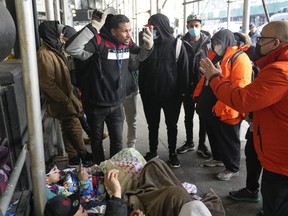
Recent
immigrants to the United States talk to city officials in front of the
Watson Hotel in New York, Monday, Jan. 30, 2023. The immigrants, mostly
from Venezuela and other Latin American countries, had been living in
the hotel until recently, when they were told to leave the temporary
shelter. Photo by Seth Wenig /AP
U.S.
States adjacent the border with Mexico developed a strategy whereby
they bus illegal migrants that enter their states, deep into the heart
of the United States, to Democratic states that have been
sanctimoniously condemnatory of their Republican brother-states
unwilling to absorb the ongoing presence of increasing numbers of
seemingly unstoppable illegal entrants to the United States. To solve
their own problems partially and to stamp 'pay-back', bus loads of
migrants have been arriving in New York City which now claims it has no
space left to house and care for the migrants.
And
while New York City is understandably enraged over the perfidy of Texas
sending illegal migrants onward to become their problem, the city has
discovered a nifty new way of alleviating their own problem. By doing
precisely what Texas has been engaged in. Only they're not sending the
migrants back to Texas, they're floating the benefits of entering Canada
to claim asylum there where they can find a new prosperous and secure
life in a country built on immigration.
Immigration,
that is, not illegal entry of unauthorized migrants. The way to enter
any country as a desired destination is and always has been legally.
Applying for visas, applying to become an immigrant. Canada invests
millions in accepting immigrants from all over the world. It has an
economy dependent on a labour force, but an aging population, one that
is not replacing itself by natural means, with a steadily falling
birthrate. Immigration to Canada has been averaging a third of a million
people annually.
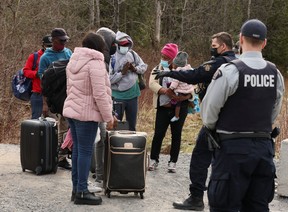
Asylum seekers talk to a police officer as they
cross into Canada from the U.S. border near a checkpoint on Roxham Road
near Hemmingford, Quebec, April 24, 2022. REUTERS/Christinne Muschi
Canada
has its own problems in absorption of such huge numbers. Settling them
in is extremely costly on the social welfare system, the universal
medicare system, and the fact that there is insufficient public housing
for people as things stand now, and housing is scarce and prohibitively
expensive. The health care system has taken a beating since the pandemic
and is having problems catching up to the level of service considered
minimal. Adding tens of thousands of unwanted people entering illegally
to declare the need for haven comes at a rather awkward time, to say the
least.
But
those buses from New York taking passengers representing illegal
migrants to the border with Canada keep coming. And only now is it being
revealed that delivering passengers by cab companies who take over as
the buses debus the passengers, to enable them to access illegal entry
border areas, bypassing official entry points continues. To the sum of
an average of 39,000 annual illegal entries to Quebec alone, in the past
several years.
Taxi drivers wait for migrants at the Plattsburgh terminus with signs indicating they will drive to Roxham Road. (Romain Schué/Radio-Canada)
Reports
have emerged that migrants resort to tearing up their American
immigration documents as they travel from Plattsburgh, New York, to the
Canadian border. Christine Frechette, Quebec's immigration minister,
"surprised" to discover the plan hatched by New York City, turns to the
federal government to reach a solution to the problem at Roxham Road,
used as an unofficial border crossing south of Montreal, enabling tens
of thousands to cross into Canada to claim asylum. These asylum-seekers
are not turned away; by Canadian law they complete documents that will
be assessed and either accepted or rejected. In the meanwhile, they are
able to live in Canada, assisted by social services.
In
cities like Toronto, temporary housing for the homeless is being
compromised as are other levels of social services by illegal migrants
requiring similar assistance. If New York City finds itself overwhelmed
by the burden of caring for tens of thousands of migrants whose human
needs cannot be ignored, it must realize that cities like Montreal and
Toronto face the same dilemma; disingenuously Mayor Adams claims to be
just 'helping' the migrants get on in life . The idea being, to pass on
the problems rather than face them and strategize a solution.
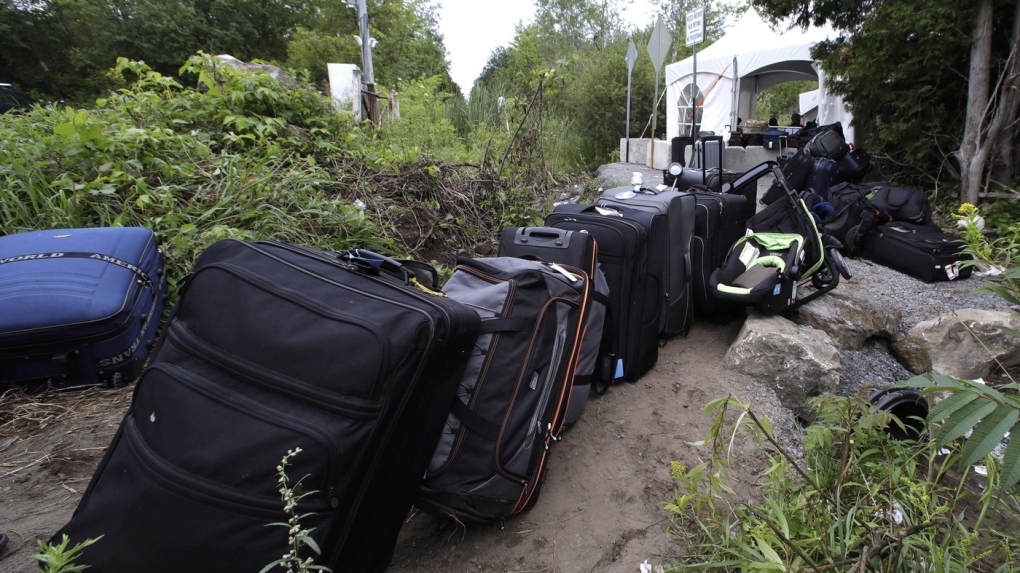
Luggage from migrants fills a pathway at an illegal crossing point from
Champlain, N.Y., to Saint-Bernard-de-Lacolle, Que.. Quebec's immigration minister says she's surprised by reports that
the City of New York is helping to provide free bus tickets to migrants
heading north to claim asylum in Canada. THE CANADIAN PRESS/AP
Photo/Charles Krupa
This represents a general opinion site for its author. It also offers a space for the author to record her experiences and perceptions,both personal and public. This is rendered obvious by the content contained in the blog, but the space is here inviting me to write. And so I do.