Assessment of Money Laundering and Terrorist Financing Risks in Canada
"The Port of Montreal is a known link where luxury vehicles are shipped to Lebanon, financially supporting Hezbollah.""While the volume of terrorist financing in Canada is assessed to be low, the consequences of enabling deadly and destructive terrorist attacks in Canada and abroad are grave.""The misuse of the charitable and NPO sectors has been observed as a prominent financing method used by Hamas and Hezbollah.""Hezbollah remains a highly active global player in the cocaine, heroin, fentanyl, and captagon trades with trafficking networks spanning Latin America, Canada, and the United States."Department of Finance report
"Organizations like Samidoun masquerade as charitable actors that claim to provide humanitarian support to those in need, yet in reality divert funds for much-needed assistance to support terrorist groups."Treasury spokesman Bradley T. Smith
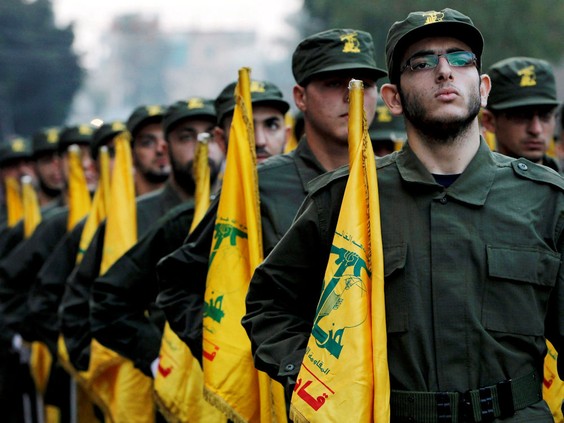 |
| Hezbollah fighters Photo by AP Photo/Hussein Malla |
Canada
remains a hub for terrorist financing, enabling extremist groups to
capitalize on everything from charitable fraud to rising rates of drug
trafficking as well as auto theft, according to a newly-released 125
page report from the Department of Finance. Hezbollah, the Lebanese
terrorist group is recognized as a leading recipient of funding
originating from Canada, the black market vehicle trade in particular.
Compared
to the problem of conventional money laundering, the amount of
terrorist financing originating in Canada is deemed relatively low, but
the authors of the report note that the damage that can be done by "a lone terrorist actor or terrorist group" represents a threat of potential negative consequences proportionately higher.
Canadian
money ends up with the Palestinian terror group Hamas, not only
Hezbollah, in addition to extremist Sikh groups named as Babbar Khalsa
International and the International Sikh Youth Federation; all
organizations that "have been observed by law enforcement and intelligence agencies to receive financial support originating from Canada", the report notes.
The funding is derived from various sources; from "crowdfunding" to crypto currencies to "abuse of non-profit organizations".
Toronto resident Khalilullh Yousuf was given a 12-year sentence four
months ago for organizing GoFundMe campaigns to, on the surface, raise
money for humanitarian purposes for Gaza, while actually funnelling it
to Islamic State affiliates.
Canada
listed Samidoun, the Vancouver-based anti-Israel group last October as a
terror entity, as did the United States. Long active in promoting
terrorist ideology in Canada and abroad, Samidoun's status was that of a
fundraiser for terror groups, specifically the Popular Front for the
Liberation of Palestine, cited as the primary focus to list it as a
terror group. Despite which its status has not changed, it remains
listed as a charitable group, and it is free to continue its illegal
activities due to the fact that the Liberal government has done nothing
to disrupt its activities as the illegal entity it is.
 |
| Samidoun Website |
The
Department of Justice cited Canada's lucrative illicit drug trade as
one where terrorist groups were the likely beneficiaries. Hezbollah's
use of the Port of Montreal to ship out luxury cars represents only one
of several criminal organizations that use the same tactics. When rates
of auto theft were at all-time highs in 2022, industry representatives
stated that it was well-known that stolen cars were headed to Montreal
on their way to leaving Canada. "The
question is, how serious, or how bad does this situation have to become
before the authorities really do something about it?" said a frustrated David Adams, president and CEO of Global Automakers of Canada.
CSIS (Canadian Security Intelligence Service)
estimates Canadian money laundering networks move between $45 to $113
billion annually in total, of which money laundering for terrorism is
but a relatively small part. The real alarm raised by the report notes
that hostile state actors manage similar money laundering networks to
finance interference plots within Canada itself.
 |
| The Port of Montreal's location makes it a hub for the illegal export of stolen vehicles to Africa and the Middle East. (Charles Contant/CBC) |
"Foreign states seeking to interfere in Canada often rely on networks of proxies within Canada to carry out their activities.""Foreign states seeking to funnel money into foreign interference activities can take advantage of existing networks, often criminal in nature, to co-mingle and launder funds from different sources."Department of Finance report
 |
| Deputy Commissioner Marty Kearns, Investigations and Organized Crime at the Ontario Provincial Police, left, talks with Deputy Chief Benoit Dube of the Surete du Quebec beside two recovered stolen vehicles during a news conference in Montreal. (Graham Hughes/The Canadian Press) |
Labels: Canada, Department of Finance Report, Money Laundering, Terrorist Groups
posted by Pieface @ Saturday, September 06, 2025


<< Home