China Welcoming Friends Old and New
"This parade showcases the ascendancy of China propelled by Trump's inept diplomacy and President Xi's astute statecraft.""The Washington consensus has unravelled, and Xi is rallying support for an alternative."Jeff Kingston, professor of Asian studies, Temple University, Japan"Though the Russia-North Korea tie has resumed to a military alliance, China refuses to return to the year of 1950 [when Beijing sent soldiers to support North Korea's invasion of the South and the USSR provided critical military aid].""It is wrong to believe that China, Russia and North Korea are reinforcing bloc-building."Zhu Feng, dean, School of International Relations, Nanjing University"I want to say that no one has been plotting anything, no one was weaving any conspiracies.""None of the three leaders had even thought about such a thing."Yuri Ushakov, Putin foreign affairs adviser"Kim can also claim a diplomatic victory as North Korea has gone from unanimously sanctioned by the U.N. Security Council for its illegal nuclear and missile programs to being embraced by the UNSC permanent members Russia and China."Leif-Eric Easley, professor of International Studies, Ewha Womans University, Seoul
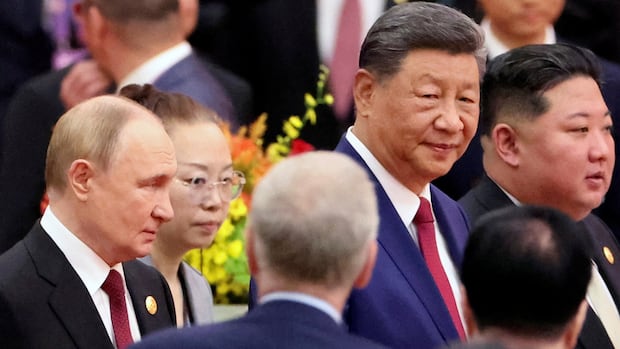 |
| China put its military might on display Wednesday with a large parade. Also on display was China’s Xi Jinping flanked by Russia’s Vladimir Putin and North Korea’s Kim Jong-un, a group of leaders united in a desire to challenge the dominance of the United States. Still from video/CBC |
Standing
shoulder to shoulder, leaders of China, North Korea and Russia watched
high-tech military hardware moving impressively along with thousands of
soldiers marching the streets of Beijing in an massive show of strength
and power. Indian Prime Minister Narendra Modi, Russian President
Vladimir Putin and Chinese President Xi Jinping spoke with private
confidence, smiling, clasping hands at a meeting several days before the
military parade, at a meeting of the Shanghai Cooperation Organization.
The
meetings represented living proof of a message being sent to the United
States of America and its allies through a shift from the
U.S.-dominated world order led by the West with American President
Donald Trump withdrawing from his nation's historic alliances, while
imposing trade tariffs on friend and foe alike, shaking the world
economy, puzzling allies and placing them on the defensive, looking
elsewhere for validation of their right to aspire to economic and
political stability, left adrift by the one guiding-light nation that
has turned inward.
"Please
give my warmest regards to Vladimir Putin and (North Korean leader) Kim
Jong Jun, as you conspire against The United States of America" was
President Trump's message to his Chinese counterpart, while
congratulating China on its celebration of emergence from the Second
World War, free from Japanese occupation. A freedom from occupation not
due to China's own defences, but owing to the offensive offered by the
United States in humbling and defeating Japan through the persuasive
power of its then-emerging nuclear capabilities.
 |
| The latest drones, missiles and other weapons were on display during a military parade to commemorate the 80th anniversary of the end of the Second World War, in front of Tiananmen Gate in Beijing on Wednesday. Chinese President Xi Jinping invited dozens of leaders, including Russian President Vladimir Putin and North Korean leader Kim Jong-un to his nation's largest-ever military parade. (Liu Xu/Xinhua/The Associated Press) |
The
80th anniversary in Beijing commemorating the end of the Second World
War was the annual showcasing of Beijing's dedication to its own
burgeoning nuclear arsenals on land, in the air and at sea. China's
assertiveness, its expansionist imperatives and
economic/manufacturing/infrastructure/trade and foreign investment
through its ambitious Belt and Road initiative signal it as the emerging
counterpart of the powerful United States of America.
The
leaders invited to share China's celebratory commemoration, from Russia
to North Korea, India to Turkey, Iran and to Cuba, share one issue in
common between them, isolation and sanctions from the United States and
its Western bloc of allies. Beyond that shared connection is the fact
that each of those nations is fully focused on their own aspirational
futures, some in direct contradiction to China's. Even while isolation
drives their friendship, it is a facade, since they all aspire to
achieve their goals, while gravitating around China's lead.
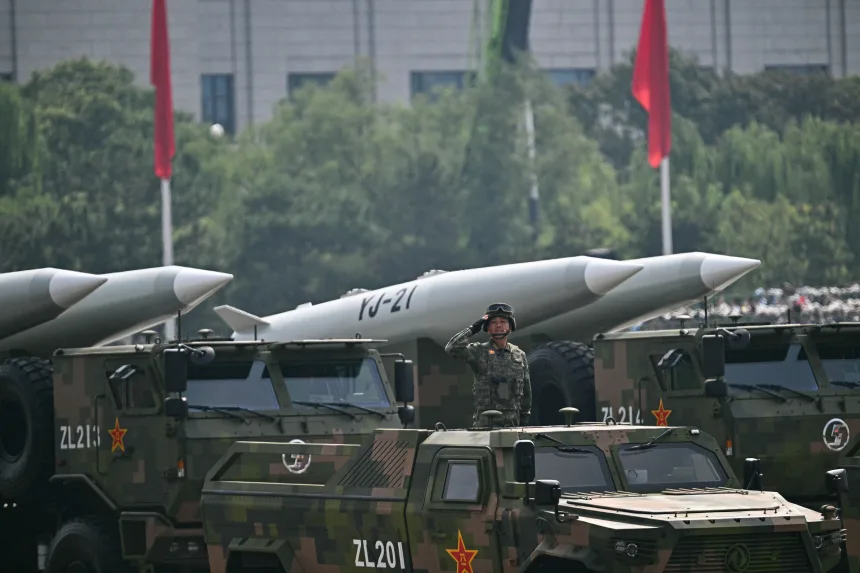 |
YJ-21 hypersonic
anti-ship ballistic missiles are seen during a military parade marking
the 80th anniversary of victory over Japan and the end of World War II,
in Beijing's Tiananmen Square on September 3, 2025. Pedro Pardo/AFP/Getty Images |
China
remains concerned with North Korea's nuclear power which has softened
its support for Kim. Making common cause with Putin, both deeply
isolated from the West, belies the reality that though both have signed a
military pact strengthening their overt ties, they still and will
always have territorial disagreements in a silent infiltration of
Chinese in Russia's far east, scantly populated by Russians and
increasingly taken possession of by Chinese settlers.
The
free trade agreement that India and Washington were negotiating fell
apart when Trump imposed a 25 percent tariff across the board as
punishment for the Russian oil New Delhi has signed on to; with combined
tariffs at 50 percent taking Modi aback at a time when relations with
the U.S. were on rocky ground of late, forcing India to look elsewhere
for support and for the time being, moving closer to China and Russia.
"India is carefully walking this tightrope between the West and the rest, especially when it comes to the U.S., Russia and China.""[Modi did not participate in Beijing's military parade since] distrust with China still exists.""Because India does not believe in formal alliances, its approach has been to strengthen its relationship with the United States, maintain it with Russia, and manage it with China."Praveen Donthi, senior analyst, International Crisis Group
| Military personnel take part in a military parade to commemorate the 80th anniversary of Japan’s World War II surrender held in front of Tiananmen Gate in Beijing, Wednesday, Sept. 3, 2025. (AP Photo/Ng Han Guan) |
Labels: Beijing's Military Parade, India, Iran, North Korea, Russia, Sanctions and Isolation, Trump Tariffs, United States, WWII End Commeration
posted by Pieface @ Friday, September 05, 2025


<< Home