The Gallantry and Honour of the French WWII Military

June
27, 1940: ...But from what I've seen in Belgium and France and from
talks I've had with Germans and French in both countries, and with
French, Belgian, and British prisoners along the roads, it seems fairly
clear to me that:
France did not fight.
If
she did, there is little evidence of it. Not only I, but several of my
friends have driven from the German border to Paris and back, along all
the main roads. None of us saw any evidence of serious fighting.
The
fields of France are undisturbed. There was no fighting on any
sustained line. The German army hurled itself forward along the roads.
Even on the roads there is little sign that the French did any more than
harry their enemy. And even this was done only in the towns and
villages. But it was only harrying, delaying. There was no attempt to
come to a halt on a line and strike back in a well-organized counter-
attack.
But
since the German chose to fight the war on the roads, why didn't the
French stop them? Roads make ideal targets for artillery. And yet I have
not seen one yard of road in northern France which shows the effects of
artillery fire. Driving to Paris over the area where the second German
offensive began, an officer from the High Command who had missed the
campaign kept mumbling that he could not understand it, that up there on
that height, dominating the road and providing wonderful artillery
cover with its dense woods, the French must have had the sense to plant a
few guns. Just a few would have made the road impassable, he kept
repeating, and he would order us to stop while he studied the situation.
But there had been no guns on those wooded heights and there were no
shell-holes on or near the road. The Germans had passed along here with
their mighty army, hardly firing a shot.
At
no point in France and at only two or three in Belgium did I see a road
properly mined, or, for that matter, mined at all. In the villages and
towns the French had hastily thrown up tank-barriers, usually of blocks
of stone and rubbish. But the Germans brushed them aside in minutes. A
huge crater left by an exploded mine could not have been brushed aside
in a few minutes.
D.B.
in Paris, having seen the war from the other side, concludes that there
was treachery in the French army from top to bottom -- the fascists at
the top, the Communists at the bottom. And from German and French
sources alike I heard many stories of how the communists had received
their orders from their party not to fight, and didn't...
Many
French prisoners say they never saw a battle. When one seemed imminent,
orders came to retreat. It was this constant order to retreat before a
battle had been joined, or at least before it had been fought out, that
broke the Belgian resistance.
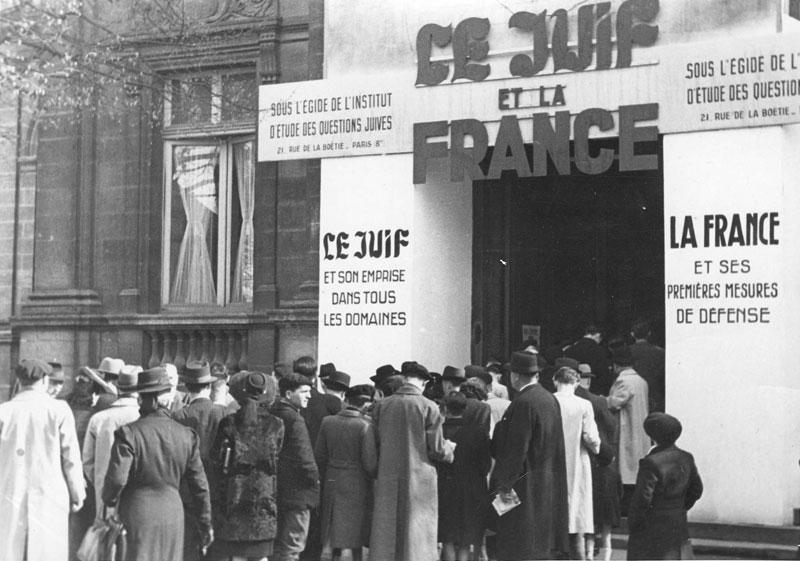 |
| Bordeaux, 1942: the entrance to the anti-Semitic exhibition “The Jews and France”. |
The
Germans themselves say that in one tank battle they were attacked by a
large fleet of French tanks after they had themselves run out of
ammunition. The German commander ordered a retreat. After the German
tanks had retired some distance to the rear, with the French following
them only very cautiously, the Germans received orders to turn about and
simulate an attack, firing automatic pistols or anything they had out
of their tanks, and executing complicated manoeuvres. This they did, and
the French, seeing an armada of tanks descend upon them, though these
were without ammunition, turned and fled.
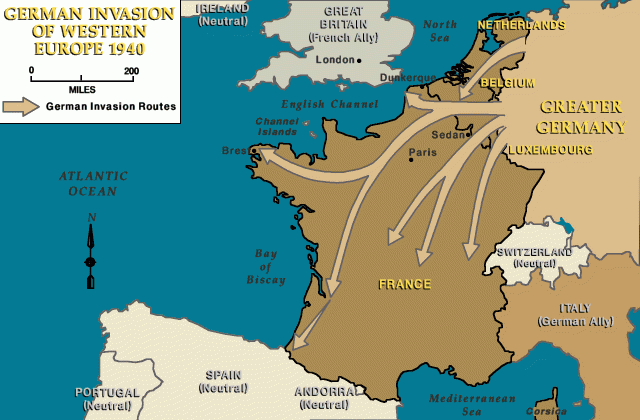
Another mystery: After the Germans broke through the Franco-Belgian border from Maubeuge to Sedan,
they
tell that they continued right on across northern France to the sea
hardly firing a shot. When they got to the sea, Boulogne and Calais were
defended mostly by the British. The whole French army seemed paralysed,
unable to provide the least action, the slightest counter-thrust.
On
the whole, then, while the French here and here fought valiantly and
even stubbornly, their army seems to have been paralysed as soon as the
Germans made their first break-through. Then it collapsed, almost
without a fight. In the first place the French, as though drugged, had
no will to fight, even when their soil was invaded by their most hated
enemy. There was a complete collapse of French society and of the French
soul. Secondly, there was either treachery or criminal negligence in
the High Command and among the high officers in the field. Among large
masses of troops Communist propaganda had won the day. And its message
was: 'Don't fight'. Never were the masses so betrayed.
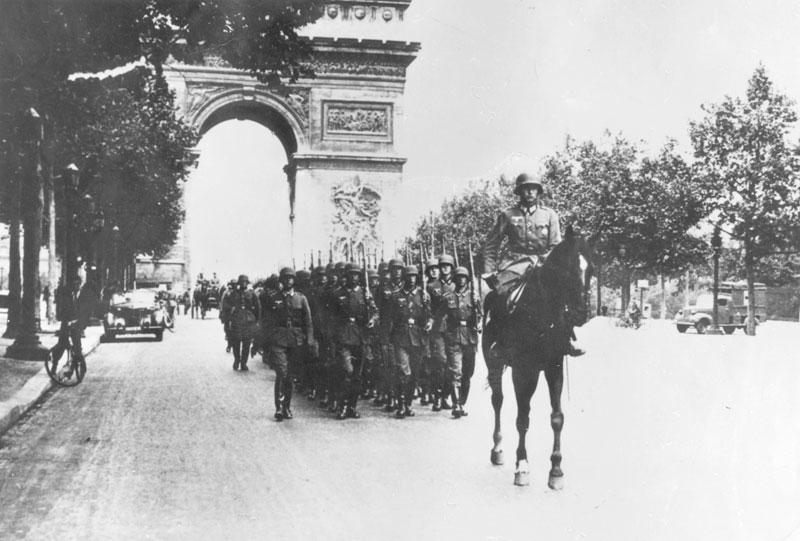 |
| A German military unit, marching down the Champs-Élysées; Paris, 4 July 1940 Yad Vashem |
July 8, 1940:
Tomorrow France, which until a few weeks ago was regarded as the last
stronghold of democracy on the Continent, will shed its democracy and
join the ranks of the totalitarian states. Laval, whom Hitler has picked
to do his dirty work in France -- the notorious Otto Abetz is the main
go-between -- will have the French Chamber and Senate meet and vote
themselves out of existence, handing over all power to Marshal Petain,
behind whom Laval will pull the strings as Hitler's puppet dictator. The
Nazis are laughing.
July 9: The Nazis are still laughing. Said the organ of the Foreign Office Dienst aus Deutschland,
in commenting on Vichy's scrapping the French Parliament today: 'The
change of the former regime in France to an authoritarian form of
government will not influence in any way the political liquidation of
the war. The fact is that Germany does not consider the Franco-German
accounts as settled yet. Later they will be settled with historical
realism ... not only on the basis of the two decades since Versailles,
but they will also take into account much earlier times'.
July 10:
Hans came in to see me. He had just driven from Irun, on the
Franco-Spanish border, to Berlin. He said he could not get over the
looks of Verdun, which he visited yesterday. Not a house there has been
scratched, he said. Yet in the World War, when it was never taken, not a
house remained standing. There you have the difference between 1914-18
and 1940.
William L. Shirer ... The Journal of A foreign Correspondent, 1934-1941 BERLIN DIARY
 |
| Holocaust Encyclopedia |
Labels: French Resistance, German Invasion of France, World War II
posted by Pieface @ Wednesday, January 28, 2026


<< Home