Monday, January 26, 2026

The Gaza Board of Peace

"[The Board of Peace would] work with many others, including the United Nations."
"Once this board is completely formed, we can do pretty much whatever in conjunction with the United Nations. You know, I've always said the United Nations has got tremendous potential."
"Every one of them [those signing on the 'Board of Peace'] is a friend of mine. A couple, let's see, a couple I like, a couple I don't like."
"No, I like, actually, this group. I like every single one of them, can you believe it? Usually I have about two or three that I can't stand." 
"[I wish that] we didn't need a Board of Peace [but the UN had failed to help solve the world's conflicts]."
U.S. President Donald J. Trump
https://i.cbc.ca/ais/8f612cf8-f89b-4dcd-a025-c68c6ac790a6,1769206282159/full/max/0/default.jpg?im=Crop%2Crect%3D%280%2C3%2C5900%2C3318%29%3BResize%3D860
U.S. President Donald Trump, centre, sits with leaders of other countries during a signing ceremony for his 'Board of Peace' initiative aimed at resolving global conflicts, at the World Economic Forum in Davos, Switzerland, on Thursday. (Jonathan Ernst/Reuters)
"I think what you're seeing is a board that has been cobbled together for Gaza with much bigger aspirations. But with a set of skills and a set of people that is really very Middle East centric, and I think has quite little relevance to crises outside of that region."
"Yes, the UN has very serious problems. But I think that doesn't mean that Europeans [and] many others — in South America, for example — want to see a world in which the White House, in which Trump, in which Americans acquire disproportionate power over these sorts of decisions."
"This is not just a contest that the U.S. can shape by itself and say, 'I'm done with the UN, it's over.' The Chinese will keep playing this game. Very powerful rising countries like Brazil and India will have a stake in the UN, and they will seek to influence its agencies and bodies more and more as the U.S. draws back." 
Shashank Joshi, defence editor, The Economist  
President Donald Trump in Davos officially launched his Board of Peace initiative, claiming his very personal project so dear to his heart which may yet gain him 2026's nomination for the Nobel Peace Prize, joined on stage by his board's founding members comprised of political allies such as President Javier Milei of Argentina, Hungarian Prime Minister Viktor Orban and representatives from Bahrain, Morocco, Azerbaijan, Bulgaria, Pakistan, Saudi Arabia, Turkey, the United Arab Emirates and Uzbekistan.
 
All of whom were pleased to join Mr. Trump at the document signing table where the board's charter was declared to be 'in full force', as an "official international organization". Phase two of the Peace Plan is set to proceed, despite the fact that Phase one has not been fully implemented. And considering the critical nature of fully implementing the first portion of the plan focusing on dismantling and disarming the Hamas terrorist group governing Gaza, to follow on seems a trifle premature. It represents, in fact, a failure.
 
Not according to Mr. Trump who considers the initial peace plan phase successful, emphasizing his intention and that of the United States to have Gaza 'properly rebuilt'. There are some heads of state who, given the uncertainties that lie ahead and their concerns regarding the makeup of the board's membership who prefer to hang back before finalizing their decisions to join, and others who are certain there is no good reason for them to be part of the notional planned success. 
 
https://static-cdn.toi-media.com/www/uploads/2025/10/AFP__20251013__78MR6PK__v1__HighRes__EgyptUsIsraelPalestinianConflictTrump-1024x640.jpg
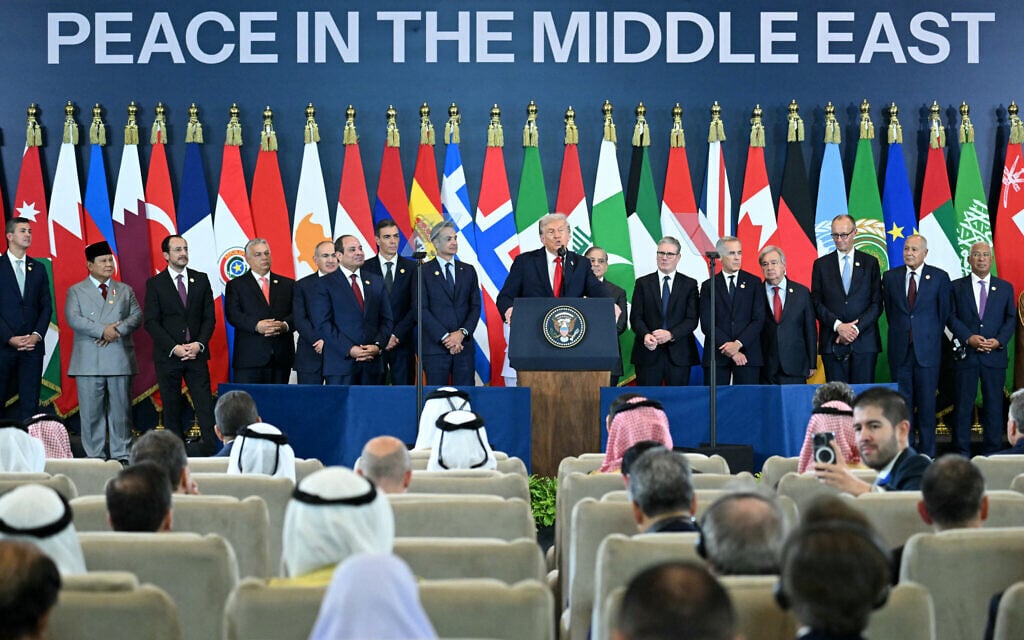
US President Donald Trump (C) speaks during the Sharm El-Sheikh Peace Summit in the Egyptian Red Sea resort town of Sharm el-Sheikh on October 13, 2025. (Photo by SAUL LOEB / AFP)
 
American allies, part of the Group of Seven, remain uneasily on the sidelines. Originally the board was proposed to help oversee the reconstruction of Gaza. A broader purpose has been newly revealed: to "secure enduring peace on areas affected or threatened by conflict", a vision that places many U.S. allies on alert, concerned there is a hidden agenda to rival and perhaps replace the traditional 'relevance' of the United Nations.
 
That a new draft plan suggests countries joining the board contribute $1 billion each should they wish to  place themselves past the initial three-year registration to permanent status, may have taken many aback. The view being that Mr. Trump will remain its chairman in perpetuity, making all the decisions as its "inaugural chairman". The invitation extended to Russian President Vladimir Putin and Belarus's Alexander Lukashenko certainly persuaded Volodymyr Zelenskyy to politely turn down his own invitation, while raising eyebrows throughout Europe.
 
Altogether some 60 leaders were given invitations to join. France, the United Kingdom, Sweden, the Netherlands, Norway and Germany have declined their invitations. Canada accepted, but given its trade overtures to Beijing that followed, has been  summarily disinvited.  The UN Security Council had originally endorsed the Gaza plan, but may since have had second thoughts.


Labels: , , , , ,

Sunday, January 21, 2024

Which 'Two-State Solution' Might That Be?

"It's still delicate, it's fragile, and it will take a long time, but I think that it is actually an opportunity to move forward in the world and the region toward a better future."
"When nations come forward and say 'two-state solution', they have to first deal with a preliminary question, which is a core question for human beings: Are we offered real safety?"
"Israelis lost trust in the peace process because they could see that terror is glorified by our neighbours."
"[Hamas's attack on Israel was planned and carried out by one of the proxies of the] empire of evil emanating from Tehran."
"We are praying that all the medication …. will reach them [Israeli hostages held in Gaza], but that’s only the beginning."
"We all understand that there has to be a vision, and I think part of it should be also going back to the normalization process of Israel and its neighbors in the region. I think it’s part of a package."
"But that requires to support Israel's efforts to undermine the capabilities of Hamas, and it’s still there."
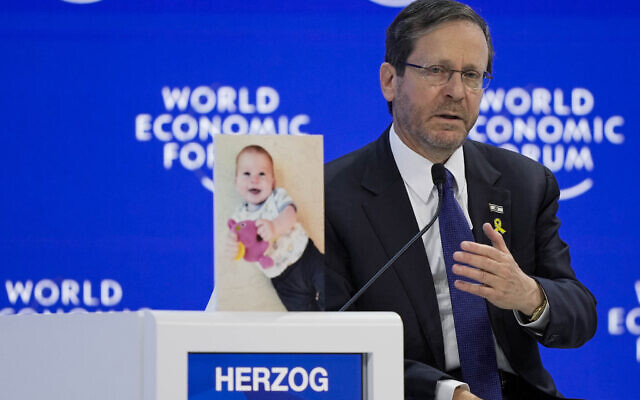
Israeli President Isaac Herzog, speech, World Economic Forum Davos Meeting 
Israeli President Isaac Herzog. Stefani Reynolds/Pool via REUTERS

The day before Israel's president addressed the World Economic Forum in Davos, Saudi Arabia's foreign minister, Prince Faisal bin Farhan, spoke on a Davos panel of the Kingdom having agreed "regional peace includes peace for Israel". That Saudi Arabia "certainly" would recognize Israel as part of a larger political agreement. Of course, there are conditions, nothing new about those conditions, since they're reiterated constantly.

"But that can only happen through peace for the Palestinians, through a Palestinian state", he averred in a familiar refrain. Omitting the obvious, that 'peace for the Palestinians' is actually in the hands of the very Palestinians that Saudi Arabia persists in advocating for. It is the Palestinians that have had their peace negotiators throw roadblocks time and again during now-defunct/frozen/dead peace talks with Israeli negotiators, where each and every concession at great cost to Israel, was rejected.

It is from Fatah, through the Palestinian Authority that incitements to violence and encouragement of children through school curricula to seriously consider the avocation of 'martyr' as 'resistance to occupation' has taken place, with the PA speaking one set of conditions to its audience in the West, and its true intentions to its home audience. It is from Hamas that the assurance comes that it will never abandon its charter promise to eradicate Israel from the map of the Middle East. Details, mere details.

As for the United States' position on the necessity of a 'two-state' solution to the impasse between Israel and the Palestinians, U.S. Secretary of State Antony Blinken took that opportunity as well to exhaust the patience of any Israeli leader in the wake of October 7, and subsequent West Bank Palestinian polls that showed Hamas enjoying high popularity among Gazans and even more so among West Bank residents, averaging out to 82 percent of Palestinians believing Hamas did well in prosecuting their cause by raping, mutilating and slaughtering over 1,200 Israeli civilians.

Traumatized Israelis, said President Herzog, are focused on their security, translating to low support for the two-state conditions the outside world insists on imposing on Israel. What other nation on Earth would be prepared to live in such conditions that Israelis face day by day, never knowing when some hate-crazed assassin will lurch at someone standing at a bus stop with a knife, with intention to kill, or a vehicular homicide perpetrated by a Palestinian, or a forced night-time entry to a girl's bedroom who will be raped and murdered.

Knowing that people who live a stone's throw across a border are prepared at any given time to wreak  havoc and target Jews for death, either singly or in gatherings, Israelis live with an existential tension few other countries have ever had to contend with. The lesson taught by Hamas terrorists, supported by Palestinian Islamic Jihad and the PLFP on October 7 was a stark reminder of the level of lethal hate Israel is subjected to. Horrendously, ordinary civilian Palestinians flocked into southern Israel with the terrorists to add to the demonic chaos and death count.

Israel still awaits the return of 130 of the hostages left in Gaza. In reality there seems to be scant hope they will be recovered. Signs are that Hamas has been murdering the hostages they hold; bodies of Israeli hostages are being discovered by the Israel Defense Forces. Hostages with chronic health conditions were to have finally been given medication as a result of mediation, yet the Red Cross which has never stirred itself to insist it be given access to hostages to evaluate their conditions refused to deliver the drugs, handing them over to Hamas.

Once again the world community stands by in shallow sympathy with the Jewish state, just as they stood by when genocide was being actively perpetrated by state machinery addicted to annihilating Europe's Jews during the Holocaust years, when neither the Vatican, the Red Cross, Interpol, or world powers made any overtures to intervene. On that occasion it was Jews abandoned and alone; on this occasion it is the Jewish state reborn to protect their own.

President Isaac Herzog speaks at the World Economic Forum in Davos, Switzerland, Jan. 18, 2024, alongside a photo of Hamas-held Israeli hostage Kfir Bibas. (AP Photo/Markus Schreiber)


Labels: , , , , ,

Follow @rheytah Tweet