Venezuela's Military Alliances
"The things they said were plausible and they were consistent with more than 15 years of engagement with China, Russia and Iran. [But] not everything that they claimed by showing a satellite image was necessarily proven by that image... It's not nothing, but I don't regard it as a significant 'Ah-hah!""Venezuela now for literally more than two decades has been one of the biggest strategic challenges to the U.S. To me the drugs the U.S. is currently going after are only the tip of the iceberg of a broader, longtime, multi-dimensional threat."Dr. Even Ellis, research professor, U.S. Army War College"There were several times when I was confounded by what he [Lee Wheelbarger, former U.S. army technology developer] presented to me, and then it blew my mind when I validated it was accurate: 'Holy crap, OK, cool'.""One thing I've learned is he's not going to put his word on the line unless he feels he can back it up. He will substantiate everything he has."Michael Torres, retired U.S. air force colonel
 |
| Satellite show images of Trump's strike on Venezuelan neighbourhoods, The Independent |
According
to Dr. Ellis of the Army War College, military ties that Venezuela has
with Russia, China and Iran are of long standing. Venezuela purchased
$12 billion in defence materiel from Russia starting in 2006 that was
inclusive of a fleet of Sukhoi-30 fighter jets, helicopters, numerous
S-300 anti-aircraft missiles and armed vehicles. A Russian fleet of
war-vessels visited both Cuba and Venezuela last year. At least 27 of
its K-8 fighters have been supplied to Venezuela by China, along with
radars and associated equipment, while the Republic of Iran sourced
Venezuela with a number of fast-attack boats, trained Venezuelan special
forces members and collaborated on the production of drones.
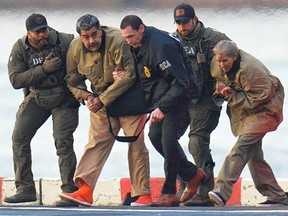
Intelligence
experts are mulling over a report arguing that satellite images reveal a
launch site in Venezuela that has the potential to aim ballistic
missiles at Washington, D.C., produced by a group of amateur
intelligence analysts. The report was released just prior to the
dead-of-night surprise American military raid that captured Venezuela's
president Nicolas Maduro and his wife Cilia Flores, taking them back to
the United States to stand trial in New York for drugs and weapons
charges deemed to be criminal offences in the United States, but not
necessarily in Venezuela.
 |
According
to the group's report, it was in fact, not drugs but military
developments in Venezuela alongside Russian, Chinese and Iranian troops
stationed nearby that persuaded the Trump administration to make their
strike, despite that the U.S. military dismissed that contention as
"speculative". "I
don't think it [scooping up the Venezuelan president and his wife] has a
damn thing to do with the drug boats. I think the drug boats are
completely irrelevant. That's an excuse", stated Lee
Wheelbarger, who led the group investigation whose findings, including a
video compilation of satellite picture were presented to a
defence-oriented think tank meeting, the Mackenzie Institute, in
Toronto.
A spokesman for the U.S. Southern Command covering South America contended that the organization makes no comments on "speculative
reporting or unverified premises. Our mission remains focused on
supporting regional stability, combating illicit activities, and working
with our partners to address shared security challenges".
Yet according to a Russian lawmaker, Russia considered supplying its
new Oreshnik ballistic missiles to Venezuela, requested by Nicolas
Maduro along with other equipment from Russia, China and Iran.
It
has been confirmed that Venezuela has close military ties with the
three countries, as well as with Hezbollah out of Lebanon, the Iranian
proxy militia. The images collected by Wheelbarger's group and the
analyses produced led to conclusions explaining the sudden midnight
action by the U.S. against Venezuela. Action culminated from the
threatening appearance of American warships, including an aircraft
carrier patrolling the region, even as the U.S. destroyed dozens of
boats claiming they were carrying drugs to end up in the United States.
Deadly incidents decried as extrajudicial executions by those
purportedly involved in drug trafficking who would normally face arrest
and trial.
Wheelbarger,
for several years a senior technologist with the U.S. army -- was a
contractor developing night-vision equipment, communications gear and an
advanced technological protocol enabling battlefield medics to transmit
images to military hospitals, and then receive instructions on a video
display -- was lauded with claims that "Wheelbarger's electronic creations have extended the eyes and ears of America's intelligence network", by the History Channel's Modern Marvels program, in 1999.
According
to the man himself, he engages in the collection of publicly available
images from 28 satellites operated by Maxar Technologies, Planet Labs,
Airbus Defence and Space, BlackSky, Capella Space, ICEYE,
SkyFi, European Space Imaging, Apollo Mapping, Satellite Imaging Corp.,
and L3 Harris Geospatial; also accessing images from ground cameras,
along with another video method that remained unexplained, to glean
information from global human sources. He possesses three-dimensional
renderings of military hardware that can be placed over satellite images
to match shape and size aiding in identifying specific equipment.
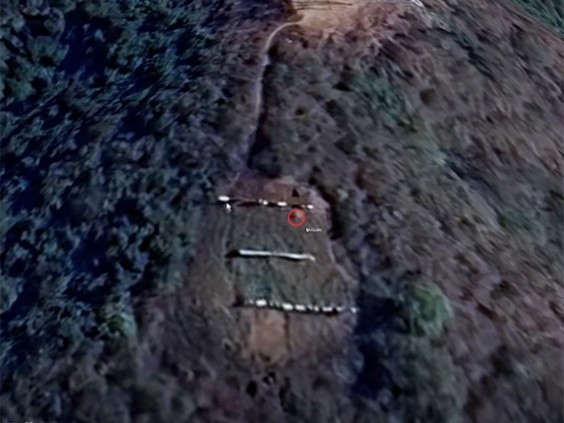 |
In
his Toronto presentation video he identifies images close to Caracas
including a Russian base complete with 94 T-72 and T-74 tanks.
Impressively, he points to a mountain hollowed out in the creation of a
subterranean military complex with openings cut into the hill surrounded
by rebar suggesting creation of a massive concrete facade with
"millions of cubic yards" of excavated dirt piled nearby. The
mountainside features an area with three parallel, straight lines of
holes which Wheelbarger and his colleagues identify as tubes to fire
intermediate-range ballistic missiles from, basing their theory on
matching underground launch sites located in Iran.
Jeff
Nyquist, writer and geopolitics blogger who collaborates with
Wheelbarger, notes that intermediate-range missiles could reach north to
the U.S. capital. The Cuban airfield images cigar-shaped objects at a
runway's end, identified by the analysts as Kitchen missiles. Russian
weapons travelling at almost five times the speed of sound that can
destroy naval ships, usually fired from aircraft, generally the Tu-22
bomber, not seen in the images, but readily disassembled and smuggled
into Cuba on larger cargo planes, according to Wheelbarger.
| A stunning U.S. raid to capture Venezuela’s president came after a group of amateur intelligence analysts argued that satellite images reveal a Venezuelan launch site that could send ballistic missiles as far north as Washington, D.C. National Post |
Labels: China, Cuba, Hezbollah, Ian, Russia, Trump's War on drugs, US Raid on Venezuela, Venezuela's Military Alliances, Venezuelan President Nicolas Maduro Captured
posted by Pieface @ Thursday, January 08, 2026


<< Home