"[Havana]
aligns itself -- and provides support to numerous hostile countries,
transnational terrorist groups and malign actors adverse to the United
States [including Russia, China and Iran]."
"[The
communist government provides] defense, intelligence and security
assistance to adversaries in the Western Hemisphere [while violating the
human rights of its citizens]."
"[Cuba] will be failing pretty soon. They got their oil from Venezuela. They're not getting that anymore."
"[I will impose tariffs on any country that] directly or indirectly provides oil to Cuba."
U.S. President Donald J. Trump
"We
did not touch on the topic of Cuba [during their 40-minute telephone
conversation], and in the evening then this [executive order] came out."
"The
imposition of tariffs on countries that provide oil to Cuba could
create a far-reaching humanitarian crisis [severely impacting the
operations of hospitals, the electrical grid and the food supply]."
"[Cuba is currently] going through a difficult moment [but Mexico cannot be put] at risk in terms of the tariffs."
Mexican President Claudia Sheinbaum
A drone view shows the Pajaritos terminal of Mexico's state-owned oil company Pemex, in Coatzacoalcos, Veracruz state. (Angel Hernandez/Reuters)
An executive order was signed on Thursday by U.S. President Donald Trump when he declared Cuba represented an "unusual and extraordinary threat"
to U.S. national security for which tariffs would be imposed on all
U.S. imports from any country supplying Cuba with oil. In the wake of
the lightning military raid on Caracas in mid-January that took
Venezuela's President Nicolas Maduro into U.S. custody for trucking with
drug cartels, Mr. Trump turned his attention directly on Cuba.
Subsequent
to the raid, the Trump administration now controls Venezuela's oil
exports and took the occasion to block deliveries of oil to Cuba, long
reliant on its regional ally in Venezuela to supply it with petroleum.
Mexico, under critical trade duress found it necessary to cancel its
latest scheduled delivery for the month to Cuba, taking into account the
looming renegotiation of Mexico's free-trade pact with the United
States and Canada.
Under
these constraining issues, the sobering 'sovereign decision' was made
to temporarily halt Mexican oil shipments to Cuba. Earlier in the day
following the Trump order appearing on the White House website, the
Cuban government attempted to rally Latin American and Caribbean
neighbours to its rescue. "The peace, security and stability of Our America are in danger", Cuban Foreign Minister Bruno Rodriguez stated in a social media post, denouncing the U.S. for imposing "peace through force".
In
an appearance before the Senate Foreign Relations Committee the day
before, Secretary of State Marco Rubio -- of Cuban descent -- was asked
whether he would rule out forcing "regime change" in Cuba. "I think we would like to see that regime change", responded Mr. Rubio. "That
doesn't mean that we're going to make a change, but we would love to
see a change. There's no doubt about the fact that it would be of great
benefit to the United States if Cuba was no longer governed by an
autocratic regime".
Long
dependent on Venezuelan supplies of oil which it trades for security
and medical personnel with Venezuela under Maduro and previously Hugh
Chavez, Cuba produces little oil of its own. Imports averaged 37,000
barrels daily, the bulk of which arrived from Venezuela in 2025. Cuba is
now left with a mere 15 to 20 days of oil, according to the Financial Times. Island-wide blackouts are common and frequent, impacting basic human services like drinking water.
Preparing dinner during a blackout in Havana on Wednesday, as
Cubans from all walks of life hunker into survival mode, navigating
seemingly interminable blackouts and soaring prices for food, fuel and
transport as the U.S. increases pressure on the communist‑run nation. (Reuters)
Signing
a new defence co-operation pact with Havana last fall, Moscow pledged
$1 billion in investment over the next five years in efforts to retain a
hemispheric foothold. Diplomatic support has emanated to Cuba by both
China and Russia. The determination of the U.S. to direct oil supplies
away from Cuba along with a fleet of navy and coast guard ships in the
Caribbean for operations against Venezuela tasked to stop drug
smuggling, the oil blockade of Cuba was next on the agenda.
Seven
sanctioned oil tankers carrying Venezuelan crude have been seized by
the U.S. to date -- blockading legitimate shipments to Cuba risks global
criticism of violating international law, according to maritime
experts. In response to questions in the immediate aftermath of the
Caracas raid, the U.S. president responded that he felt no additional
actions were required against Cuba, since lacking oil from Venezuela, "Cuba looks like it's ready to fall".
"The
things they said were plausible and they were consistent with more than
15 years of engagement with China, Russia and Iran. [But] not
everything that they claimed by showing a satellite image was
necessarily proven by that image... It's not nothing, but I don't regard
it as a significant 'Ah-hah!"
"Venezuela
now for literally more than two decades has been one of the biggest
strategic challenges to the U.S. To me the drugs the U.S. is currently
going after are only the tip of the iceberg of a broader, longtime,
multi-dimensional threat."
Dr. Even Ellis, research professor, U.S. Army War College
"There
were several times when I was confounded by what he [Lee Wheelbarger,
former U.S. army technology developer] presented to me, and then it
blew my mind when I validated it was accurate: 'Holy crap, OK, cool'."
"One
thing I've learned is he's not going to put his word on the line unless
he feels he can back it up. He will substantiate everything he has."
Michael Torres, retired U.S. air force colonel
Satellite show images of Trump's strike on Venezuelan neighbourhoods, The Independent
According
to Dr. Ellis of the Army War College, military ties that Venezuela has
with Russia, China and Iran are of long standing. Venezuela purchased
$12 billion in defence materiel from Russia starting in 2006 that was
inclusive of a fleet of Sukhoi-30 fighter jets, helicopters, numerous
S-300 anti-aircraft missiles and armed vehicles. A Russian fleet of
war-vessels visited both Cuba and Venezuela last year. At least 27 of
its K-8 fighters have been supplied to Venezuela by China, along with
radars and associated equipment, while the Republic of Iran sourced
Venezuela with a number of fast-attack boats, trained Venezuelan special
forces members and collaborated on the production of drones.
Intelligence
experts are mulling over a report arguing that satellite images reveal a
launch site in Venezuela that has the potential to aim ballistic
missiles at Washington, D.C., produced by a group of amateur
intelligence analysts. The report was released just prior to the
dead-of-night surprise American military raid that captured Venezuela's
president Nicolas Maduro and his wife Cilia Flores, taking them back to
the United States to stand trial in New York for drugs and weapons
charges deemed to be criminal offences in the United States, but not
necessarily in Venezuela.
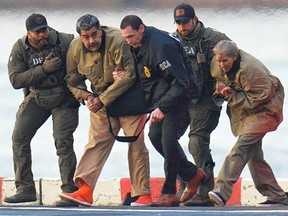
Nicolas
Maduro and his wife, Cilia Flores, are seen in handcuffs after landing
at a Manhattan helipad, escorted by heavily armed Federal agents as they
make their way into an armored car en route to a Federal courthouse in
Manhattan on Jan. 5, 2026, in New York City.Photo by XNY/Star Max /GC Images
According
to the group's report, it was in fact, not drugs but military
developments in Venezuela alongside Russian, Chinese and Iranian troops
stationed nearby that persuaded the Trump administration to make their
strike, despite that the U.S. military dismissed that contention as
"speculative". "I
don't think it [scooping up the Venezuelan president and his wife] has a
damn thing to do with the drug boats. I think the drug boats are
completely irrelevant. That's an excuse", stated Lee
Wheelbarger, who led the group investigation whose findings, including a
video compilation of satellite picture were presented to a
defence-oriented think tank meeting, the Mackenzie Institute, in
Toronto.
A spokesman for the U.S. Southern Command covering South America contended that the organization makes no comments on "speculative
reporting or unverified premises. Our mission remains focused on
supporting regional stability, combating illicit activities, and working
with our partners to address shared security challenges".
Yet according to a Russian lawmaker, Russia considered supplying its
new Oreshnik ballistic missiles to Venezuela, requested by Nicolas
Maduro along with other equipment from Russia, China and Iran.
It
has been confirmed that Venezuela has close military ties with the
three countries, as well as with Hezbollah out of Lebanon, the Iranian
proxy militia. The images collected by Wheelbarger's group and the
analyses produced led to conclusions explaining the sudden midnight
action by the U.S. against Venezuela. Action culminated from the
threatening appearance of American warships, including an aircraft
carrier patrolling the region, even as the U.S. destroyed dozens of
boats claiming they were carrying drugs to end up in the United States.
Deadly incidents decried as extrajudicial executions by those
purportedly involved in drug trafficking who would normally face arrest
and trial.
Wheelbarger,
for several years a senior technologist with the U.S. army -- was a
contractor developing night-vision equipment, communications gear and an
advanced technological protocol enabling battlefield medics to transmit
images to military hospitals, and then receive instructions on a video
display -- was lauded with claims that "Wheelbarger's electronic creations have extended the eyes and ears of America's intelligence network", by the History Channel's Modern Marvels program, in 1999.
According
to the man himself, he engages in the collection of publicly available
images from 28 satellites operated by Maxar Technologies, Planet Labs,
Airbus Defence and Space, BlackSky, Capella Space, ICEYE,
SkyFi, European Space Imaging, Apollo Mapping, Satellite Imaging Corp.,
and L3 Harris Geospatial; also accessing images from ground cameras,
along with another video method that remained unexplained, to glean
information from global human sources. He possesses three-dimensional
renderings of military hardware that can be placed over satellite images
to match shape and size aiding in identifying specific equipment.
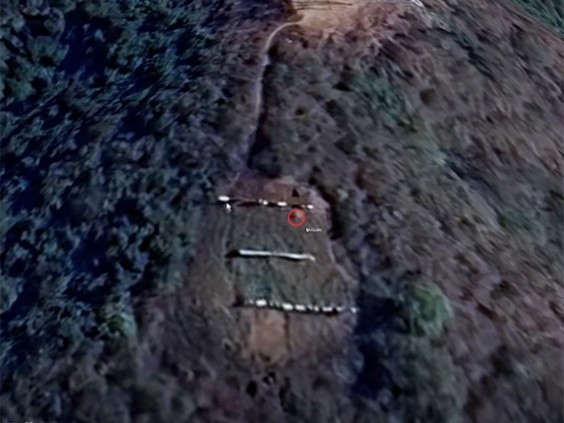
A
clearing on a mountain near Caracas, Venezuela that a group of private
intelligence analysts says shows three rows of missile "tubes" that
could be the launch sites for intermediate-range ballistic missiles.Photo by Lee Wheelbarger
In
his Toronto presentation video he identifies images close to Caracas
including a Russian base complete with 94 T-72 and T-74 tanks.
Impressively, he points to a mountain hollowed out in the creation of a
subterranean military complex with openings cut into the hill surrounded
by rebar suggesting creation of a massive concrete facade with
"millions of cubic yards" of excavated dirt piled nearby. The
mountainside features an area with three parallel, straight lines of
holes which Wheelbarger and his colleagues identify as tubes to fire
intermediate-range ballistic missiles from, basing their theory on
matching underground launch sites located in Iran.
Jeff
Nyquist, writer and geopolitics blogger who collaborates with
Wheelbarger, notes that intermediate-range missiles could reach north to
the U.S. capital. The Cuban airfield images cigar-shaped objects at a
runway's end, identified by the analysts as Kitchen missiles. Russian
weapons travelling at almost five times the speed of sound that can
destroy naval ships, usually fired from aircraft, generally the Tu-22
bomber, not seen in the images, but readily disassembled and smuggled
into Cuba on larger cargo planes, according to Wheelbarger.
A stunning U.S. raid to capture Venezuela’s president came after a
group of amateur intelligence analysts argued that satellite images
reveal a Venezuelan launch site that could send ballistic missiles as
far north as Washington, D.C. National Post
"People outside keep making claims that this is psychological. This might give them some peace and some vindication that there is something real there and it is not just in their heads." "Everyone who examined these patients feels this was real from a neurological point of view, that this was a true neurological disorder." Dr. Douglas Smith, director, Center for Brain Injury and Repair, University of Pennsylvania, Perelman School of Medicine
The study was based on MRI scans of US diplomats who were in Cuba and their relatives Getty Images
"In collaboration with Health Canada, a physician is following up with each affected individual to ensure they receive appropriate medical treatment through the Canadian provincial health-care system." "All employees and their families who have reported symptoms have received medical testing in Canada. We are working closely with the Dalhousie University Brain Repair Centre to support further research." Global Affairs Canada spokesman, John Babcock
The sounds weren't those of crickets, the mind-numbing effects not psychosomatic, the controversial issue of Canadian and American mission staff in Cuba experiencing strangely mystifying exposure to a force of some kind that affected their brains has undergone scrutiny since 'Havana syndrome' first surfaced several years ago with diplomats and their families suffering concussion-like symptoms with no visible signs of traumatic head injury.
Not mass hysteria at all. The cause and motivation remain unknown. But some suspect the injuries could have resulted from directed-energy weapons, like microwaves. U.S researchers have now published a paper in the Journal of the American Medical Association, revealing their finding that advanced neuro imaging had uncovered the presence of differences of a significant quality in the brains of 40 American government personnel.
They had experienced "directional phenomena" while serving in the diplomatic core in Havana. Their brains were compared to those of a control group. The findings, according to Dr. Douglas Smith, one of the authors, represented vindication for the patients treated and studied at the University of Pennsylvania's Perelman School of Medicine which had taken the lead in the matter. Those afflicted with the symptoms of 'Havana syndrome' were made to feel like unreliable imposters.
But it was discovered by the researchers who studied the patients, the presence of significantly smaller brain white matter in the concussion-type symptoms as compared to the control group. Tissue containing nerve fibres connecting parts of the brain and which signal nerves to communicate, is white matter. In the changes identified by researchers, the similarity to the brains of concussion patients were identified. Along with a unique change to the signals helping nerves to communicate.
Researchers found no swelling in the long fibres contained in white matter as would be the case in concussion patients; instead the opposite was found in the Havana patients, possibly indicating that the brains of Havana patients could contain a lower percentage of moisture in their white matter. "These types of changes are truly unique and don't fit any known disorder that we have come across", explained Dr. Smith.
A range of symptoms including eye tracking difficulty, headaches, problems with balance, hearing and cognition difficulties, were experienced by the patients; symptoms that have for most patients resolved, while for others they have continued. Havana syndrome or something quite akin to it has also been experienced by American diplomatic government employees posted to China, and they are similarly being treated at the University of Pennsylvania.
Some of the Canadian diplomats and their family members had travelled to the University of Pennsylvania, paying their own way to do so, in the hopes they too would be examined, only to discover that authorities at the university had been informed by the government of Canada that the Canadians should not be treated there. Since then, Canadian diplomats and their families have been examined and treated at Dalhousie University in Halifax by brain researchers there.
A common experience among those affected were sounds coinciding with the symptoms being experienced. One diplomat posted to Havana in 2017 described waking during the night to a "grinding, screeching, metallic noise" filling the bedroom, that made him nauseous and then his son entered the room with a severe nosebleed. That family experienced headaches, cognitive problems and nosebleeds. On return to Ottawa the diplomat's wife actually 'lost' her sense of direction and was unable to find her way home.
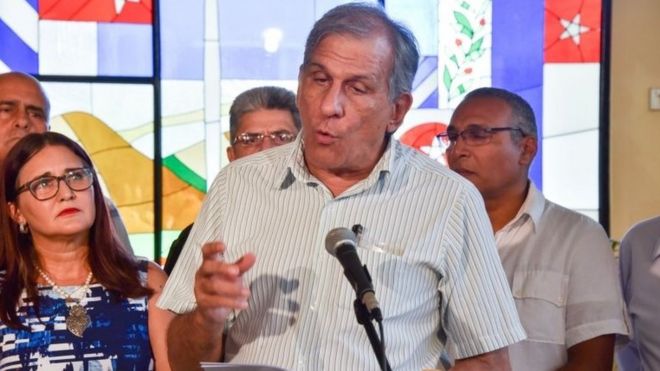
The release and publication of the study's findings has been entirely rejected by Cuban neuroscientists. Who had themselves carried out their own study from their perspective. Cuban authorities have claimed to be as puzzled as American and Canadian researchers over the peculiar events. Prof Mitchell Valdés-Sosa, the Cuban lead scientist, criticized the study's methodology and "inconclusive results".
At a news conference propelled by news of the study results, Professor Valdés-Sosa stated: "the changes in the brain
images are very small, very diverse and very diffuse. They do not
correspond to a coherent explanation."
Prof Mitchell Valdés-Sosa of the Cuban Neuroscience Center dismissed the findings of the study AFP
"[The Cubans] are key consultants and advisers, but I don't think they're calling the shots." "Cubans often complain that Maduro doesn't listen to them." David Smilde, Venezuela expert, Tulane University, New Orleans
"They are certainly ideological brothers-in-arms. But it doesn't have the same friendliness as it used to. And the Cubans aren't getting as much out of it [the friendship] as they used to." "[Should Mr. Guaido and the opposition gain control in Caracas] that would, of course, be very bad news for Havana." "That will very quickly change the relationship with Cuba." Ted Piccone, senior fellow, Brookings Institution
"This agency [Venezuelan intelligence agents, detaining Juan Guaido briefly] is controlled & directed by experienced oppressors sent by #Cuba & these kinds of tactics are textbook methods used by the Cuban regime." U.S. Senator Marco Rubio, Twitter
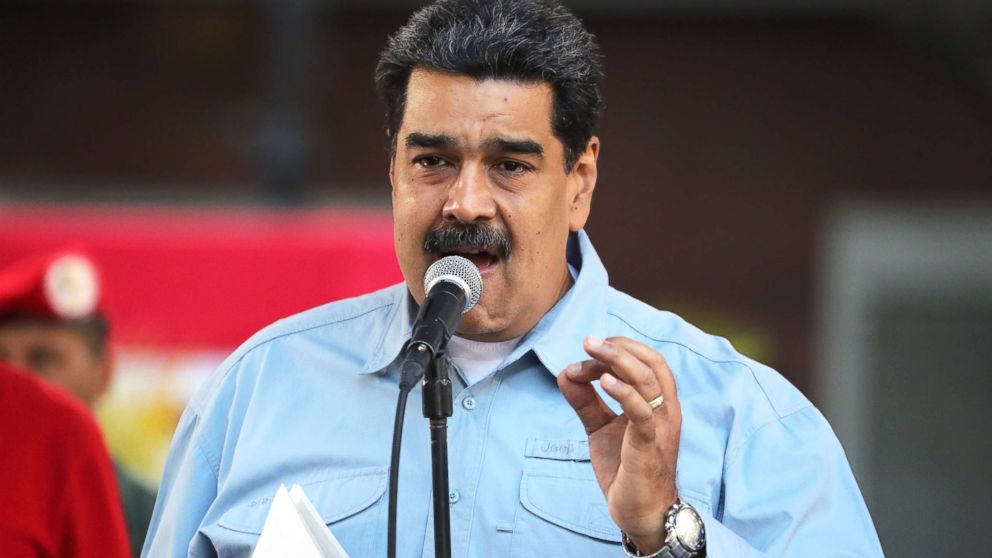
(MiguelL Gutierrez/EPA via Shutterstock) Venezuelan President Nicolas Maduro speaks during an event at Bolivar Square, in Caracas, Venezuela, Feb. 07, 2019.
A longtime ally of Venezuela, Cuba has been Venezuela's most enthusiastic and robust supporter in the geographic region they occupy, where President Miguel Diaz-Canel has offered President Maduro his government's "unwavering solidarity", naming Venezuela's political turmoil "the attempt to impose a coup d'etat, a puppet government at the service of the United States."
Cuba is to blame in large part for Maduro's endurance in office, in the view of many opponents of the Maduro regime, pointing to the presence of Cuban operatives throughout the country; spies, intelligence and political advisers, counterintelligence agents, military trainers. Supporters of Juan Guaido, who has declared himself the legitimate interim leader of Venezuela, insist that Cuba has propped up Maduro through aiding him in suppressing popular dissent.
The presence of Cubans in the Venezuelan armed forces was "unacceptable", points out a Venezuelan opposition leader, Maria Corina Machado. The Cuban government "must understand that they have to let go of Venezuela". When Hugo Chavez came to power in 1998 a deep friendship between himself and Fidel Castro existed, and they drew even closer with the Venezuelan election making Chavez president.
(Meridith Kohut/The New York Times via Redux)
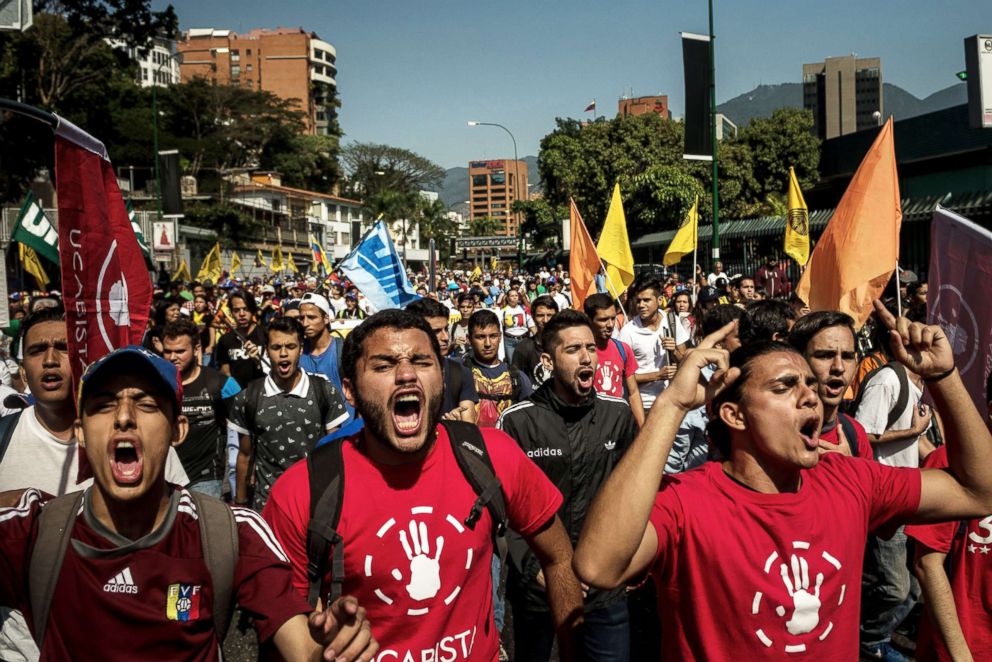
Venezuelan opposition supporters march in a demonstration protesting
the authoritarian rule of President Nicolas Maduro of Venezuela in
Caracas, Feb. 2, 2019.
"They were very close, like a father-and-son relationship", specialist on the Cuban economy Richard Feinberg, at the University of California, commented. When Hugo Chavez was diagnosed with cancer, it was to Cuba for expert medical attention that he turned. Cuba had benefited hugely from the generosity of President Chavez's oil gifts to the country. Cuba reciprocated by sending security and military specialists along with doctors, nurses, teachers and athletic coaches in support of Venezuela's professionals.
Venezuela's subsidized crude oil shipments to Cuba -- an estimated 100,000 barrels daily, was of inestimable help to the Cuban economy, especially since the dissolution of the USSR and Cuba's loss of revenues from that quarter, leaving it to deal with harsh U.S. sanctions minus Russian financial support. Cuba was able to sell surplus oil from Venezuela it had refined, to the international market to aid its economy.
The Brookings Institution estimated that the trade in goods and services amounted to 2.8 percent of Cuba's gross domestic product. Since the economic crisis that Venezuela has wobbled under in the past few years, crude exports to Cuba have dropped in lock step with Venezuelan oil production collapse. Now, say experts, the ranks of Cuban professionals at work in Venezuela have been depleted, the Maduro regime's relations with the new Cuban leadership waning.
Which doesn't mean that Cuba will no longer remain intensely obligated to support the Maduro regime, since Havana faces the risk of losing a vital economic benefactor and at the same time a crucial leftist ally in a geographic region that has been shifting rightward of late.
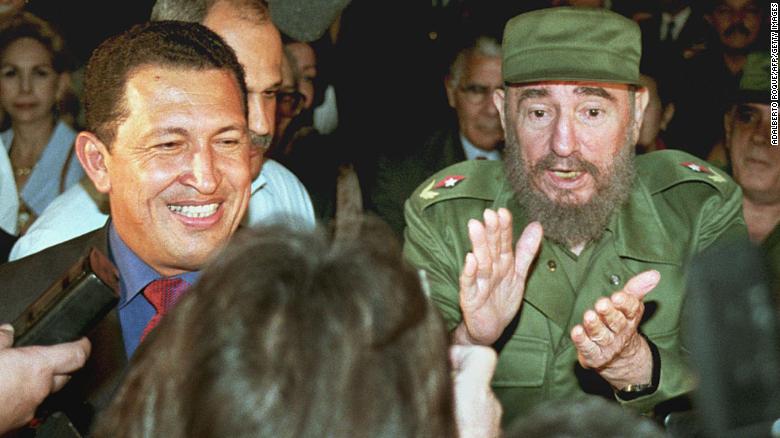
Venezuela's then-president-elect Hugo Chavez, flanked by then-Cuban
leader Fidel Castro at the Jose Marti airport in Havana in 1999.
"While in China, if you experience any unusual acute auditory or sensory phenomena accompanied by unusual sounds or piercing noises, do not attempt to locate their source." "Instead, move to a location where the sounds are not present." U.S. Consulate, Guangzhou, China
"I know of no acoustic effect that would produce concussion-like
symptoms; according to my research, strong effects on humans require
loudness levels that would be perceived as very loud noise while
exposed." Jürgen Altmann, physics professor, Technischen
Universität Dortmund, Berlin
"If you took any one of these patients and put them into a brain injury
clinic and you didn't know their background, you would think that they
had a traumatic brain injury from being in a car accident or a blast in
the military." "It's like a concussion without a concussion." Dr. Randel Swanson, specialist in brain injury rehabilitation, University of
Pennsylvania
"We don't want to see that this individual case would be magnified, complicated or even politicised."
"China has been investigating this matter in a very
responsible manner. We haven't found that any organisation or
individual has carried out such a sonic influence."
"[The US might with to carry out an] internal [probe into the case]."
Chinese Foreign Minister Wang Yi
"The employee was sent to the United States for further evaluation.
On May 18, 2018 the Embassy learned that the clinical findings of this
evaluation matched mild traumatic brain injury (MTBI)." "The Chinese government has assured us they are also investigating and taking appropriate measures." Jinnie Lee, U.S.
Embassy spokesperson, Beijing
There it is, again. Consular officials once more exposed to some mysterious sound wave likened to a 'sonic attack', that occurred just recently in China, after that same peculiar and inexplicable event occurred earlier, a year back, in Cuba, in some cases seriously affecting both American and Canadian Embassy officials, and their family members. Why nowhere else in the world have these events occurred? Only in Communist nations with undercurrents of hostile attitudes toward the West. Strange indeed!
For some of the diplomats and their family members who experienced the peculiarly strange phenomenon that made them peculiarly ill, their experience and its results still linger. Those affected reported "mental fog" that "slowed" them for months, according to a commissioned report. Some became beset with a sense of nervousness and irritability. Two of those interviewed for the study evidently met criteria for post-traumatic stress disorder. Their job performance capability was reduced substantially.
Three of those affected required hearing aids in response to moderate-to-severe hearing loss that resulted from their exposure to the unknown-in-origin sound. Many others continued to experience pressure or ringing in their ears, while over half required prescribed medication to enable them to sleep or to respond to headaches.
And among those affected, many were unable to return to work, given symptoms not typical of concussion; pain and ringing in one ear only. Another difference the study noted was that though concussion patients frequently make swift, full recoveries, these patients had their symptoms persist for months on end.
Photo: File photo of the Guangzhou skyline (Getty)
The similarity between the Cuba experience and that now identified in China is striking and puzzling. A government employee in the southern Chinese city of Guangzhou reported "subtle and vague, but abnormal, sensations of sound and pressure", alerting the U.S. State Department of a mild traumatic brain injury brought on by "abnormal" sensations of sound and pressure, resembling those that occurred to American diplomats in Cuba.
"The U.S. government is taking these reports seriously and has informed its official staff in China of this event", stated the US. consulate. As yet, no other cases within or without the diplomatic community have been reported. The U.S. Embassy in Beijing called members of their diplomatic corps from five consulates in China to a meeting for staff to air questions and receive responses. The U.S. is preparing to send a medical team to Guangzhou to conduct medical evaluations for any employees requesting such.
In Cuba, 24 diplomats and their family members had been victimized by "specific attacks" that left them with injuries such as those occurring with brain trauma. When Canadian diplomats experienced similar symptoms, Canada withdrew its officials from Cuba as well. And while investigators suspect the involvement of a "sonic weapon", no proof has arisen other than speculation that this might be the cause of those events.
The "unusual sounds or auditory sensations" reported by the victims have never been identified.
Do ‘Sonic Weapons’ Adequately Explain ‘Health Attacks’ on Diplomats in Cuba? Inaudible sonic weapons are an unlikely cause of the mysterious symptoms suffered by American and Canadian diplomats in Cuba. Snopes
"When you leave Cuba for the first time, you discover many things that you had been blind to. There comes a time when you get tired of being a slave." "You are trained in Cuba and our education is free, health care is free, but at what price? You wind up paying for it your whole life." Yaili Jimenez Gutierrez, 34, Cuban doctor, Minas Gerais State Brazil
"The end of the program [by the U.S. to welcome Cuban doctors] was a huge blow to us. That was our way out." "It was a pretty acceptable offer [to leave Cuba for Brazil, finance-wise, initially] compared to what we made in Cuba." "We began to see that the conditions for the other doctors were totally different. They could be with their family, bring their kids. The salaries were much higher." "It's sad to leave your family and friends and your homeland. But here we're in a country where you're free, where no one asks you where you're going, or tells you what you have to do." "In Cuba, your life is dictated by the government." Maireilys Alvarez Rodriguez, Santa Rita, Maranhao, Brazil
Part of the over 7,000 Cuban doctors working in Brazil. Photo: Juvenal Balán/granma
Cash-strapped Cuba has garnered an enviable reputation as a country that trains more doctors than it could possibly have use for within the country itself. And the purpose of all those redundant medical professionals is to farm them out to other countries in need of what Cuba has an excess of. Contracts are signed between the host country and the services-providing country and young doctors are persuaded to further their life-saving careers abroad where they gain experience, are honoured, and in the process do a great service to their country of origin.
Cuba receives $3,620 monthly for each doctor they send to Brazil. At the present time, 18,600 Cuban doctors work in Brazil, out of the 18,000 doctors from Cuba who have completed their contract time in the country. Great satisfaction is felt that this program, according to the United Nations, has significantly lowered the infant mortality rate in Brazil, while extending care to indigenous communities served by the presence of these Cuban doctors.
When Dr. Alvarez was first recommended to go abroad by the Cuban government the offer was a stipend that appealed to her and to her husband, Arnulfo Castanet Batista, another doctor. They would have to leave their two children in the care of relatives after signing up, but each would earn 2,900 Brazilian reals monthly, to the value of $1,400 compared to $30 monthly they would earn in Cuba, although that original $1,400 is now worth $908. "There is no injustice", Brazil's health minister Ricardo Barros stated. "When they signed up, they agreed to the terms." He speaks here of lawsuits launched in Brazil by a number of Cuban doctors. A year ago a Cuban doctor had a conversation with a clergyman in a remote village. Arriving at the conclusion of her three-year medical assignment, Anis Deli Grana de Carvalho having married a Brazilian man wanted to remain in Brazil. When the pastor learned what the government pays Cuba and what the doctor received, he introduced her to a lawyer. She sued. Other doctors followed.
Brazilian lawyer Andre de Santana Correa analyzed the contracts coming to the conclusion they were not compliant with the equality provisions in Brazil's Constitution. Justices issued temporary injunctions but a federal judge ruled that allowing Cuban doctors to walk away from their contracts represented "undue risks in the political and diplomatic spheres". The Cuban doctors were immediately fired, each invited to fly back to Cuba within 24 hours, or face an eight-year exile.
Dr. Alvarez and her husband had the good fortune to keep their jobs and be granted a large pay raise, enabling them to bring their children to Brazil. But Dr. Jimenez has been unable to find work since she was fired and now she is barred from Cuba for an eight-year period. Mr. Barros, Brazil's health minister feels the Cuban doctors were not poorly compensated; their salaries equal to what Brazilian doctors earn during residencies.
"You can buy transducers on the Internet that emit these frequencies. Anybody with a bit of engineering background could put one together." "That’s a little harder for me to believe [ultrasonic sound’s potential to cause permanent brain damage]. The sound would have to enter the brain tissue itself, but if
you’ve ever had an ultrasound scan you’ll know they put gel on. If
there’s even a tiny bit of air between the sound and your body it
doesn’t get through." Robin Cleveland, professor of engineering science, University of Oxford
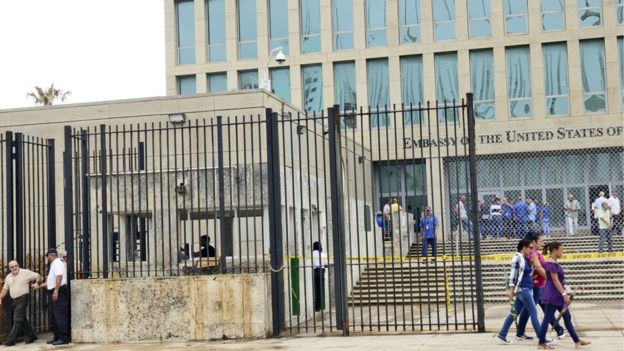
Staff stand within the United States embassy facility in Havana, Cuba,
on Friday. The United States issued an ominous warning to Americans on
Friday to stay away from Cuba and ordered home more than half the U.S.
diplomatic corps, acknowledging neither the Cubans nor America's FBI can
figure out who or what is responsible for months of mysterious health
ailments.(Desmond Boylan / The Associated Press)
"[It is possible, particularly] if the diplomats share meals together,
it is a distinct possibility that somebody poisoned their food." "Does
chemical poisoning explain all the known symptoms, even for those
victims who heard noises in the middle of the night?" "Possibly. Chemical solvents can cause nerve damage, which can manifest
in different ways. With auditory nerve damage, some people might
experience ringing (tinnitus), and others might find certain noise
frequencies excruciatingly intolerable while others barely notice." Jamie Wells, Director of Medicine, American Council on
Science and Health and microbiologist Alex Berezow
Diplomats, assigned to represent their countries' best interests are delegated to live and work in Embassies in foreign nations. Those embassies and the living arrangements of the diplomats are held to be the de facto territory of the nations they represent, as distinct of the property of the nations they are located within. As such, they are in theory and according to convention protecting any nation's diplomatic staff, untouchable. Yet both Canadian and American diplomats posted to Cuba have reported verifiable illnesses whose cause has been immune to detection.
Diplomats who suffer inexplicable symptoms that cannot be attributed to any discernible cause, yet the symptoms are there, and some who are affected by them, are quite serious in nature, making the afflicted extremely ill and threatening their health in ways that cannot be fully understood. Symptoms ranging from hearing loss and vertigo, to nausea and concussions where people are left reeling from the effects, unable to concentrate and even jog their memories to bring up words common to their vocabularies.
Some of the affected claim to have felt vibrations or having been exposed to loud noises that could be heard in portions of a room but not other areas, while other people present in that same room remain unaffected, hearing and feeling nothing untoward. Canadian and American diplomats have been affected by these truly mysterious events. Those who have suffered serious repercussions have left Cuba for treatment in Canada and the United States for conditions whose causes remain unknown despite all available means of investigation.
Finally, though Canada has decided for the time being to do nothing about their diplomats and their mission in Cuba, the United States has decided to return all designated non-essential personnel from Havana and at the same time travel advisories have gone out to all Americans against visiting the country for safety reasons until such time as investigators can put a reason to these strange occurrences. Perplexedly strange, there are theories but none that can be proven. Of the most apt, the sonic theory of sound attacks is particularly favoured.
In light of the fact that some of the people affected report hearing losses following strange and loud acoustic events and vibrations, conceivably related to ultrasonic frequencies, that are notably high-pitched, which have somehow been harnessed and directed for possibly malicious purposes. As in the case of puzzles steeped deep in mysteries, high frequency sound has no capacity to travel through barriers such as a wall or even something slighter, like a curtain.
Equally or perhaps even more problematical is the theory of ultra-sonic sound causing permanent brain damage, as reflected by some Cuban diplomats themselves having been diagnosed with brain injury of mild traumatic effect. Electromagnetic waves, on one hand are readily directed, just as a laser is controlled, to travel through walls and their presence unknown. Yet if they were to be used the diplomats would report having experienced burning sensations since they heat body tissue in causing physical damage..
Mercury and lead, on the other hand, are elements known to be harmful to humans; could be the cause of hearing and brain damage. Other types of industrial solvents could also fit the bill. But nothing as yet has been revealed that might conceivably solve this strange dilemma. Since there is no possible benefit to Cuba in afflicting diplomats of countries whose cooperation with the communist state is of use to it, the finger of suspicion points not at Cuba but to other entities dissatisfied with any entente between Cuba and the U.S.
"In Cuba, products were developed to solve pressing health problems, unlike in other countries, where commercial interests prevailed." World Health Organization report "The data is intriguing, but we need to do more definitive studies." Justin F. Gainor, oncologist, Massachusetts General Hospital
"Since I have been taking Cimavax, it [lung cancer] hasn't come back." "There's no doubt that without this medicine [Cimavax], I would be dead." Mick Phillips, 69, Appleton, Wisconsin
Mick Phillips's doctor credits a lung cancer vaccine from
Cuba with sustaining the Wisconsin man's remission from a disease he
learned he had more than five years ago. (CBC)
Cancer patients from Canada and the United States have been travelling to Cuba for the promise held out by a vaccine that appears to be able to halt the progress of the cancer they're suffering from, even those who have been diagnosed with late-stage cancer that is seen to be incurable by any methods currently practised in North America. Cuba's vaunted biotechnology industry is known to have produced a cancer vaccine that appears effective, but is not approved for use in the United States.
So, 78-year-old Zuby Malik, just incidentally a retired obstetrician-gynecologist, who was diagnosed with Stage 4 non-small-cell lung cancer a year earlier, and who has undergone and exhausted treatments available to her in the United States to little avail, determined to travel to Cuba to bring back with her the cancer vaccine that many other Americans have been successfully using to treat their cancer where all other optional treatments have been tried and found lacking.
New York Governor Andrew Cuomo, in recognition of the medical tourism undertaken by Americans, has given public notice that the Roswell Park Cancer Institute in Buffalo has received the requisite authorization to enable it to conduct a clinical trial of Cimavax, the Cuban vaccine for lung cancer. This would be the first time in sixty years that Cuban and American institutions have partnered scientifically in a joint venture.
Cimavax was developed initially in a bid to halt the growth of cancer and to block cancer from recurring in people diagnosed with non-small-cell lung cancer. The drug is geared to stimulate the immune system of the body in the production of antibodies to bind to a protein called epidermal growth factor (E.G.F.), preventing the protein from further feeding the cancer's growth. The drug is available in Peru, Paraguay, Colombia and Bosnia and Herzegovia.
Although trials undertaken in Cuba have manifested a modest benefit where, in the most recent trial, patients given the vaccine after chemotherapy treatment lived only about three to five months longer than those who did not receive the vaccine, it continues to hold out hope in the minds of those patients with nothing left to lose but their lives. The Cuban study was published in the journal Clinical Cancer Research. It found that patients who were vaccinated with Cimavax who had a high concentration of E.G.F. in their blood lived longer than the others.
Foreign medical tourists are exposed to an initial round of four injections at an international health center, La Pradera, catering for the most part to foreign patients in Havana. Thereafter, patients continue to administer themselves their periodic injections at home, for up to several months on the Cimavax protocol. Cuba, famously known for its superb cigar production favoured the world over, was plagued by a high rate of lung cancer.
Which led Cuban researchers to work on Cimavax, and it was produced in the 1990s. Patients began receiving the vaccine free of charge, in 2011. It has since been administered to over four thousand patients worldwide, according to Roswell Park Cancer Institute in Buffalo, set to begin their own trials on the promising new treatment. The Roswell Park trial plans to combine the vaccine with a form of immunotherapy named a checkpoint inhibitor that restrains the cancer from turning off a patient's immune system.
In Cuba, a four-shot dose of Cimavax has a price tag of up to $100 to manufacture, according to Dr. Kelvin Lee, chairman of immunology at Roswell Park. Mr. Phillips, a lifelong smoker whose diagnosis came in 2009, estimates that he pays $9,000 for his yearly supply of Cimavax; roughly $1,500 each dose. In some patients' experience the price has dropped to $850 each dose. The entire cost of the trip to Cuba can amount to over $15,000 taking into account airfare, lodging at La Pradera and a few months' worth of the vaccine.
For Mr. Phillips, the vaccine has been a godsend, extending his life far longer than he was given hope for. For Ms. Malik, the experience has been less than stellar. The fluid in her lungs initially diminished with the first injection of the vaccine, but since then fluid has once again filled her right lung. She has become weak and short of breath, and her son said she is now considering dropping Cimavax. "It's not panning out as we'd hoped It's really like the Wild West trying to know what is best to do", he stated.
Say what one will of the countless negatives of Cuba's loyalty to the communist ideal, its health system presents as a model of true health-care benevolence within a rigidly authoritarian regime. Its rigorous bioscientific research is undertaken with the health of its population uppermost in mind. And its pharmaceutical production is not primarily greed-inspired, profit-motivated, marketing its products at astronomical pricing as reflected in the free-market system of capitalism. It is instead modestly priced, to make it available to those in dire need.
"The Revolution, over and above the rights and guarantees achieved for all its citizens of whatever ethnic background or origin, has not had the same success in its fight to eradicate the differences in social and financial status for the black population of the country." "Blacks don't live in the best houses; you find that they still have the hardest, most physically wearing and often worst-paid jobs and that they receive much less help from their family members no longer in Cuba, in dollars, than their white compatriots." Fidel Castro, My Life
"My children go to school for free, their uniforms are given to us by the government. So they can read, as can I, where my mother could barely write her name." "That still doesn't mean they'll have any kind of a future. They'll grow up here in Los Olmos and they'll probably die in Los Olmos." Rosaria, 38, Los Olmos, Santiago, Cuba
"I had nothing a week ago, before Fidel died. I have nothing now, I'll have nothing next week and next month and next year." Alberto, 67, former baker
Some 22,000 people reside in this overwhelmingly black barrio in the
northeast sector of Santiago de Cuba. Here, two young boys try to fly a
kite made from a garbage bag and two sticks. (Rosie DiManno / Toronto Star)
Alberto, whose last name has been left blank to protect him from repercussions, is retired. The state grants him a princely monthly pension of $12. He lives in an impoverished community. And in that community live mostly black Cubans. Black Cubans still reel under racial prejudice and the class system excludes them from any hope of social mobility. Their housing is decrepit and unsanitary.
All Cubans, on the other hand, have what might be considered problems with living expenses, barely earning enough for subsistence, and hugely reliant on their relatives' remittances, who have long since departed the island for America, to send back U.S. dollars to help them live. In actual fact, Cuba itself is hugely reliant on those same U.S. dollars sent from Florida to keep the government itself afloat. Tourism, especially from Canada, cannot do it all....
Tourists often salve their consciences and feel particularly sanctimonious about travelling to Cuba by defending their decision stating that the Cuban people deserve better, and yes they most certainly do deserve better. Tourist dollars help Cuba, even if the righteous tourists never see the Cuba they cannot quite imagine exists, since Cubans are not permitted entry to those exclusive, guarded tourist destinations. And many tourists do take along with them badly needed medications.
The vaunted medical system that Cubans are so proud of and rightfully, provides them with education and with doctors to spare, but little in the way of updated medical facilities, much less the drugs and medications needed to help keep their medical conditions under control and surgeries well equipped for maximum efficiency and success. Perhaps a little less spent on military affairs, to transfer the savings to medical affairs...
The U.S. Coast Guard has seen an increase in Cuban migrants risking their lives to cross the Straits of Florida to arrive to safety and freedom on the south coast of Florida. While no one knows how many Cubans have perished in their attempts to leave Cuba and arrive in the land of Liberty which will allow them to stay if they can reach U.S. shores before they are intercepted, 2014 recorded the arrival of 3,737 successful Cuban migrants, while 7,411 were intercepted and returned to Cuba.
Fidel Castro's remains in the cortege carrying them across Cuba to Santiago where his revolution had its start will skirt past this town of 22,000 to reach Cementerio Santa Ifigenia for interment after an odyssey of 900 kilometres across Cuba's length, the trip in reversal to the one that Fidel Castro took to revolutionize Cuba and destroy the corrupt Battista regime with its close affiliation with the United States. It was the Cuba that Ernest Hemingway knew and loved.
But Fidel Castro vowed to free Cubans from the Batista dictatorship and corruption and he did accomplish that. Unfortunately, freedom was not in store for the freed people of Cuba, but another dictatorship most certainly was. And a Communist way of sacrificial life that stifled all opportunities for social and economic advancement could be regarded as a corruption of the Cuban peoples' expectations....
People line a street to watch as the caravan carrying the ashes of
Cuba's late President Fidel Castro arrives in Santiago de Cuba, Cuba.(IVAN ALVARADO)
Those in the international community who toast and revere Fidel Castro never had to live under the Commandante's rule. The privation that Cubans have suffered through made some proud of their sense of self-reliant resilience, as though Communism demands constant sacrifices to uphold its principles of one-for-all- and-all-for one, which always exempted the leaders who knew of privation only by second-hand narration and observation.
Once the Caravan of Freedom has completed its trek back to Santiago where the revolution was lionized, supported and drew its fighters from, eager to join the adventure and excitement of guerrilla warfare, to culminate in the 1959 triumph proclaiming the revolution's success and the procession onward to Havana, the mourning will cease, and Raoul Castro will continue to rule in his brother's inimitable pattern. "It's not right to recommend that anyone leave by raft, because it's a trip that can lead to death. But the reality of living in Cuba can lead to that ... and much more", said Rodolfo Liedes, 72, who arrived in Florida with 26 other Cubans seeking haven on a motorized raft comprised of empty 55-gallon drums after being sent to a work camp by the Cuban revolution, and being blacklisted from employment, in 1994.
"We are very grateful to Uruguay for this important humanitarian action, and to President Mujica for his strong leadership in providing a home for individuals who cannot return to their own countries." U.S. State Department envoy Clifford Sloan "[Guantanamo Bay prisoners were prisoners of] an atrocious kidnapping." Letter from Mr. Mujica to Mr. Obama
The U.S. government said on
Sunday Dec. 7, 2014 that six men who have been held more than 12 years
at Guantanamo Bay have been sent to Uruguay to be resettled as refugees.-- photo Brennan Linsley, AP
The United States has succeeded in transferring 19 prisoners out of Guantanamo this year. Which leaves 136 yet remaining in the infamous prison camp in Cuba. Still, that represents the lowest number since the prison opened in 2002. And several additional such releases are anticipated to take place by the end of the year.
President Obama is anxious to make good his pre-election promise to rid the United States of the embarrassment of Guantanamo. He also discovered, as president, that this was easier promised than accomplished. Where to place those men from Afghanistan, Iraq, Tunisia, Syria, Lebanon, Egypt, Saudi Arabia, and elsewhere in the Arab and Muslim world?
Some of those who were previously released were later found to have returned to their preoccupation of violent Islamist jihad; one of whom surfaced in Libya, and was said to have been responsible for the terrorist cell that targeted the American ambassador to Libya Christopher Stevens, while visiting at the Benghazi consulate.
But there it is, six prisoners who had spent a dozen years at Guantanamo Bay, now arriving as 'refugees' to a South American country. The Uruguayan government has committed to aiding the men in their adjustment to a new life. Their arrival will boost the presence of Muslims in Uruguay to about 306 individuals.
There is as yet no mosque in Uruguay, but before long no doubt Montevideo will be the proud venue of a mosque as Muslims realize they have respect and haven in that country. Tamar Chaky, director of the Islamic Cultural Organization of Uruguay pledged the Muslim community would be welcoming the newcomers.
They will no doubt be enormously pleased that the president of Uruguay has urged the president of the United States to end its 53-year-old embargo of Cuba and depart its shores, vacating Guantanamo.
The
North Korean-flagged cargo ship Chong Chon Gang, yellow, sits docked at
the Manzanillo International container terminal on the coast of Colon
City, Panama, early Tuesday, July 16. Panama's president said the
country has seized the ship, carrying what appeared to be ballistic
missiles and other arms that had set sail from Cuba. Arnulfo Franco/AP
Cuba announced Wednesday that a ship seized in Panama was carrying "obsolete" Cuban missiles that were on their way for repair in North Korea, a sign that the two cold war era allies could be taking tangible steps toward boosting bilateral relations.
Officials in Panama reported that the ship, which was flying under a
North Korean flag, was carrying 529,000 pounds of missile parts hidden
among bags of brown sugar. The ship’s captain reportedly attempted
suicide and the 35-member crew violently resisted Panamanian police as
they boarded the ship in Colon City, Panama on Tuesday. Panamanian
authorities detained the crew and have asked that United Nations investigators inspect the ship.
As
two avowedly socialist regimes, North Korea and Cuba have a history of
cooperation. Though Cuba is now making moves toward introducing market
mechanisms to its economy and coming out of isolation somewhat, North
Korea has made no such reforms. The North Korean leadership does appear,
however, interested in further developing partnerships that can reduce
its reliance on China. Analysts say increasing cooperation with Cuba
could be part of the Kim Jong-un regime’s strategy of enhancing
partnerships with other countries.
“Because of international
sanctions, it’s hard for North Korea to develop new partnerships, so
they’re more likely to boost ties with countries they’ve been friendly
with in the past,” says Dongguk University professor Kim Yong-hyun.
Officials from the two countries expressed intentions to increase
cooperation during a visit in late June by Kim Kyok-sik, a high-ranking
North Korean military official.
Cuba and North Korea
established diplomatic ties in 1960, but Kookmin University professor
Andrei Lankov told the BBC that economic exchange between them is
“negligible.”
In May, retired Cuban leader Fidel Castro published a
column in the Cuban Communist Party’s newspaper Granma that stated that
North Korea and Cuba always have and always will be friends. After the
December 2011 death of North Korean leader Kim Jong-il, Cuba flew flags
at half-staff and observed three official days of mourning.
The
shipment of the missile parts violates UN Security Council resolution
1718, which was passed in 2006 after North Korea claimed to have
conducted its first nuclear test. Among other measures meant to prevent
North Korea from developing nuclear weapons, the resolution banned the
import and export of all weapons, with the exception of small arms, by
the North. According to the resolution, all UN member states, including
Cuba, must not conduct any large weapons deals with North Korea.
In
February, the UN further tightened sanctions on North Korea in response
to its third nuclear weapons test. Those sanctions also strengthened
the authority of states to inspect North Korean cargo, in an effort to
cut off routes of supply and funding to North Korea.
“This case
could make it be a sign that North Korean ships will now be more closely
inspected, which will make it harder for North Korea to get the things
it needs for its weapons programs,” says Koo Bon-hak, a professor at
Hallym University professor.
South Korean government officials are
verifying the reports of the ship’s seizure and “closely watching” the
situation, reported Yonhap News Agency.
This represents a general opinion site for its author. It also offers a space for the author to record her experiences and perceptions,both personal and public. This is rendered obvious by the content contained in the blog, but the space is here inviting me to write. And so I do.