Honouring Those to Whom Honour is Due
"I believe that in the geopolitical circumstances I was taking office ... the threats to the North were actually quite serious.""I think I've been borne out in that regard, I didn't anticipate that being our southern neighbour.""I think the reality is, the federal government manages this country right, puts the stress on unity and not on ideological tangents, and there's no reason why we can't pull the country together at this moment."Former Canadian Prime Minister Stephen Harper"During his tenure as prime minister, Mr. Harper emphasized the importance of Arctic sovereignty to Canada, foreshadowing recent geopolitical developments in that region.""His government oversaw the creation of Canada's first urban national park in the Rouge Valley, protected Sable Island as a national park reserve, expanded Nahanni National Park and created Naats'ihch'oh National Park in the Northwest Territories."Royal Canadian Geographic Society press release
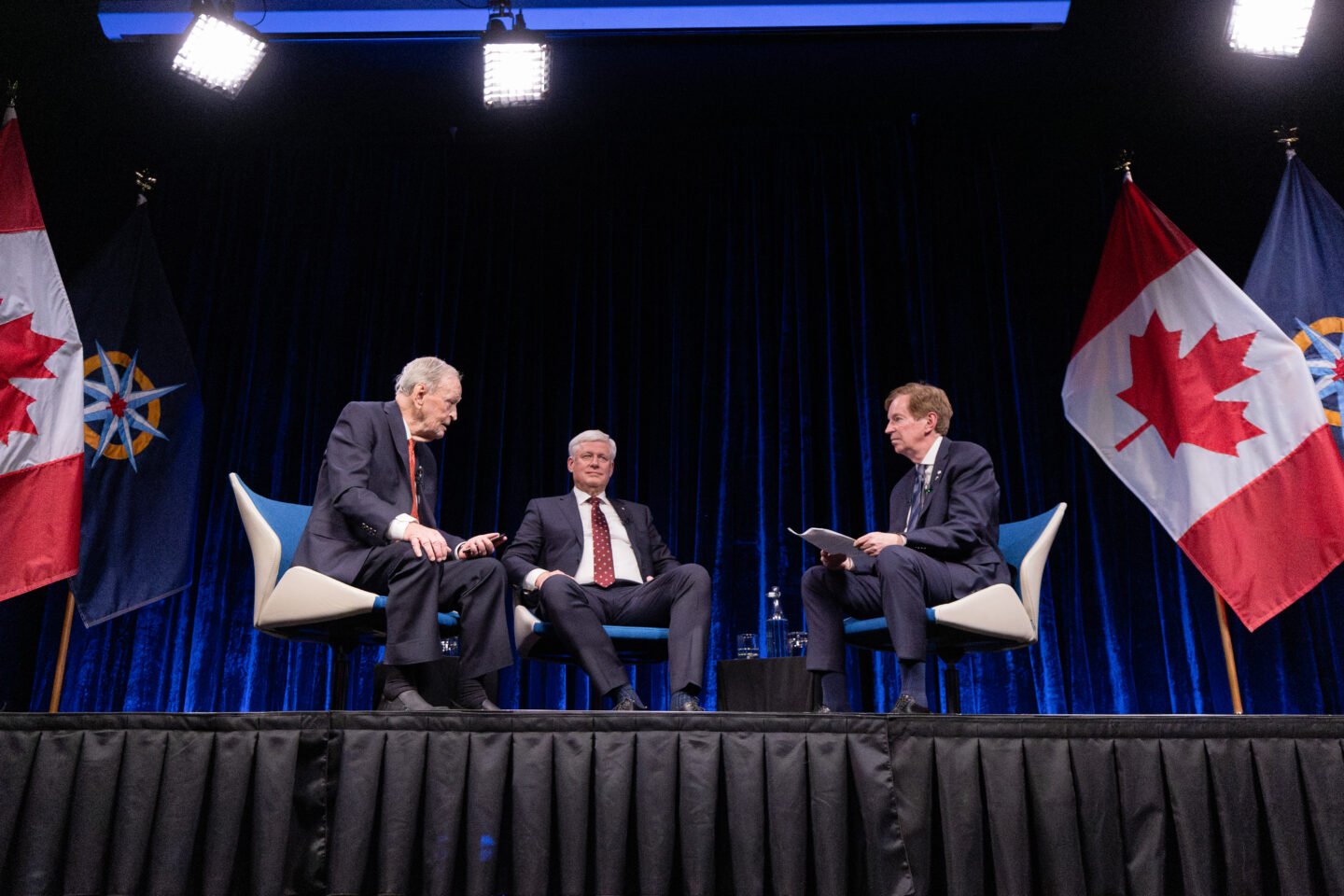 |
| Former prime ministers Jean Chrétien, left, and Stephen Harper, centre, take part in a discussion of Canadian unity moderated by RCGS CEO John Geiger. (Photo: Charlie Woolf/Can Geo) |
When
Stephen Harper was Canada's Conservative prime minister in three
governments; a minority and two majorities, he focused on the Canadian
Arctic and the need to protect it. At that time it was primarily Russia (and China) who
contested Canada's boundaries in the Canadian Arctic. Russia began the
militarization of the Russian Arctic, restoring old Siberian military
bases, expanding and stationing Russian military operatives there. It
claims the Lomonosov Ridge gives Russia entitlement over areas of the
seabed allocated to Canada and Denmark.
Suddenly,
it appears that although Russian claims while not diminished, have been
pushed back somewhat in light of the Trump administration's claims that
for security purposes against the malign intentions of Russia and China
make it imperative for the United States to claim Denmark's Greenland
as a protectorate of the U.S., to give it sole authority over the
island, while casting the same type of ownership claims over the
Canadian Arctic.
Mr.
Harper, speaking on a panel at the Royal Canadian Geographic Society
described his concerns over the necessity to reinforce Canada's Northern
sovereignty. At the time he could never have envisioned that a threat
to Canada's sovereignty in the North would emanate from the United
States. Yet, there it is: U.S. President Trump argues for greater U.S.
military presence in the Arctic, and where Greenland was involved, went
so far as to suggest military action to achieve his goal. That threat of
expansionism is interpreted by many, to include Canada's northern
territories.
As
sea ice recedes, routes through the North West Passage presage a new
era of shipping in routes from the Atlantic to the Pacific. Mercantile
trade worldwide will be affected, and Northern nations stand to benefit
from the potential easing of maritime routes in trade opportunities,
which is precisely what has lured China to stake its own claim as a
'near-Arctic' (laughable as it is) stakeholder. Russia is
prepared to begin mining for the natural resources known to entice
interests from natural gas to minerals.
 |
Canada
now is alert to a changing world order, and Mr. Harper exhorted the
need to defend the nation's land, airspace and waterways, on its own, no
longer depending on its neighbour to the south to respect its
territorial integrity. He had ordered Arctic icebreakers to be built for
Canada. The occasion of Mr. Harper's speech was linked to the
Geographical Society's honouring the former prime minister with a gold
medal to celebrate his outstanding public service on the 20-year
anniversary of his first of three election wins that brought him to the
prime ministership.
A
few days later another event took place on Parliament Hill, the hanging
of the former prime minister's official portrait. At that event he
urged political parties to recognize the need for unity at this critical
time in Canada's history; to work against "external
forces that threaten our independence and against domestic policies
that threaten our unity. We must preserve Canada, this country handed
down to us by providence, preserved by our ancestors, and held in trust
for our descendants."
"He served as prime minister of Canada for nearly a decade -- the sixth-longest tenure in our history -- leaving an extensive record of policy and legislative accomplishments.""In a political climate increasingly buffeted by noise, he brought composure, intellect and decisiveness to public life."Liberal Prime Minister Marc Carney
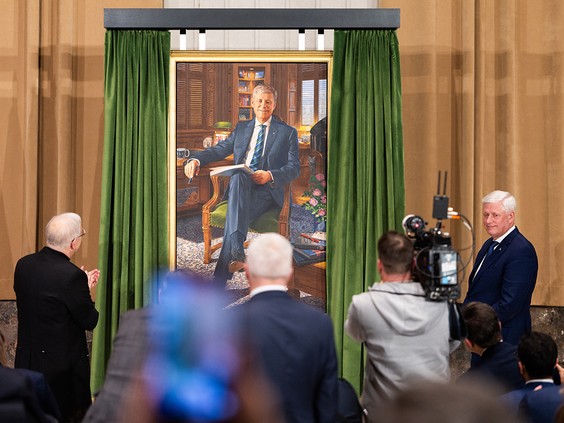 |
| Former prime minister Stephen Harper, right, at the unveiling of his official portrait during a ceremony in Ottawa, on Tuesday, Feb 3, 2026. Photo by HYUNGCHEOL PARK/Postmedia |
Labels: Canadian Arctic, Former Prime Minister Stephen Harper, Gold Medal, Official Portrait, Royal Canadian Geographical Society, Sovereignty
posted by Pieface @ Friday, February 06, 2026


<< Home